Edward Torres, direction: My wonderful collaborators, Brian and Jesse—who always do stellar work!—helped me envision Chad Deity by focusing their designs on telling the story of the play. I’m actually a fan of wrestling, so I understand the media aspects of it; and I also have a film degree, so this production was a kind of melding of those two worlds. We wanted to create not just a play but a theatre event—the kind of theatricalized spectacle staged by WWE [World Wrestling Entertainment]. So we scrapped every theatrical convention we knew and went for big effects, loud music, explosions and so on, with the goal of drawing the audience into that world. The “elaborate entrances” of the wrestlers were shot on video in different environments (for the Geffen production, the locales were all around L.A.), then when the wrestler appears live, it’s as though he were emerging from the video into the theatre.
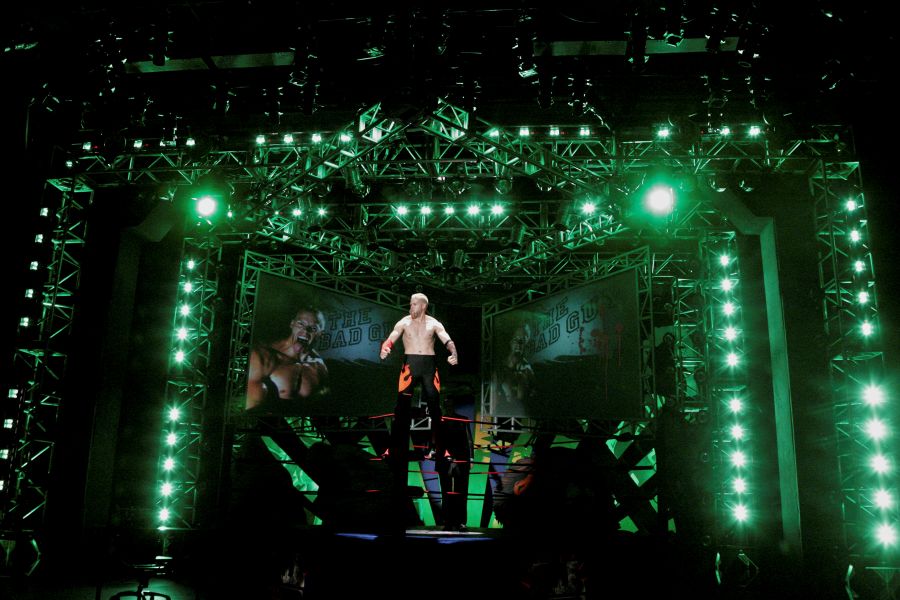
Brian Sidney Bembridge, scenic design: The same basic design team has been working on this show since its inception at Victory Gardens Theater in Chicago three years ago—the move to Second Stage Theatre in New York and the transfer to the Geffen have meant making some minor changes, mainly to accommodate the size of the houses. My job has been framing the show in a crazy, pop-culture, cartoonish sort of way, creating the background for the performers and for Jesse Klug’s lighting. As you can see in the photo, he’s placed lights inside the truss, making it glow and vibrate with all kinds of beautiful effects. The wrestling ring was actually the easiest part of the design—we built our own in Chicago, but in New York and L.A. we had professional sports companies build rings for us. At the Geffen, we also put video screens out in the house in order to make audiences feel even more inside the world of the play.
Jesse Klug, lighting design: The image above is one of five “elaborate entrances”—this one at the top of the second act is for a character known as the Bad Guy, and after his entrance the audience sees real wrestlers slugging it out in the ring for the first time. This is the moment that the show becomes not only a play but an entertainment spectacle—the whole set comes to life, lighting-wise, and gains a rock-concert, arena vibe, full of color and excitement. Most of the lighting instruments are actually pointed at the audience, which could be uncomfortable—but because the action in the scene allows them to cheer and boo, they fall right into the rhythm of the play.
Kristoffer Diaz’s The Elaborate Entrance of Chad Deity ran Aug. 30–Oct. 9 at the Geffen Playhouse in Los Angeles under Edward Torres’s direction. The production featured scenic design by Brian Sidney Bembridge, costume design by Christina Haatainen Jones, lighting design by Jesse Klug and sound design by Mikhail Fiksel.