If you are concerned about the future of the American theatre, you need to invest in the young audiences of today.
Instead of waiting for our young audiences to grow up into theatre lovers who will fill your seats, sit in your board rooms, and advocate for your funding, we need to reframe the conversation to recognize the value of creating exciting, artistically rigorous, and challenging content for them—now.
By centering young audiences as empathetic and engaged art appreciators who are deserving of your attention and innovation, consider how your theatre—even if it’s not a traditional Theatre for Young Audiences company—could widen your audience and deepen your impact, source new funding, and strengthen multigenerational communities.
As the executive director of Theatre for Young Audiences/USA, the national membership organization serving the field through professional development, programming, research, and leadership opportunities, I am thrilled to report that our TYA theatremakers across the country are meeting the moment with innovation, a deep understanding of community needs, and partnerships outside and within the sector.
Admittedly, our TYA industry has taken a major hit over the last few years: The National Endowment for the Arts withdrew and terminated our arts grants, and Department of Education funding was revoked; we lost the Kennedy Center’s beloved New Visions, New Voices program (and so much more). And most recently, the American Theatre Wing suddenly banned “children’s theatres” from applying for their $100,000 National Theatre Company Grants.
Despite these challenges and setbacks, I am astonished by the progress and resilience from the field as a whole. The sector has adapted to the change by building new community engagement strategies, identifying new funding streams, and working together as an industry.
In service of engaging young audiences no matter where they are, there is a long history of looking beyond the walls of our own institutions and bringing TYA out into the community. Our theatres have traveled to schools, libraries, hospitals, community centers, detention facilities, and transitional housing sites. And as we grow the list of outreach sites and the partnerships that are forged, the opportunities for funding are also expanding.
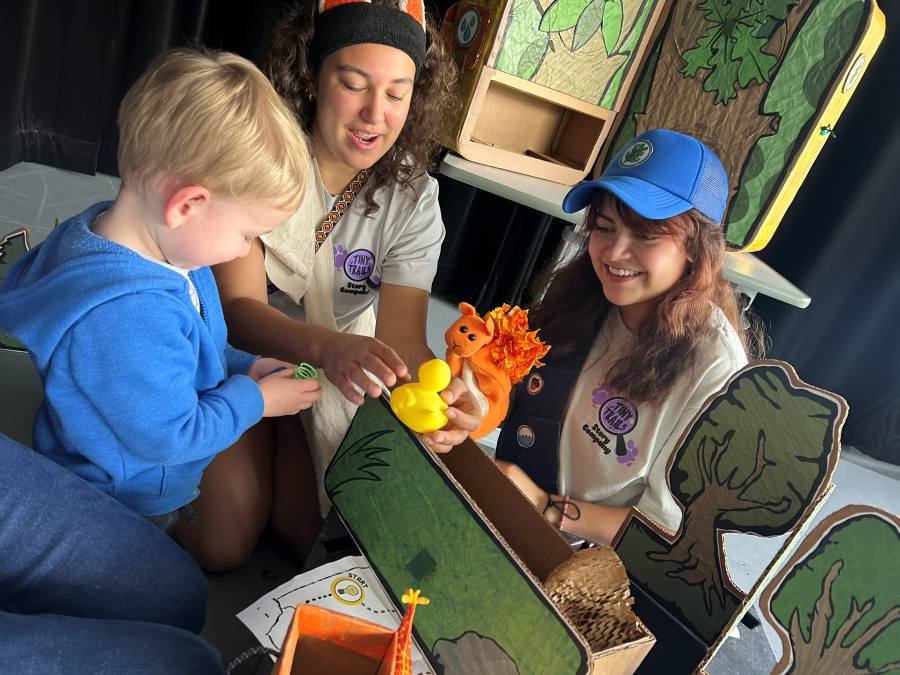
Earlier this month on the TCG podcast “The Bridge,” Christopher Moses, co-artistic director of the Alliance Theatre in Atlanta, asked, “How do we use our art form itself in service of greater needs in the city?” As TYA theatremakers, we position the greater needs of young people, their families, and their whole communities at the center of our work. As theatres devoted to young people, we have a civic responsibility to ensure their well-being. Our TYA work is a piece of the larger picture. When our regular and trusted funding sources disappear, how can we widen our perspective to see our TYA work in a new light: as mental health support, as community crime prevention?
University professor and theatremaker Elizabeth Brendel Horn is building a replicable university-based model for bedside pediatric theatre, training emerging theatre artists to deliver personalized, participatory performances to hospitalized children. This work originated through family philanthropy at University of Central Florida and has expanded at Northwestern University through university curriculum-innovation funding and alumni support.
“My students learn about deep listening and responding, improvisation, adaptability, and so much more by creating theatre with and for an audience as small as one child,” said Brendel Horn. “And they’re learning that their impact as an artist knows no bounds, when they experience a child with chronic pain light up with laughter, or hear a caregiver comment on the increase in range of motion their child used when playing with a teaching artist, or see family members join via video call to watch their hospitalized child experience the magic of theatre.” Bedside pediatric theatre is continually bending the definition of theatre to make it accessible in the most unexpected of places, proving that even the tiniest theatre can make a huge impact.
Based in Bethesda, Maryland, Imagination Stage received a three-year grant (2025-28) from the Kaiser Permanente Fund at the East Bay Community Foundation to reach more than 65,000 students and educators per year around the country. Thanks to this partnership, Imagination’s Educational Theatre provides mental health education through absorbing interactive plays and workshops, making complex health topics both accessible and memorable to school staff and K-12 students. Presented at no cost to participating schools, the program aims to inspire students to engage in supportive conversations about their emotional well-being and provide strategies that help them build resilience.
An independent evaluation from Dr. Matt Omasta demonstrated that 98 percent of school-based staff felt theatre-based programs are an effective way to help students’ empathy and emotional regulation. And 80 percent of educators shared that they felt more confident using, or referring students to, mental health supports after participating in the programming.

“This is the only program that partners a theatre with a national health organization and is reaching students at this broad level around mental health,” said Joanne Lamparter, Imagination Stage’s chief artistic programming officer. “The productions we are bringing to schools around the country are taking often stigmatized topics such as teen depression and bringing them to life with expert storytelling and levity in a way that is easy for students to digest, connect with, and know they are not alone.”
Approximately 75 percent of Honolulu Theatre For Youth (HTY) productions feature a community partnership, transforming traditional theatre into a powerful engine for public education and community engagement. They have collaborated extensively with government agencies like the Hawaiʻi State Department of Health and the City and County, alongside vital nonprofits such as the Sex Abuse Treatment Center. “As our partnership model evolves, we are shifting from single-agency collaborations to building robust coalitions of diverse partners around specific, high-impact projects,” said HYT artistic director Eric Johnson. “This allows us to amplify our reach and tackle complex community issues from multiple angles at once.”
This spirit of innovation is also changing how our TYA sector develops and funds new work. Rather than asking individual institutions to shoulder the full financial risk of developing new plays, the TYA sector is finding new ways of working together to pool resources. And TYA/USA’s continuously sold-out conference, held each spring, is often a meeting point of new initiatives and ideas. Most prominently, the TYA Tour Development Collective began as a brainstorm at a TYA/USA Festival & Conference. Founded in 2024, the TYA TDC is a nationwide initiative bringing together 21 (and growing) performing arts venues in 16 states to pool commissioning funds for the creation and development of new touring theatrical works for youth and family audiences. In 2026, the Collective proudly awarded $139,000 in commissioning support to six exciting projects.
In a similar vein of supporting new-work development across the sector, educator and playwright José Casas led the TYA BIPOC Superhero Project, a major national new-play project in which 24 BIPOC playwrights were paired with 23 professional theatres around the country to develop and produce original TYA plays centered on the idea of the “superhero.” TYA/USA has lifted up this initiative by featuring readings, panels, and professional development workshops based on these works. Productions run through the end of 2026, after which the plays are intended to live on in a published two-volume anthology.
These initiatives aren’t simply evidence of the TYA’s sector’s resilience. They demonstrate what is possible when theatres stop protecting their individual corners of the field and instead begin building infrastructure together with community responsiveness and collaboration.
There are many examples of TYA productions that have been co-produced, co-commissioned, and had rolling nationwide premieres over the last few years—all the more impressive at a moment when producing new titles can feel riskier than ever. There is increasingly more crossover between “adult theatres” and TYA theatres, including formalized partnerships, such as one that has brought together Seattle Children’s Theatre and Seattle Repertory Theatre. We are also seeing more crossover with the content, as more playwrights with careers in “adult theatre” are investing in writing for TYA: Idris Goodwin, Lauren Gunderson, Matt Schatz, José Cruz González, Madhuri Shekar, Naomi Iizuka, and others. These playwrights recognize that young people are not merely audiences-in-training. They are some of the most honest, forthright, and devoted audiences you can find.
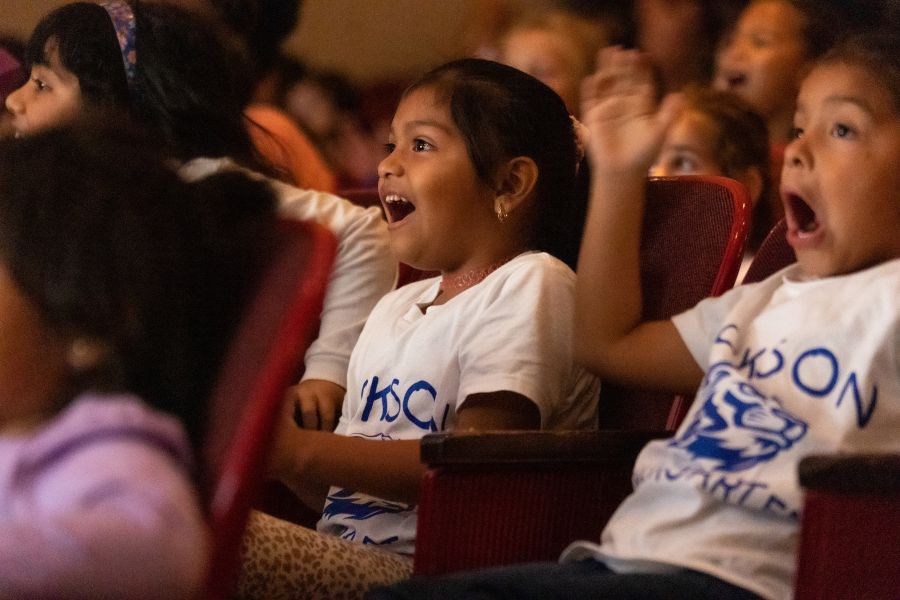
At the recent 2026 TYA/USA Festival & Conference at the Alliance Theatre, our 350 attendees watched Into the Burrow, in which Peter Rabbit grappled with the grief of losing his father to violence, and struggled to accept his own ability to protect his community from the same harm. In one heightened moment, a 4th grade audience member suddenly yelled out, “I love you!” The entire theatre gasped and went silent. Juan Carlos Unzueta, the actor playing Peter, turned around and looked her in the eye, took a beat, and then continued in the scene with renewed bravery.
Theatre for Young Audiences is relevant, responsive, and revolutionary. The future of the American theatre isn’t waiting for us in an updated budget document or in an email about season selection—it’s getting off the school bus and filling our front rows, right now.
Sara Morgulis is an award-winning nonprofit leader, educator, and the Executive Director of Theatre for Young Audiences/USA (TYA/USA), where she advocates for a more equitable and sustainable future for the field.