Sometimes I feel discriminated against, but it does not make me angry. It merely astonishes me. How can any deny themselves the pleasure of my company? It’s beyond me.
—Zora Neale Hurston, “How It Feels to Be Colored Me”
Thirty years ago, Zora Neale Hurston was laid to rest in an unmarked grave in a rural Florida cemetery designated “Negroes only.” Novelist, playwright, anthropologist and performer—the so-called Queen of the Harlem Renaissance—Hurston died in poverty and obscurity, with most of her books out of print, most of her friends and relatives dead or disaffected.
But in recent months, Hurston has staged a posthumous comeback: No less than four major productions based on her life and works have sprouted on stages across the country, a number of her books have been reissued, and her autobiography has been dramatized by Ruby Dee on public television. The tiny Florida burg where she was born is busily planning its second annual tribute to its most famous daughter: a Zora Neale Hurston arts festival slated for Jan. 23-27, 1991. American theatregoers, so long denied, are once again discovering the profound pleasures of Hurston’s company.
She was an artist whose flamboyance matched that of her name. Her personality swerved from contradiction to contradiction: As a writer she was talented but undisciplined; her politics were alternately radical and reactionary; and socially, she was at once belligerently independent and gregarious. The “real” Hurston has been clouded in misstatement and mystery even the date of her birth is unknown, usually placed anywhere between 1891 and 1901. So it’s no wonder that her spiritual descendents—African-American playwrights, performers and other theatre artists of the current generation—are intrigued with her dramatic possibilities.
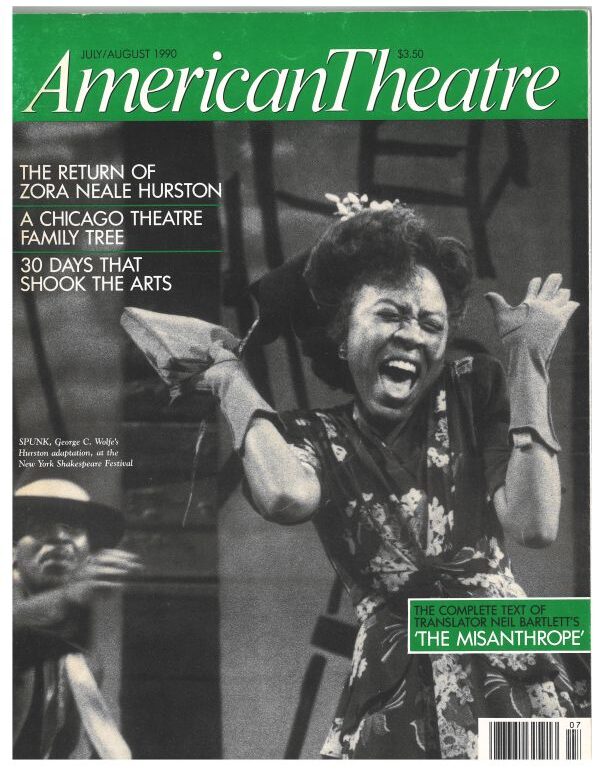
The new plays Hurston has inspired range from the spare to the spectacular. Laurence Holder’s Zora Neale Hurston is a straightforward, bare-bones depiction of the artist’s life. Spunk is a musical, mystical collection of three Hurston short stories adapted and directed by George C. Wolfe. Experimental artist Ellen Sebastian brings a cinematic sensibility to bear on Hurston’s essay “The Sanctified Church” in her multimedia Sanctified. And next January, New York’s Lincoln Center Theater Company is undertaking the first-ever production of Mule Bone, a large-scale folk musical co-authored by Hurston and poet Langston Hughes.
Holder’s two-person Zora Neale Hurston played to sell-out crowds at American Place Theatre in New York this spring with Elizabeth Van Dyke portraying Hur-ston, Tim Johnson playing several men in her life—including Hughes and the anthropologist Franz Boas—and Wynn Handman directing.
The action begins as Hurston, about 10 years before her death, is preparing to leave New York City to return to the South. Arriving in a vacant bus station, she settles herself on a bench and begins to recount her personal history. Hurston was reputed to be a great talker—raised in the southern oral tradition with, as she wrote, “the map of Florida on my tongue”—and Van Dyke does her justice, illustrating every episode with expansive gestures and rhythmic exclamations.
She tells of Hurston’s childhood in Eatonville, Fla., a “pure Negro town”—the first incorporated black town in America. Zora’s mother was a proud woman who constantly admonished her daughter to “Jump at de sun!”, her father a self-taught preacher who became Eatonville’s mayor. Both neglected to teach Zora to humble herself before white people or despair of her own dark skin. Much later she wrote, “I am not tragically colored…I do not belong to the sobbing school of Negrohood who hold that nature somehow has given them a lowdown dirty deal.” This aggressive pride followed her to New York, where she scorned her black compatriots who were obsessed with “the race problem” and scoffed at the overanxious pretensions of the Harlem literati—“the Harlem Niggerati,” as she called them.
But it was back in Eatonville that she first was exposed to the “big old lies”—the folktales—that would animate her novels and playscripts throughout her career. To her, the men who lounged around the porch of the local store were “big picture talkers” who used “the side of the world for a canvas.” It was they who introduced Hurston to Brer Rabbit, Brer Fox and the crafty slave John and his hapless Massa.
Some few years after her mother died in 1910, Hurston ran away with a traveling Gilbert & Sullivan troupe, working as a wardrobe girl. From there, her career ascended. She earned her high school diploma at Morgan Academy in Baltimore, attended Howard University, and then, encouraged by the publication of one of her stories in the Urban League’s magazine, Opportunity, she stole away to New York City with $1.50 in her pocket. There she became in short order the toast of the literary movement known as the Harlem Renaissance, celebrated for her pluck and her entertaining “lies.” She also became a protege of anthropologist Franz Boas, under whom she received a degree from Barnard in 1928. Over the following 20-odd years, she published four novels, including the landmark Their Eyes Were Watching God in 1937; two books of black American folklore, collected on anthropological expeditions to the South; her autobiography; over 50 essays and short stories; and well over a dozen plays and musical revues. She was granted several honorary doctorates and a Guggenheim fellowship, was featured on the cover of the Saturday Review, and in the midst of all this, married—albeit briefly —at least twice. (As with the year of her birth, the actual number of Hurston’s marriages is the subject of some debate.)
"People are drawn to Hurston now because she's one of the most arrogant figures we've had. Her writing is totally, unapologetically colored."
George C. Wolfe Tweet
However, as Holder’s protagonist relates, Hurston’s success was qualified by the constraints commonly imposed on members of her race and gender. Money was more elusive than praise, and Hurston was often reduced to pleading with white patrons for funds with which to continue her work. A final blow to her equanimity was struck when, in 1948, the police appeared at the door of her Harlem apartment and arrested her for allegedly sexually abusing a 10-year-old boy. The charges—patently false—were dropped within several days, but the humiliation Hurston suffered in the black press was too much for her, and she soon retreated to the South to live out her days in quiet obscurity.
The tale that playwright Holder has to tell in Zora Neale Hurston is surely strange and dramatic, but it is the force of Van Dyke’s performance that carries the play. We see the way Hurston’s “lies” light up her face, and the joy that jolts through her limbs when she meets up with a man who can jitterbug. “He can dance and sing and play the piano!” the eminent anthropologist squeals when she meets her first husband.
Playwright Holder was bitten by the Hurston bug when a friend lent him a copy of Their Eyes Were Watching God. He then devoured the rest of her writings, including her contradiction-laden autobiography. Undaunted by the inconsistencies in her life’s story, Holder set about adapting her experiences to the stage, and his original version of Zora Neale Hurston was first performed in 1979 at the 13th Street Theatre in New York. “It’s true she concealed many things,” he says. “She exaggerated, and was filled with semitruths. But that’s just who she was. I concentrated on the dramatic content of her life; my aim was to create the sensation of this very ballsy lady.”
To what does the playwright attribute Hurston’s sudden surge in popularity? “There’s an Afro-American push that we haven’t seen since the late ’60s and ’7Os,” he says. “There are a lot of writers wanting to deal with history; August Wilson is on the forefront of this. Also, before now, people were just not ready to hear a black woman stand up and say, ‘Go take a flying leap.’”
George C. Wolfe, adaptor and director of Spunk, concurs. “Black American culture has taken on an unencumbered arrogance,” he says. “You see it in music, on TV—and you see it in the theatre. There’s an attitude that’s been building for a long time, an attitude of ‘this is about me and I don’t have to qualify it.’ People are drawn to Hurston now because she was one of the most arrogant figures we’ve had. Her writing is totally, unapologetically colored.”
Spunk is a celebration of the resilience of African-American culture, and particularly of African-American women. The three stories which comprise it are all about survival, though they vary greatly in tone. “The evening is a journey from the macabre to the vaudevillian to the romantic,” as Wolfe describes it. “Sweat” is a dark story about a young woman who is terrorized by her estranged husband but ultimately escapes him. “Story in Harlem Slang” is a farce—narrated in 1930s-era Harlem-ese—about two slick con-men who try to bilk a streetwise young woman out of her purse. And “The Gilded Six-Bits” is a tale of infidelity overcome. Running like a thread through this patchwork are bluesy musical interludes performed by Ann Duquesnay and composer Chic Street Man. The whole tapestry has a fairy-tale texture, enhanced by masks, puppets and mobile scenery.
The outlines of Spunk were first sketched in May 1989, when Wolfe staged the three stories “with just stools and music stands” for the literary cabaret at the Mark Taper Forum in Los Angeles. After further developing the piece at the Taper, Wolfe transported it to Crossroads Theatre Company in New Brunswick, N.J., site of his 1986 success, The Colored Museum. (Crossroads had already demonstrated its commitment to reclaiming Hurston’s life’s work in 1988 with its staging of Bonnie Lee Moss Rattner’s adaptation of Their Eyes Were Watching God, called To Gleam It Around, To Show My Shine.) Spunk was subsequently selected for participation in the NBC “New Voices” program, and picked up for production by the New York Shakespeare Festival.
Hurston’s short stories were not, of course, designed to be staged, but according to Wolfe, “Their compactness makes them inherently compelling and dramatic.” Indeed, her stories—like her novels and plays—have the potency of parables. Symbolic, fast-paced and uninterrupted by lengthy accountings of psychological motivation, they are allegories of becoming—of arriving.
Take “The Gilded Six-Bits,” which Wolfe compares to the parable of Adam and Eve. In this preciously crafted tale of sin and redemption, a young bride, Missy May, trades away her fidelity for a gold coin, which turns out to be fake. The gilded six-bits, discovered by her husband Joe, becomes a symbol for their estrangement, until finally, a year later, he finds it in his heart to forgive her and spends the coin on a peace offering: a bag full of candy kisses. Played with dreamy innocence by Danitra Vance and Kevin Jackson at the New York Shakespeare Festival, Missy May and Joe amplify the notions of faith and mercy. Wolfe explains, “This is a parable, so we set it in as artificial a world as possible. In some peculiar way, that makes the emotions more real, and more vulnerable.”
“Story in Harlem Slang,” meanwhile, is not so much an allegory as a cartoon. Jelly and Sweetback are two fast-talking Depression-era Harlemites, up to no good. Posing on a street corner in their “zoot suits with the reet pleats,” they engage in a ritual of boasting and scamming that would be unintelligible to the contemporary ear without the aid of the glossary of obsolete Harlem slang provided in the program. They hang out bull-skatin’ (bragging) and beatin’ up their gums (talking to no purpose) until a frail eel (a pretty young girl) comes along to put them in their place.
It’s hard to imagine a piece like this being staged 10 years ago because of its surface similarities to minstrelsy. Played with gleeful overstatement by K. Todd Freeman and Reggie Montgomery, both men strut and gesticulate elaborately, eyes bugging, mouths flapping. At first glance it looks like the worst kind of stereotyping.
But in Wolfe’s hands, Hurston’s cartoon is actually much more complex than that. It is at once a critique of certain attitudes within her own culture and a celebration of the richness of African-American speech and movement. Jelly and Sweetback are held up for ridicule because of their citified airs—their denial of their southern roots and their preference for women with light complexions (“I don’t deal in coal,” one of them quips). But their rhymes, their boasts, their bluffs—their “lies”—are still a source of true delight, and an unwitting testament to the strength of their oral traditions. As Wolfe says, “Style is the only way these people have to survive.”
“Story in Harlem Slang” reveals one of Hurston’s greatest gifts as a writer: her ear for southern black American dialect and dialogue. The “big picture talkers” that she knew as a child (and later studied as an anthropologist) engaged not only in storytelling but in elaborate spoken games of mock-combat and one-upsmanship. They peppered their conversations with metaphors, slang and well-turned insults, using rhymes as codas to mark the completion of certain proscribed exchanges: “Stepped on a pin, de pin bent, and dat’s de way de story went.”
Wolfe believes that it is this sing-song language that strikes a chord in today’s audiences. “It was incredible doing the workshop in L.A. where there are all these transplanted black folks from Texas and Oklahoma. When they started to hear those rhythms, it was like those little aliens in Close Encounters of the Third Kind with their ‘Doo doo doo doo doo,’” he sings. “People were responding to the notes, to something from the other world. In ‘The Gilded Six-Bits’ when the characters read off the list of food”—buttermilk, hot-fried mullet, ham hocks and cracklin’ bread—“the audience would get into this ‘Mmm, mm, mm!’ It’s a sense of recognition and knowledge of where we come from.”
Ellen Sebastian, whose touring, multimedia production of Sanctified was recently seen at the Museum of Contemporary Art in Los Angeles, also attests to the power of Hurston’s language, especially for older, southern blacks. They are the ones most likely to “talk back” to the actors, she says. “Our audiences in the South—in Texas—were incredible. They got every bit, even the gestures and stuff that the people in the North don’t understand. For instance there’s a moment in the piece where people hear the sound of a screech owl and pull their pockets inside out —it’s a ritual gesture. People in the South were on the floor, they were laughing so hard. People in the North think it’s some mysterious, evocative, performance art thing.”
Sanctified is based on an anthropological essay exploring the connections between black southern Christianity and what is commonly called voodoo or hoodoo. In the late ’20s and early ’30s, Hurston spent months in New Orleans and Haiti collecting Afro-Caribbean folklore, at times apprenticing herself to various root doctors and conjurers. Her abiding interest in African-American mysticism was later fully manifested in her 1939 novel, Moses, Man of the Mountain, which recast the Hebrew prophet as a hoodoo man.
It was Hurston’s brand of “home spiritualism” which first attracted Sebastian to her subject. “Sanctified is my homage to Hurston,” the San Francisco-based experimental artist says, “my attempt to create the bigness and complexity of her spirit on stage.”
A fictional re-creation of the last 24 hours of Hurston’s life, Sanctified takes place on a sand-covered, moss-draped stage representing a plot of land in Eau Gallie, Fla. Hurston, portrayed by Esther Scott, is seen digging up various artifacts—a pair of scissors, a piece of cloth—which conjure up memories or spirits from her past. The eight-member cast in L.A. was augmented by eight gospel singers from the local First African Methodist Episcopal Church choir, and the performance coincided with MOCA’s exhibition of Sanctified Visions, a series of commissioned installations created by L.A. artist Betye Saar as a response to the times and mysteries of Hurston’s life.
Sebastian’s aim is to wed Hurston’s spirituality with the artist’s own ’90s sensibility: “I want to take the heart and soul of folklore and weave them into a sort of MTV reality, so that a modern audience, and especially a young audience, comes and says, ‘This is totally hip.’”
Sebastian insists that Hurston is “so modern,” even though her heyday is now 60 years past. “People today respond to her humor, her love of life…her bigness. She was a real visionary—a black woman out on her own, taking risks.” And by recording and explaining the complexities of African-American speech, religion and gesture at a time when blacks were commonly believed to be “primitive,” Hurston provides an intellectual rationale that enables people “to feel good about themselves,” Sebastian believes.
"The minute we say we're not going to have a field of knowledge organized solely around Western European men, Hurston becomes an obvious person to include...because she's so goddamned good."
Gregory Mosher Tweet
While Sebastian plans a tour through the South, Lincoln Center Theater director Gregory Mosher is preparing to unveil the only play of this Hurstonian season which the writer actually penned with her own hand: Mule Bone, a collaboration with Langston Hughes which has until now never been produced.
Mule Bone is a musical based on a southern folktale about two hunters who quarrel over a turkey they both claim to have shot. The title and the plot now ring with irony, since the play became a serious “bone of contention” between its co-creators, both of whom later claimed sole authorship. Mule Bone turned Hurston and Hughes, sworn friends, into lifelong enemies.
The saga of Hurston and Hughes’s falling-out is one of jealousies, misunderstandings, harsh words and bad behavior—on both writers’ parts. The ignoble details have all been well-documented by Hurston’s fastidious biographer, Robert Hemenway, and the event stands as further illustration of Hurston’s volatile personality and all-consuming pride.
Embroiled as it was in controversy, Mule Bone never reached the stage, and has never even been published in full. One of the few extant copies of the manuscript was procured for Lincoln Center Theater by Henry Louis (“Skip”) Gates Jr., a leading African-American scholar who counts among his specialties “literary archaeology”—that is, digging up rare or lost African-American texts.
Mosher recalls, “Skip just plopped this manuscript down on my desk and said, ‘You gotta do this.’” The musical is now slated to debut in January 1991 with an original score by Taj Mahal and Michael Schultz directing.
Mosher sees Hurston’s current vogue as part of the trend toward expansion of the Western literary canon, which proceeds apace on college campuses across the country in defiance of attacks from the “Killer B’s”—author Allan Bloom and former Secretary of Education William J. Bennett, both defenders of the traditional (i.e., white, male-dominated) core curriculum. “There’s a tremendous interest right now in non-mainstream writing,” Mosher says, “whether it’s Gabriel García Márquez or Hurston or Central European writers. The minute we say we’re not going to have a field of knowledge organized solely around Western European men, Hurston becomes an obvious person to include, because she’s so goddamned good.”
Like the blues riffs which wend through the play, the folktales which enrich Mule Bone are an oral art form best understood when performed live. As Hurston’s biographer Robert Hemenway puts it, “Zora’s legacy is to remind us of the artistic expression that goes on around us every day. That’s easy to forget in a world in which all our art is packaged in television and videotape.”
Indeed, Hurston’s tales have not yet been successfully recorded, as evidenced by Ruby Dee’s Zora Is My Name!, a dramatic collage based on Hurston’s autobiographical and anthropological writings recently seen on public television. Although admirably faithful to Hurston’s material, the writer’s soaring words seem to fall flat on the sound stage when there are no living ears to catch them.
By the time Zora Neale Hurston’s tongue was stilled, she had “been in sorrow’s kitchen and licked out all the pots.” The fame she deserved was never fully forthcoming; rather, it had been doled out grudgingly—in the form of glib book reviews and meager grants—by a white public who never truly understood her. Her art was too “adulterated” by folklore for a readership weaned on Fitzgerald and Hemingway; it was too rural, too “unapologetically colored.”
Even many of her black contemporaries ultimately forsook her. Hurston’s powerful pride in the black race and her distrust of the notion of cultural assimilation often allied her peculiarly with white segregationists; she even once went so far as to say to the World Telegram that “the Jim Crow system works.” As she aged she became increasingly active in reactionary politics and was accused by other black writers of exacerbating the “race problem” by pretending that it didn’t exist.
In the end, Hurston was alone.
The Master-Maker in His making had made Old Death. Made him with big soft feet and square toes. Made him with a face that reflects the face of all things, but neither changes itself, nor is mirrored anywhere. Made the body of Death out of infinite hunger. Made a weapon for his hand to satisfy his needs.
—Zora Neale Hurston, “Dust Tracks on a Road”
When Death crept up on Zora Neale Hurston in 1960, she was residing at the Saint Lucie County welfare home in Fort Pierce, Fla. The janitor there took her few remaining effects outside and proceeded to burn them, until a deputy sheriff, who had heard of Hurston, doused the fire with a garden hose in hopes of salvaging a manuscript which might help defray the cost of her funeral.
Thirteen years after Hurston’s burial in an unmarked grave, the novelist Alice Walker traveled to Fort Pierce and placed a tombstone in the segregated cemetery where she lay. It reads, in part: “Zora Neale Hurston, A Genius of the South.” Walker later wrote in a foreword to Hurston’s biography, “We are a people. A people do not throw their geniuses away. If they do, it is our duty as witnesses for the future to collect them again for the sake of our children. If necessary, bone by bone.”
Like Alice Walker, African-American theatre artists are now reclaiming an ancestor; rescuing Zora Neale Hurston’s emphatic southern voice from the silent clutches of Old Death.
Stepped on a pin, de pin bent,
And dat’s de way de story went.
Support American Theatre: a just and thriving theatre ecology begins with information for all. Please join us in this mission by joining TCG, which entitles you to copies of our quarterly print magazine and helps support a long legacy of quality nonprofit arts journalism.