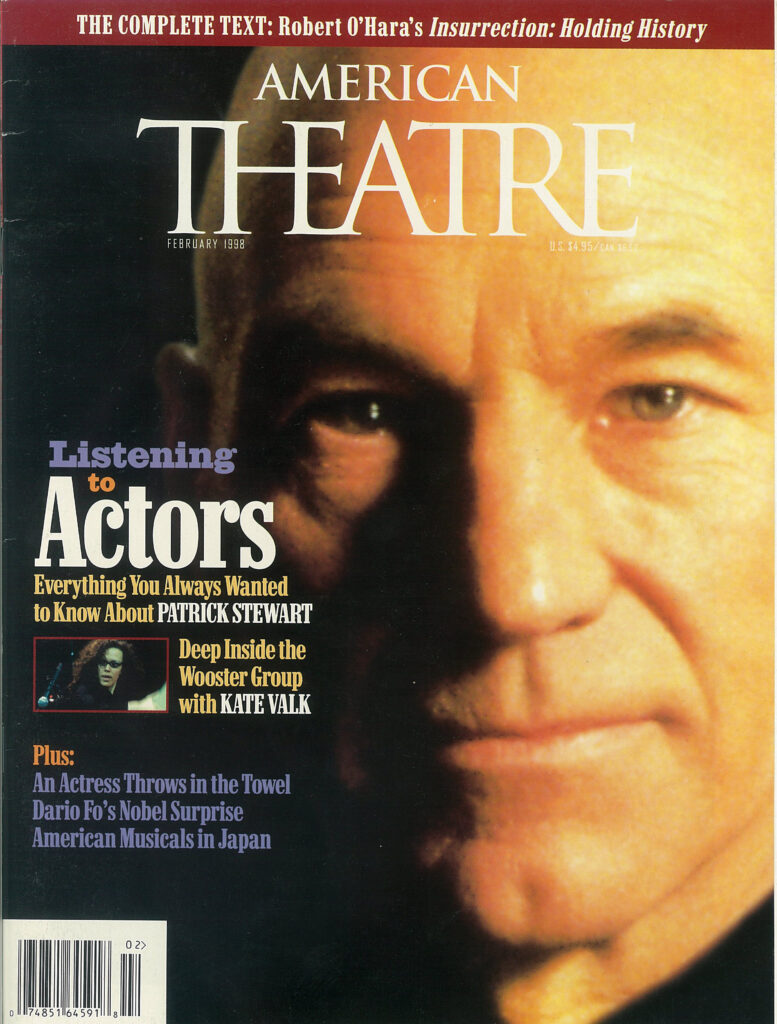
I’m in the coldly elegant sitting room of Patrick Stewart’s rented Washington, D.C., townhouse admiring a modest fire and too many flowered pillows. Though the place exudes a bland Georgetown charm, there’s one substantial element that’s missing: This overly crafted place obviously isn’t really anybody’s home. A controversial rendition of Othello at the Shakespeare Theatre has brought Stewart to the nation’s capital (he plays the lead role in an otherwise nearly all-black cast), and while he’s delighted with the production, his recently vagabond lifestyle has caught up with him in the worst kind of way. “I haven’t lived anywhere for the past four and a half years—I’ve been a gypsy,” he sighs in his deliciously dark, distinctive timbre.
Stewart’s legendary voice and clean-shaven head are instantly recognizable, though not because of his forays into the theatre. Nonetheless, his theatrical resume is impressive: Trained as a Shakespearean actor, Stewart was a member of the Royal Shakespeare Company for 17 years, essaying Shylock, Enobarbus, Henry IV, Leontes, Titus Andronicus, Touchstone and Oberon to great critical acclaim. He has delivered major performances in Chekhov (he appeared as Dr. Astrov in a production of Uncle Vanya that toured the English-speaking world) and his George in a London version of Who’s Afraid of Virginia Woolf? earned him the London Fringe Award for best actor. In 1995 Stewart thrilled Broadway audiences (and won a Drama Desk Award for best solo performance) with his own adaptation of Dickens’s A Christmas Carol—a one-man performance so bravura that one critic felt sure he had interpreted the Christmas goose as well as the 40 human characters. He followed that hard act with a brooding, eloquent Prospero in George C. Wolfe’s Broadway production of The Tempest.
Stewart is one of the few major classical actors of our era who has become a movie star, comfortable at any point along the performance spectrum—from the BBC’s legendary miniseries I, Claudius to his animated appearances on The Simpsons. Soon to be aired is a four-part TV miniseries of Moby Dick, in which Stewart plays Ahab. The production was filmed in Australia and bankrolled by the USA Network at an unprecedented (for television) $18 million. But the role that has wedged him into the hearts and minds of millions worldwide is, of course, that of Star Trek: The Next Generation‘s Jean-Luc Picard. This phenomenally successful TV program is estimated to have nearly 20 million weekly viewers—a rather far cry from the few thousand who have been lucky enough to see Stewart onstage. But his steadfast devotion to the theatre continues.
The Shakespeare Theatre’s race-reversed production of Othello was a bold choice for Stewart. All the lead actors, with the exception of Stewart and the actress who plays Bianca, Cassio’s prostitute lover, are African-American. While director Jude Kelly has modestly dubbed her approach “photo negative,” many of the play’s nuances strike the ear as ludicrous: Desdemona’s skin is decidedly not “alabaster” nor is Stewart a “black devil” with “thick lips.” The concept was so controversial that three companies (two American, one British) rejected it before the Shakespeare Theatre’s artistic director Michael Kahn decided to take the plunge. Perhaps it was because of the show’s riskiness that it completely sold out months before it opened. But most likely it was due to Stewart’s status as an international force to be reckoned with: His wickedly rich talents are enough to beam anyone up.
TOBY ZINMAN: It must be a terrific pleasure to be a multi-generational sex symbol, someone who’s admired by audiences young and old.
PATRICK STEWART: I can say now, yes, it does feel good. It’s a tool for the actor. Of course, one must use it with great care. At first I was inclined to deny it. I still don’t understand it—it’s a mystery to me, having come quite late in my career, and because I spent my teenage years and my early twenties believing myself to be very unattractive and uninteresting—a person women would never, ever be interested in at all. And I didn’t have much fun as a result. I had no confidence in myself. So it’s been a little confusing all of this, but it’s interesting.
I was saying to my fiancee on the phone the other day that I can play being in love so much more easily now than I ever could when I was younger. I can actually give myself now to the feeling of being in love and of being loved, and it’s interesting in my mid-fifties to find I can play a romantic lead, which I’d never done. I used to avoid romantic roles because they made me feel uncomfortable.
Watching Othello I was fascinated by the moment when Othello, who up until that point has been all cool self-possession, greets Desdemona when she arrives in Cyprus. The shift from the cold and military to the warm and personal seems pivotal, and you do “besotted” so gorgeously.
I suppose it was about halfway through rehearsals when Jude [Kelly, the director] and I began talking about Othello, the love story. Round about this time, too, I was beginning to experience why this role has been described as “unactable.” It’s really rather like being in two plays—there’s the play that goes up to Act 3, Scene 3—up to then, except for the small problem of Cassio’s getting drunk, it feels like being in a love story and that’s all, for an hour and 20 minutes. But then the play changes. In the same scene, Othello has the lines, “Excellent wretch! Perdition catch my soul/But I do love thee!” and “Damn her, lewd minx! O! Damn her…I will withdraw/To furnish me with some swift means of death for the fair Devil.” The problem is how do you get from there to there?
Over the years I’ve begun to discover that if in Shakespeare something doesn’t seem to make sense, then the solution might be not to worry about connecting it all logically, but simply to fully inhabit each state. If you truly inhabit each line, it works, because as a playwright, Shakespeare knew what he was doing. You’ve got to trust him. He won’t let you fall.
So, it was about then that I felt it was necessary for Othello to seem to be “besotted”—just the right word—because if he was, his murderous intent would not be seen to be as extreme as it would if the love did not match it. Because Patrice Johnson [who plays Desdemona] looks so young, it made me uneasy; although there is always a generation between Othello and Desdemona, this felt like several generations. She has a childlike look, a tiny body, almost an undeveloped body.
But that reads on stage not as childlike but as fashionable.
I suppose she looks like all those emaciated models. But if Othello and Desdemona have both fallen for each other as totally as it seems they have, if she has become everything to him, she was in effect replacing what his life had been before.
The intensity of the look that crosses your face, the pause that follows the line “Chaos is come again,” creates the impression that for just a moment Othello has been swept back in memory to some terrible recollection.
When I read the play for the first time, those two and a half lines leapt off the page—those were the most important lines in the play. That short passage is probably the heart of the character, because there is a mystery about him: You don’t know what he’s talking about. There are hints that seem to belong to that same world of chaos, of being taken by “the insolent foe/And sold into slavery,” the “distressful stroke/That my youth suffered,” and there are other tiny indicators of darkness all the way through. At about the same time, I was struck by the repetition of the word “pity”—he sees her feeling pity for him almost as though it’s a new experience. So there is, then, something for her to pity—the accumulation of what his life had been.
There is some need to make the murderous man of Acts 4 and 5 make sense, so we have to have some glimpses of the man before then. We decided in the brawl scene in the barracks to have Othello come in to stop the ruckus in a high rage; it’s very important that we see him tremendously angry, so that when he threatens “dies on the moment” he means it.
There is a quality given off by some men which makes you step back. I have known one or two dangerous, frightening men—men you knew had done horrible things. They were the qualities we wanted to find here, all the while contrasting it to the man in love.
Your father was a soldier, wasn’t he?
Yes, he stares back at me out of the mirror from time to time, particularly when I’m wearing Othello’s dress uniform. I know my father would have been pleased when the marine colonel [who acted as a consultant on the production] said he didn’t have to worry about my bearing—it was military already. He needed to work on the other guys. My father was a regimental sergeant-major—a superstar—so I have that easily accessible.
The conventional difference between British and American actors is usually summed up in that apocryphal story about Dustin Hoffman and Laurence Olivier making Marathon Man: When Hoffman ran miles to ready himself for a scene in the film, arriving on the set panting and sweaty, Olivier said, “Why don’t you just act?”
That story always made me uncomfortable. The first time I heard it I didn’t laugh. I thought, this is not fair, neither is it honest. It’s doing both actors a disservice.
If I were given a choice as to which actor I’d want to be identified with, it would be Dustin Hoffman without a measure of doubt. With the exception of The Entertainer, I was never in any cinema or theatre once engaged or caught up by anything Laurence Olivier ever did. I admired, I was dazzled, but I was never engaged. But Dustin Hoffman has tossed me around the cinema many times. And that’s what I look for now both in the work I do and the work other actors do—I need to experience that emotional openness, vulnerability and complexity; otherwise it’s of no interest to me at all.
So great acting requires more than technique?
In a speech I gave last week to the National Press Club I talked about actors telling “beautiful lies,” and that’s why you should never take an actor as a lover or a partner, nor should you ever lie to them, because we’re of course experts at it and we know when it’s being done to us.
Patrice Johnson is never in any danger of me murdering her, even though it’s my job to make the audience believe it’s happening. In order to do that, I believe I have to get as close to the realization of those feelings as possible. What I found with Othello is that the longer I do it, I can do it with more ease and grace.
What about the production’s rape scene?
The rape scene is horrible. I have to go down a flight of steps when I come off from that scene. Were there not a handrail to hold onto, I’d never make it down. Releasing those feelings shocks me so much each time that we do it. Actually what we do in that scene is exactly what we did when we first improvised it in rehearsal. I said to Patrice, I really admire you, I respect you, are you game to try this? I said to Jude, can we just do it, not talk about it first? We did it, and we never rehearsed that scene again. I can’t substitute—I don’t want to edit anymore. I spent too much of my career editing my work.
Were you editing to please someone—or were you defending yourself against something?
To please someone, to protect myself, to do what I thought was right—a waste of time. In my last year of training, my brilliant director Duncan Ross, told me, “Patrick, you will never achieve success by ensuring against failure.” I heard him say it and I didn’t do anything about it for a long time, but that was then, and these are happier days. I cannot think of a year that has been more intense in terms of the nature of the work.
What roles are you looking forward to next?
Well, doing Othello has whetted my appetite for more Shakespeare. No, “whetted my appetite” is absurd—it was never dulled. Two years ago I did The Tempest and that was my first full-scale Shakespeare production in 10 years, and that was much too long. I have a plan that every 18 months to two years I will do theatre, and at least every three years I’ll do Shakespeare. And this is the first time I’ve dipped my toe into one of the four great roles. I feel that the great roles are the mystery roles as well: Hamlet, Lear, the Scottish play and Othello. Prospero is a minor great role—he simply isn’t on stage long enough, and like Shylock, it’s a superb and brilliant role, but he does not dominate the play. The same could be said of Leontes, a role I love dearly, and Henry IV—great dramatic roles but they do not have this huge tragic dimension.
I’m thinking I’d like to do Macbeth next, and I have this feeling about playing Lear that you should do it twice—once when you’re strong enough and then once when you’re old enough.
Do you foresee doing these plays in the United States?
Yes. It saddens me because not much is happening for me in the United Kingdom. And given that I’ve spent 28 years of my working life there, it remains something of a puzzlement. There’s a Peter Schaffer play, Yonodab, which I did in London. It wasn’t thought successful there, but I have a deep commitment and investment in it, and when we were doing it at the National, I thought this was a play for New York audiences.
What’s the difference between a London and a New York audience?
Well, Yonodab is a funny, cruel play, an extended scabrous Jewish joke, at which the London audiences squirmed, never sure whether they should laugh or not. But New York audiences are much braver and more daring in what they’re prepared to find funny, and I have this hunger to stick it in front of them and see what they will make of it. If I had my druthers, that’s something I’d be doing this time next year.
I feel I’ve found a voice here, especially on the East Coast, as an actor—that sounds so pompous. But since I’ve been working here, whether it’s been A Christmas Carol or The Tempest or now this Othello, I feel heard—not only from the response of the critics, but I feel the audience understands what interests me. I sometimes felt that wasn’t the case in London.
Here, they “get” you.
Yes, they “get” it, they “get” me in the roles. David Mamet has been saying that that is utterly irrelevant, that the actor should not be “got” in that sense. But when I go to the theatre, I want to know about the man behind the role—if I go to see a play I want more than the author on the stage. I want to have revelations that have to do with the performers as well. I think the actor can bring his own life to what he does to fully animate it, to fully light the fires. If acting in plays does not light fires, we should stay home and read them. If a script doesn’t make the blood pulse faster through your veins, why do it?
I’d heard you were interested in doing Who’s Afraid of Virginia Woolf? again.
That is a bitter and a sad subject. I cannot get that it of my mind. I had been doing that play in 1987 at the Young Vic with Billie Whitelaw, and I simply connected with the role. It simply became for me among the three or four most important theatrical experiences of my career—actually, I would say one or two. So we were negotiating its transfer to the West End—it had been a huge critical success and a personal success for me, when I was offered Star Trek: The Next Generation. I had five days to make the decision, and since Billie was leaving and we had not managed to recast Martha yet, I decided to do the series, and it was the right thing to do. But I have not got George out of my system—I’d only played it for four weeks, and throughout the seven years I was doing the series, I fantasized about doing the play again. When the production in Los Angeles was mounted with Glenda Jackson and John Lithgow, it was so painful to me that I couldn’t bring myself to drive down the street past the theatre where it was playing. Actors always struggle against allowing this to happen, but I felt I had taken possession of the play as it had taken possession of me—it was like still being in love and seeing another man with your lover.
It is a very, very great play. I think it is one of the great plays of the 20th century, a masterpiece of modern American theatre. And there’s not a day goes by when I don’t think about it. But I don’t think it will happen now. I tell myself at least I did it once, and that I had the experience of being inside that gargantuan play. Albee is astonishingly brilliant; I would like to do some more of his work—A Delicate Balance, Tiny Alice. He can write in a way which is tragic and wonderfully funny at the same time—extraordinary.
Have you ever considered doing Beckett?
Beckett has eluded me all my life. But I recently saw a production of Krapp’s Last Tape and it moved me deeply. I always admired Beckett but without ever feeling, “Damn it, I must do that soon.”
What other playwrights interest you?
I’ve been interested in a circle of British playwrights not well known here, especially not on the West Coast—Edward Bond, Charles Wood, Howard Barker. I did Bond’s Bingo and I’d like to do it again. I was too young when I did it the first time. I think it’s Bond’s finest play. I’ve missed out on the last 10 years of new writing in Britain—I feel very cut off. It’s dismaying to me when I look at the credits for a new production for the Royal Shakespeare Company and I don’t know a single actor’s name—or the directors either.
I wish there were more happening for me on the other side of the Atlantic. I did my first job in 10 years in England—a film called Dad Savage. I play the eponymous role, and it’s something quite different for me, a pretty basic sort of individual, a working man out in the fields. It’s a kind of rural thriller, quite brutal.
It’s been quite a year for me in that sense. I finished filming Conspiracy Theory, in which I was a very bad man and I did horrible things to Julia [Roberts] and Mel [Gibson], and from that I went straight into Dad Savage, and from there I went to Australia to make Moby Dick, and now Othello. It’s been a year marked with savagery and brutality, with murder and mayhem of many kinds.
Do you feel purged?
Yes, I do. I would love to think the next thing I was going to do is Hay Fever. I would love not to have to suffer for a while, but in fact the next thing I do will be Star Trek 9—which goes into production in March. It’ll be fun to be Jean-Luc again. I still enjoy him very, very much, and it’s like a family reunion.
Can you tell me about Moby Dick?
I was especially lucky with the role of Ahab—there won’t be many more productions of Moby Dick.
Gregory Peck [who played Ahab in the 1956 John Huston film] is in this one, too, isn’t he?
Gregory is extraordinary. He plays Father Mapple, who gives the sermon early on. I just hope to hell people keep watching after he’s gone from it. Quequeg is played by a Maori actor—the tattoos he wears are his own tribal tattoos, and he brought to it things no writer could have added: the racial, tribal and cultural life. And he’s huge—absolutely terrifying to look at. Ted Levine, who of course is noted for playing murderous psychotics [Levine was the serial killer Buffalo Bill in Silence of the Lambs], plays Starbuck. I so wanted Ted to do it since I thought it would be wonderful to have an actor who has all that intensity and crazy rage play the moral center of the story, the upright, Christian man. It put an extraordinary spin on it.
Most of the book is in it. Of course the Melville scholars will be miserable about some things, but I guess about 98 percent of what I saw is Melville. It feels Shakespearean, it felt very natural to go from Melville to Othello. We know, of course, that Melville was reading a lot of Shakespeare while he was writing Moby Dick—phrases like “I am madness maddened” and “My pulse makes these very planks beat” sound Shakespearean.
As with Othello, the struggle is while trying to make sense of the enigma that is Ahab, trying to make him add up, to retain the mystery which can never be fully explained. With both Othello and Ahab, pain plays a huge unconscious role in their lives. It’s been a nice time, and I should be on my knees morning, noon and night. I’m enjoying it so much, and that enjoyment is spilling over into the rest of my life.
I heard you’re getting married. When’s the date?
We haven’t set one. My fiancee and I have known each other for 10 years—we were very good friends before we became a relationship. I had heard about this, although I never understood how it worked—what about the falling in love first? Well, that happened as well, but it happened after, and it’s just grand. It’s an interesting time. I feel quite fulfilled—but still driven.