1920 (105 years ago)
Hamlin Garland sent a letter reluctantly joining the other jurors in awarding the 1920 Pulitzer Prize for Drama to Eugene O’Neill even though his play was not “noble” or “uplifting,” according to Garland. Although he expressed disappointment in the play, he recognized in an earlier letter from April that the play had “no competitors.” The play, Beyond the Horizon, was the second play to ever win the prize. It is O’Neill’s first full-length play and centers on two brothers, Andrew and Robert, and their rural American family. According to Garland, it was a “depressing delineation of a decaying family.” The committee declined to give the award to any play in 1917 and 1919. Garland was on both committees. O’Neill would go on to write Strange Interlude and Long Day’s Journey into Night, winning him two more Pulitzers.
1930 (95 years ago)
Lorraine Hansberry was born on May 19 in Chicago in the first Black-owned hospital in the United States, Provident Hospital. She is best known for her play A Raisin in the Sun. The play is based on Hansberry v. Lee, a case directly involving Hansberry’s family. Hansberry’s father Carl Hansberry, a real estate broker, bought a house in Woodlawn, a white neighborhood in Chicago covered by a racially restrictive covenant which stated that no part of the neighborhood could be “sold, leased to, or permitted to be occupied by any person of the colored race.” Resident Anna M. Lee and other residents used the covenant to evict the Hansberrys from the neighborhood. Carl Hansberry argued that the covenant was not enforceable because not enough homeowners had signed it. After the Supreme Court of Illinois held that the covenant was enforceable based on an earlier court decision, the case moved to the Supreme Court of the United States which reversed the decision and allowed the Hansberry’s to take possession of their home.
1960 (65 years ago)
Bruce Norris was born on May 16, just within Hansberry’s lifetime. He was inspired by A Raisin in the Sun to write Clybourne Park, a play that takes place before and after the events in Hansberry’s play and takes place in the same house. Clybourne Park was the first play to win the Tony for Best Play, the Pulitzer for Drama, and the Olivier Award for Best New Play. In his Tony acceptance speech, Norris thanked Hansberry “who actually built the neighborhood of Clybourne Park. We just moved in and depressed the property values.”
2005 (20 years ago)
Daughter of a Buffalo Soldier ran at Karamu House in Cleveland, Ohio. The dance-theatre performance told the life story of Marjorie Witt Johnson in two acts. Johnson founded a dance troupe for inner-city teenagers at the former settlement house now known as Karamu House, a prominent theatre in Cleveland with a legacy in the Harlem Renaissance and fight for civil rights. Education and social justice are focal points of their mission. Founded in 1915, it is the oldest Black theatre in the United States. Johnson was a highly decorated artist and educator, winning the 1999 Governor’s Awards for Arts in Ohio, the Cleveland Arts Prize in 1999 for Distinguished Service to the Arts, the 1997 Sankofa Award from the National Black Storytellers, and the Oberlin Alumni Distinguished Service Award. She passed away in 2007 at the age of 97.
2015 (10 years ago)
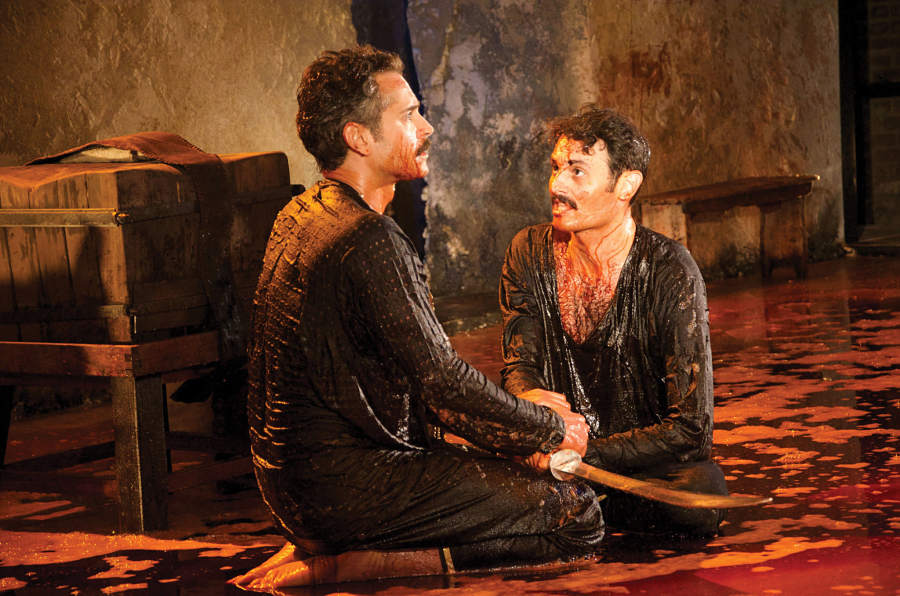
Rajiv Joseph’s Guards at the Taj premiered at Atlantic Theater Company in New York City. First developed at the Lark Play Development Center, the play takes place in Agra, India, in 1648 when two young guards, Humayun and Babur, find out that they will be tasked with chopping off the hands of all the men who built the Taj Mahal. Actors Arian Moayed and Omar Metwally both won Obie Awards for their performance and later revived their roles at Steppenwolf Theatre in Chicago in 2018. Already a highly decorated playwright, Joseph won the Obie Award for Best New American Play, the Lucille Lortel Award for Outstanding Play, and the Laurents/Hatcher Foundation Award. American Theatre published the play in our September 2015 issue.