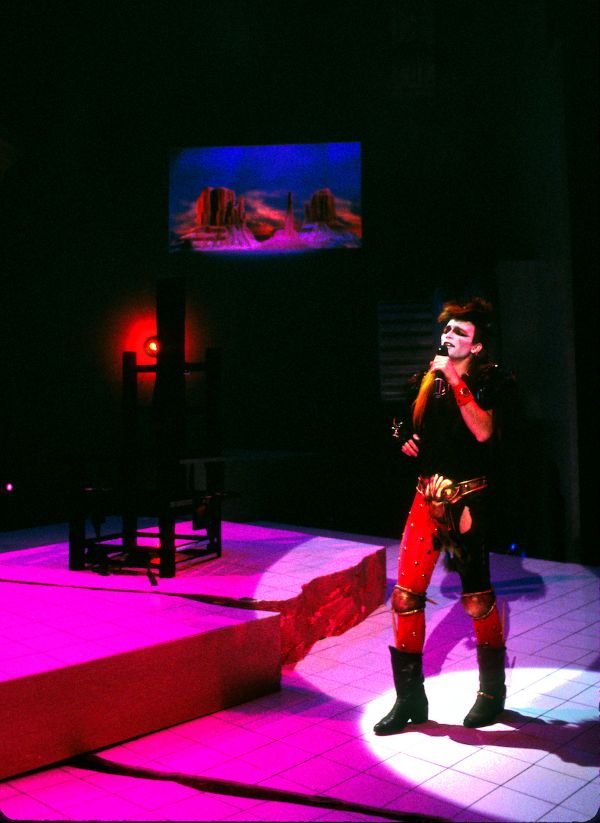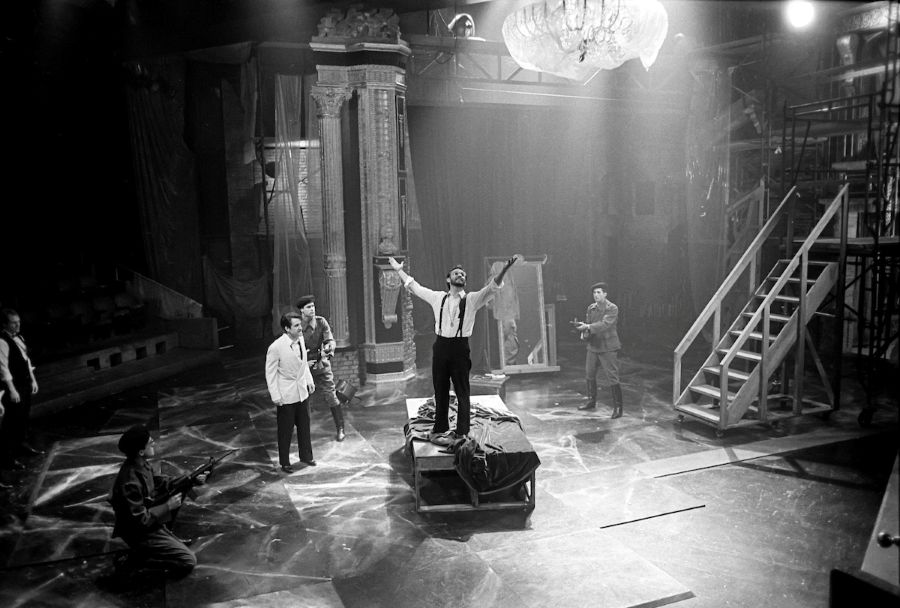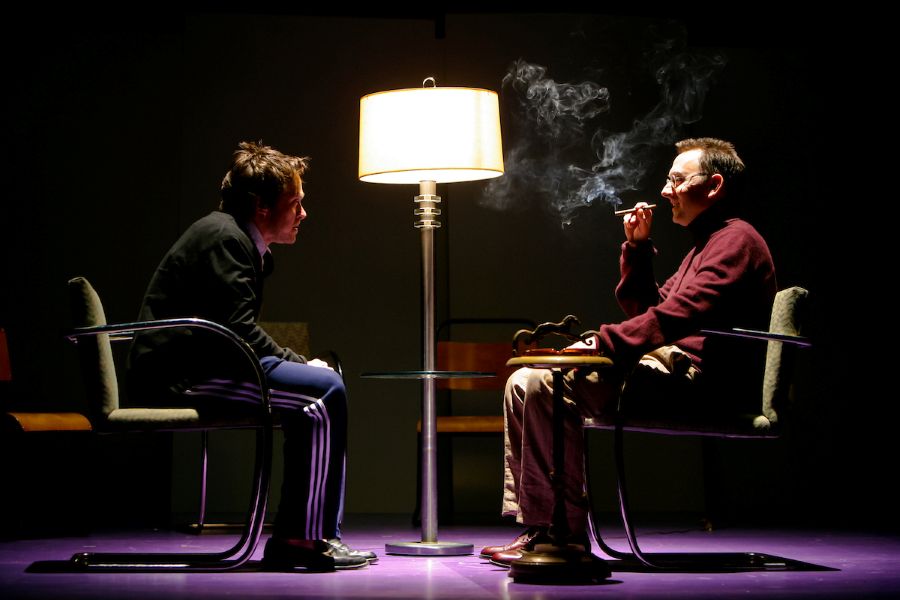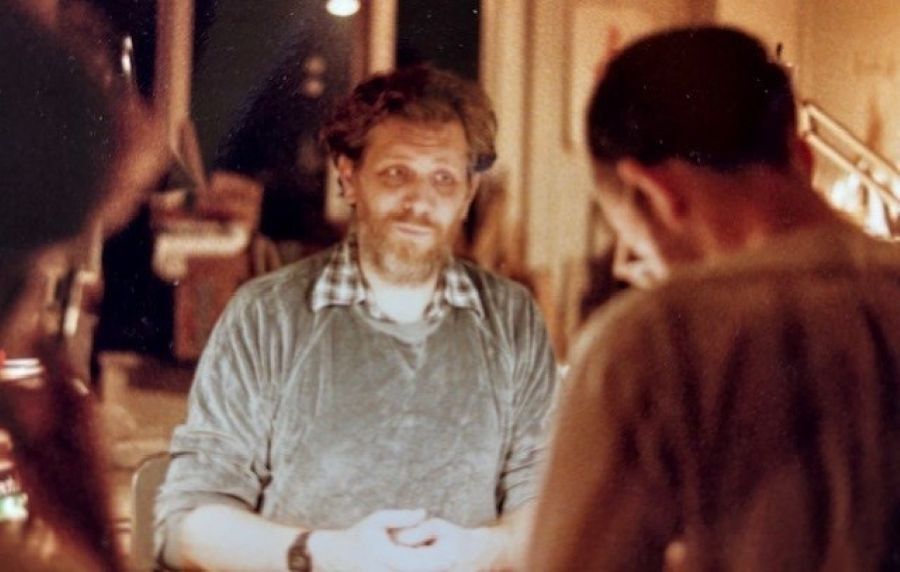
The prolific and beloved theatre and opera designer John Conklin died on June 24. He was 88.
The first time we met was in a fitting room at the Guthrie Theater in the mid-1970s. I was an actor then. He was designing Rosencrantz and Guildenstern Are Dead. I was playing Guildenstern. This congenial, quiet, almost unassuming man with twinkling eyes, a nest of perpetually unkempt hair and a beard somehow always in need of a trim, had watched some rehearsals, made some rough sketches (mine looked an awful lot like me). During fittings he was quizzical, puzzled, doubtful. “What if we—?” And in answer, an Elizabethan ruff was shortened, matching cuffs were added at the wrists. Then, “Would it work if—?” Buttons on the doublet were reordered, decoration on the shoes simplified. The costume gave me buoyancy, vulnerability, piercing intelligence. Everything that Guildenstern required.
A very few years later I “inherited” John when my mentor Michael Langham bowed out of the inaugural season of the California Shakespearean Festival in the small town of Visalia, an hour south of Fresno, and I took over. John was given the chance to drop his commitment (he’d signed on to work with Langham, after all), yet I would come to see that John never shied away from anything new. He embraced the idea of working with new collaborators, especially younger ones. This was his one of his great gifts, as well as his greatest gift to the many artists, craftspeople, and students he worked with, trained, taught, and inspired over the years. God, I was lucky. By the time we began working together he had made an impressive reputation in the American theatre, on Broadway, and at many prestigious nonprofits. I was pretty much in awe of him, as well as flattered.
But as we met to begin work on a repertory of Romeo and Juliet and The Taming of the Shrew, he made it hard to be in any kind of awe. He carried a completely beguiling set of eccentricities about him, seeming sometimes hapless or slightly confused in the face of the daunting work at hand as he queried and listened. “What if?” “Why is it that—?” “Do you suppose we could—?” “What is this really about?” Those queries of his were the mantras that would serve to inspire and sustain me over the course of my career.
We would continue to work together in a wide range of productions for the next 25 years. Plays by Shakespeare, the Greeks, Ibsen, Sartre, Ansky, Chekhov, among others. Operas by Richard Strauss, Mozart, Massenet, Verdi, Britten. He trusted instincts and inspired and questioned himself and all our decisions in equal measure. Our excitement was childlike when we surprised each other with a new idea. You were never wrong, you were only on a quest. “That alley a dead end? Let’s head into another! Or maybe — wait! What if—?”
Probably everyone he worked with experienced some of this, but to me, just starting out and bringing my background as an actor to the process of directing, I was suddenly dropped, vertiginously, into a dazzling world— John’s world— of queries and ideas, art history, architecture, philosophy, stagecraft, (He once announced, presenting a model, “I’m having a fit of forced perspective.”). There were, constantly, shared books, more books, more music, thrilling discoveries that came out of our work together. I was hungry for every meeting, ready for astonishment, and gravid with ideas. Collaborating with him unlocked my caged pasts: I’d studied ballet, entered university on a violin scholarship, worked for over a decade as an actor. All of that was now called upon.
I adored his quirkiness, his sense of humor, often self-deprecating or quite cutting. He never stopped thinking about making theatre. Some people felt he had no life; but he had an incredibly rich one, since his gift was bringing texts and drama and music to life. He enriched every production with his erudition, his constant need to learn. I once asked him what he’d read on a long flight he’d just taken. “I prefer listening to operas with my earbuds and creating concepts for productions of them.” He could get through Turandot, Lulu, and Monteverdi before landing.
After one particularly bumpy flight ( he worked all over the country, and in Europe, constantly), he said he’d resolutely continued listening to his cassette player. “I figured, if I’m gonna die, I may as well do it listening to The Magic Flute, right?”
Collaborating with John was an endless, tantalizing swirl of questions. We rejected stasis but embraced rigor, deep investigation, quixotic insights, and crazy ideas. We tossed nothing out, we only imbibed, stuffing the concept to overflowing. Then we sat down with the text again—or the score—and went through the piece again, scene by scene, fiddling with the model, sharing pictures, digressing, questioning and surprising each other. Nothing stopped for John, even when the design was supposedly finished. “Is this the way we really want to go?” we’d murmur a couple days before presentation was due, staring at the model, flipping for the hundredth time through the costume renderings. When it wasn’t—no matter how many sketches and models and fabric swatches had been made by breathless, devoted, opinionated assistants, and no matter that the deadline was just days away—out it went, and the deposing idea flamed to life. We were ruthless with ourselves. And we gave tech directors and production managers vertigo. Yet. They all succumbed to John. Resistance was useless. Those shoulders shrugging, seemingly helplessly, the shamefaced smile, the answers to all their questions, his understanding of the challenges, and the way he sought their advice. They became eager to collaborate, and he so valued that kind of collaboration. Together with him, construction problems were solved.
He taught us to trust the mystery, to embrace the quixotic, to be fearless and rigorous in protecting leaps into instinct and madness. “Too soon to edit!” Chance was always more important than certainty. The thrill of the chase and the culmination during the final, often immense, discoveries during tech rehearsals with all the elements in front of us, the rest of the team, and the bemused actors, remain unforgettable. His vision lifted us up as we worked within it, as he altered it, as Pat Collins’s—and later, Robert Wierzel’s—light fell upon it, illuminating aspects that had only been subconscious during our collaborative creation.
Right to the very end of his life, John was working in tech rehearsals on four opera productions for Glimmerglass, the last from a hospital bed in Cooperstown via Zoom. He died peacefully shortly after techs ended. “It’s done.”
Weeks earlier, my husband Jerry and I had visited John at Mt. Sinai West, where, for months, doctors were trying to understand what his condition required. While we sat with him he mentioned that when he had been first rushed to the emergency room after a small stroke (the beginning of his long final ordeal), he was in thrall to the drama and the narrative of a busy hospital and an emergency room filled with people in various states of extremis. He had his earbuds in, he was listening to Handel’s Messiah. He’d recently read Charles King’s excellent book about, as the book cover proclaims, “The desperate lives and troubled times that made Handel’s Messiah.”
“I saw all these people,” John murmured quietly, lost in his vision, “struggling and in pain, desperate and ill and frightened, and the nursing staff trying to cope with them, and all during this kind of pandemonium, I was hearing, you know, ‘Comfort ye…’ and ‘Come to me…’ and ‘Be lifted up’ and it was as if this music and these words were hovering over all the people in the emergency room. ‘Comfort ye.’” He spoke, as he so often did when beginning to find a vision for some kind of conception, with a quiet raptness, a sense of surprise and wonder. The combination of Handel’s music, those words, and what John could see as he listened, were the very essence of how he worked, and how his life worked.
Mark Lamos has been artistic director of three companies: Hartford Stage, for which he accepted a regional theatre Tony Award, Westport Country Playhouse, and the California Shakespearean Festival. His work has been seen on and Off-Broadway and in theatres around the country and overseas. He has also worked extensively in opera here and abroad.
Support American Theatre: a just and thriving theatre ecology begins with information for all. Please join us in this mission by joining TCG, which entitles you to copies of our quarterly print magazine and helps support a long legacy of quality nonprofit arts journalism.