“I get the impression that you’re excited,” Peggy McKowen told the crowd at the top of her curtain speech at the July 11 opening night of this year’s annual Contemporary American Theater Festival. In one sense, she was reporting a simple fact: There was indeed a palpable pre-show buzz in the 376-seat Frank Center Theater on the campus of Shepherd University, where CATF has been staging new plays each summer since 1991.
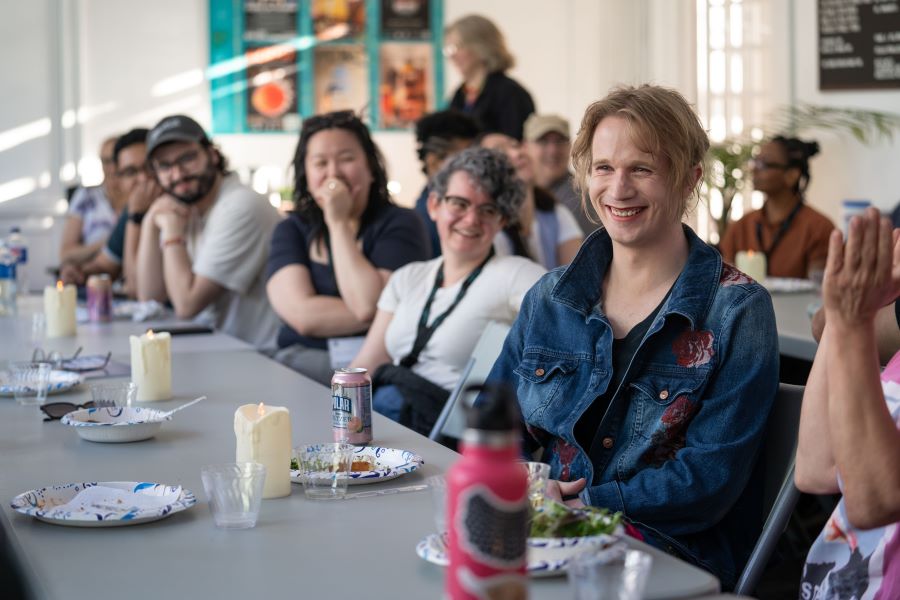
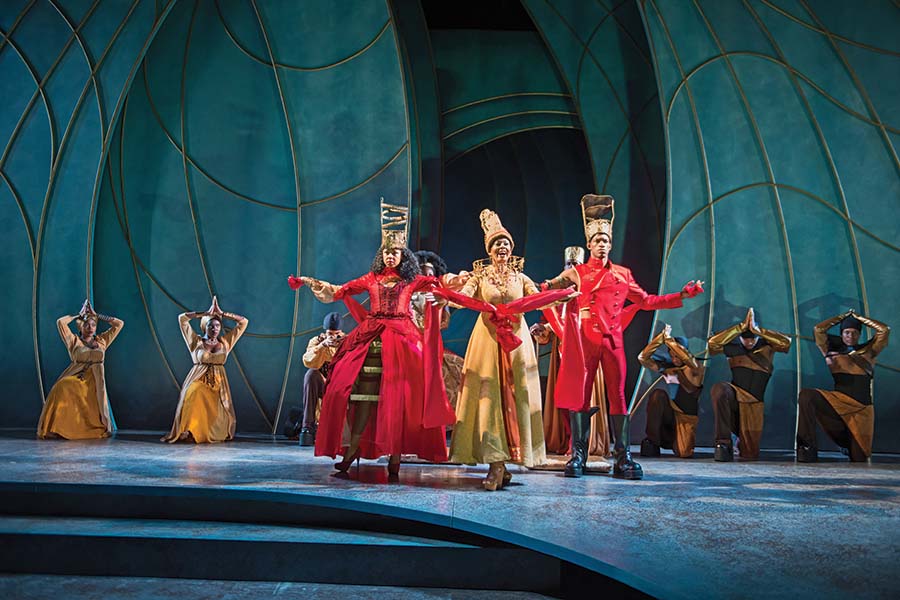
But McKowen, the festival’s artistic director since 2021, was also doing a bit of warm-up hype before the start of Happy Fall: A Queer Stunt Spectacular, a sprawling new smorgasbord of a play by Lisa Sanaye Dring. In various curtain speeches and a brunch meeting with patrons throughout the opening weekend, I heard McKowen voice variations on the theme, “Welcome to the future of the American theatre, right here in Shepherdstown.” Or, as the festival’s website puts it pithily: “America’s newest plays in West Virginia’s oldest town.”
It’s an ambitious mandate for a $2.3 million company that materializes, Brigadoon-like, on a sleepy campus for a month during the university’s summer downtime. And this new-play mission has fresh urgency in a U.S. theatre field battered by Covid lockdowns, inflation, shifting funding priorities, audience attrition, and talent drain, where some of the most notable casualties have been organizations that support new-play development. While many new-play festivals are holding on (and other new ones are blooming), CATF now maintains a unique position in this fragile ecosystem. Since the demise of the storied Humana Festival of New American Plays at Actors Theatre of Louisville, which programmed its last full season in 2019, CATF is now the only new-play festival in the nation that presents exclusively full stagings as its bill of fare. Pacific Playwrights Festival at South Coast Repertory mixes a few full productions with readings, while most other new-play gatherings, whether in Ojai or Omaha or Denver, follow the time-honored tradition of readings at music stands. While that ritual can be an invaluable part of a new play’s development, there is nothing like a full production to see what works—and what doesn’t—in a new work.
Ralph B. Peña, who directed Dring’s Happy Fall, can attest to that. While confessing mixed feelings about the production, which definitely gives full value to each word in its subtitle (“queer,” “stunt,” and “spectacular”), Peña valued the process, saying, “You’re not going to ever know what works and what doesn’t unless you put it up. There’s no way to know it on the page. You gotta put it up in space and see how it lands.” Though the busy Dring wasn’t able to be present for rehearsals or performances, this co-production of CATF and two L.A. companies (Rogue Artists Ensemble and the Los Angeles LGBT Center) “was a big learning experience” for all concerned, and he hopes that Dring can take lessons from an archival video.
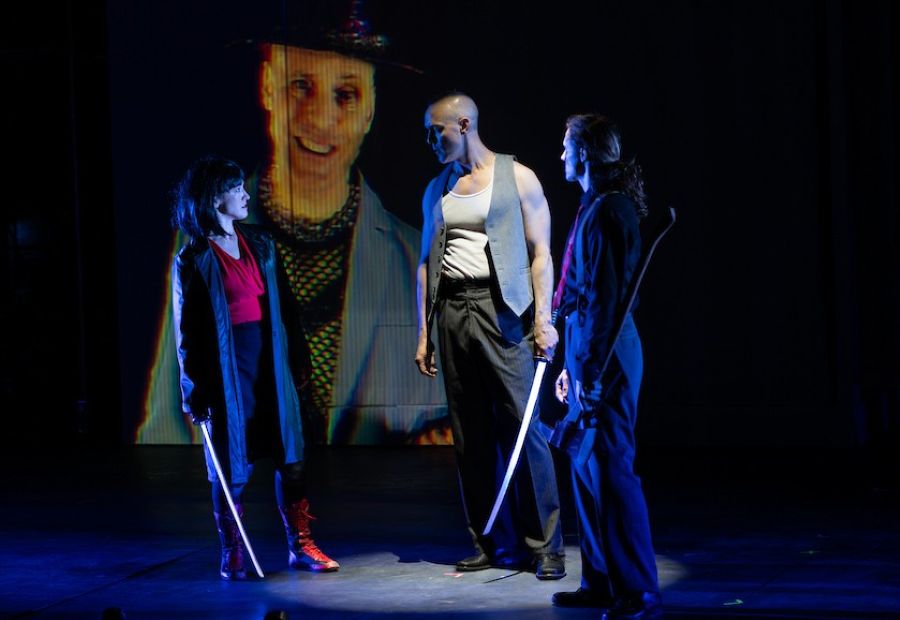
It was also a big swing for CATF, which spent $203,000 on the production—$10,000 more than last year’s epic staging of Donja R. Love’s two-part, four-hour What Will Happen to All That Beauty? Some of that Happy Fall budget went to a three-day stunt workshop in Brooklyn. Peña, who runs New York City’s Ma-Yi Theater Company and directed Dring’s Sumo at the Public Theatre, was also able to bring along some trusted design collaborators, Jiyoung Chang (lighting) and Stephanie Bulbarella (projections).
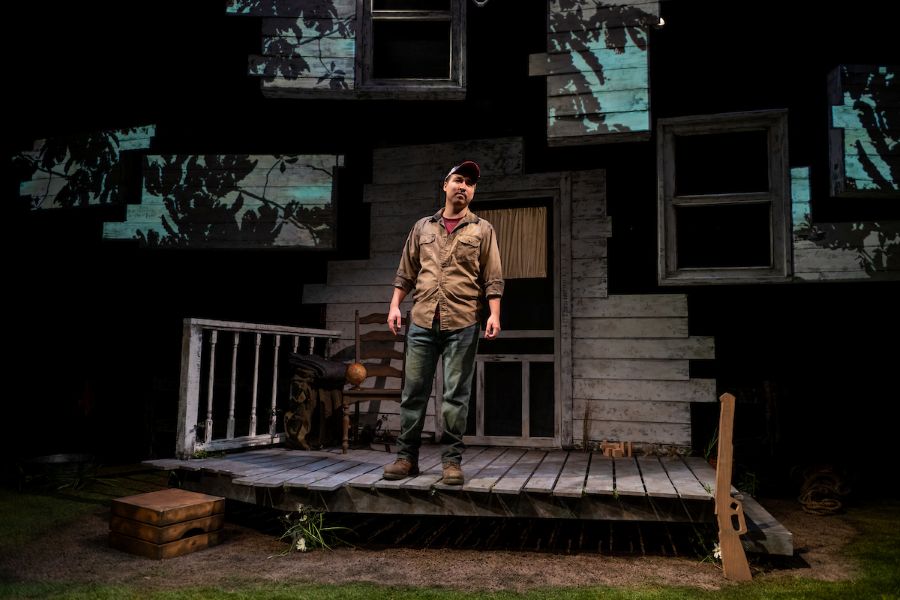
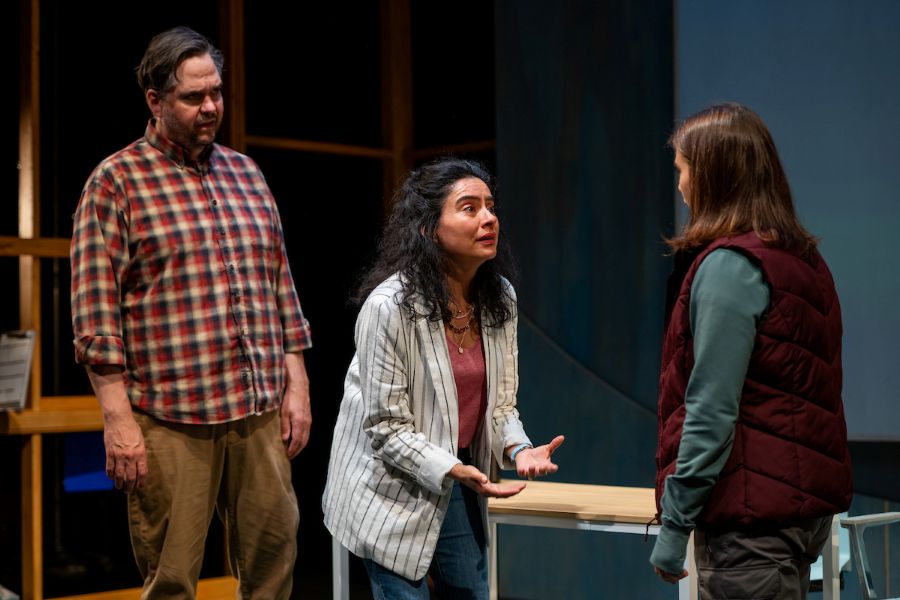
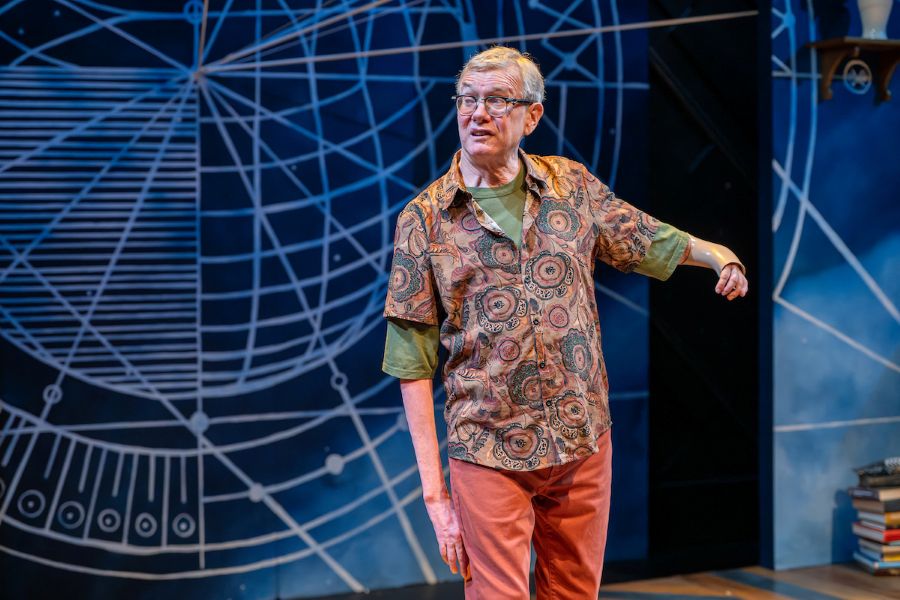
Happy Fall is on the high end of the festival’s production scale this year. There is also a bona fide solo play, Cody LeRoy Wilson’s moving Did My Grandfather Kill My Grandfather?, as well as a kind of souped-up solo show, Kevin Kling: Unraveled, which has the iconic Twin Cities storyteller caper brilliantly around a lavish set accompanied by a live musician, Robertson Witmer. Mark St. Germain’s thoughtful Magdalene, meanwhile, is a classic speculative history two-hander, and Lisa Loomer’s Side Effects May Include… is a bracing, meta-theatrical bio-play about her son’s dramatic real-life battle with akathisia, with four actors playing multiple roles around a single narrator.
A program of five plays, offered in three campus spaces of various capacities, reverts to longstanding CATF practice. Though numbers have fluctuated throughout its long history, five was the magic number from the late 2000s until 2017, when founding artistic director Ed Herendeen decided to up the ante to six. That held until the Covid crash, which is also around the time that Herendeen gave his notice and McKowen, a longtime associate artistic director, stepped up to the helm. McKowen bravely staged a full comeback with six productions in 2022, but she now recalls that experience as “stressful,” not least because the festival did it in rotating repertory, as of old. This year’s festival has some helpful designer overlaps to smooth the change-overs within the 180-seat Marinoff Theatre (where David M. Barber designed the sets and Harold F. Burgess the lighting for both Magdalene and Unraveled) and the 112-seat Studio 112 (where Chelsea M. Warren and Ruidi Yang designed the sets and Mary Louise Geiger the lighting for both Grandfather and Side Effects). But none of the actors are sharing parts among various shows, as they once often did.
McKowen clearly has plenty on her plate without adding one more logistical hurdle. For one, she said, she is very conscious of the renewed attention CATF is getting from writers, agents, and fellow producers in a post-Humana field.
“I definitely feel the responsibility,” she said of CATF’s unique role in the new-play ecosystem. “We really want to be able to be that national incubator and get the work out there.” She admitted that the festival’s location can be a hurdle, though less a physical one (Shepherdstown, along the Potomac River border between Maryland and West Virginia, is just a 90-minute drive from Washington, D.C.) than a perceptual one. “It’s kind of hard for people to really grasp what we do until they come and experience it.”
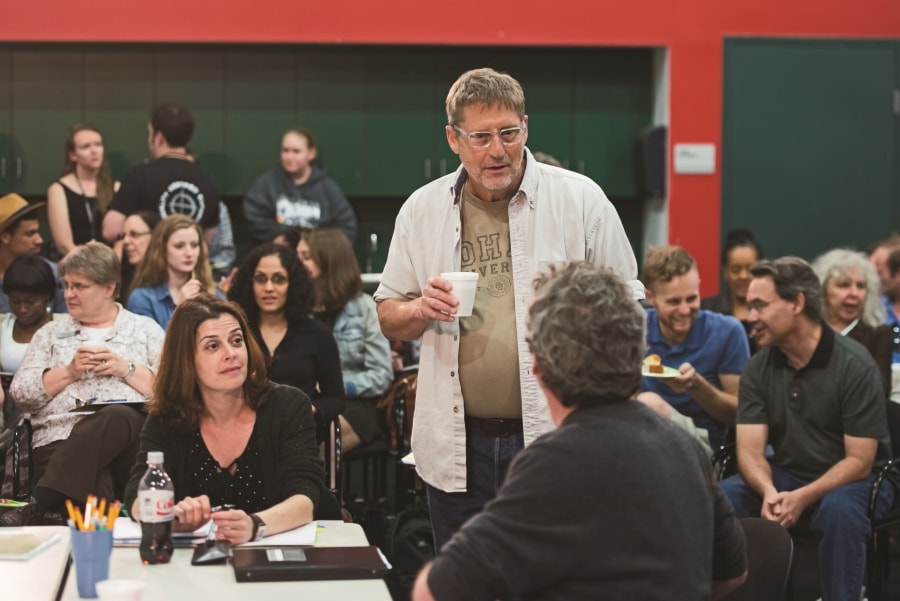
A loyal audience has indeed grasped it, and keeps coming back for more. In addition to the expected DMV crowd, over my weekend at CATF I talked to a couple who’d come from Cincinnati, and I ran into Steven Dietz and his wife, Allison Gregory, both of them playwrights who’ve had work produced at CATF in previous years. Dietz, who splits his time with Gregory between Austin and Seattle, was in town to direct Kevin Kling’s show, and he couldn’t rave enough about the CATF experience. “This place is a gem,” he told me.
I definitely understood the appeal, and not only in the vivifying experience of sitting with capacity audiences attuned to, and eager for, the roller coaster ride of a weekend full of brand-new plays. (Building and curating this kind of ready-for-anything audience has been as crucial to the success of a venture like CATF as programming the plays, though of course these two are symbiotically related.) I also relished the recognizable college-town pace and feel of historic German Street, just a 10-minute walk from the university campus, with its candle-and-culinary emporia, pastry shops, fine restaurants, and a comfy bookstore. In all, it has the kind of pleasantly crunchy vibe I recognize from my trips to Ashland’s Oregon Shakespeare Festival.
And while its home base remains Shepherd University, the festival has quietly expanded its purview into this neighborhood, staging occasional special events and plays at German Street’s historic opera house (including last year’s The Happiest Man on Earth, Mark St. Germain’s play about Holocaust survivor Eddie Jaku). CATF also recently acquired the nearby Christ Reformed Church, which dates back to the town’s founding in the mid-18th century. It is the festival’s first dedicated performance venue, and McKowen told me she has in mind some kind of Christmastime offering there, though perhaps a Halloween play would be more apt—as she quipped to patrons, “We may be the only theatre in the U.S. with a Revolutionary War graveyard.”
Indeed, CATF and its insistently forward-looking programming stand in sharp relief to the American history that grounds and surrounds the region. Founded in 1762 by local land owner Thomas Shepherd, Shepherdstown is just a short drive from Harper’s Ferry, where John Brown’s raid foreshadowed the Civil War, and Antietam National Battlefield, where that war had its bloodiest day. Some of that history pulses through Cody LeRoy Wilson’s Did My Grandfather Kill My Grandfather?, and for good reason: He is the first West Virginia playwright to be produced at the festival.
“I spent 10 years in New York trying to be seen—I had to come back here to do it,” Wilson said on an afternoon panel of fellow CATF playwrights that included Kling, Loomer, and Dring (Zooming in from Greece). Wilson’s relationship to his home state is complicated, though: He is the mixed-race child of a Vietnamese woman adopted as a baby by a white veteran from the tiny town of Plum Run, West Virginia, in the 1970s. Wilson has spent much of his life trying to resolve questions about his identity and ancestry. (His father, who is white, has never been in the picture.) Though his play’s title refers to his speculation about whether his biological grandfather faced his adoptive grandfather in the jungles of Nam, his tale also reverberates with American history, not only in Ho Chi Minh’s famous quotations of Thomas Jefferson but in the Civil War sense of brothers turned against brothers.
“West Virginia culture teaches you, if there’s something that you don’t like, you just push that shit down,” Wilson told me in an interview. Excavating that history from his tight-lipped family thus took a long and painful journey, and he remains particularly protective of his mother, who hasn’t seen the show. But if he grew up in West Virginia facing suspicion and shame about his heritage, he has been gratified by the response of CATF audiences.
“Here people are willing and ready to listen, without a preconceived notion,” he said. “I’m genuinely surprised by how immediate their involvement is—like, I don’t get two words in before they’re starting to make noise.”
He mentioned that as a happy contrast with the relatively jaded attitude of seen-it-all New York audiences. But I heard another level of welcome in his words: Doing his play at CATF represents a homecoming to a more accepting version of West Virginia as well.
In this sense CATF stands as a beacon for more than just the worthy, embattled cause of giving new American plays full productions. Making theatre with living playwrights of a wide variety of backgrounds in Shepherdstown—a blue dot in a red state that voted overwhelmingly for President Trump—is also not a low-stakes endeavor. McKowen talked to patrons and to me about the support the festival has received, from individual donors as well from the West Virginia Humanities Council, which recently got a grant from the Mellon Foundation to replace funding that was pulled from the National Endowment for the Humanities. In general, she said, support from the state, in which CATF is on the “fairs and festivals” budget line, has also been reliable. CATF currently has a program in which they place teaching artists in every 4th grade classroom in Jefferson County, and she hopes to expand that.
The festival’s values, she told a gathering of patrons, are “fearless art, diverse stories, and community and inclusion,” adding that in the face of renewed backlash against these concepts, “Now is the time to rise up.” These words and sentiments are so familiar in liberal nonprofit circles that they can sound like so much boilerplate. At the Contemporary American Theatre Festival, they have a more dramatic ring to them.
A sleepy college town on the front lines of the culture war? Consider me enlisted.
Rob Weinert-Kendt (he/him) is editor-in-chief of American Theatre.