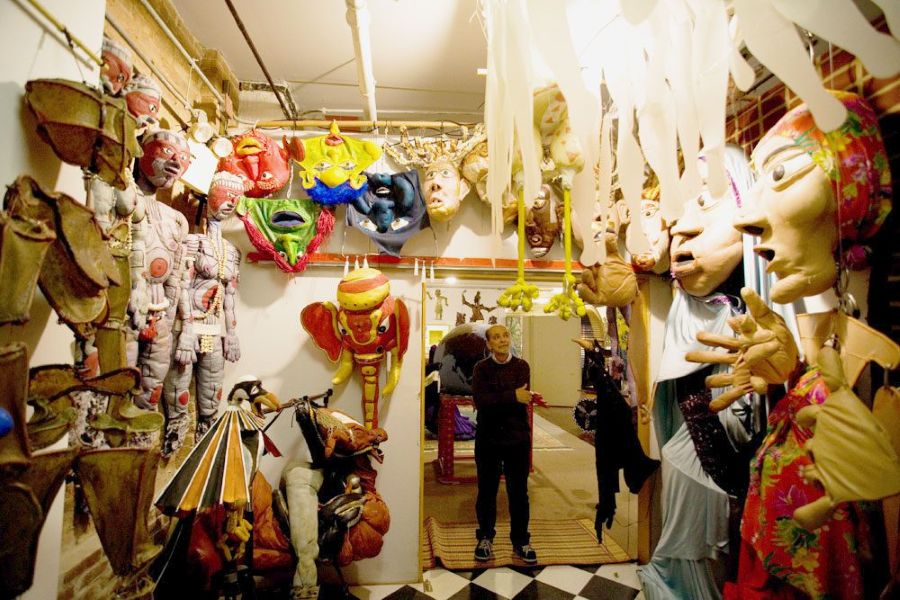
Oswald (Ozzie) Rodriguez Jr.—playwright, actor, director, visual artist, and master archivist, who joined Ellen Stewart’s then-young La MaMa ETC in 1972—made a graceful exit from the world stage on July 24. He was 81. As La MaMa’s archivist, he preserved and kept the theatre’s legacy alive. He was a pillar of, and beloved by, the larger La MaMa community.
Ozzie was born on Feb. 20, 1944, in the Bronx into a tightly knit multigenerational Puerto Rican family to which he was devoted. He attended the High School of Performing Arts in NYC. His first theatre job was Off-Broadway in 1963 with Frank Langella in The Immoralist.
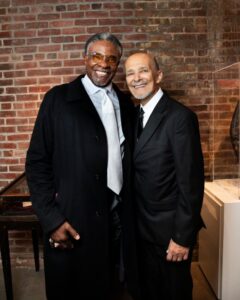
He debuted at La MaMa in 1967 and went on to act in new plays by Sam Shepard, Shuji Terayama, and Lanford Wilson, among many others. In 1972, he became a resident director at La MaMa, working with artists such as Anna Deavere Smith, Ron Perlman, and Keith David. He also toured the world as a member of the Great Jones Repertory Company.
Keith David, who remained friends with Ozzie through the years, said: “Ozzie’s energy always made me want to smile! Whether he was joking with you or reprimanding you. He ran a tight ship. And had a great sense of humor! Wry sometimes, but always there. And I love the way he respected actors/artists and the process. Not everyone understands the way performers process; he always gave us respectful space! And he was a gracious human being. I love him and will miss him. God bless you, Ozzie.”
In 1987, founder Ellen Stewart officially named him director of the La MaMa Archive. His background in publishing, with former jobs at Knopf and Harper & Row, helped him undertake this enormous task with his characteristic passion and dedication. Ozzie was instrumental to the development of the La MaMa Archive. He was La MaMa’s historian and gatekeeper, meticulously building a collection which embodies La MaMa’s unique standing in global theatre.
In an interview with the New York Innovative Theatre Foundation in 2014, Ozzie described the evolution of the Archive:
We had a cabaret in the basement of La MaMa, and around 1987 the Buildings Department decided that that was not a suitable space for audiences. So we could no longer use it as a cabaret. One day Ellen asked me what I thought we should use the space for. I looked around and said, “Well, why don’t you make some room in the office upstairs by sending all the past records down here and we’ll call it the Archive?” At that point we had done about 1,460 original productions, so it was a lot of material. She thought it was a wonderful idea.
I went off on tour—I think it was to Japan . When I came back, she had had all of those files for those years brought down, and she asked me if I would curate it…I said that I would monitor it …She immediately started emptying out all of her closets, and things that were under the bed, and everything that she had saved for all of those years.
Ozzie’s passionate intensity was legendary. His tours educated and inspired thousands of artists, scholars, students, researchers, historians, and the public. With his lived experience of the very history he archived, visitors were awed by his enthusiasm and breadth of knowledge. Connecting the artists’ work to the social/political movements of the time, Ozzie made it come alive.
After a visit, Sally Plass, director of Primary Stages’ Off-Broadway Oral History Project, wrote to him: “I still have not recovered from the extraordinary tour you gave me Friday. You are not only able to convey the importance of the collection but also the passion, fluid generosity, open community, and genius of La MaMa, Ellen, the collection, and all who are currently connected to La MaMa. A living, breathing entity with what is past and can be done now and in the future. Keeping the artifacts available now for alI—not just locked away in the public library! It is so full of life.”

One of his singular achievements as archivist was a four-gallery exhibition at the Cooper Union School of Art and Architecture, “La MaMa in Print: The Paper Trail.” In 1995, The Village Voice awarded Ozzie a special Obie Award for his work in the organization and preservation of the La MaMa Archive.
When asked what part of his work meant the most to him, Archive associate Shigeko Suga, who worked with Ozzie for more than 30 years, noted his real care and concern for mentoring younger artists by helping them “find ways so that they can prosper… Yes, indeed, the same tradition that Ellen had begun long ago.”
Shigeko also recalled a story of Ozzie working with an intern and photographer from overseas. “When he asked, ‘Why do you like this picture?’ she said, ‘Because I took it.’ He laughed so hard and loved her ever-so-simple expressions…Self-expression in the arts, through the arts, I believe, in such a simple and truthful manner, was what triggered Ozzie to be excited and move forward.”
Outside of La MaMa, Ozzie was founder and artistic director of two experimental theatre companies: the North Shore Community Arts Center in Great Neck, New York, and Sol/Sun Experimental Theatre in San Antonio, Texas. A bilingual playwright, he authored several plays, including Madre Del Sol / Mother Of The Sun, for which he received the Distinguished Contributions to Hispanic Culture Award.
La MaMa artistic director Mia Yoo spoke of his devotion to the company
Every day Ozzie came from the Archive to water our plants in the office. The largest of these plants belonged to our founder, Ellen Stewart. The plant is decades old, and it was magical to see it continue to grow new leaves and roots. His care for this plant held such significance for me. It embodied the energy that he gave to everything he loved. Through Ozzie I understood our legacy and the need for us to honor and uplift our intergenerational community. Artists who came to the archive went away feeling the power of La MaMa’s history, and its roots, and that their work would now be part of its ever-expanding legacy. Ozzie, your powerful spirit lives on in us. We will continue to water that plant and protect those roots.
A memorial will be held at La MaMa; date to be announced.