Role models are imperative in any young person’s life. Whether they’re family members or media figures, we look to external examples to learn how we fit into society. Gender nonconforming and trans youth have been less likely to find role models with whom they can fully identify, and studies have shown that youth without such role models are at a higher risk of psychological distress and a fractured sense of identity. Without positive representation, young gender nonconforming people may have difficulty accepting themselves because they cannot envision a happy or stable future. Some can’t imagine a future at all.
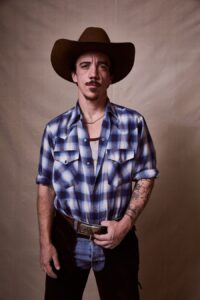
“I had the whole ’80s blurring my vision,” recalled actor Hennessy Winkler, who appeared in Sweeney Todd on Broadway and in the national tour of Oklahoma! “Jerry Springer and all the talk shows showed trans people as these evil characters. Sex perverts! I didn’t want to identify with that.” As this media was his introduction to transness, Winkler developed an unconscious aversion to that identity, causing him to resist transitioning for years.
People often cope with this dissonance by donning a costume, a mask that helps them assimilate more easily. For some, performance itself provides that gateway. Winkler felt immense euphoria whenever he was cast in male roles at the start of his career, noting, “It was the only time I was allowed to be myself and be acknowledged by other people as myself.”
Problems arose for Winkler, though, when he realized that he was performing in life the same way he performed onstage. “I didn’t really think of myself as a human,” he admitted. If one’s performance in life is critiqued in the same terms as onstage performance—Am I believable? Am I doing it right?—what follows is an anxiety that’s hard to shed.
Early in their career, Cole Escola said they feared being seen as disingenuous when asked to embody men onstage. “I felt like I, the person, needed to be male, and that felt false. It felt dangerous to me—everyone’s going to see that I’m not really a man.” Once Escola started meeting and collaborating with like-minded artists—those who also bucked against the rigidity of the binary—this fear began to dissipate. Through this companionship, Escola became more comfortable relinquishing the pressure to adhere to the binary and find their unique gender expression. Within this freedom, their performances flourished. Indeed, many of the artists surveyed expressed that their connection to their art deepened once they had a better understanding of themselves.
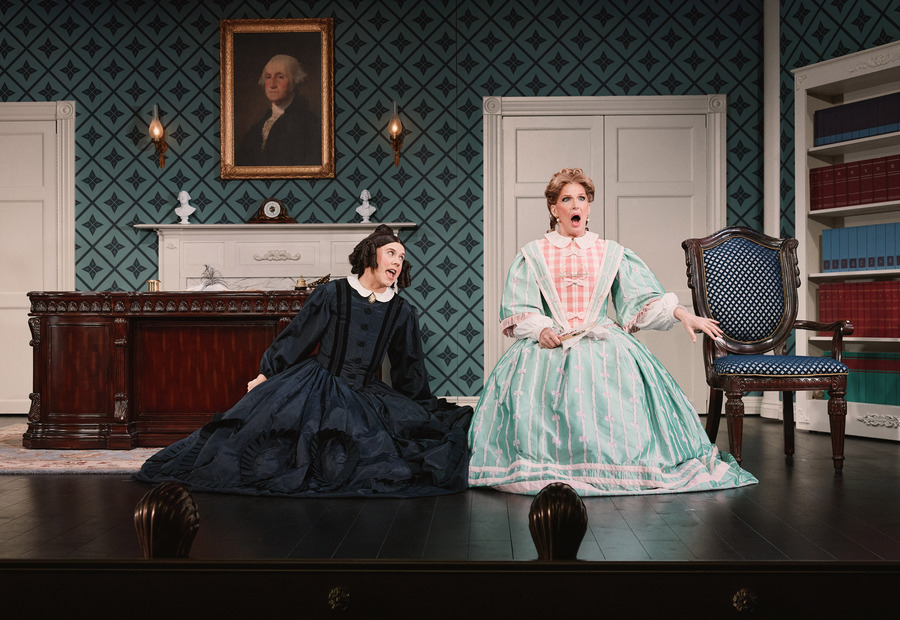
The life and career of the gender nonconforming artist cannot be defined by rejection. For every person who rejects, there is (at least) one who celebrates. Perhaps the most essential step in an artist’s development is finding a community. In the arts, connections dictate your career, but for the gender nonconforming artist, those connections are more essential because fewer people are willing to take the risk on new talent.
Despite dazzling audiences as Hildy in a 1998 revival of On the Town, Lea DeLaria struggled to get past industry perceptions of her butch gender expression. These perceptions didn’t constrain director Christopher Ashley. That same year, he cast DeLaria in the male role of Marryin’ Sam in the New York City Center Encores! production of Li’l Abner. Then he cast her as Eddie and Dr. Scott in the 2000 Broadway revival of The Rocky Horror Show. Soon writers began to create roles specifically for DeLaria to showcase the very authenticity that had once intimidated some in the industry, and she cherishes her relationships with the creatives who identified with her early on.
“I was way too dykey to be a Broadway leading lady, so there were ceilings I hit,” she said. “I was working, don’t get me wrong, but I had to work with the right people.” In addition to Ashley and George C. Wolfe, who directed On the Town, DeLaria cited artists like Graciela Daniele, Michael John LaChiusa, and Susan Stroman as advocates. “I’ve been very lucky to work with some of the best fucking directors and creative writers out there,” she said.
Actor, playwright, and MacArthur genius Taylor Mac recounted a similar inability to break through at the start of judy’s career (judy is Mac’s pronoun).
“I walked into the theatre and it was a solid no from every place I tried to go,” recalled Mac, who was often told to “butch up” or that judy’s work was too radical. Meanwhile, Mac was embraced by the club and cabaret scene, where judy made a home and took inspiration from drag, burlesque, and performance art; indeed, most of judy’s career has been defined by this dichotomy between abject rejection and radical acceptance.
Soon Mac was able to employ grants and presentation spaces to bridge the gap between theatre and the clubs. Because places like La MaMa and HERE initially presented judy’s shows for limited engagements, they weren’t beholden to the illusion of commercial appeal; both institutions had long histories of platforming innovative artists outside the mainstream. Mac used spaces like these to create fantasias of queerness and ravenous curiosity, like The Lily’s Revenge, and extravaganzas like Taylor Mac’s 24-Decade History of Popular Music, as well as writing plays for the theatre: Hir, Gary: A Sequel to Titus Andronicus, and the recent Prosperous Fools.
Mac’s journey, in turn, created space for others who felt similarly rejected—people like Wes Olivier. Olivier met Mac after finishing college as part of a queer activist choir, and the performance veteran took Olivier under judy’s wing, casting them in The Hang and in the Broadway-bound Midnight in the Garden of Good and Evil, for which Mac is writing the book. The latter is Olivier’s first foray into the commercial theatre—an opportunity they never thought they’d get. Olivier credits Mac’s mentorship with giving them much of the confidence they’ve gained as an artist and encouraging them to embrace themselves in rehearsals and onstage. Olivier has also made lifelong friends during the process.
I stated earlier that youth look to role models to learn how they can fit into society. These role models prove that an authentic life is possible. When J. Harrison Ghee was growing up, they assumed they could only play leading men because that’s all they could see. It wasn’t until they discovered Billy Porter in Kinky Boots that they saw more possibilities. “I get to be fabulous and femme and soft and all the things,” they recalled.
Porter’s success gave Ghee permission to continue exploring their gender expression and further develop their craft. Later in their career, Porter acted as a mentor to Ghee, supporting their artistic endeavors and creating more opportunities for them. In the case of Mac, judy had judy’s eyes opened by “drag mother” Flawless Sabrina, who made a name for herself staging drag pageants as far back as the 1950s. Sabrina’s demeanor validated Mac’s curiosities about gender expansiveness because, as judy put it, she had “given up any sense that beauty is a specific genre.”
Relationships with role models do not need to be direct to be beneficial. DeLaria takes inspiration from the legacy of LGBTQ+ activists that came before her. “I had so many people to look up to,” she said. “We are all standing on the shoulders of giants. Del Martin and her lover were probably some of the biggest for me. They formed the Daughters of Bilitis, a dyke organization, back in the 1950s. They were one of the first, so it was a big deal!”
While DeLaria described her connection to history’s activists, Mac expressed a connection to history’s artists —those who laughed in the face of conservative ideals. “It’s all a trickle-up culture, you know,” judy said. “It really starts with [LaMaMa founder] Ellen Stewart and goes from there: Caffe Cino, Charles Ludlam, Jack Smith, all those queens.”
As a gender nonconforming artist, it’s easy to feel alone, but it can help to take a step back. Recognizing that you are in community with a multitude of artists, both living and dead, who have fought the fight before you and will continue to fight after you, creates a feeling of belonging that can be life-saving.
Indeed, the importance of building community around you cannot be overstated. Actress Bianca Leigh (Oh, Mary!, The Lily’s Revenge, Transamerica) spoke fondly of the community she formed upon moving to New York City in 1984, describing her peers at the club Lips as her chosen family; when outside society rejected them, they had each other. That camaraderie made everything else somewhat bearable; she could only imagine the horrors of being without that support system.
“I live in New York City and transitioned 40 years ago,” said Leigh. “So I know a lot of dolls. I don’t personally know any who committed suicide; I know there are some I have heard of through peers. They were isolated; they had no one to talk to. I’m not saying that’s why they committed suicide, but there seems to be a correlation between not having a support group, a peer group, and being unhappy and unsatisfied. You know, there’s a sense of despair.”
It’s important, above all, to surround yourself with people who don’t doubt your humanity. People you don’t have to convince of anything. This is both a personal and a creative imperative.