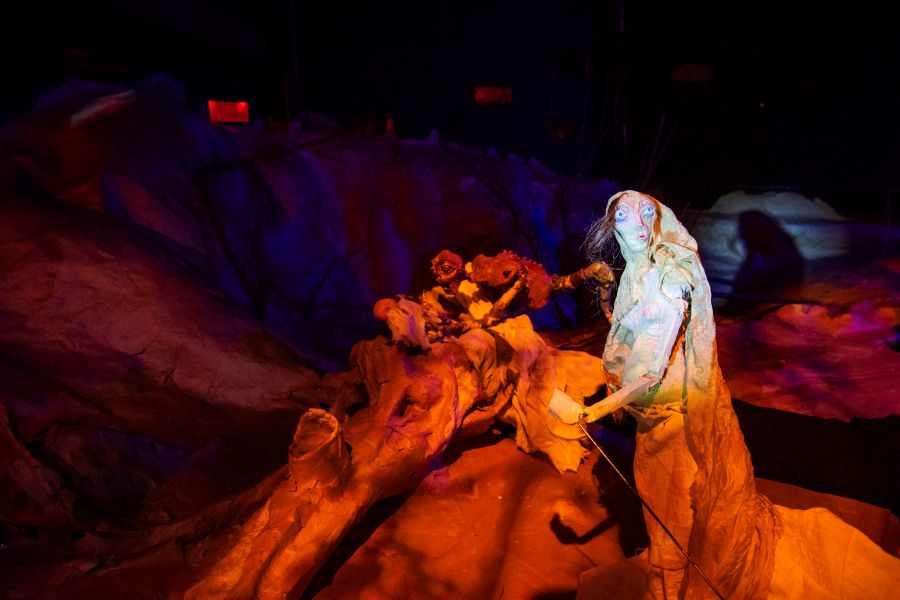
Hello, and welcome to spooky season. I’ll be your guide around a few Chicago-area stops. Now, before we get started, I should warn you, the following contains eerie puppets, ghost stories, and the paranormal.
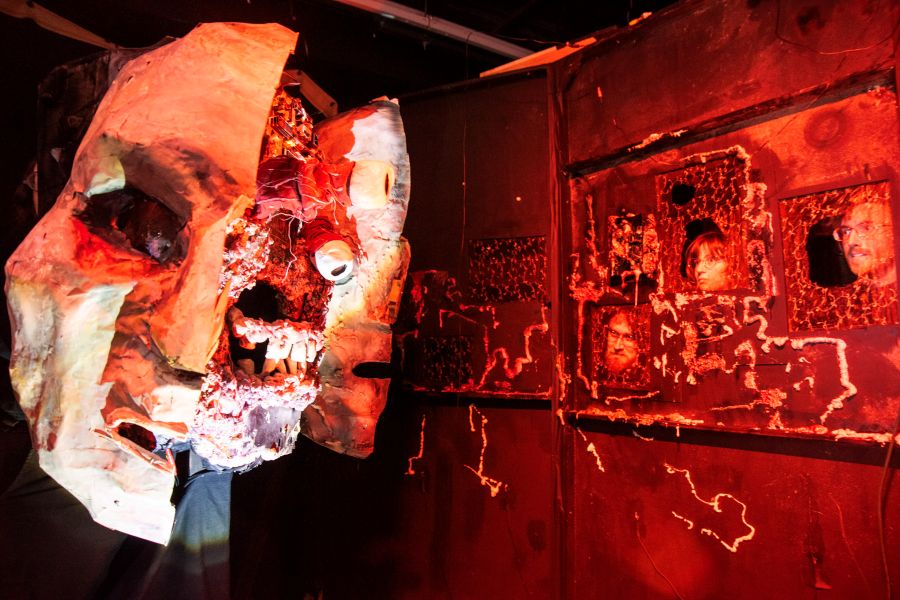
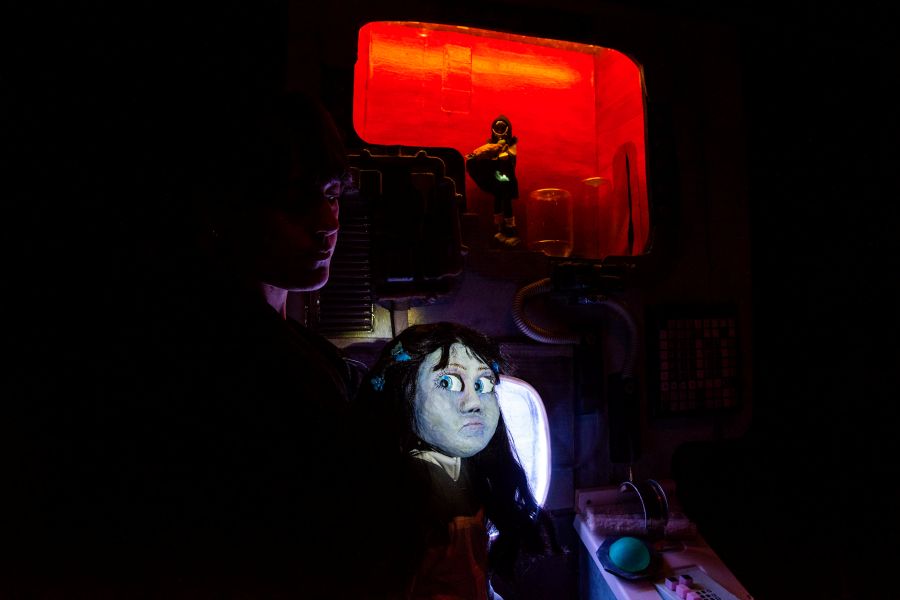
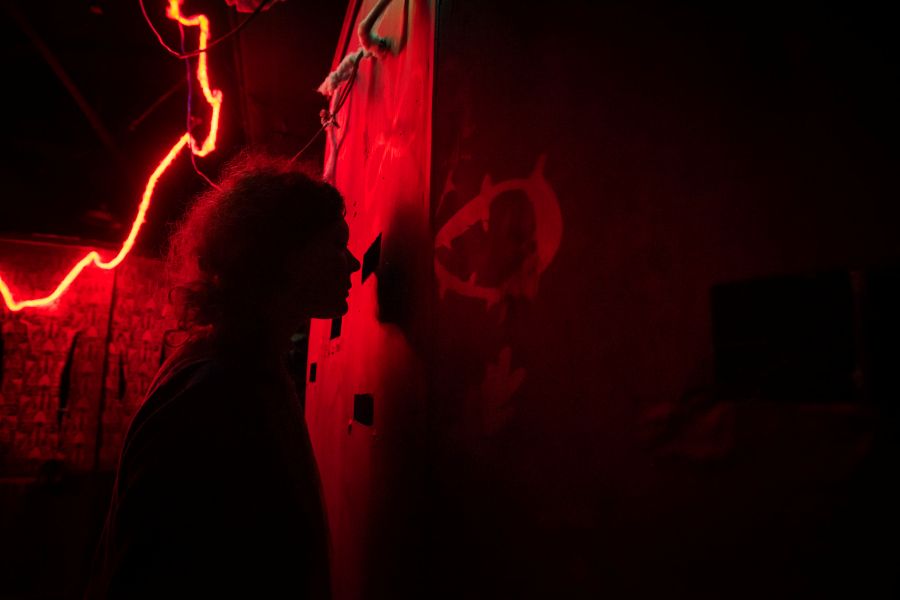
 For our first stop, we stroll past Steppenwolf, bypassing their cozy Front Bar on a drizzly Saturday afternoon, skipping their front doors and the people heading in to see Rajiv Joseph’s Mr. Wolf, and instead head to a sneaky door settled between the entrance and exit to the Steppenwolf-adjacent parking garage. Inside the Merle Reskin Space at Steppenwolf, Rough House Puppet Arts has set up camp for House of the Exquisite Corpse V: Blood & Puppets, a multi-room, immersive puppet haunted house (through Nov. 1).
It’s the fifth official Halloween season for House of the Exquisite Corpse, born from an idea of a decade ago, when Rough House co-founder and artistic director emeritus Mike Oleon brought up the possibility of doing a puppet haunted house. The first year Rough House gave it a try was 2018, under the name Harrow House.
“We built a whole house, which is ridiculous,” admits Rough House artistic director Claire Saxe. “We should have just found a house! But we built a house in the basement of this theatre.”
Indeed, in the basement of the century-old Chopin Theatre, Rough House created their first iteration of an immersive puppet haunted experience, a theatrical story that was divvied up between artists as they crafted individual scenes of the full experience’s story. At the time, the Reader’s Dan Jakes said Rough House’s “dramatic, puppet-filled walk-through haunted house is a formidable addition to the venue’s storied history”—a history, Jakes notes, that includes David Cromer’s intimate production of Our Town.
“It was cool,” Saxe says, “but it didn’t quite feel like what we were going for.”
So they tried a variation. When Covid hit, with all its related restrictions, they took the opportunity to reevaluate as they took audience and performer safety into account. As a result, the experience morphed. Today, House of the Exquisite Corpse, features six individual rooms, each featuring the work of a different group of artists who have crafted stories around the year’s theme. And the audience, rather than walking through a haunted house, instead takes a more voyeuristic stance.


When Sydney Lynne Thomas was in high school, her mom took her to go see a Cirque du Soleil show in Las Vegas.
“I didn’t really have any theatre background at the time, and I saw that stage and I was like, ‘Wow, there’s something really magical about this space,’” Thomas says. “I didn’t know that there were theatrical experiences where you could do something super dynamic and never before seen. So when I saw that, I was like, ‘I absolutely have to get into whatever this is.’”
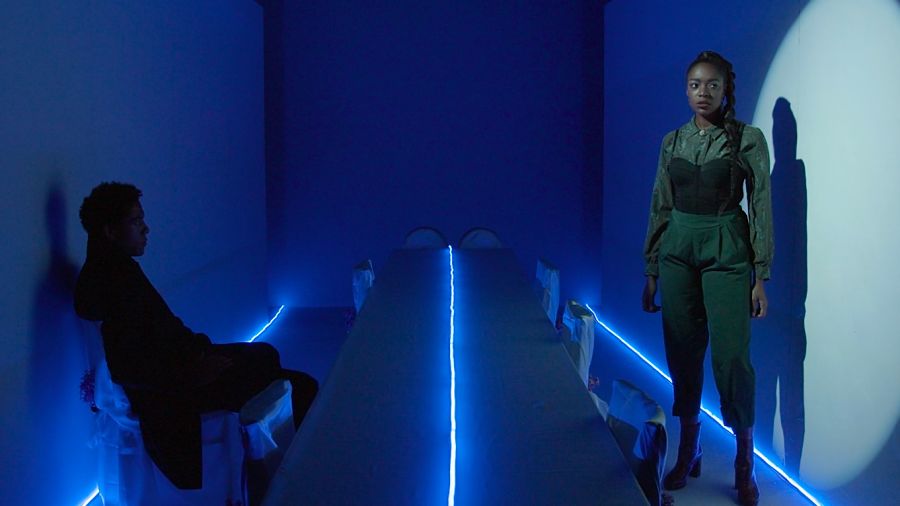
We’re sitting in the lobby of Raven Theatre following a performance of Terry Guest’s Southern Gothic Oak (through Nov. 15), which follows two Black children as they try to avoid a mysterious creek monster they suspect is at the heart of many recent disappearances. Thomas, who was born in New Orleans before being raised in Plano, Texas, designed the production’s set.
“I feel like a lot of my creative sensibility has come from New Orleans, because it has that kind of a magical quality to it,” Thomas says, pausing briefly to greet an exiting Brianna Buckley, who plays Peaches, the children’s mother, in the play. “Then Plano, at least when I grew up there, was very much a field, and so I feel like it really just activated my ability to use my imagination.”
A visual artist as well as a scenic designer, Thomas’s work has been seen all around Chicago, from Chicago Shakespeare to Victory Gardens to Lookingglass. She has just returned to the city where she’s based, pausing between working on the touring production of Hell’s Kitchen and attending the Chicago International Film Festival to chat about her career so far and where her future passions lie.
JERALD RAYMOND PIERCE: What’s your process like? How do you approach a script to find your idea for what you’d like to do?
SYDNEY LYNNE THOMAS: What’s really important about doing design work is that there is the container of the story of the world, and then there’s the container of the actual theatre in the real-life context that you’re doing. For me, it’s not only about exploring the themes and the energies and the exciting factors of what that world has to offer; you also have to think about trying to create that sense of a world inside of a space that already has its own sensibilities and its own features. It’s a blend, really, between taking the themes and the structures that I’m interested in from an imagination standpoint and blending them with the actual container that exists.
For this particular show, it was important to me to not try to think too much about how to create the sense of this forest environment by putting fake trees onstage, but rather, what is the kind of feeling that I’m trying to entice? Like the spooky scary silhouettes, or the feeling of what dripping rope or dripping burlap or those kinds of textures do for our imaginations. That to me is the exciting part of it.

As you look back at the sets you’ve done, is there a particular show or set or experience that you hang your hat on?
The show that I think speaks to me most personally is maybe not the one everyone might point to, and that show is called Queen of the Night, which was at Victory Gardens. Terry Guest actually starred in it. That particular set was also a very natural, organic environment, and it was really about finding a way to creatively use different fabrics and textures and things to create a very similar forest-like environment. That was a time where I really felt like I could use my sculptural interests to fill out a space in a way that feels really compelling and activating to our imagination. I feel like I was really able to successfully use all of the materials I was interested in, because it was more about creating that sense of this forested world. It was also immersive in some capacity; when you walked into the theatre, there were leaves and vines and things hanging everywhere.
What would you say is like the most common misconception about the work you do?
I have to say two. When I first became a scenic designer, I thought it was going to be a lot more about the imagination and the whimsy and the painting and the picking out materials, right? And the job is highly technical. It’s a lot of drafting. It’s a lot of model-making. It’s a lot of communicating among different parties. It’s about looking at build drawings. It’s about looking at architecture. In order to communicate all of that artistry, you have to put it in a format that is highly technical. People are often surprised by the pages and pages of actual paperwork in black and white.
The second thing is that scenic design in general establishes the baseline a lot of the time for the world. But a lot of what we see onstage is really left up to the carpenters, the engineers, the painters—the people who are actually putting in the physical hours to translate the vision from the paperwork to the stage. It’s really important to remember, though the design has my name on it, that the magic of the world is being created by so many other people in the room that are very highly skilled in their own different professions. It does end up being this really compelling collage of everyone’s skill sets in a way that’s really fulfilling to see.
What’s been the biggest learning curve for you as a designer?
The most recent thing is that I was recently on the production of Hell’s Kitchen. I had never personally done a show that needed to tour across the country. So finding the way that you take a set that’s already been established in a lot of ways and figuring out how it breaks apart into many pieces and travels across the country to be loaded in eight hours in one day so the show goes on that night—that was very different from the experience of having worked in many different spaces in Chicago, but never having to take something that lives in one space and find a way that it can live in many.
The other instance I would say was at the beginning of my career. I went to school for scenic design, didn’t have any theatrical context or background. There wasn’t a program at Northwestern that was formally established yet for the undergraduate program, so I had to take the graduate classes. Then I was spit out into the real world, having never done theatre, and started working professionally almost immediately because, as we know, there’s a need for theatrical designers, specifically scenic designers, from my demographic background. So I found myself working rather quickly at relatively high levels, having to teach myself how to draft on the sidelines to make it happen.
I had a lot of support from my collaborators who understood me to be very early-career in some later-career spaces. And there were some very public falters that came with just being young and not having worked yet. One of the things was realizing that people were going to review me; I had never heard of that in my entire life. I think my first review ever was in the Chicago Tribune, and Chris Jones mentioned me by name. It really established for me that it’s all a part of something bigger.
If you were going to advise somebody starting out in scenic design, what’s the main piece of advice you’d want to give?
One of the pieces of advice I would give is that we are all artists and creatives and great thinkers in our own rights. You have to value yourself when you bring yourself to the table. You have to know what your skill sets are and that you’re deserving to be in the room, even if you are early in your career, even if you are of certain demographics that are not historically represented, because you have an offering. You’re in the room for a reason. Someone chose for you to be here, and/or you advocated for yourself, and so you shouldn’t take that lightly.
Is there a dream design project you want to work on?
Absolutely. I was hoping you’d ask this, because I’m currently designing a theme park. I’m really inspired by the work you’re able to do when creating a world. As we move toward a more digital space, the need for live events is just going to continue to grow. So blending my interest in the visual artists and the installation world and scenic design world, I started developing this theme park that is grounded in the aesthetics of New Orleans, specifically hoodoo culture and Mardi Gras culture. The hope is to use traditional theme park structures—a carousel, the ship ride, a fortune teller box—and use those to reimagine aspects of New Orleans history. The dream is full-scale, interactive carnival rides that each tell an aspect of the history of New Orleans. Then I want to pack up like the Ringling Brothers and travel cross country and unpack in parking lots.
I’ve actually been able to meet a lot of people on my journey who are quietly putting together this event, and I think it’s going to be very, very fruitful.
Jerald Raymond Pierce (he/him) is managing editor of American Theatre.