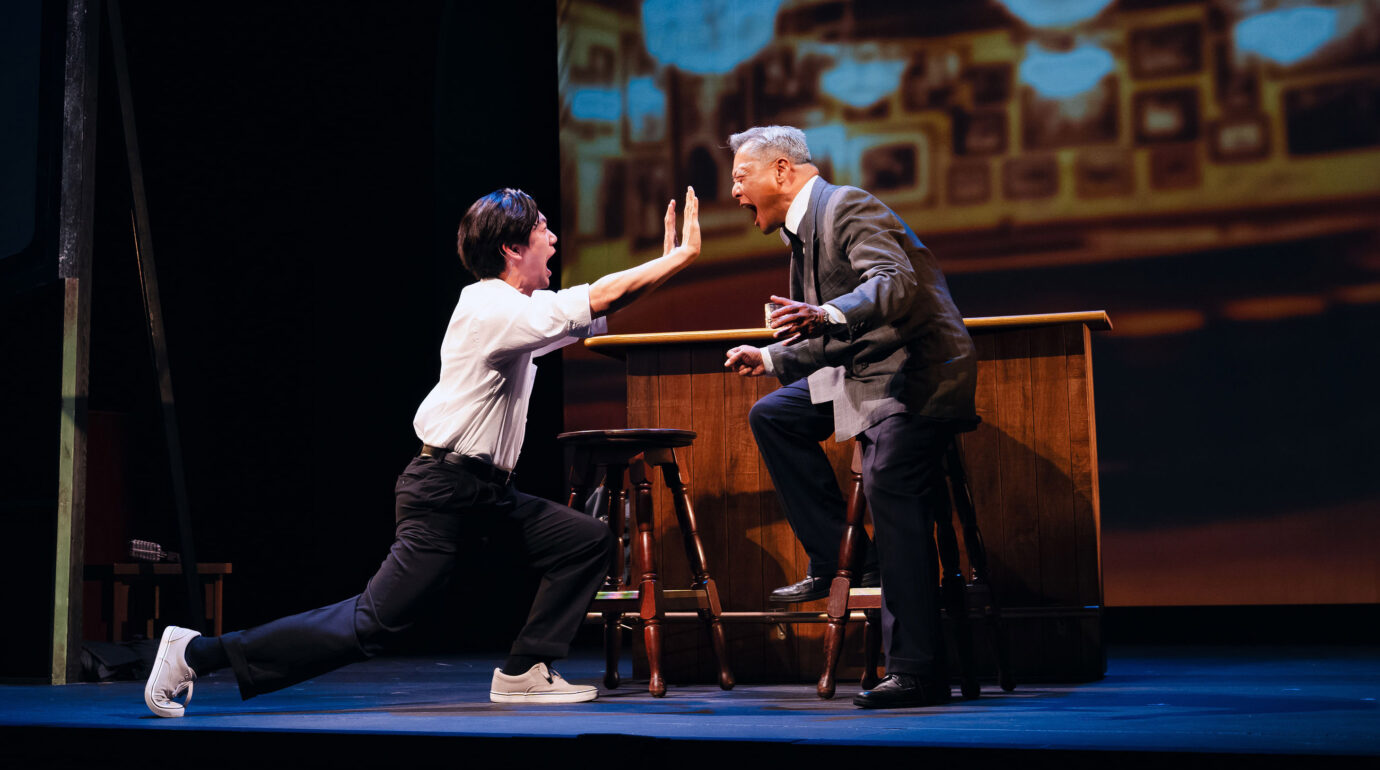
“So, we’re going to try something a little different for this scene,” said properties designer Glenn Michael Baker. It was two and a half weeks before the July opening of East West Players’ revival of Yankee Dawg You Die, and the cast paused their run-through of the play’s final moments to inspect Baker’s drawings of a cardboard-style theatre, complete with stick puppets, plastic toys, and interchangeable sketched backdrops. The intricate prop was to be operated by the actors of this two-person play by Philip Kan Gotanda, as they played out a comical interlude in which Godzilla rampages through various Northern California locales—all for a live feed’s tiny hidden camera that would broadcast throughout the David Henry Hwang Theater.
“That’s very funny—I love it,” said actor Kelvin Han Yee, visibly beaming. He then pointed at an oceanside diagram and asked, “These waves—is there any movement? How does that one go?”
“You can, if you want!” responded Baker, delighted at the idea. “This is all for us to have fun with, and we’re all playing here together. And then, after we land that laugh, it all really goes off the rails.”
In applauding Baker’s mock-up, everyone in the room smiled and laughed—a shared utterance of joy that felt refreshing and even radical in its own way. For weeks, Los Angeles had been embroiled by ICE’s aggressive immigration sweeps, with locals’ protests against the city’s increased militarization unfolding in and around downtown, not far from East West Players’ theatre in Little Tokyo. Numerous historic buildings in the area were vandalized, and businesses closed temporarily in accordance with the city’s mandatory curfews.
On June 14, the day of the nationwide “No Kings” demonstrations, East West Players partnered with community organizations to distribute water bottles to the protesters and posted “Private Property” signs to prevent ICE agents from threatening audiences convening at the theatre. As a safety precaution for the cast and creative team, the production’s initial table read was held virtually, and this mid-June afternoon’s rehearsal, usually held onstage, had relocated a few blocks away to a space offered by the St. Francis Xavier Chapel – Japanese Catholic Center.
All of that outside context doesn’t just disappear during a rehearsal, though. “My character talks about how he’s being made to feel like he doesn’t belong here, even though he’s American, and in this current context, that line resonates really deeply now,” actor Daniel J. Kim told me afterward. “This play has such an expression of anger and grief and hope for something better. And I hope that the people who are needing some kind of community and healing will feel it when they see our show.”

Of course, such an effect couldn’t have been predicted when Lily Tung Crystal programmed Yankee Dawg You Die for her inaugural season as the artistic director of East West Players, now celebrating its 60th season. The play centers on two Asian American male actors at opposite stages of their careers with contrasting opinions on how best to navigate Hollywood: which roles to embrace or refuse, why they each find performing important, and what social responsibilities they feel they have to audiences and fellow actors as representatives on film and TV. Gotanda’s play made its world premiere in 1988 at Berkeley Repertory Theatre, and subsequently played the Los Angeles Theatre Center. It was last staged by East West Players in 2001.
“We wanted to represent East West Players in a full way—the past 60 years, the current work, and the work of the future,” explained Crystal in an interview. Yankee Dawg You Die is one of two canonical works she’s featuring in her first season; the other is Flower Drum Song, with David Henry Hwang’s newly updated book, coming in spring 2026.
“Since this play was written, there’s been so much progress that our Asian American elders and current artists have attained, but we’re still fighting a lot of the same obstacles that the two actors in Philip’s play battled,” she said. “There’s still not enough stories about Asian Americans that are by Asian Americans, and we can count on one hand the A-list Asian American actors in the field. A revival of this play gives us a chance to celebrate our wins, and also consider what we’re still facing and how we can fight to make it better for the next generation.”
The production is its own full-circle moment, since Gotanda was first inspired to write Yankee Dawg You Die while collaborating with East West Players. At the time, he was working on the 1979 world premiere of his musical The Avocado Kid (Or, The Zen in the Art of Guacamole).
“Before that, I had been working with a young theatre in San Francisco that later became Asian American Theater Company, and its whole point of existence was to have a very political point of view as to what an Asian American was,” recalled Gotanda during a video call. Upon arriving in Los Angeles, he found himself surrounded by Asian American actors who worked in film and TV as well as theatre, some even with decades-long screen careers.
“As I got to know them, I began to notice these big differences of points of view within the world of Asian American theatre,” he explained. “In San Francisco, there were these younger actors thinking, ‘Why did these older actors play those stereotypical, offensive roles?’ And then the older actors who had been working in Hollywood had the position of, ‘This is what we had to do to survive, and that we were onscreen at all was a victory—how dare you look down on us?’ That generational tension became the play, which was speaking to the internal conflicts that Asian actors experience.”
Gotanda compiled his conversations with real-life Asian American actors to create his Yankee Dawg You Die’s composite characters: Vincent, the middle-aged “never turned down a role” actor, and Bradley, the 20-something Next Big Thing, who scorns performers simply taking what they can get. They collectively lament the limitations that the industry places on Asian performers—reductive characterizations, accent-driven jokes, dehumanizing dialogue—and the sacrifices they’re forced to make for a paycheck and a credit. (The piece’s title quotes a game the characters play in which they measure how much hypothetical humiliation they’re willing to endure to land a role.)

Gotanda described it to me as a period piece, capturing an era in Hollywood history when Asian characters were largely faceless, originless, and unworthy of any kind of equating or empowering acknowledgment by others in a scene, if they were played by Asian actors at all. (One onstage exchange cites a romantic kiss between an Asian man and a white woman being cut from a broadcast for its potential offense to audiences at home, lest he be framed as conventionally desirable.)
That the content of the play sounds dated should be a good thing. Asian representation has drastically improved in film and TV, with actors toplining superhero movies, network sitcoms, sci-fi titles, and romantic comedies—some of which are written to authentically showcase a particular Asian heritage, and others that strategically practice “colorblind” casting.
Hollywood has also since seen the rise of the Asian male heartthrob — thanks to nuanced writing, aspirational storylines and the viral social movement #StarringJohnCho countering a long-established pattern of emasculated portrayals. In terms of theatre, Yankee Dawg happened to rehearse and run mere weeks after the Tony Awards, where the South Korea-set musical Maybe Happy Ending won six awards and numerous actors of Asian descent—Francis Jue, Darren Criss, and Nicole Scherzinger—took home trophies.
“The systemic progress that we see now—all these younger Asian American playwrights getting produced everywhere, Asian Americans getting behind the camera as directors and producers—is tremendously satisfying,” said Gotanda. “On the other hand, I used to think that, once we reach the moment that we are in now, so many things would be solved and answered in regards to race. What’s troubling to me is how anti-Asian hate and anti-immigrant attitudes have surfaced now with perhaps more strength or voice than ever. How can they coexist?”
It’s a question that director Jennifer Chang considered deeply when deciding whether to take on the revival at all. She initially turned down the gig, having just completed a number of back-to-back directing jobs and finalized a much-needed vacation with her family. She finally agreed to helm the production when she figured out how a 1988 text might galvanize a 2025 viewership.
“I’m gonna be really real—it’s very dusty,” said Chang, describing her initial read of Yankee Dawg You Die. “But as a director, I’m obsessed with this idea that every play lives on four timelines: the context the playwright was in when the play was written, the time period the play is set, the actual duration of the play when it’s performed, and the real-life context that the audience is in when they see it. I’m thinking about how those four timelines are in conversation with one another, and how we can best bring that conversation forward for the audience.”
That conversation “is not just about Asian American actors,” Chang continued. “It is very specifically talking about Hollywood as a system, and how it perpetuates harms against the Asian American community. Because of what we see on-screen, how do we limit ourselves in what we believe we can do and what we allow ourselves to do? And what limits do we then project on each other, even today?”


Yankee Dawg You Die opened on a balmy Sunday evening in early July. The performance inside the David Henry Hwang Theater was prefaced by an onstage condemnation of ICE’s ongoing immigration sweeps across Los Angeles and the suppression of peaceful protests by military forces. “When one community is under attack, we are all under attack,” said managing director Kevin Johnson-Sather in a curtain speech. Added Tung Crystal, “Our stories are immigrant stories; our stories are refugees’ stories.”
That night’s curtain call was met with a rousing standing ovation, which only grew when Chang, Tung Crystal, and Gotanda joined actors Kim and Yee onstage. Also among them: Sab Shimono, whom Yee hugged tearfully and introduced to the audience as “My Vincent.” (Shimono told me afterward that he loved the production: “It was so magical and open, the lighting and the visuals really opened it up.” Of Yee, he said, “I loved his Vincent. I’m gonna steal from him if I ever do the play again!”)
After the show, actor Gedde Watanabe was heard telling a fellow audience member that the conflicts onstage were unfortunately all too familiar to him personally. In the reviews that followed, Stage Raw’s Deborah Klugman called the production “a sterling revival” of the “astute, funny, and enduringly relevant Yankee Dawg You Die,” and StageSceneLA’s Steven Stanley applauded its full-circle casting of Yee as Vincent. BroadwayWorld LA’s Evan Henerson deemed it “a full-throated production,” and ArtsBeat LA’s Terry Morgan lauded Chang’s direction: “Her staging of the scene in which the two leads create a new Godzilla movie is delightful.”
A surreal moment took place after that opening performance, when the event’s attendees—including Cosmo, Gotanda’s dog—gathered in the courtyard for a champagne toast with the cast and creative team. They took turns delivering short speeches, pausing every now and then as not to be drowned out by circling helicopters and ambulance alarms.
In a quiet moment between the sirens, Yee reminded the crowd that East West Players’ physical home, the Union Center for the Arts, was formerly the Union Church—a building that was at the center of another time of great conflict, World War II.
“To be here at East West Players, in this building that has a history of having been where Japanese Americans had to wait for the bus to go to the internment camps,” he said, in tears. “This church! But now we have it, and we tell our stories from this space.”
Ashley Lee (she/her) is a Los Angeles-based entertainment reporter and critic who writes about theatre, movies, television, and the bustling intersection of the stage and the screen. @cashleelee