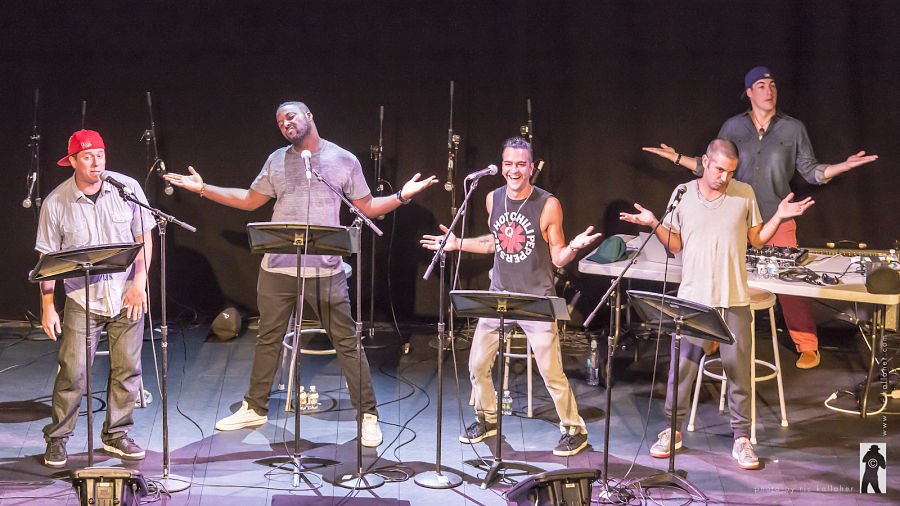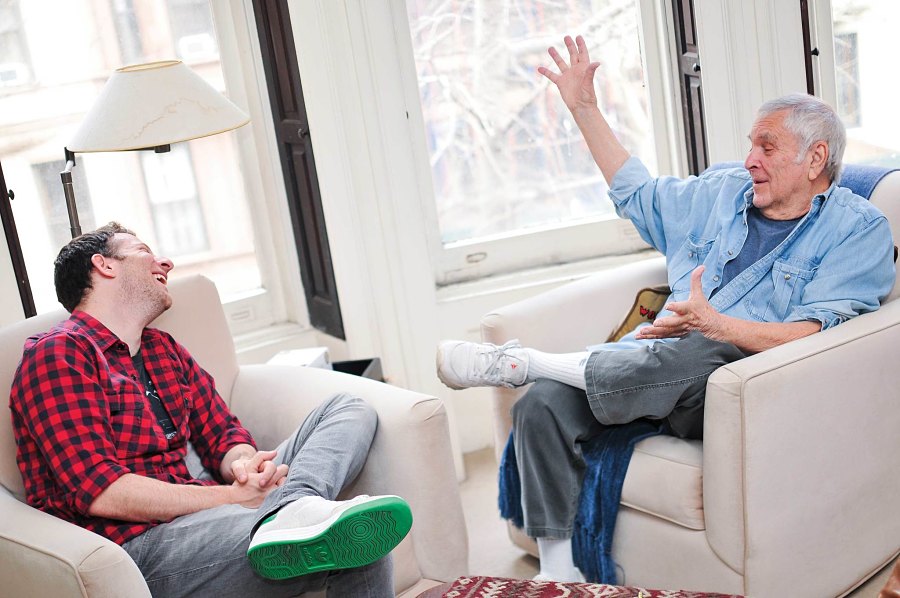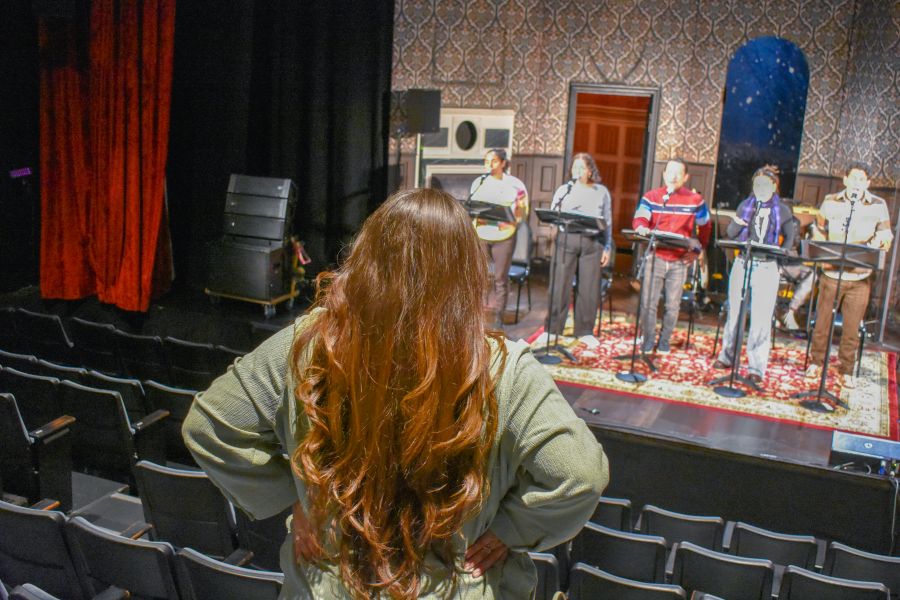
The National Alliance for Musical Theatre’s Festival of New Musicals at New World Stages, which ran for its 37th year Oct. 23-24, offers an annual chance to reflect on the state of new musicals and wonder: What does the future of musical theatre look like? As an artist who has performed and worked on music teams for new works, I hoped to see unconventional musicals by underrepresented artists pushing the form. This year I had an added question: How are creators thinking creatively amid tough times?
In one whirlwind week, I got glimpses of the musical theatre future: personal stories leaning into vulnerability, connection, power—revolution, even—with new voices that speak to a political world. Seeing seasoned and emerging artists telling stories of young people with historical and cultural influences to advance the form of tomorrow’s musicals made me think: The intersection of well-honed craft, evolving musical styles, diverse voices, and untold stories is where musical theatre storytelling is, and should be, heading.
Since 1989, the annual NAMT festival and showcase, an industry-only event, has been “the gold standard for musical theatre showcases,” said Michael Kooman, the composer for Finn, which was part of this year’s showcase. A “musical theatre Super Bowl” is how festival selection committee member and producer Neen Williams-Teramachi described it. It’s the place where such shows as Songs for a New World, The Drowsy Chaperone, Come From Away, Children of Eden, Thoroughly Modern Millie, It Shoulda Been You, and Lempicka got showcased before going on to Broadway and beyond. A presentation here in front of producers can open up possibilities for development, productions, tours, licensing, albums, and more.
According to NAMT executive director Betsy King Militello, last year’s festival had record-breaking attendance, with 875 people. This year handily surpassed that, with 1,170 festival attendees, making it the nation’s largest musical theatre festival. The lines were long outside both of New World Stages’ basement-level theatres, snaking around the lobby. Every day was a race to get out of one show and straight into the line for another.
Such enthusiasm and turnout is remarkable in an industry where new-work labs are facing challenges. A number of NAMT member organizations have consolidated, condensed, or dissolved their new-works efforts, while production expenses are increasing and theatres are facing funding uncertainties, including with their NEA grants. All this, said Militello, “makes it even more important we lean into the festival and all our new-work activities, because that will continue to feed the field, even while they are recovering from where we are.”
NAMT changed its application process a few years ago, eliminating the application fee and the requirement for every show to have a third-party endorser, adding an artist statement, and broadening the judging committee’s representation. With stories by women, BIPOC, and queer artists present in the lineup, such changes clearly made a difference. The priority above all remains work that sparks passion.
“We don’t want everything that is good,” said Militello. “We don’t want everything that is nice. We want things that one person’s going to love, and one person’s going to wonder why we put that in the festival.” She continued, “There’s a brain piece of it, but there’s also a visceral part. Did it get you? Did it evoke passion? Do you want to live with this play for a long time?”
Festivalgoers only get a sneak peek of each show, with 45-minute staged readings that offer representative samples of full-length works. Prepared with a 29-hour rehearsal process, shows go through a process of simultaneous elimination and growth, as they decide which sections to keep for their shortened presentations. NAMT generally discourages writers from revealing the show’s full arc (though several chose to go that route this year). Writers are instead encouraged to lean into the music and to ask, “What story are we really telling here?” Militello said.
But before the festival came NAMT’s fall conference, which I attended Oct. 21-22 along with 165 others at the New York Public Library for the Performing Arts at Lincoln Center. Especially following the stark New York Times article about how new Broadway musicals are “in trouble,” it was rejuvenating to meet professionals in the regional and licensing circuit, with a national perspective proving that Broadway isn’t the end-all and be-all.
NAMT members have experienced the new-work crunch firsthand, so the conference’s opportunity to connect in-person to discuss the struggle was most welcome. Jessica Francis Fichter, executive director of South Carolina’s Trustus Theatre and writer of Dandelion, a TikTok-famous musical, talked about how, though Trustus programs one new musical every year and is overall in better shape budget-wise (they’re a non-union outfit), new work remains “high-risk and low-reward.” As other members shared experiences, the strategy of co-production was a recurring theme. Mark Fleischer, executive producer of Pittsburgh CLO, said that his company is part of a “co-production alliance” among larger theatres who work together, including Southern California’s La Mirada Theatre, Houston’s Theatre Under the Stars, and more.
Along the lines of working together across the country, some folks I met brought new ideas for engaging diverse producers to the conference, including Manuel Moran of Teatro SEA, a new NAMT member spearheading his initiative, El Musical. He aims to welcome more Latine funders for new musicals, including folks like Luis Miranda, because “we need to talk about owning our own stories as producers,” Moran said.
In a keynote, producer and consultant Brett Egan tackled three major shifts he said the modern “hybrid arts leader” should be aware of. To address the first shift (changes in audience retention), he suggested “decreasing negative friction” and “increasing positive friction” to make the experience of seeing theatre easier for audiences. Regarding the second shift he identified (the increasing adoption of AI), he defended its use for menial tasks that can “refocus us in the work of connection,” and estimates “in 10 years, workers will be focused on value creation and relationships.” (He is a member of Arts Administration for AI). The third shift he mentioned (changes in federal arts funding), he called on theatres to ask themselves, “Will the arts of America define its own national policy or have the policy defined for them?”
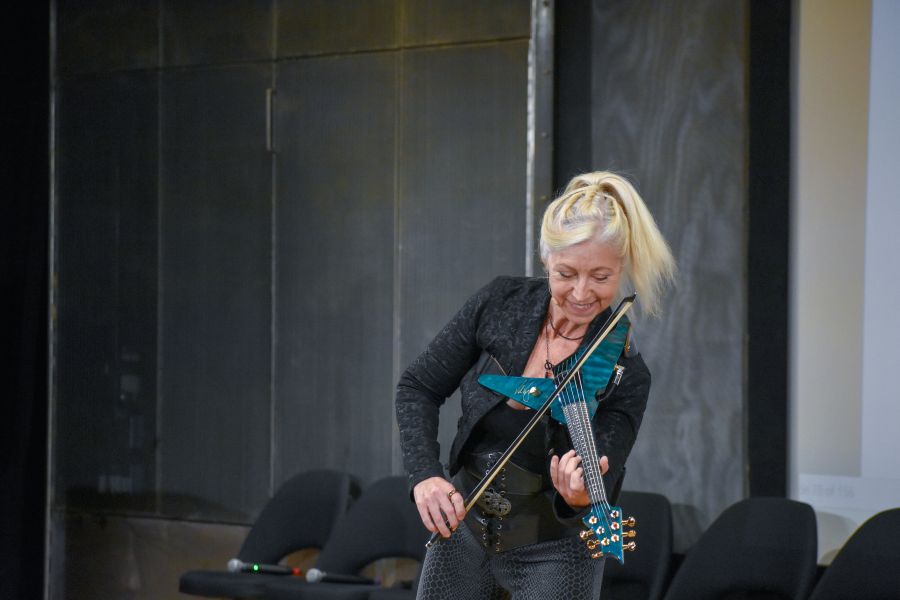
The most exciting keynote was Val Vigoda’s opening. The NAMT alum and composer of such musicals as Striking 12 interspersed anecdotes about her early NAMT and touring days with performances of her music. Playing electric violin with live looping, accompanied by Brian O’Connell on piano, she invited the audience to join in singing along. And she offered three helpful “R”s of resilience: “Reclaim your foundation of self-trust, reframe unhelpful stories, and raise the roof by creating connection through expression.” Surviving and thriving were ultimately the biggest points of the conference, with members sharing such takeaways as leadership through transformation, taking pride in success, and adjusting to change at its end.
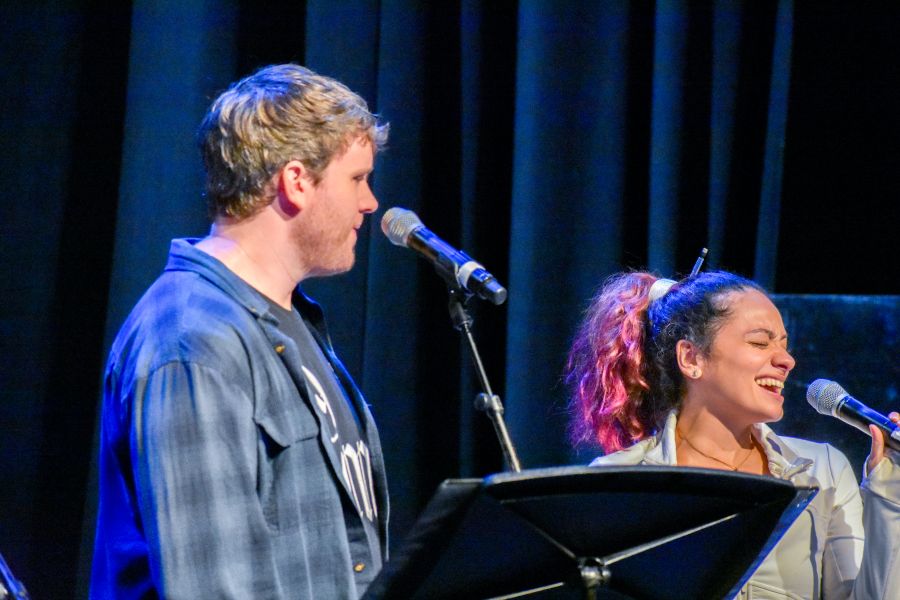
Of course, as important as it is to talk about new work, members were here to see it on its feet. The transition from the conference to the festival started with a Meet the Writers panel on Wednesday, with showcase presentations beginning Thursday. While the writers of this year’s offerings range in developmental goals, in presenting their musicals in 2025, a year of national upheaval, the personal can’t avoid feeling political.
Finn is the primary example of a new musical unexpectedly caught in political turmoil. A Theatre for Young Audiences (TYA) show about a shark who discovers he may be a colorful, sparkly fish at heart—a narrative intentionally coded as queer—Finn had its Kennedy Center tour canceled in February, as the Trump administration took control of the Kennedy Center. The team, who met at past NAMTs, applied for the festival last fall during its Kennedy Center premiere. When it was canceled, playwright/lyricist Chris Nee said, the NAMT showcase “became something we could focus on to replace some of the damage that had been done to the trajectory of this show.” (I happened to catch Finn’s return to D.C. at Theater Alliance and Monumental Theatre Company during Pride Month.)
The show’s recent NAMT presentation included almost the entire 60-minute show, with only some dialogue cut. Its backing tracks were fully orchestrated to demonstrate the package available for productions, and Broadway actors Grey Henson and Isabelle McCalla starred. Playwright/lyricist Chris Dimond said they wanted to give attendees “the opportunity to see the show themselves and what the show is all about, beyond what they might have seen in the headlines.” It’s already made a splash: At the top of its opening presentation, Concord Theatricals announced that it has acquired Finn’s licensing. Clearly Finn is ready to “swim in oceans around the world,” as Nee put it.
At its heart, Finn exemplified an exemplary standard for TYA and musical theatre: universally seen, taken seriously, and loved as much as any other contemporary musical. Nee added that while people “keep declaring that the musical is dead,” popular musical films and TV shows like K-Pop Demon Hunters would seem to prove that the form is not “a passé genre.”
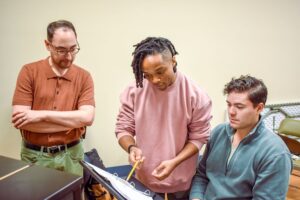
As creators advance the form, one can “look all the way backwards and forwards,” said The King of Harlem composer/lyricist David Gomez. “Our show is rooted in different hidden histories that we’re still figuring out—not just new forms, but how to reconcile old forms with current themes.” His co-writer, John-Michael Lyles, put it more succinctly: “The future is Black.”
Employing jazz, gospel, and Latine folk music, The King of Harlem follows Black prizefighter Mercy Wheatley, who falls in love with Spanish writer Federico García Lorca when the famed Spanish playwright registers for a summer session at Columbia University. “It’s an opportunity for audiences to look back and ask themselves, if I lived 100 years ago, how hard would I have fought for love?” Lyles said. “Lorca is as gay and messy as we are.”
Their presentation offered an abridged version of the show’s first act, starting with Wheatley’s triumph at a boxing match and ending with Wheatley opening himself up to love. It celebrates, and it yearns. Director Raja Feather Kelly’s intention, he said, was to create an experience where “everyone can experience craft, spectacle, and love.” Music director Paul Byssainthe Jr. called the show “unique and still relevant for this time.” Indeed: At the writers’ table where producers connected with the team to discuss future opportunities, I overhead one say, “This could go beyond the regional route.”
Lorca’s songs made The King of Harlem one of two NAMT shows with Spanish lyrics. The other was Roja, Jaime Lozano and Tommy Newman’s twist on Little Red Riding Hood, set during the Mexican revolution, with a trickster coyote helping Roja, who wants to bring her dead Papa back to life. Lozano and Newman started writing in 2022 and did further development at Rhinebeck Writers Retreat over the summer. At NAMT, they realized it could be a two-act with six actors and three new songs. First they expanded the show, then cut it back down to 45 minutes for the presentation.
Lozano’s wife, Florencia Cuenca, directed the reading, emphasizing traditions of oral storytelling and amplifying magic in her staging of this “act of resistance,” as Lozano put it. “Our collaboration reflects what this work should be. Unfortunately, we’re living in really challenging times. Just the fact that we’re putting on a show with Spanglish, with Mexican music, that is set on the border—it’s a political act.”
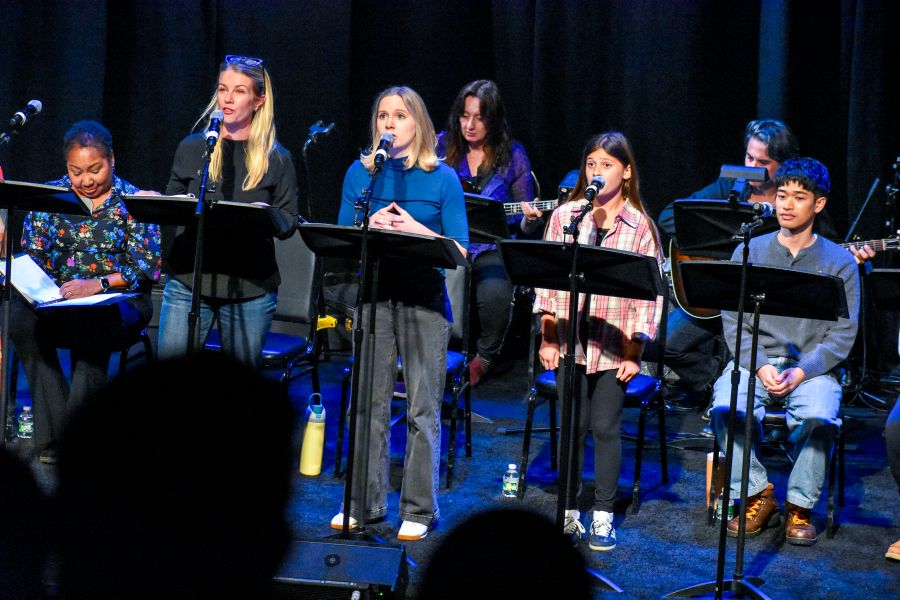
Roja was the first “small show that feels big” I noticed, particularly ones involving young people dealing with grief. As Alice Bliss lyricist Adam Gwon said, “Something musicals do incredibly well is tell the story of an intimate group of people against the backdrop of something larger.” (Full disclosure: I performed in a workshop production of Gwon’s musical The Boy Detective Fails at American University in 2020.) They allow writers to “lead with their heart,” said Alice Bliss book writer Karen Hartman.
Hartman, Gwon, and composer Jenny Giering’s musical is about a 15-year-old girl (Elizabeth Teeter) whose dad is deployed to the Iraq War in 2007. The story felt personal for Hartman, whose father served in Vietnam. She only learned while working on the show that the cause of his death was Agent Orange poisoning. “I now have a son who is 18, and I would never, until this year, have the fear that my son could be called up to serve,” Hartman said. “When I look at what’s going on in our country and I ask, ‘What could they really take from me that would really matter?’ it feels much closer to home.”
Gwon, incidentally, recently wrote a piece for the online publication The Hat about theatrical intimacy, which he defined as “not the intimacy of small rooms or quiet moments, necessarily, but an almost romantic intimacy—the shock of feeling seen, of a relationship that defies outside interpretation, of something like love…” When a work of art is “able to make someone feel seen, whole, and complete, it allows that person to view others as whole, complex, and complete,” Gwon said. “That is what we need right now in a world that is trying to flatten everyone so we are divided. We need to be whole and to see others as being whole.”

Innovative uses of music can amplify intimacy—and can be a strategy in unlocking it. That’s the case for the gaming-themed musical PARTICLE from composer Derek Gregor, playwright Autumn Reeser, and lyricist Selda Sahin, about a girl recruited for a professional e-gaming team and her twin, who becomes terminally sick (Claire Kwon and Nathan Levy, respectively). Sahin said the future of musical theatre is in digital storytelling, which is fitting, as the trio worked on their show over Zoom during the Covid-19 pandemic, and digital music revealed a key motif.
Gregor said he wanted to use electronic elements like “blippity blop stuff, video game aspects, shameless, sugary electropop.” His digital keyboard included a keyboard patch called “Particle,” which became so fundamental to the score that the writers leaned into the concept of particles and quantum entanglement. “That fit on top of the framework we already had and put the whole thing together,” Gregor said. “It’s all just because of this happy accident that this beautiful synth sound that’s got sparkles and cool artifacts is called Particle.”
The show ends up suggesting that the twins are “always connected the way particles are: Every time you touch one, the other one responds, no matter how far away they are,” aligning its electropop score thrillingly with the highs, lows, brightness, and nostalgia of a story that captures both the excitement of gaming and the grief of family loss.

On a lighter note, Love Is Dead, by L.A.-based writers Brett Ryback and Jeff Luppino-Esposito (known for their podcast musical In Strange Woods), is a “date-night spooky rom-com” three-hander with a heartbroken woman, a sexy ghost, and a third cast member who plays everyone else. The pair exudes Team StarKid energy in their wonderfully warped sense of humor, the way they “explode” the form with accessible new media platforms, and their vision for “small, independent, and absurd” new musical theatre.
It’s intentionally a small show, as the pair are conscious of rising costs, but they still want it to be “an epic night of theatre even if it’s only three people,” said Luppino-Esposito. “If you can take three people and make a raucous, special night of theatre, it means everyone is bringing their artistry to the fullest extent.” That also means getting audiences to use their imaginations. “They have to participate,” Ryback said. “They don’t just sit back. They lean in. It makes it a communal experience.”
On the other hand, going it alone is a common theme for playwrights, composers, and lyricists Kevin Wong and Jenn Grinels, who wrote the shows Soft Magical Tofu Boy(s) and Wakeman, respectively. Wong, the queer Chinese Canadian writer of the loosely autobiographical Tofu Boy(s), said he’s noticed “really exciting personal musical theatre where people are taking the best of what’s come before craft-wise, and using it to tell their stories, or stories they very deeply understand.” He cited A Strange Loop, Passing Strange, and Fun Home: fitting inspirations for a writer whose unconventional story structure jumps through periods of time and versions of himself. “In addition to the big blockbuster entertainment we’re always going to get, I love getting to see these specific stories.” (Full disclosure: I music-assisted Tofu Boy(s) during its 2024 development at the Eugene O’Neill Theater Center.)
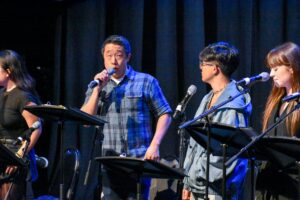
Tofu Boy(s) is about three Chinese Canadian brothers with magical powers. Adult lawyer Kenneth has “magic walls” to protect himself; teen Calvin employs “magic singing” as he discovers his love for ’90s R&B and pop; and child Di Di likes “drawing in the air.” Wong showed the first act of Tofu Boy(s) at NAMT, the same place where another Canadian musical, the popular Come From Away, had a crucial launching pad. Though he doesn’t often think of the show or himself as “very Canadian,” he conceded that it represents “our repression, our politeness, our whimsy, our weirdness.” As his plane landed in New York, he said, he “started to cry, because I suddenly realized: I am carrying with me every single Canadian writer, mentor, teacher, producer, who ever took a moment to teach me something.”
For Wakeman’s Jenn Grinels, NAMT was a homecoming to her first love, musical theatre, after a career as a singer-songwriter. Her folk Americana musical is inspired by a real-life soldier, Sarah Rosetta Wakeman (Ari Notartomaso, along with co-stars like Fun Home’s Beth Malone), who disguised herself as a man, enlisted in the Civil War, and wrote letters home. Grinels employs Saidiya Hartman’s concept of critical fabulation, or adding fiction and nonfiction together, incorporating Wakeman’s actual letters verbatim and interpreting her emotions in the music and original book scenes. This “critical analysis of what’s going on and being sensitive to themes you’re trying to share,” Grinels said, literally “gives voice” to an untold story, with music that “bypasses people’s intellect, expectations that they have, and preconceived notions.”
One of her goals is to explore the bridge between hypertheatricality and concert-style music. “There are certainly times when I want an actor to grab a microphone or mic stand or get handed an electric guitar and wail on it,” Grinels said. “Because there are no rules in theatre, really, that actually could happen. I’m excited to see how far it can go into concert-land.”
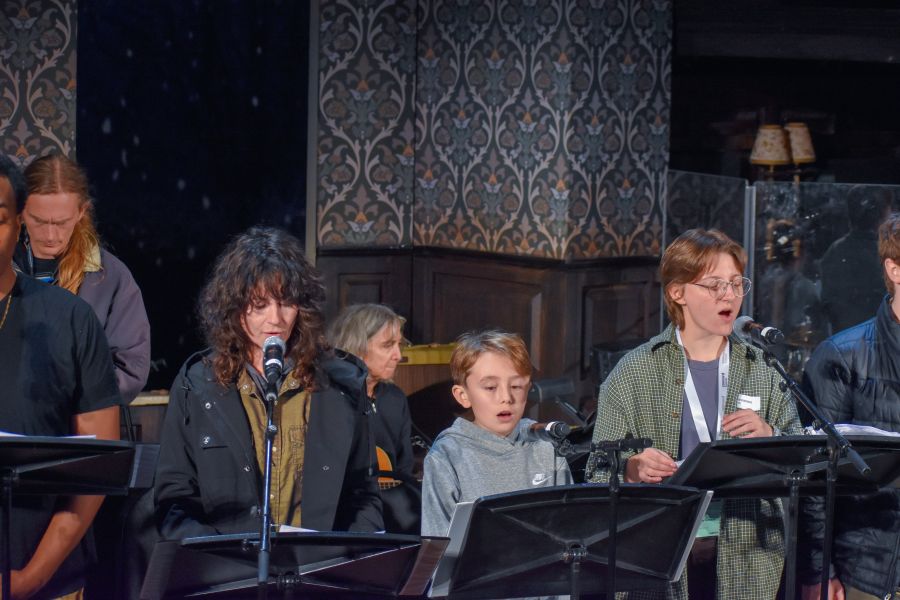
So, what is the future of musical theatre storytelling? I asked all the writers this (see more here). My own takeaways: The future always lies with the writers and the community they write with and for, and there are so many thrilling possibilities. The future could be found in the Asian American, Native Hawaiian, and Pacific Islander affinity corner after Tofu Boy(s), including a community gathering hosted by CAATA and East West Players. It could be heard in “I want” solos from emerging actors and stalwart stars in Finn, Alice Bliss, and PARTICLE. It showed up in the surprising randomness of Love Is Dead, and in the magic, physicalized in music and movement, of Tofu Boy(s) and Roja. It was there in waking up to a high note (Wakeman); in the musicalization of “Federiiiiiiico” García Lorca’s name that repeated three times before we heard the whole song in King of Harlem; in the practice of music directors using tracks with Ableton, playing keys, and bandleading all at once, as PARTICLE’s Andy Collopy did, or in the piano-conducting, guitar-conducting, and Spanglish song coaching of Roja’s Gonzalo Valencia-Peña.
It was about feeling a beat, a gasp, a tear, a call-and-response, a cry for help, a thrillingly confused “What?” It was embodied in what Val Vigoda called “collective effervescence,” the intense emotion felt in a group that unites for a shared purpose. It was about hearing young, diverse voices, both in the characters portrayed onstage and among the creative assistants working on these presentations whom I enjoyed meeting (and who may point the way to other musical theatre futures).
In all, it was “a safe space to confront difficult truths,” as new-works director Frankie Dailey put it. At the festival’s end, Dailey urged attendees to be “healers, gathering souls and bridging divides…but also guardians. Everything you’ve seen in the past two days is on the chopping block. We can’t leave the responsibility of storytelling to the writer alone.” This writer is happy to share that responsibility.
Daniella Ignacio, a writer, theatre artist, and musician based in Washington, D.C., is a contributing editor of this magazine.
This coverage was made possible by a travel grant from Critical Minded.