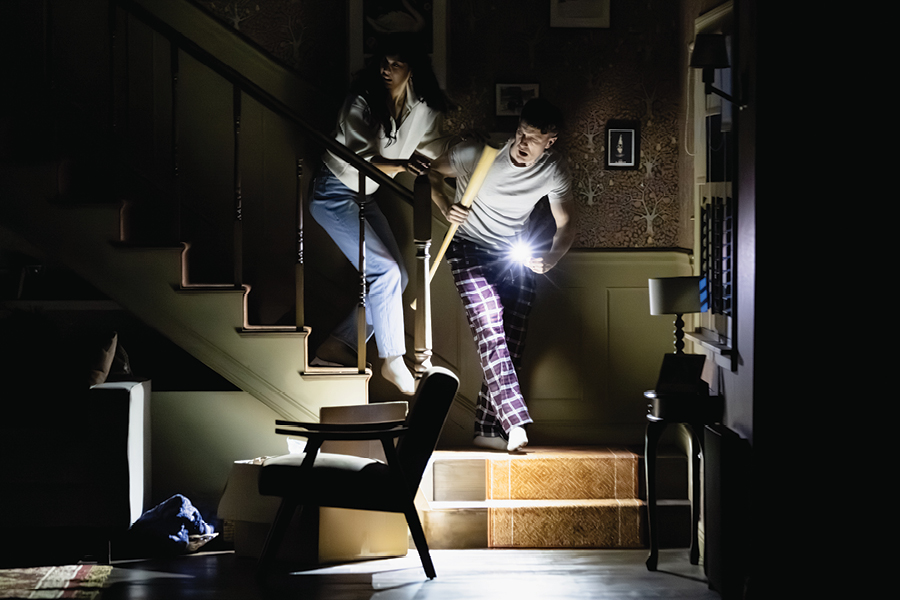
“Right away, we learned that you can only set someone on fire onstage for 17 seconds,” playwright Levi Holloway said. “I mean, who knew?”
No, Holloway isn’t a sadist or a pyromaniac. But as we talked in the upstairs lobby of Chicago Shakespeare Theater’s the Yard during a break from tech rehearsal for his new stage adaptation of the horror film franchise Paranormal Activity, which debuted last fall in Chicago and at Center Theatre Group’s Ahmanson Theatre in L.A., it was clear he’s had to spend a lot of time dreaming up nightmares.
Indeed, the show began with nightmares: That’s what Holloway and director Felix Barrett talked about as they walked along the Thames early in the creation process. They discussed what frightened them as children and lauded the work of Welsh author Arthur Machen, including The Great God Pan—which Stephen King, in a self-interview published on his website, called “one of the best horror stories ever written”—and The White People, a short story “written like a drug,” Holloway said. “It’s unnerving to read. We wanted to capture that.”
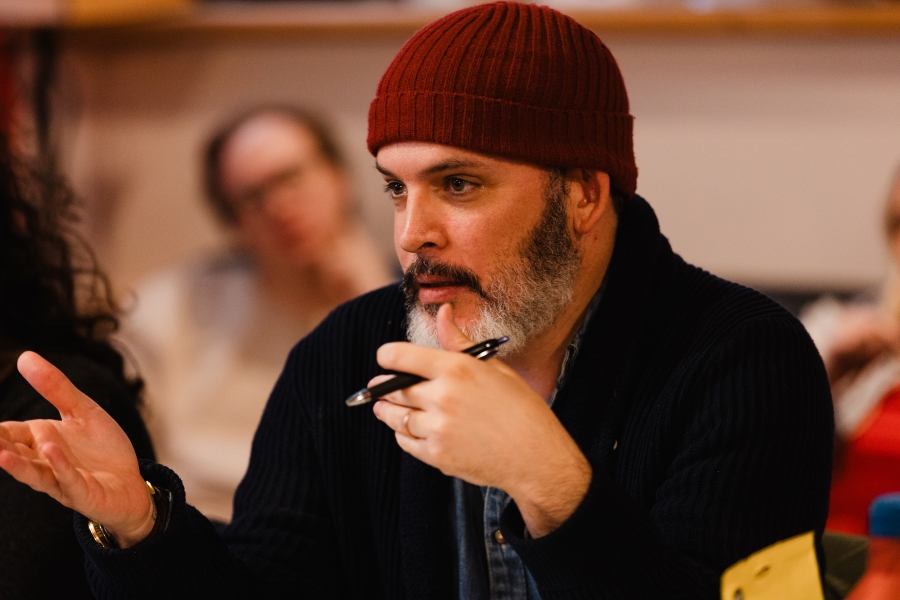
Barrett had been approached by producer Simon Friend about the possibility of a stage adaptation of the popular horror franchise Paranormal Activity. Barrett knew Holloway would be the perfect voice for the project, based on Holloway’s familiarity with the unnerving: His spooky thriller Grey House, about a couple taking shelter from a blizzard in a cabin in the mountains, made its way to Broadway from A Red Orchid Theatre in Chicago, where Holloway is an ensemble member. Barrett is no slouch in this department, as the artistic director of Punchdrunk, the company behind immersive works like Sleep No More. Once they met, they bonded over their shared passion for horror stories and thrillers.
“We just sort of adore each other and really share a language, not only in this specific genre, but also just in storytelling,” Holloway said. “We got along like a house on fire,” is how Barrett put it.
Their take on Paranormal Activity began with a developmental production at Leeds Playhouse in the northern U.K. in 2024, before moving to the U.S., first at Chicago Shakespeare Theater (Oct. 8-Nov. 2, 2025), then Center Theatre Group in Los Angeles (Nov. 13-Dec. 7, 2025). Next up: Shakespeare Theatre Company in Washington, D.C., Jan. 28-Feb. 7, and American Conservatory Theater in San Francisco, Feb. 19-March 15. In addition to this four-theatre co-production, the show opened in December on London’s West End, and has been extended at least through April 25. There’s hope, Barrett said, that the show will eventually add New York City to its itinerary.
After its release in 2007, the film Paranormal Activity, boasting a scant budget of $15,000 and a gross of more than $193 million worldwide, became a cornerstone of the “found footage” horror genre, alongside the likes of The Blair Witch Project, eschewing extreme blood and gore to focus on the eerie, voyeuristic experience of watching a young couple whose lives are gradually overtaken by supernatural forces. According to Holloway, Blumhouse Productions and Paramount Pictures, the film’s original producers, “didn’t hand down a heavy mandate” about what they expected from the stage show. “If there is a mandate, it’s almost tonal.”
The movies, at their found-footage core, offer viewers worlds that could very well be very real. That’s what Holloway set out to create for the stage: a hyper-realistic world where the supernatural seeps from the seams.
“That kicked off the conversation for us,” Holloway said. “What story do we want to tell, and how do we scare the shit out of people while we do it? But keeping it more about the human than the horror, which I think is really key.”
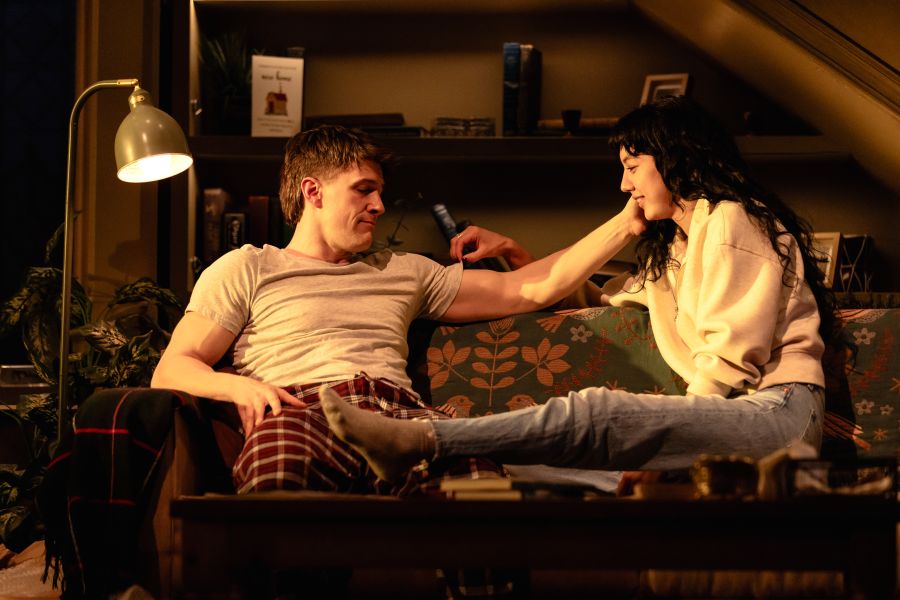
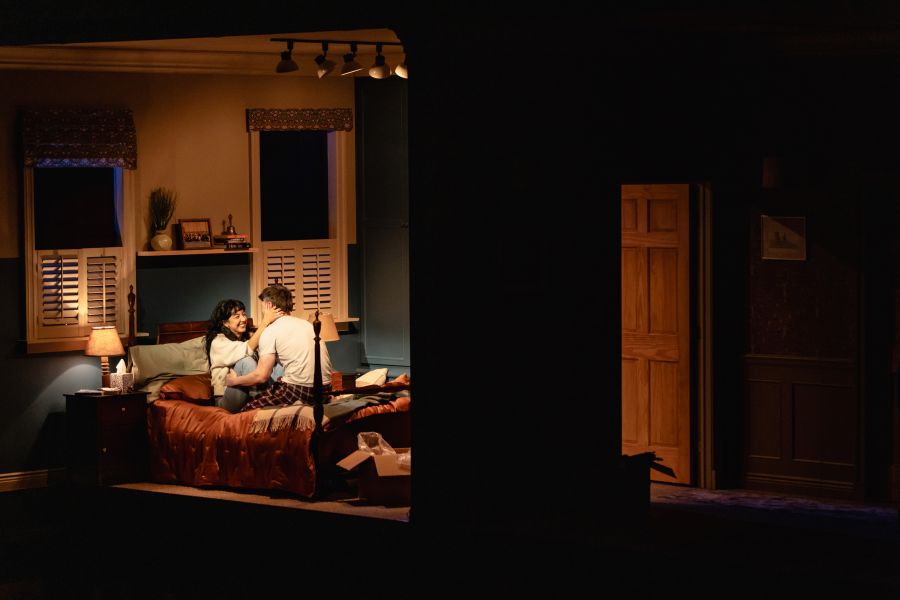
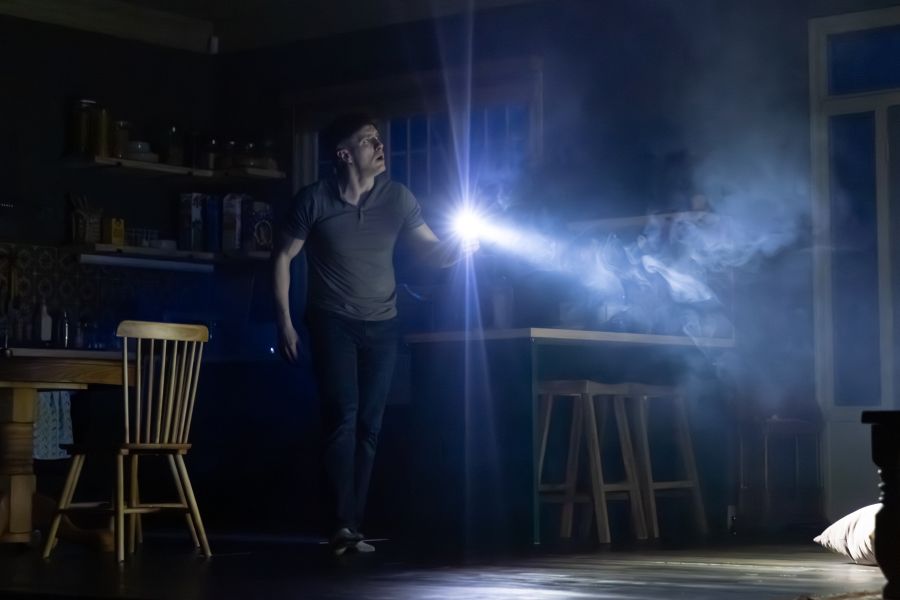
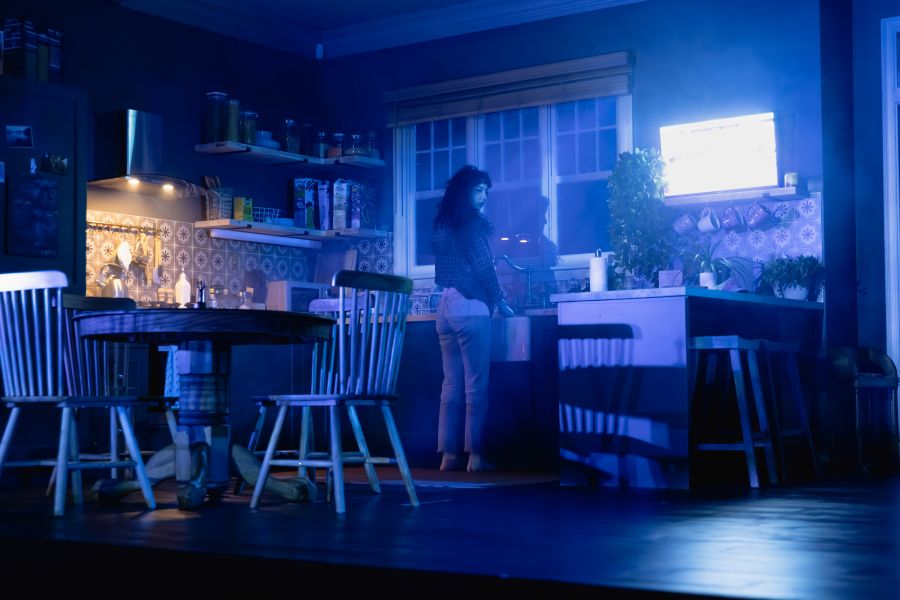
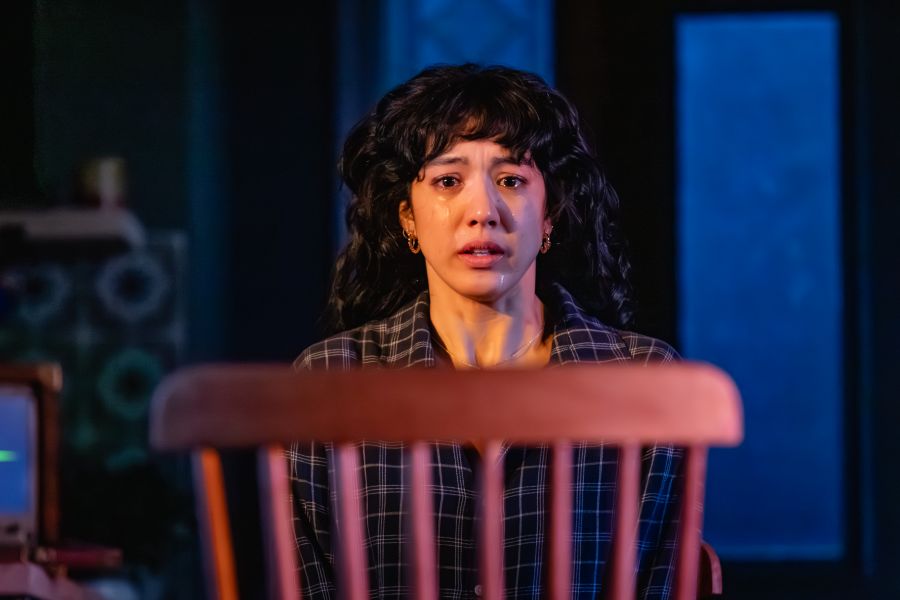
The new play is not an adaptation of the film’s plot but an original story about a young couple, James and Lou, who have moved from Chicago to London in the hopes of escaping the trauma of their pasts. The play features one setting, designed by Fly Davis: the couple’s new London home, where they quickly learn that no matter how far they run from the horrors that are tracking them, escape isn’t an option.
“In every horror movie, you ask the question, ‘Why don’t they run? Why don’t they get out?’” Holloway said. That’s why, he explained, even in Grey House, the setting is a cabin in a blizzard. “As a writer, you want to isolate your characters. But what if it’s not where they are, it’s who they are?”
Early on in the writing process, Holloway settled on a tagline for the show: “Places aren’t haunted, people are.”
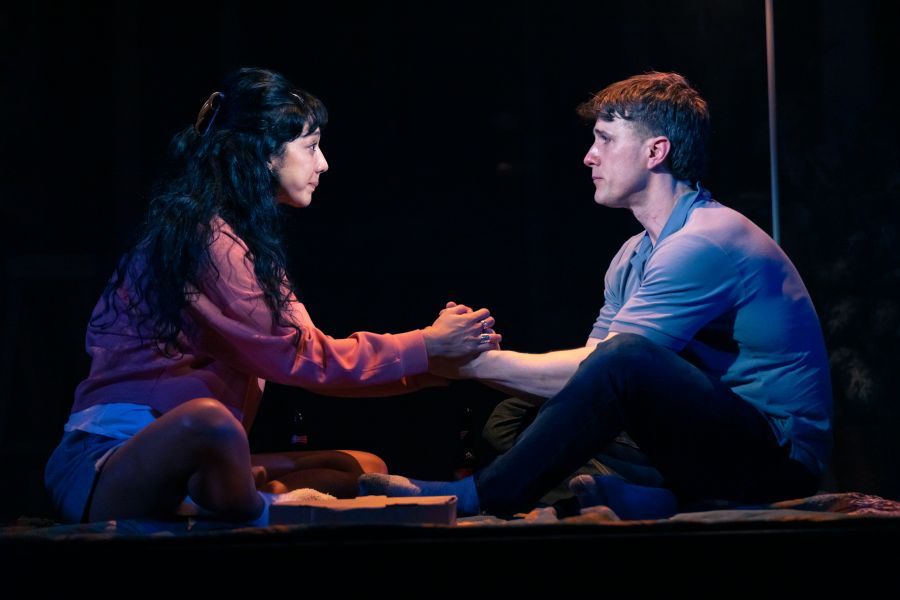
When crafting a show like this, you can’t start with the desire to unnerve the audience. You need to start with something more grounded. So Holloway and Barrett set out to create a realistic couple that audiences could see themselves in and contemplate what they would do if their partner became convinced that the supernatural was tormenting them—or, alternatively, if they refused to believe. After all, when the paranormal comes knocking, it’s not like you can call the police. It’s just you and your partner.
“Usually in horror, characters have to change in order to survive,” Holloway said, “which usually means that, because of the circumstances, who they really are is exposed. We, as an audience, subliminally ask ourselves: What would we do? Would we rise up or fall down?”
There’s community in that feeling, Holloway added, in the experience of sitting in the dark with strangers and pondering these questions together. But that can only be achieved if the story can pull its audience in with the feeling that the movies can elicit—the uneasy feeling, as Holloway put it, of wondering, “Should I be allowed to watch this? These raw, personal moments between a couple struggling with something? This intimate portrait of a marriage being rocked?”
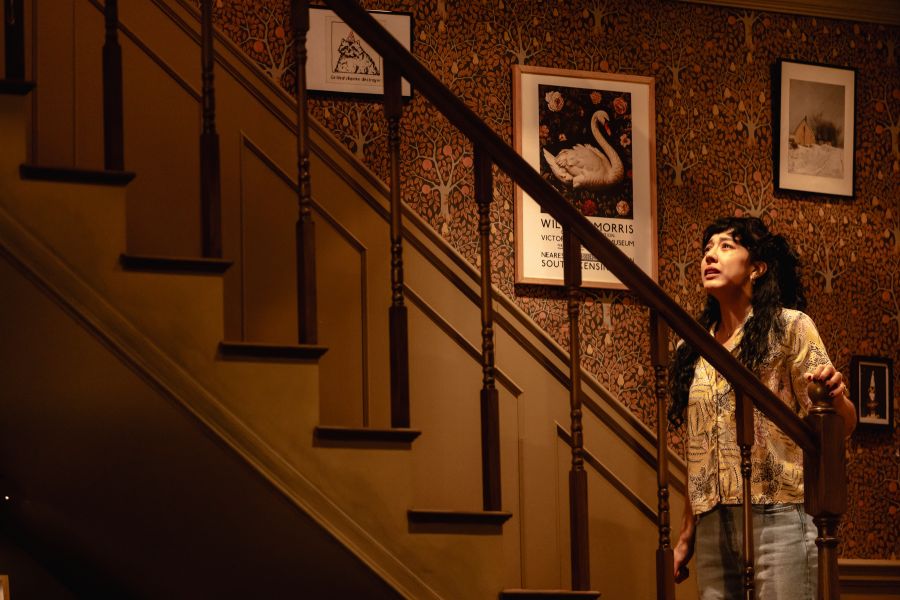
Part of that effort means making sure these realistic characters have an appropriately lifelike setting. Barrett and Holloway credit scenic designer Davis (who also designed the costumes) for that piece of the show’s naturalism. She created a towering two-story house cutaway: The bottom floor features a cozy kitchen that flows past a front door and into an inviting living room. Stairs rise behind the couch, leading to an upstairs bedroom and bathroom. Barrett and Holloway find plenty of moments to allow the show’s pace to slow and let the audience lean into a sense of place.
“We just tried to find out, what are these films doing? And they’re just saying, Hey, this is real.”
“We realized that restraint was a buzzword,” Barrett said via video call. “It’d be so easy to make it over the top. Sometimes these sort of horror things can be a bit arch or a bit exaggerated or stylized or get to a place of mania. We really wanted to follow the doctrine of the films, which is to do very little.” (Barrett told me he had a less commercial version of the show in mind, in which the husband, James, would cook pasta in real time onstage. “The negative space that would create would be so excruciating for an audience,” Barrett said. “I love creeping dread.”)
A commitment to realism is why, despite the movie franchise’s roots in faux-found footage, the team knew they wanted to avoid leaning on multimedia and video screens. That would be “a very predictable way through it,” Holloway said. “We just tried to find out, what are these films doing? And they’re just saying, Hey, this is real.”
When you’re aiming for realism in a show called Paranormal Activity, though, you have to be able to deliver a real-seeming onstage haunting, a task that is tougher when an audience can’t be fooled by the handheld, amateur-feeling nature of a found-footage film. Audiences for the film may feel like they’re peering through security videos, but audiences for the play bought tickets to sit in front of a proscenium and watch a talented cast: Cher Álvarez as Lou, Patrick Heusinger as her husband James, Shannon Cochran as James’s mother Carolanne, and Kate Fry as the medium Ethelien Cotgrave. Those audiences are going to be wondering, as Holloway put it, “Where’s the rug pull?” Holloway said. “Where’s the surprise? Which never, to us, means jump scare. Jump scares are easy. We’re not interested in easy.”
That’s not to say this Paranormal Activity doesn’t have some jump scares. There are certainly a few moments that catch you off guard in exactly the way you’d expect from a horror franchise, most of them thanks to sound designer Gareth Fry. But the eerie moments that linger—the ones audiences leave the theatre chattering away about—turn stagecraft into the impossible, leaving you to wonder if you can actually believe your eyes.
Enter illusions designer Chris Fisher. Fisher, who has been doing magic since he was 4, is a pro at stage scares and surprises, as you might expect from someone with Stranger Things: The First Shadow and Harry Potter and the Cursed Child on his Broadway résumé. The Paranormal Activity team knew they wanted Fisher involved as early in the process as possible.
“We knew that the illusions needed to come before the design,” Barrett recalled. Past mistakes had taught him, he said, not to create a beautiful design that would then need to be retrofitted to make illusions work. Fisher agreed, noting that audiences can usually recognize that something’s just been tacked onto an existing design.
“Illusion in theatre is about integration into the narrative, integration into the story,” Fisher said. “You don’t want it to feel like you’re wheeling a magic box on, like you’re preempting something that’s going to happen. Then you potentially dilute the moment. Magic is all about surprise, all about that moment of wonder.”
The team flagged a handful of major landmark moments in the script where they knew something uncanny or unexplainable needed to be realized. Then they held workshops where they tried to mount some of the show’s potential illusions to see how they felt, throwing anything they could think of at the wall to see what stuck. Holloway marveled that, no matter what challenge they gave Fisher, he’d always come back with options to make it happen.
“Unfortunately for him,” Holloway said, “once we knew he wasn’t going to say no, we were like, ‘All right, dude, how about this?’ Sometimes he’d laugh and be like, ‘You guys are nuts.’ But he’s the same kind of nuts.”
Fisher and his team built bare-bones structures to demonstrate potential options, and then they’d stress-test. Holloway loved to peek behind the curtain to see just how Fisher was pulling some of these illusions off, while Barrett preferred to keep some distance.
“I actively didn’t want to see the process,” Barrett said. “I can be an audience member, seeing where it worked. It was kind of incredible. There were a couple that I actually didn’t know how they were done until very later in the process when I had to.”
Said Holloway, “I’m the opposite. I have to know. I think it’s part of wanting to know how a nightmare works, you know? Or a gore effect. It’s like I want to know because it makes it safe.”
Plenty of ideas wound up on the cutting-room floor, including the aforementioned person-on-fire bit, a lengthy mesmerism act, and a trick “that would be so phenomenal that it’s almost worth building a whole show around it,” according to Barrett. (He couldn’t tell me what it was, of course—only that you’d need to retrofit an entire theatre to make it work.) Fisher mentioned a cut idea where a character would have been dragged up the stairs by their feet. “It was a great stunt,” Fisher said, but too much of the audience would be able to spot how it was done.
Sometimes the reality of what they could or couldn’t make work onstage would mean that suddenly a scene felt like it needed to take a left instead of a right, so Holloway would adjust. “The paranormal activity in the play is non-negotiable, right?” he reasoned. “So when we would identify the event that we knew must happen, sometimes we would shape the narrative around that event.”
From his audience perspective, Barrett said, he would ask himself what he would expect to happen next. Then they’d try to do the opposite.
“It was one of the most detailed processes I’ve been through,” Fisher said of the show’s development. “Right from the beginning, trying to nuance what it is that scares people, how to scare people, and what we can do within that.”
This also meant melding their aspirations with an ambitious design. Fly Davis, Gareth Fry, and lighting designer Anna Watson were brought in to help proof concepts and work closely with Fisher to ensure that any details needed to make the illusions work could be seamlessly integrated into the naturalistic designs.
“You could even probably get quite close up to that set, look around that set, and not see anything,” Fisher said of how they hid the mechanisms behind the show’s illusions, “but have it all actually be in clear sight as well.”
Bit by bit, the design came together around the illusions. Fisher joked that he often feels like he can be the bane of a production process: The set has to be exactly a certain way to pull off his illusions, ditto the lights and the direction. He was grateful in this case that the interdepartmental collaboration was harmonious.
“The show is designed within an inch of its life,” Holloway said, noting specifically Davis’s extraordinary scenic work. “She knows what every seat in every house can see. If you point to a seat, she can tell you what they see, what they don’t see.”
Davis’s set is massive—so massive that it’s easy to think it’s perhaps too big for what essentially boils down to a two-hander. But Barrett loves the empty space the set creates onstage—space an audience can fill with the anticipation of wondering what’s going to happen next in that corner or room (or, from the seat where I sat, a dingy-looking attic access hatch in the second floor ceiling).
“I can actually happily watch an empty space onstage for a long time,” Barrett said. Especially with a small cast that can’t be everywhere, Barrett said the trick is to give those empty spaces a charge. Lighting, especially rays streaming in from windows, became a key element, leaving spaces in almost darkness, like a house without the lights on. Said Barrett, “I’m a firm believer in giving the audience darkness so their imagination fills in the gaps.”
One place those gaps get filled is during that intermission or in post-show chatter, as audience members compare notes and theories with fellow patrons.
“We want that conversation, that sort of energy to pervade the audience, especially at the interval,” Holloway said. “We want people to be like, ‘Oh my God, how do they do it?’ But not even how—I want them to ask if we did it.”
That was my experience, both during intermission and after the opening night production at Chicago Shakes last October. As my counterparts were leaving, we excitedly exchanged notes on what our favorite surprises were, how we thought they pulled off some of the more delightful illusions, and whether or not some of us caught something the others missed. Even during the production, the audience flowed from nervous laughter following a genuine scare to borderline Theatre-for-Young-Audiences-esque audible warnings to the characters, as if we could open their eyes to the dangers lurking nearby.
To say the production was well received in Chicago is a mighty understatement. On Theatre in Chicago, which aggregates reviews from any and all outlets reviewing Chicago theatre and categorizes their views of a given show ranging from “not recommended” to “highly recommended,” Paranormal Activity received a “highly recommended” from all 17 reviews tracked.
“There were more screams, shouts, and screeches floating around the Yard Theatre than at a City Hall budget hearing,” quipped Chris Jones in the Chicago Tribune. The Chicago Sun-Times’s Steven Oxman said Barrett was the ideal director to find an alternative to found footage, writing, “You can tell Barrett has brought with him an understanding of what draws audiences in, what gets them comfortable so that they can then be discomfited, and what frightens them enough to do a butt bounce in their seats and emit a gasp or short scream, followed by a communal titter of relief and giggle of pleasure.”
And the Reader’s Catey Sullivan praised the effects, writing “they’re all deployed with hair-raising effectiveness. Sounds that should be benign—running water, a doorbell, a droning podcast—thicken the atmosphere with a miasma of suffocating terror that peaks with a final, spine-chilling scene that isn’t just the mother of all jump scares: It’s a shock that will burn an afterimage into your eyelids.”
That afterimage is what had me—as I left the bustle of Paranormal Activity’s Chicago opening night behind—recalling the tagline that Holloway had crafted so early on in the process: Places aren’t haunted, people are. True, there weren’t ghosts tormenting audience members when they set foot inside Navy Pier’s premier theatre. But the actors, script, design, direction, and certainly the illusions of Paranormal Activity left a lasting impression on me.
Indeed, there are some effects I’m disappointed I can’t spoil in this article that will stick with me for as long as I have a memory. (See the show, then let’s talk.) So no, that place isn’t haunted. But I sure am.
Jerald Raymond Pierce (he/him) is managing editor of American Theatre.
Support American Theatre: a just and thriving theatre ecology begins with information for all. Please join us in this mission by joining TCG, which entitles you to copies of our quarterly print magazine and helps support a long legacy of quality nonprofit arts journalism.