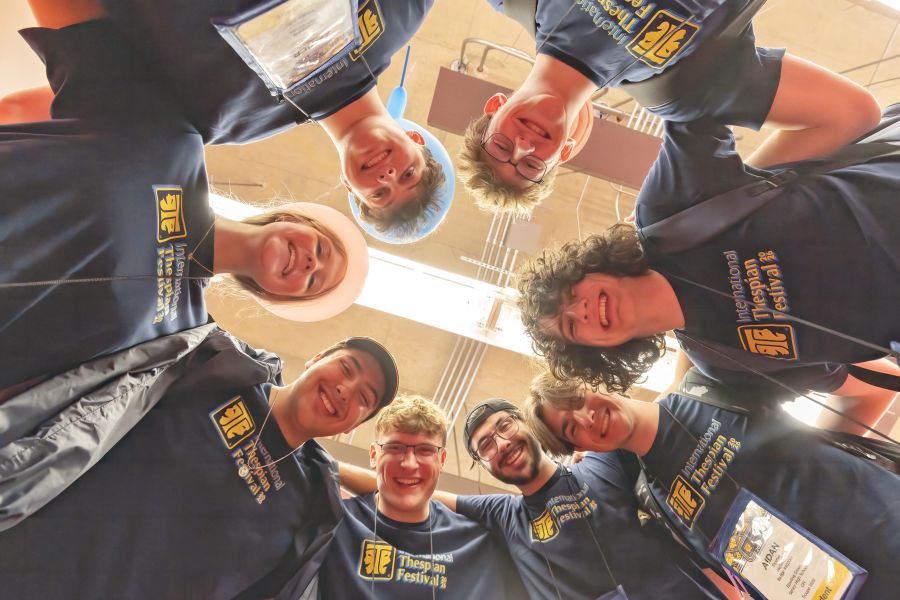
In June, I was invited to serve as a guest adjudicator at the International Thespian Festival (ITF) and the Thespian Awards, known as the Thespys. For a week, more than 5,000 high school and middle school theatre kids from around the country gathered on the campus of Indiana University in Bloomington to audition, sing, dance, learn, and laugh. For me, it felt like a full-circle moment, since I participated in one-act competitions and thespian conferences on the county and state level when I was in high school. There’s something so refreshing, endearing, and inspiring about the fact that theatre kids never change. Their imaginations are still wild, their sincerity is unmatched, and their ability to see into the hearts of people is far beyond their years.
 My time at ITF made me wonder how we could harness some of that energy and enthusiasm in professional theatremaking. I often say that the key word in theatre is play, and sometimes it feels like we miss the play (or lose the play) in the business of show. Below I offer five observations from my time at ITF that can perhaps lighten the room as we embark on the 2026-27 theatre season.
- Theatre doesn’t wait for you to be brave. Thespys alumnus Jaleel Battles Jr., who has played Young Ibrahim in Buena Vista Social Club on Broadway, gave the opening ceremony keynote, which also included a performance to mark the 20th anniversary of High School Musical. As someone who was in high school at the time the Disney blockbuster premiered, I felt aged but also heartened that pom-poms still reign supreme. In his keynote, Battles said, “Theatre isn’t just something that we do, it’s something that shapes who we become… Theatre doesn’t wait till we’re ready.” These words have been hanging in my mind ever since. My takeaway: Theatre is permission to experiment and be imperfect out loud in public. Let go of perfectionism and urgency and just go! Art-making is inherently brave, and the best thing we can do to invigorate it is to add our own bravery.
- Budget and imagination don’t have to be dependent upon one another. As an adjudicator, I sat through dozens of ensemble and duo scenes from canonical work, but no presentation felt stale. I saw a group of students form the mast of a ship with their bodies for a scene from Peter and the Starcatcher by Rick Elice, and another group mime so effectively that they dropped me into the barbershop scene in Keenan Scott II’s Thoughts of a Colored Man. Sometimes a glimpse at others’ access to money can leave us with a scarcity mentality. I think we often forget that the ability to create with whatever we have at hand is what got many of us into theatre in the first place. These kids don’t have time to get stuck on the fact that the school down the street has more resources. Yes, resource allocation matters, but imagination allocation matters more.
- There are many roles in theatre, and new ones can be invented. In the educational theatre space, the commitment and desire to include as many young people as possible in the process means that sometimes roles in a production that may not exist must be invented. Everybody can do something. Sometimes it’s to be a table or to help someone put on a shoe. Other times, the job is simply to read something back to someone. In the business of make-believe, we can make entry points for people that don’t exist on any organizational chart. There’s no shortage of need for people in theatre, and we must open up the fourth wall for a new generation to enter.
- Play between the scenes. Too often, professional theatremakers move from gig to gig, show to show, and never take time to celebrate a successful run, the launch of a cool program, or having pulled off the thing that seemed so impossible. We bulldoze our way through art-making, which is serving neither staff retention nor our hearts. Watching students laugh, play, and cheer each other on between scenes reminded me that when we do something really ambitious, we deserve to celebrate each other when we pull it off.
- The next generation is ready, but are we ready for them? I had the distinct pleasure of co-hosting the first annual ITF playwriting showcase and awards ceremony, which featured eight short plays penned by student playwrights. The plays covered a range of topics, from a chance meeting between two musicians contemplating ending it all to a young woman who remembers the Christmas celebrations of her poor immigrant family. Another play took an extraterrestrial journey, while another plopped us down right in the middle of adolescent angst. If these plays are any indication, the next generation is expanding what kinds of stories are told, and also how they’re told. These young writers aren’t just writing for prosceniums or thrusts. The plays felt as intimate as living room conversations and as expansive as the launch of Artemis II. My hope is that we don’t clip their wings by telling them that the wildest things they can imagine aren’t producible. Instead, much like their peers, I hope the professional theatre will set out to figure it out, because the theatre kids really are all right.
Kelundra Smith is TCG’s director of publishing. Her play The Wash received a 2024 National New Play Network Rolling World Premiere. Her articles have also been published in The New York Times, ESPN’s Andscape, Garden & Gun, Atlanta magazine, and elsewhere. More at kelundra.com.