Water has always been tempting subject matter for Black female writers, and for good reason. The element is teeming with metaphorical possibility, spiritual significance, and ancestral trauma. Water has carried our languages, foods, and, yes, bodies, to and from—a traversing that has resulted in both invention and destruction in equal measure.
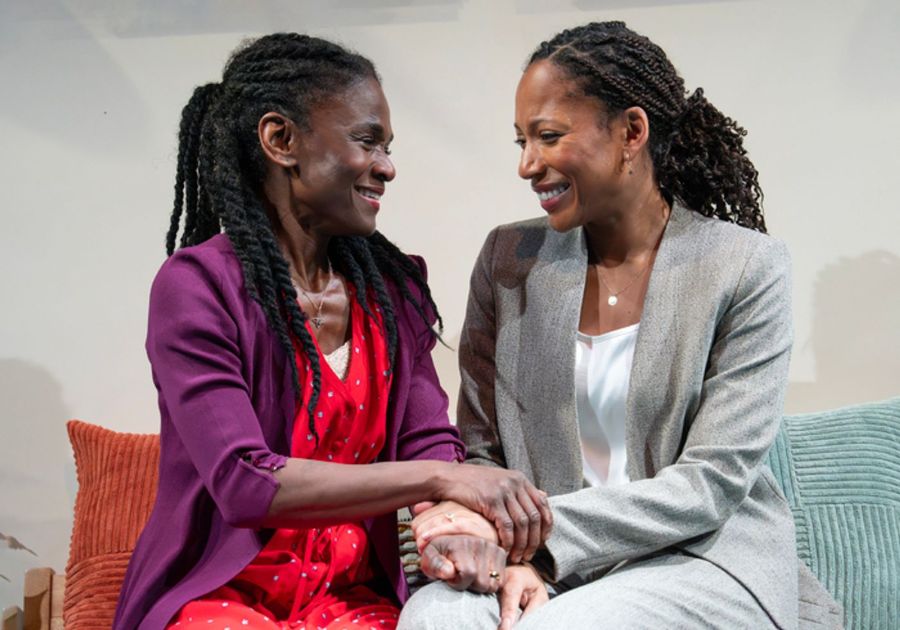
Enter The Waterfall, a new play by Haitian American playwright Phanésia Pharel, currently in its debut at Off-Broadway’s WP Theater, in a co-production with Thrown Stone Theatre Company, through March 1. “My mom has said, and I do believe this, that water carries power,” Pharel told me in discussing her play. “Water can transport you and water has the power to cleanse. I’ve never been to Haiti, but I have fantasized about being there while on beaches in Miami.” Water, it seems, even carries dreams.
In The Waterfall, Haiti-born matriarch Emiliene, or Emi, knows this truth intimately. She began seeing visions in the waterfall near her commune of Croix-des-Bouquets ever since she began seeking its cool shelter as a child. Emi’s Haitian American daughter, Bean, is more skeptical of the chute’s power, having never been to the island to see it herself. This is just one of several opposing perspectives the two women contend with throughout Pharel’s intimate, dialogue-driven drama.

The playwright first introduced the liquid element while workshopping a one-act draft at the University of California at San Diego’s Wagner New Play Festival. “I knew these two characters needed a special place,” Pharel explained. “With some gentle pulling, my mother told me about the waterfall that’s really in the town of Croix-des-Bouquets, where she’s from. My grandmother’s surname is Dessources,” she added. The word translates to English as “from the springs” or “from the source.”
Initially, the waterfall served a technical purpose for Pharel: It was an operating metaphor that helped track the emotional states of the characters and orient the audience to where they were in the story. With time, however, the symbolism took on a life of its own. In the New York production, directed by Taylor Reynolds, water runs deep, flowing directly into the characters’ other major conflict: Bean’s choice not to have a child.
“That’s a really challenging conversation,” Pharel said, between “a mother who gives her child everything, and the child who may want to go in a different direction. Then it becomes even deeper, right? It’s about more than just the children. It’s asking: What does it mean that I came to this country and I have a vision of what your life should be? What does it mean that you want to be different?’”
The back-and-forth dynamic of Emi and Bean’s points of view is the roux of this dramatic stew, thickening the play’s tension and amping up its stakes. Each character strains to get the other to understand her way of thinking. Pharel said she began percolating on motherhood after reading Israeli sociologist Orna Donath’s Regretting Motherhood. Based on interviews with 23 women from varying socioeconomic backgrounds and ages, the book shares real-life accounts of exactly what its pointed title implies: remorse.
One story in particular—about an Ethiopian mother in Israel who faced extreme racism, a trauma that only intensified when she became a parent—shifted something for Pharel. “I found that story fascinating, because my mom had the same experience, but her approach was the opposite,” she explained. “After coming to the U.S., my mom had the mindset of, ‘I’ve experienced racism. I’ve been looked down upon. I’m going to raise these excellent children as a response.’”
The notion that desiring motherhood isn’t inherent to womankind, or that mothering can be so disrupted by violent, external forces, remains taboo in many families. The subject can dredge up feelings of insecurity, shame, and guilt, especially between mothers and daughters. During a particularly fraught exchange in the play, Emi vulnerably questions whether her own shortcomings are responsible for Bean’s choice not to become a mother. Bean’s response reveals that it is quite the opposite:
That’s how I know
If I had a bad mother maybe I would be able to stomp out this feeling
And blame it on her
But I had the best mother
That’s how I know
I’m not supposed to be a mother.
Bean’s adamancy not to reproduce reverberates for audiences, especially as U.S. birthrates have fallen to record lows and politicians increasingly frame “depopulation” as an existential threat. Tellingly, Haiti remains one of the only countries in the Caribbean region facing the opposite problem. The country is grappling with overpopulation, producing children at a rate higher than is safe or sustainable given the nation’s resources. These demographic realities sketch out the contrasting dynamics between Emi and Bean—and the perspectives each has forged based on her homeland—even further.
“My mom is a really lovely person and gave so much to me in my childhood. If I were to tell my mom I don’t want to be a mom…” Pharel trailed off before laughing. “Essentially, I think the final boss of the child-free movement would be a Haitian mom.”
This toggling between the immigrant and U.S.-born experience is particularly interesting when focused on a country as maligned as Haiti. For all of its triumphs—Haiti was the first free Black republic, one that birthed independence movements many of us benefit from to this day—it is also a land that has been radically abused and misunderstood. At points in the play, both characters speak with heartbreaking bluntness about the mockery and cruelty they have faced in the United States because of where they come from, compounded by the shared ache of never returning to their motherland.
“Because this play is about a mother and daughter, that relationship is our primary focus,” said Reynolds, the play’s director. “But throughout the process, we’re learning and exploring how identifying as Haitian, as a Haitian immigrant, and as a Haitian American adult child is both different and similar, and how complex those experiences are.”
Reynolds does not share Haitian ancestry, but as a former producing artistic leader of the Harlem-based Movement Theatre Company, she is no stranger to cultural work and has consistently gotten her hands dirty in the garden of new plays, directing work by scribes like Aleshea Harris and Vivian Barnes.
“I prioritize stories of Black women first and foremost,” Reynolds said. And within that emphasis, she added that she particularly loves “working on plays from writers of Caribbean or West African descent—these cultures that I feel connected to, especially living in New York. Through meeting Phanésia, who is from Florida, and actor Natalie Paul, who is from Brooklyn, it’s been amazing to immerse myself in the Culture, capital C. And of course, they discovered yesterday that they know the same people.”
Pharel can confirm: “My dad’s from a close town to where Natalie’s family is from. Very close—like, 20 minutes away.”
“Honestly,” Reynolds added, “I’m surprised it took us until week two to figure it out.”
Brittani Samuel is a theatre critic and co-editor of 3Views. Her work has appeared in American Theatre magazine, Broadway News, and The New York Times. She was the inaugural recipient of ATCA’s Edward Medina Prize and the 23-24 recipient of the George Jean Nathan Award.