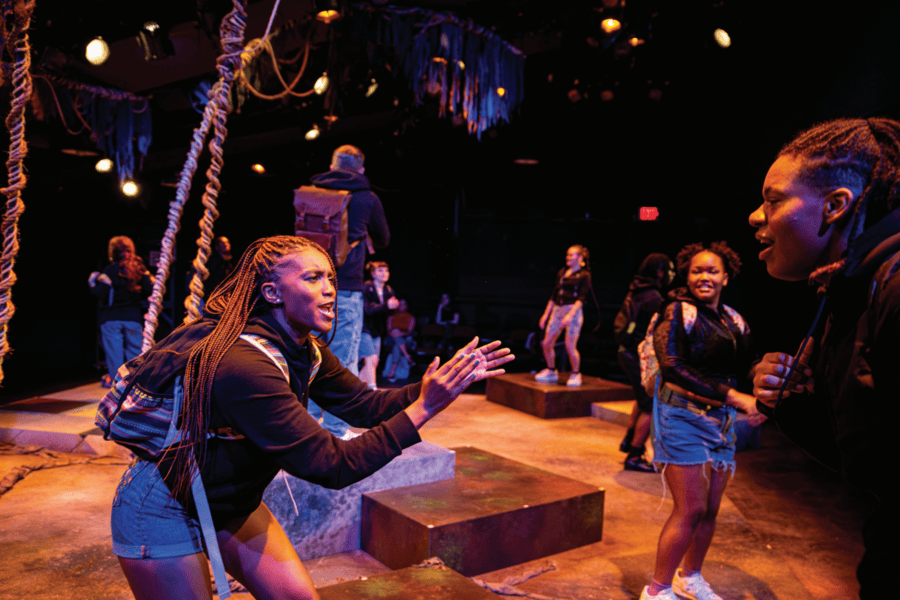
University theatre departments constitute a unique ecosystem within the larger world of American theatre: revolving doors of students with four years (or so) to get their educational needs met, and an (ideally) stable professor population with institutional memory and long-term goals in mind. These are the professors who usually make artistic decisions about season selection, since, like professional theatres everywhere, university theatre departments also program seasons of plays and musicals. Absent a board or an artistic director, how do they make these decisions? And what do their students think about their choices? To find out, we polled over a hundred theatre students at colleges and universities across the country via survey and phone interview.
Our first finding: Students are generally enthusiastic about their seasons (61 exclamation points in 113 survey responses!), and seem to understand the many factors that go into crafting them. The students we spoke with want to be challenged; they want seasons that feel well-rounded. More than anything, they want to participate.
The biggest and most common asks were for more musicals and more opportunities, period, especially for actors, whether that means more shows or bigger casts. A junior at Marietta College in Ohio thought, for instance, that the cult musical Ride the Cyclone was “a bit of a strange pick, especially with the growth our department saw this year.” Jacob Richmond and Brooke Maxwell’s dark musical, though acclaimed and beloved, has a cast size of seven. “Audition day was very competitive,” noted the student, “and although it’s going to be great at the box office, it definitely caused a lot of hard feelings for actors who weren’t cast this time around.” (Multiple students at different universities said they liked the show but weren’t crazy about the cast size.) An actor in the BFA program at Utah State in Logan lamented the downsizing of his department as a whole: “I wish it were a six-show season like we used to do for more variety of shows and more casting opportunities.”
A look at 50 somewhat randomly selected university seasons in 2015-16, and the same 50 in 2025-26, suggests that university season sizes are indeed shrinking. They’re down from a mean and a median of five productions per season in 2015 to a mean and a median of four productions this season—a significant shift for a freshman looking for their big break or a senior looking for a capstone experience. The percentage of musicals, however, has not shifted much: 18 percent of shows produced were musicals in 2015 compared to 20 percent this season (or about one musical per season for the average department, both 10 years ago and today).
In Cloud 9, Caryl Churchill wrote, “You can’t separate fucking and economics.” I often think this quote rings true of anything pleasurable in life, not the least any theatre season at any organization in the United States. I was raised on the anyone-can-do-anything rhetoric of Bill Clinton’s America, and as an undergraduate I had the outlook to match. But my current Gen Z students at the University of Nevada, Reno, were toddlers during the crash of 2008 and little kids during Occupy Wall Street, and they share a skepticism of capitalism and an understanding that all of us in the arts live together under its thumb. Suffice it to say, the students I spoke with may understand the reasons their seasons are shrinking, but respectfully expressed a desire for more. The BFA student at Utah State finished his ask for more shows by admitting, “I recognize that is not financially viable at the moment.”
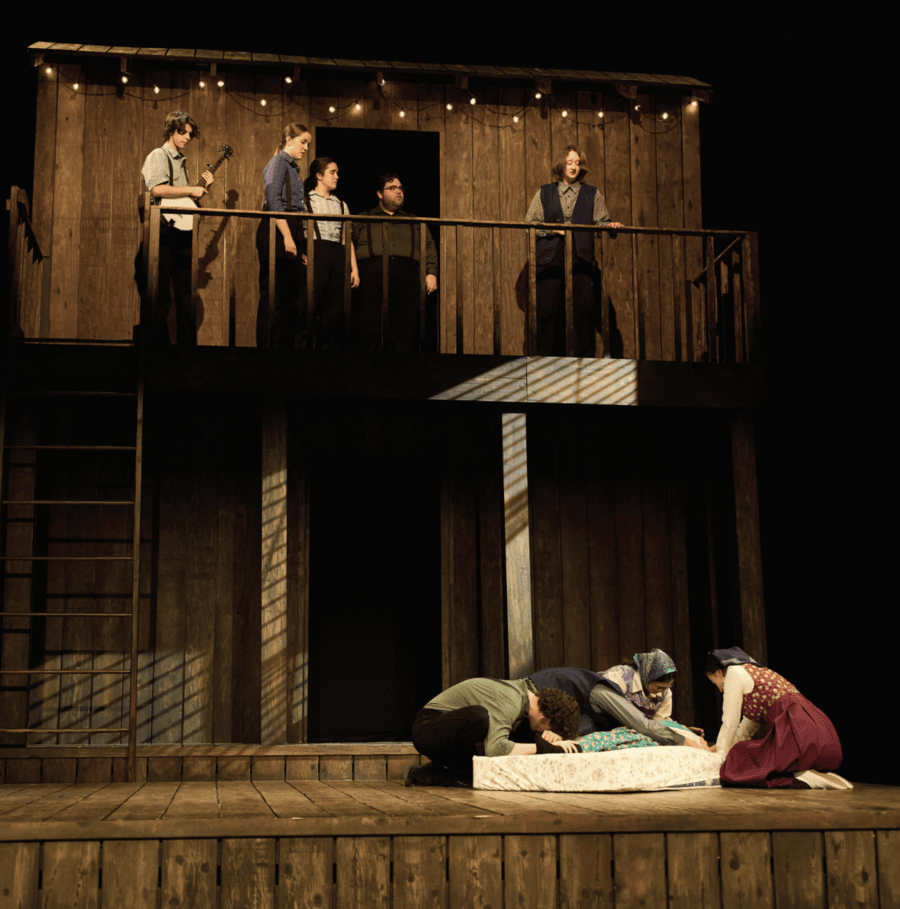
Looking at the titles typically produced across both 2015 and 2025 seasons, and comparing these to the annual data this magazine collects on regional theatres’ seasons, some key differences emerge between these two realms, and they persist year-to-year. While the average cast size has shrunk everywhere along with operating budgets, universities have a population they are contractually obligated to find roles for, so cast sizes haven’t shrunk nearly as drastically in the educational sphere. What the Constitution Means to Me, a sort-of solo show with two supporting roles, was the most produced straight play in regional theatres in 2024-25, but in universities a few Kate Hamill adaptations with ensemble casts, Little Women and Dracula (a feminist revenge fantasy, really.), split that honor. Likewise popular at surveyed universities in both years, likely due to the gender imbalance in many theatre programs, were large-cast shows with all or mostly all-female ensembles, including Jaclyn Backhaus’s Men on Boats, Sarah DeLappe’s The Wolves, and Clare Barron’s Dance Nation.
Another difference: Holiday hits are rarely seen on university stages. While A Christmas Carol is perennially the most produced play in U.S. regional theatres, there was only one on record for the 100 university seasons I combed through. University seasons also tend to push the envelope a bit more than their regional theatre counterparts. Waitress and Jersey Boys were the most produced musicals in regional theatre in 2024-25, while universities in 2025-26 are going quite a bit darker, favoring Sweeney Todd, Natasha, Pierre & the Great Comet of 1812, and Cabaret.
When schools do produce family-friendly shows that might serve as a cash cow on high school or regional stages, some students aren’t thrilled. Several students at Webster University’s conservatory program in St. Louis opined on the inclusion of The SpongeBob Musical in their current season. Said one, “I personally don’t think SpongeBob is a university-level show, and I wish our musicals felt more adult.” From another: “This year’s musical is a bit childish. I think it is a fun, family-friendly musical, but it just feels very high school/community theatre. We have done some stunning shows that have a bit more of a mature content and they always end up drawing more of an excitement from the students.”
A student at Butler University in Indianapolis, which also produced SpongeBob this year, said this reflected a larger trend.
“The four years that I have been here, many of the mainstages could be labeled as ‘children’s shows’ or aimed toward a younger audience,” the student said. “It’s frustrating as a student trying to go to college to really challenge myself and dig deeper into performing. You only get so many opportunities to perform in a mainstage, and it’s often disheartening when year after year it seems that we are doing the same kind of work in building a show made for children.”
A faculty member at Webster, Lauren Roth, pushed back on this reaction, saying, “I have seen students have some of the most (self-stated) meaningful creative experiences of their lives working on a TYA show that they were initially dreading.” Evelyn Weaver, a senior at Webster, said she experienced this shift herself: “I wasn’t thrilled originally that our mainstage musical option was SpongeBob, but now that I am working on costume designing it, my opinions have changed. The greater community here at Webster is super excited for it. Seeing that positive response has made me more excited to create.”
I recall how rankled I was when my graduate school announced that we would be doing A Christmas Carol the following season. Isn’t theatre in higher education supposed to offer young artists a wild and precious chance to stretch themselves—to focus on neglected classics and edgy new work—in that crucial period between what is considered “appropriate” for high school and what is considered financially viable in the real world? Never mind that my school had done Dürrenmatt’s The Visit and Tennessee Williams’s The Rose Tattoo the year prior—and that in the end I got to play Jacob Marley, which both stretched me as an actor and gave me an opportunity I’d be much less likely to get in the professional world. Still, from an artistic perspective, A Christmas Carol still just doesn’t sit right with me as a show a university should be doing.
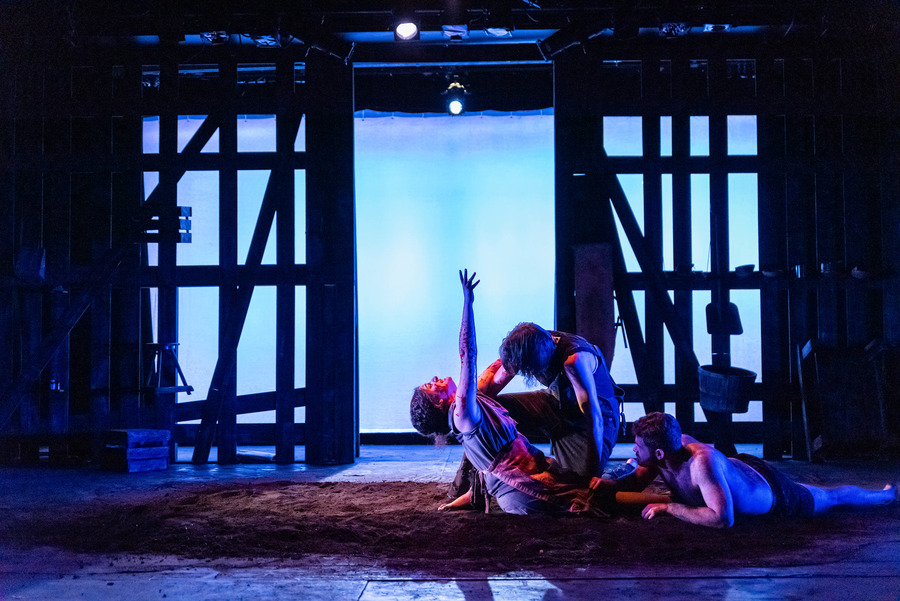
Recall the Caryl Churchill quote. Most colleges and universities I polled keep one eye on “getting butts in seats,” even as their other eye is trained on meeting pedagogical needs or on artistic excellence. Said a faculty member at a large public university in the Great Lakes, “We often wind up in a place where we must sell tickets in order to fund the season. The gap between quality content and marketable content can sometimes feel very wide.” Funding structures vary widely for theatre departments, with some not at all dependent on ticket sales to fund their seasons. But even those departments have felt a budget crunch of late. Whether the culprit is declining state and federal funding, decreased enrollments, or upper administrations giving arts departments the squeeze, every faculty member I spoke with is under some form of financial pressure that affects production choices. Jake Neighbors, a sound design professor at University of Connecticut in Storrs, said he’s seen “lower and lower budgets year-to-year. This affects our ability to afford the rights to shows and to pay for the materials and labor to construct the designs our students create, and it prevents us from bringing in overhires that would allow us to add more shows.”
At Northwestern College, a Christian school in Orange City, Iowa, lack of personnel is the main problem. “We lost one faculty member to budget cuts,” said Robert Hubbard, the department chair and a theatre history professor. “We fared better than most.”
Once again, students get it, but yearn for a middle path. “While I understand that there is also a business aspect to the theatre,” said a student at a midsize public university in the Mountain West, “I also think with that comes some disappointment in what shows we can or can’t do based on budgeting or the community and demographic we are performing for.”
Lest we forget we’re currently in the midst of a nationwide culture war, these social pressures affect theatre seasons too. This is playing out in its most extreme form at conservative Christian colleges. One faculty member at a Midwestern Baptist university said, “We have become much more restricted in what we are able to produce. We are expected to stay away from any ‘moral agenda,’ which can include anything from LGBTQIA+ issues to environmentalism, to anything that could be construed as ‘political.’”
Today’s version of cancel culture, imposed by presidential and university administrations alike, is trickling down to flagship institutions like my own. After reading about a Texas A&M faculty member who was fired for promoting “gender ideology” in a children’s literature course, I recently waffled on whether to mention the 2014 uprising in Ferguson, Missouri, in a director’s note for fear of losing my job. My chair assured me that I was safe—but only because I live in a state without anti-DEI laws on the books, and because our upper admin has (carefully) affirmed that it will resist Trump’s attempts to influence our classrooms.
Cultural pressures can go both ways, with some faculty members expressing confusion about how to best support students from marginalized communities in the 2020s, and some students expressing disappointment about which communities are represented in a given season. Said professor George Contini of the University of Georgia in Athens, “We got burned by the diversity issue. We had made a commitment to produce at least one playwright of color each season, but then the students of color were upset—they felt stigmatized because they would all be put in that show. So then we tried to focus on doing works with no color-consciousness and students were upset because we weren’t doing playwrights of color.”
A directing major at Webster summed up a student perspective I heard several times: “There also seems to be a larger desire to do shows about diverse characters and perspectives, but without the student capacity to present them. Oftentimes, conservatories will attempt to put on a show requiring Black actors that it only has just enough for. Meaning those actors are in that show, whether they want to be or not.”
This is a season selection problem that can’t be solved through season selection alone. The only answers here lie in recruitment and retention. Where those efforts fail or fall short, faculty and students are left to pin the blame on each other and on the season.
Some schools implement a form of direct student involvement in season selection, but this rarely seems to bear much fruit and instead yields frustration from students and faculty alike. A student from Butler said that the university “offers a meeting each semester for students to pitch their ideas for shows they would like to produce in the future. So they are attempting to hear our voices and opinions; however, it’s rare that a show we pitch is chosen as a mainstage.” At a large public university in the Upper Midwest, one student reported, “Students are ‘involved,’ but it doesn’t seem like faculty genuinely listen to their feedback/concerns. This season specifically, it seems like the shows are more geared towards faculty wants/needs/projects rather than student needs/interests.”
Of course, faculty members I spoke with have their own take on this. “Students usually submit titles of shows they want to ‘star’ in, without much thought,” said Steven Graver of Columbus State in Georgia. Gregory Mach of West Virginia Wesleyan said that student choices are often “stock community theatre shows. As time has gone on, we have found they have not read and seen plays that will educate them in a wide variety of genres and styles.”
Some of this was borne out in the survey; when students were asked to identify a title they’d like their school to produce, by far the most popular response was Hadestown, despite it currently running on Broadway and thus not being available for licensing. Hadestown notwithstanding, some suggestions warmed my heart. I had to look up the titles Thyestes and La Malasangre, never having heard of either. Another student suggested Beowulf. Imagine!
Beyond “more musicals” and “fewer family-friendly standards,” though, there was little agreement among students surveyed on which genres they would like to see their schools produce. “I would just prefer the opportunity to do theatre with more sociopolitical messaging,” said one directing, acting, and education student at Cornell College in Mt. Vernon, Iowa. Meanwhile a UC Santa Barbara student lamented that “three-quarters of plays are based on politics,” and a theatre BFA student at the same school said bluntly, “I hate it. Don’t get me wrong, the plays themselves are great. However, to have them all be political is just so draining.”
I suppose this is one reason students uniformly say they want well-rounded seasons: something for everyone.
It is worth noting that the word “excited” and its derivatives appeared 33 times in the students’ survey, but only twice when we polled professors. So it does seem that we may have as much to learn from them as they do from us.
My other takeaways, as a faculty member, from polling and talking to all these students? I’m going to indefinitely table that five-hander I wanted to do. I’m going to look for a way for students to be part of the selection process, and for their voices to actually mean something to that process, because there has to be a better way. And I’m never, ever going to let my school do SpongeBob.
And to the students: Please know that we’re doing our very best, even when we do program SpongeBob. As Lauren Roth from Webster put it, “It’s hard out here, kids!”
Rosie Brownlow-Calkin is an assistant professor of acting at the University of Nevada, Reno. When she’s not writing about the theatre economy for American Theatre, she’s directing her wonderful students in large-cast plays. She would like to thank two of them, senior theatre major Luis Galvez and junior musical theatre major Ora Harris, for their reporting help.