
Many nonprofit regional theatres are having some version of the same fight. On one side: artistic leadership hired, often with great fanfare, to champion new work, new voices, and audiences the institution has spent a decade saying it wants to reach. On the other: a board watching that same work lose five and six figures per production out of an operating budget that can’t absorb it.
Both sides are right, which is why the fight never ends. Staff hear every budget conversation as a referendum on whose stories matter. Boards hear every programming pitch as a request to bet the balance sheet on an audience nobody can prove exists. And the people caught in the middle—the leaders recruited specifically to make the change happen—absorb the damage season after season until they leave or are pushed out.
I believe the audience for new work is real. I’ve seen the data at enough organizations to be confident of that. What I’m not convinced of is that a legacy institution’s current audience—the subscriber file it actually has, not the one its strategic plan describes and wishes it had—is where that work can be tested fairly. And the boards, whatever else you want to say about them, are fiduciaries. When a strategy asks the existing revenue base to underwrite an unproven bet at full institutional scale, many will conclude the bet is too risky to make. That is the one job the law actually assigns them. The failure is structural: The institution offers its board no way to fund the ambition without violating the duty. Until someone builds a new structure, the argument just recycles, and everyone loses a little more each season.
But what if someone did build that structure? What if these two impulses and audiences could be uncoupled? The mission could be served, and the board could still do its fiduciary duty. If that sounds glib, let me show you what it might look like in practice.
A note on the case study that follows: I am not describing a single documented outcome, but a composite that draws on the experience of three organizations I’ve worked with: two regional theatres, one in New Jersey and one in Pennsylvania, and an opera company, also in Pennsylvania. Each agreed to let me use its experience on the condition that it not be named, and no single one of them did everything I describe. The audience data and the shape of the internal argument are drawn from all three. So you can read the fictional Riverbend Rep as a model grounded in real moves those three organizations made, not as a case that ran start to finish and produced the numbers in the tables. The figures are illustrative; the dynamics are not.
Letting the Data Lead
Riverbend Repertory Theatre is a LORT-scale regional theatre in a mid-sized American city, with a $14 million annual budget, a 620-seat mainstage, a 199-seat second stage, and a subscriber base that has declined from roughly 11,200 households in 2015 to 6,900 today. Like many of its peers, Riverbend spent the last decade expanding its commitment to new work (premieres, commissions, and developmental productions), a slate that correlated strongly with work created and performed by artists of color.
The programming drew critical praise, internal pride, and mounting friction. New productions on the mainstage consistently underperformed known titles at the box office, and the board grew uneasy about underwriting six-figure losses per production out of the operating budget. Artists and staff, meanwhile, interpreted every concern raised about the financial losses as evidence that the board did not value the choices made by the organization’s artistic leaders who were hired by that same governing body. The board expected a handful of local foundations who had been pushing for more diverse voices in theatre to step up and help underwrite these new works. What resulted instead was a game of chicken, in which the foundations refused to put up any money until the board made more visible commitments, including hitting certain diversity benchmarks among its board and senior staff (a move that would, of course, have required either letting people go simply by virtue of them not being diverse, or adding more bodies at additional cost to the institution to hit the target numbers).
Rather than litigate the question ideologically, Riverbend’s leadership did something unusual: They took 18 months of patron data seriously and let it complicate everyone’s assumptions.
The analysis covered three seasons (FY22 to FY24), 14 mainstage and second-stage productions, and about 96,000 unique ticketed households. Productions were coded as “known titles” (classics, established contemporary plays, familiar musicals) or “new work” (premieres and second productions).
Finding 1: Known titles won on volume, but not on new-audience acquisition, at least not significantly.
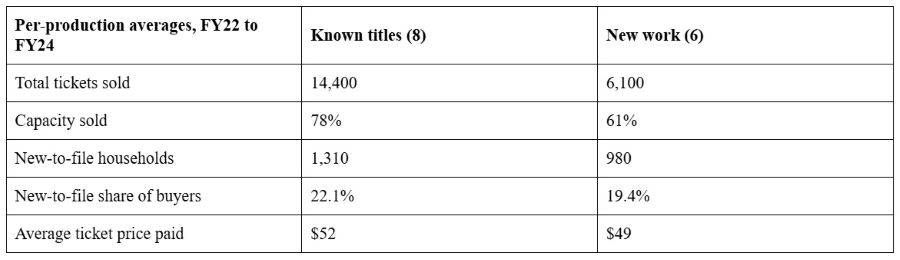
Known titles sold far more tickets overall. But as a share of buyers, the new-audience rate for new work (19.4 percent) trailed known titles (22.1 percent) by a margin that did not reach statistical significance. The new work was pulling in first-time attendees at essentially the same rate. The widespread internal belief that “new plays don’t bring anybody new in” was not supported by the data.
Finding 2: The two audiences were coming from different places, and this difference was unambiguous.
When the analytics team mapped new-to-file households by ZIP code, the picture split sharply, despite average prices paid being within a few dollars of each other.
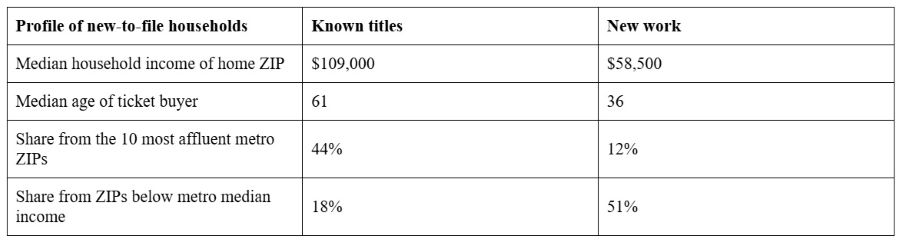
The new work wasn’t failing to build audiences. It was building a different audience: younger, from less affluent neighborhoods, with no subscription history, and, predictably, thinner near-term revenue per household. The known titles were replenishing the traditional patron pipeline: older, wealthier, and demographically similar to the existing subscriber base.
The economics on the ground were real on both sides. New-work productions lost an average of $310,000 each against their direct costs. But they were also the only programming reaching the neighborhoods every strategic plan claimed to care about.
Decide What Is Actually Mission
Before I get to the structure, there is a step most organizations skip, and skipping it is why the fight never ends. We keep calling everything “mission.”
A recent piece in this magazine quoted Jill Rafson to the effect that a nonprofit should be losing money on new work if it is doing it right. As a values statement I agree with that: Programs that are core to the mission should be subsidized; that is what contributed revenue is for. But the statement only works if you have actually decided which programs are core, and at what scale the balance sheet can carry them. Roundabout Theatre Company, with its brand equity, its balance sheet, and its Midtown NYC address, can say it owes the ecosystem a certain amount of money lost on a good cause without getting any CFO hackles up, or its donors’. A 350-seat theater in a Philadelphia suburb, or a company in a New Jersey river town, cannot say the same sentence and mean the same thing. Same values, different balance sheet.
So the first thing I do with a client is put every program on a two-by-two graph: One axis is mission relevance, scored honestly, not by the department that runs the program. The other is financial contribution after direct costs. Four boxes fall out. High mission and self-funding is the core, and you protect it. Low mission and high contribution is the engine (the holiday show, the rental business, the familiar musical), and you keep it precisely because it pays for the core. Low mission and losing money is sludge, and it gets cut, however long it has been on the schedule. That leaves the fourth box: high mission, losing money, and unproven. This is where new work usually sits, and it is the only box the two-by-two cannot settle on its own.
Everything in the first three boxes has a clear answer. The fourth box does not, because the answer depends on a fact nobody in the room knows yet: whether the audience for this work can sustain it at some scale. Boards and artistic leaders argue about the fourth box as if it were a question of values. It is a question of evidence, and evidence is what the proposed structure below is designed to produce.


Spin It Off, Capitalize It, and Give It a Real Test
In this model, the board concludes that the mainstage (with its fixed costs, union contracts, and current subscriber expectations) is the wrong vessel for testing whether this emerging audience can sustain a business. Rather than shrink the new-works program or keep subsidizing it resentfully, Riverbend spins it off.
The structure works like this: The board collectively contributes a $500,000 seed grant from board giving and a small draw on unrestricted reserves, then approaches a national foundation whose stated priorities center on exactly this kind of audience development and asks it to match dollar for dollar. The foundation says yes because the board has put its own skin in the game first; in my experience that is the single most persuasive thing a board can do with a funder. The new entity—let’s call it The Forge—launches with $1 million in seed capital and a three-year runway.
Key terms of the spin-off: The Forge operates under Riverbend’s fiscal sponsorship rather than as a fully independent entity, so it can raise philanthropic dollars in its own name and sell its own tickets without standing up a separate 501(c)(3) on day one. (This is the piece one of the three organizations actually did, and it is the piece I would argue is non-negotiable.) The $1 million is a reserve, not a subsidy. The test is explicit: If The Forge can cover the direct costs of its productions through its own ticket sales and its own fundraising, the seed capital remains intact in reserves at the end of year three, which is proof of a viable standalone model.
Every dollar of seed money spent on operating losses is a dollar of evidence against viability. Freed from mainstage overhead, The Forge produces in a leased 150-seat flexible space and community venues in the ZIP codes its audience actually lives in, at a fraction of mainstage production costs. And the success criteria are clean: Break even on operations for three years, or wind down with the remaining reserves returned.
What a Passing Test Looks Like
Here is the pro forma I would put in front of a board. The numbers are illustrative; the shape is what matters.
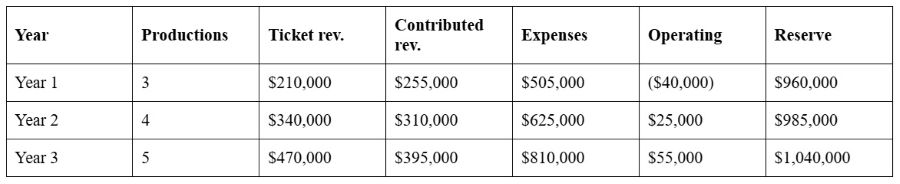
In this version, The Forge dips into reserves modestly in year one, then runs small surpluses in years two and three as its audience compounds. New-to-file households grow from 1,900 in year one to 4,700 in year three, with a retention rate (34 percent returning within 12 months) that exceeds the parent’s own single-ticket-buyer retention. By the end of the test period, The Forge holds slightly more than its original $1 million, has a donor base largely distinct from Riverbend’s (including, in the version I like to imagine, multiyear grants from the same local foundations that had played chicken with the parent), and has demonstrated the thing that can never be demonstrated from inside the mainstage budget: that this audience, served at the right scale and in the right rooms, can sustain the work.
A failing test is just as useful, and I want to say that out loud because boards rarely hear it. If The Forge burns through $600,000 of the reserve in three years, the organization has learned, at a capped and pre-agreed cost, that the audience is not there at that scale. The new-works program can then be sized as a subsidized core activity the balance sheet can actually carry, or wound down, and either way the annual referendum on whose stories matter ends. A test is worth running because it produces an answer either way.
Why It Works
Three design choices matter more than any of the numbers.
First, the disagreement is converted into a testable hypothesis. “This work matters” and “This work loses money” are both true and endlessly arguable inside one organization. But “Can this work cover its costs at the right scale within three years?” is a question with an answer.
Second, the fiduciaries fulfill their duty without killing the work. The board is legitimately obligated not to bet the institution’s balance sheet on an unproven audience. Spinning the program off with defined, capped capital lets them honor that duty while funding the experiment generously, and the foundation match means that half the risk capital comes from a funder whose mission is precisely this risk.
Third, success creates leverage instead of dependence. A new-works program that survives on internal subsidy negotiates from weakness forever. A spun-off company that has proven its model, with its own audience, its own donors, and an intact reserve, negotiates from strength. In the model, by year four the conversation inverts: The parent institution is exploring how to bring The Forge’s programming back onto its stages, on terms The Forge can now set.
What those terms might look like is worth spelling out, because this is where the inside argument gets won. The Forge chooses to remain fiscally sponsored by Riverbend for another five years, but from a position of strength, it negotiates a new agreement. It keeps the reserve it preserved and grew. It reduces the fiscal sponsorship fee it pays the parent from 6 percent to 3 percent. And Riverbend agrees to schedule one Forge production on Riverbend’s large stage each season as part of the mainstage subscription series, with a twist I particularly like: If the production beats budget on a net income basis, Riverbend sends all of the excess to The Forge, and The Forge is not obligated to cover a loss. That one clause gives the parent every incentive to co-market the production aggressively instead of relying on The Forge’s own channels to sell it.
The lesson here is not that legacy institutions should offload the work they find risky. It is that the fastest way to end an unwinnable internal argument about whose audience counts is to give the contested work real capital, real autonomy, and a real test. Theatre is the setting here, but every sector has its Riverbend: the college whose access programs lose money the trustees can’t justify, the hospital whose community clinics strain the margin the board is sworn to protect, the agency whose pilot serves people no funder is yet paying for.
Wherever a board must choose between the mission and the balance sheet, the way out is the same. Decide first what is actually core. Then give the contested work real capital, real autonomy, and a real test. And then believe the results.
Larry Bomback is a turnaround specialist and the founder and CEO of Strategic Nonprofit Finance. His writing on nonprofit finance and leadership has appeared in Forbes, Inside Higher Ed, Blue Avocado, The Chronicle of Philanthropy, The Chronicle of Higher Education, and Opera America, and his book The Turnaround Trap: Why Colleges and Nonprofits Fail, How to Save Them, and What Their Collapse Costs Us All is forthcoming.