During my time at the MFA program that brought me to this country, professors told us to leave school with one or two “calling card” scripts that we would be confident sending out. For me, that was my play Machine Learning: It got me into The Lark’s 2018 Playwrights Week, then into festivals in New Jersey, Vermont, Texas, and San Diego, and it even won me a Princess Grace Award in 2022. But I only really saw it come to life with actors, design, and paying audiences seven years into its life, when it premiered at Central Square Theatre in Cambridge, Massachusetts, in January 2024.
By then, its AI themes—which had originally been so forward-thinking as to almost be science fiction—were commented on by the (middling) Boston Globe review as “timely.” But it wasn’t just the subject matter: The play’s heart also felt less urgent to me. In 2016, when I wrote the first draft, I was barely a year into moving to the U.S. and struggling to adjust, as reflected by the immigrant family centered in the story. By 2024, my thinking (and my feelings) around the issue had evolved so much that, while the play that premiered had my name on it, I no longer felt like its author.
My journey is not unique: Opportunities for playwrights to see their work fully produced right away—or at least close to the moment of inspiration—have largely disappeared. This was not always the case. In the late 2000s, several major theatre companies around the country created programs that brought freshly written plays by new, untested playwrights to the stage, usually in a black box somewhere in the building—an institutional version of the stereotypical downtown pizza parlor basement.
This in itself was not unique, of course; many nonprofits are committed to new work and early-career playwrights as part of their mission (though not always to full productions of their plays). What set these various programs apart was the level of attention the productions got, thanks to the brand name of their originating theatres, which often set playwrights on the path to critical and economic success. How these programs came together, how they worked, and what happened to them can tell us a lot about the changes our field is currently undergoing—and what might be next.
Going Into the Basement
It was fall 2005, and the Roundabout Theatre Company—known mostly for big productions of classic plays—was beginning to think about new work. The company’s then artistic director Todd Haimes was building up buzz for Roundabout’s flashy new Off-Broadway space, the Harold and Miriam Steinberg Center, and Jill Rafson—who started at the company as an intern before becoming Haimes’s assistant—told me that part of her job was “sending out letters (actual, hard letters) to all of the big agencies saying, ‘Hi, Roundabout does new work now. Would you like to submit some?’”
The adventure stumbled out of the gate. The first play, by recent Juilliard graduate Noah Haidle, focused on a lonely 4-year-old interacting with imaginary friends and working through issues involving sexuality, drug abuse, and brutality. Reviews were not kind, and an article about it on Playbill, “New Comedy Mr. Marmalade Causes Stir—and Controversy—in Off-Broadway Debut,” opened with a quote from Haidle himself: “I was in a row last night where three people left and they had to get around me.”
The fiasco put Haimes off the idea of new work, though he was already falling in love with another unproduced script—this one by a Brown undergrad, Stephen Karam. Speech and Debate, about a predatory high school drama teacher and the students who band together to expose him, had been brought to Haimes by the producing duo Robyn Goodman and Josh Fielder, who were consulting for the company. Goodman told me that Haimes loved Speech and Debate, but that he felt he had done Mr. Marmalade “a disservice” by putting it in the Steinberg Center’s 413-seat Laura Pels Theatre. As Rafson put it, Haimes felt that “instead of offering Noah this amazing opportunity, he’d set him back.” What, then, might he do for Karam’s “charming” script?
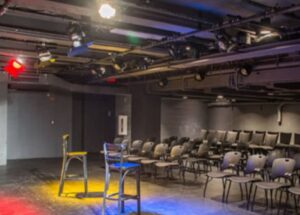
Violating a cardinal rule of horror movies, the intrepid foursome—Haimes, Rafson, Goodman, and Fielder—went down to the Steinberg Center’s basement. As Rafson recalls, it had been a functioning performance space back when the building housed the American Place Theatre. But it was leaky, with a low ceiling and spare sitting room—a far cry from Roundabout’s accustomed polish. Still, it might offer new plays a safer space to debut. “Form and function sort of came together,” said Rafson: Roundabout Underground would not be just a space, but a program. “All of us together figured out the mission statement: debuts of works by playwrights who’ve never had a production in New York,” Goodman told me, before amending (perhaps with Marmalade in mind), “or more importantly—who had never been reviewed in New York.”
Karam did not fit that bill perfectly. An English major without an MFA, he had experienced a burst of post-college success with a play he’d co-written with PJ Paparelli, columbinus, which unexpectedly transferred from its world premiere at Maryland’s Round House Theatre to New York Theatre Workshop (after the latter decided to pull the controversial My Name Is Rachel Corrie from their 2005-06 season). The transfer got Karam an agent, who started shopping Speech and Debate around, but the play did not garner much interest; a reading for Second Stage’s Uptown Series failed to turn into a production. Karam told me that, at the time, he would not have referred to his playwriting practice as “a career” at all. “I was working 30 hours a week at a law firm; my rent was $500 a month in a three-bedroom in Queens,” he recalled. “I knew where my passion was, but I was settling in for the reality that there’s just a lot of talented playwrights out there and not a lot of spaces.” Then a call came, saying that Haimes wanted it to be the first in the new Underground space. “To be honest,” Karam told me, “it was both an honor—and really exciting—to open up a space…and I was nervous that if it failed, I would also feel responsible” for the space’s fate.
Karam didn’t necessarily love the idea of being Roundabout Underground’s “poster boy,” but under the direction of Jason Moore (Avenue Q), the production opened in October 2007 to great success: The Times gave it a Critic’s Pick, and it extended several times, running through the end of February. Tickets were $20 (another feature of the Underground program), so the play was not expected to make money, but that was not a problem, according to Rafson: “If you’re a nonprofit on the size and scale of Roundabout, you almost owe it to the ecosystem of theatre to be losing your money on a good cause.” That good cause, as the organization’s current director of artistic producing, Nicole Tingir MacMillan, put it to me, was to “continue to replenish the canon and make the new plays of today, so that they can be revived 100 years from now.” To do that, a single production was not enough, as Fielder told me: “At the same time we were gonna put up [an Underground production], we’re gonna commission [the playwright’s] next work. There’s always the worry, ‘Is this my one shot?’ You already know your second work’s commissioned.”
In Karam’s case, that commission ended up being the Sons of the Prophet, with which he graduated from the basement onto the Pels for its 2011 premiere—and which was both a big box-office hit and a Pulitzer Prize finalist. It was his Cinderella experience, Karam says, but not necessarily the end of the struggle: He finally quit the law firm job while Sons of the Prophet was playing, but only because he had run out of vacation days to work on the production. It wouldn’t be until his third collaboration with Roundabout—the Pulitzer finalist and Tony winner The Humans, which also began at the Pels before transferring to a commercial run on Broadway—that he said he started earning a living as a playwright. It would be fair to say that he did become the poster boy for the program.
The second Underground playwright, Steven Levenson, followed in Karam’s footsteps. At the time that Roundabout took interest in his play The Language of Trees, about the family of an American translator working in a war zone, Levenson was scraping by, working a literary assistant job at Playwrights Horizons (a longtime new-play bastion, it should be noted). He found the production experience of Trees challenging in the best of ways. “I had done so many readings, even at that point in my career, that I think I wrote with them in mind,” Levenson said. “Then you suddenly get into production, and all those beautiful stage directions I wrote—now I had a lighting designer and a set designer going, ‘Well, what do you mean by that? What do you want us to do?’”
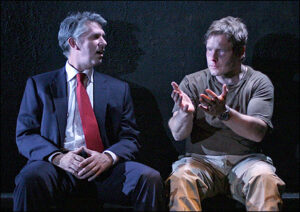
Levenson struggled with the aftermath. It was the first and last time he ever read reviews of his work, he said. “In some ways, the good ones were the worst—they’re talking about you in the third person, describing what you do, and it makes you start to view yourself from that angle: ‘Oh, I guess I do do that, I guess that is a thematic concern of mine, I guess that is a trope I [fall into]…’ Then you start to think of yourself from a critic’s viewpoint, and that’s not useful in any way.”
He had quit his job at Playwrights because of the Underground commission, as well as another from a similar program at Lincoln Center, LCT3; he told me he felt an “incredible pressure” to come up with a follow-up play, fearing Roundabout would “lose interest” in him. He produced a script very quickly, but not very thoughtfully. At a meeting with Roundabout staff, Goodman sensed his unease and asked him, point blank, “‘Do you want to write this play?’ And I was like ‘Not really,’ so she goes, ‘There’s no hurry, take that pressure off of yourself. When you find the right thing, come back and let’s talk about it.” The right thing ended up being The Unavoidable Disappearance of Tom Durnin, which premiered at the Pels in 2013, followed up four years later by If I Forget, also at the Pels. Unlike Karam, Levenson did not get to Broadway with Roundabout, but with the book of Dear Evan Hansen (which earned him a Tony).
Other Underground alums had a much less linear path. David West Read’s The Dream of the Burning Boy, about the effect of a high school student’s sudden death on one of his teachers, was programmed while he was still at NYU’s MFA program and premiered in 2011, while he was in his first year at Juilliard—a fantastic turn of events for a Canadian immigrant who needed credits for an “extraordinary abilities visa” to stay in the country. Goodman and Fielder decided to take him to Broadway the following year on a commercial run for his porn-star comedy The Performers, starring Henry Winkler and Alicia Silverstone—but what should’ve been the peak of his meteoric rise was instead the implosion of his career: a combination of bad reviews and Hurricane Sandy closed the play down after four performances. His Underground commission failed to turn into a production, and other opportunities similarly fell through. Read started to panic. “It definitely felt like what had been a very open door was now very closed,” he said. “I was really struggling for a while.”
When he finally came back to Broadway, in 2022, the reception was much warmer: & Juliet, a jukebox musical featuring the catalog of Swedish producer Max Martin, for which Read wrote the book, was nominated for nine Tony Awards (including one for Read), and is still running. Though his relationship with Roundabout was not long-lived, he still credits the Underground for much of what happened after: “I might not be a writer, period, let alone a professional writer, without that experience. I’m always thinking about how I can recreate that kind of environment of play and experimentation—and the things that I’ve done that have been the most successful do that. To be given a space where it’s okay to make mistakes and try things that might not work is something I am desperately trying to recreate in anything I do going forward.”
Getting Out of the House
Much like Haimes with his Pels Center—but halfway across the country, in Minneapolis—the Guthrie Theater’s artistic director, Joe Dowling, was looking at the plans for the company’s new building, set to open in 2006, and realizing that, according to Michael Bigelow Dixon, “filling it all with modern and classical material wasn’t going to be enough.” Dixon was at the time the associate artistic director at Actors Theatre of Louisville, where for 17 years he produced ATL’s Humana Festival under the tutelage of artistic director Jon Jory, and Dowling recruited him to program for the Guthrie. Unlike Haimes, however, Dowling did not need to create space for new work: One of the company’s three new theatres was the Studio, a reconfigurable 199-seat black box that floats above the city on the new building’s ninth floor (and has since been named after Dowling, whom Joseph Haj succeeded in 2015).
This was not a natural next step in Dixon’s career, he told me. “The Guthrie wasn’t the first place playwrights or agents would send new plays—not even the top five.” For that to change, he reasoned, “The Guthrie had to offer something that other theatres weren’t offering.” That something, as Dixon envisioned it, was not just the commissioning of work—which the Guthrie already did to an extent—but also the funding of a writer’s “inspiration phase”: the experiences, as Dixon put it, that “inform a play that playwrights could become interested in writing—rather than the plays they were already interested in writing.” Armed with a $700,000 grant from the Bush Foundation, Dixon started the Guthrie New Play Program in 2003, selecting a cohort of seven playwrights to be funded from inspiration to final draft, with the expectation that their plays would be produced at the Studio.
For the “inspiration phase” part of the grant, Dixon imagined that playwrights “could take a job at McDonald’s,” or “sit in at the U.N.,” but all seven of the playwrights instead chose to travel: riding the Orient Express from Venice to Istanbul, visiting Palestine and the occupied territories in Israel, or investigating the aftermath of the Khmer Rouge regime. The travels often yielded not only inspiration but new ways of doing theatre: Kelly Stuart incorporated Karagöz puppetry into her work after traveling to Turkey, while Charles Mee wrote Under Construction—a play that is “never finished”—after being inspired, at the Avignon Festival, by the European tradition of continuing to work on plays while they tour.
I spoke to Julie Marie Myatt, one of the cohort members, who was in Minneapolis at that time on a McKnight fellowship. When Dixon invited her to be a part of the New Play Program, she leaped at it: “It was the thing I had at that moment—I didn’t have a teaching job, I didn’t have family, I didn’t have other commissions. I was meeting the opportunity with real hunger and desire.” She traveled to Cambodia after seeing a news story about “these—for lack of a better word—brothels where young women were kept for the sex trade industry.” In this horrifying subject, she found a personal question: “What happens after that part of you is taken as a little girl? How do you grow up?” She took two trips to the country, one for research and one to film portions of a plotline that was to be projected during the production; she also did volunteer work in the U.S. at places that provide counseling for survivors of child sexual abuse.
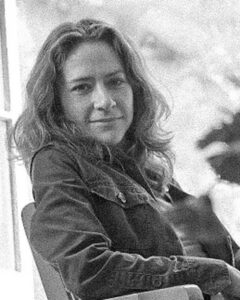
Boats on a River, as it ended up being called, premiered at the Dowling Studio in the Guthrie’s 2006-2007 season, the first one in its new home; it was one of the two projects in the New Play Program that made it all the way from inspiration to the stage (the other one, Naomi Iizuka’s After a Hundred Years, premiered the following season). The production “felt like a huge deal” to Myatt; in fact, she said, “It still does.” She had been working on it for years, and it was such a delicate subject—and to top it all off, it happened to coincide with the annual Theatre Communications Group conference in Minneapolis that year, so it informally served as an introduction of the Guthrie’s New Play initiative to the theatre industry at large. Like Roundabout Underground, the program was not designed to make money. What told her that the play was a success was people coming up to her after the show to share their own experiences with sexual abuse, telling her, “I just want to thank you. I think you caught it.”
Her experience vindicated Dixon’s instincts to fund not just a project but its inspiration. “Having a project go from birth to life within one theatre is a rarity in this career, something I didn’t realize until later,” Myatt said. “I’ve always thought commissions are a chance to work with a theatre and feel like that institution is really committed to you, but the reality is that what the theatre imagines when you pitch an idea is almost always different from what you ultimately turn in—and then they’re like, ‘Well, God, that’s not what we pictured.’ In this case, it felt like there was a dialogue that continued all the way to the realization.”
Playing in the Garage
New work is often seen as risky; audiences, the thinking goes, are not gung-ho about trying new things. But Edward Sobel, former director of new play development at Chicago’s Steppenwolf Theatre Company, thinks of it differently: “People are not afraid of the new, they are afraid of the bad.” That nugget, Sobel told me, came from a consultant the company once hired to look into audience engagement—since Steppenwolf, historically known as an actor’s theatre, had built its reputation on an outstanding ensemble that mostly performed plays which had already been successful in New York or London.
This same ensemble, though, eventually started to push for the creation of new work; some of the nation’s foremost playwrights (Tracy Letts, Bruce Norris, Tarell Alvin McCraney, Rajiv Joseph) are Steppenwolf members. As the company approached its 30th anniversary, in 2005, conversations between the artistic staff and the ensemble began to focus on new work. Sobel, who had come on board a few years before, had heard the complaints from colleagues about plays being “workshopped to death and being in development hell,” so he pitched the artistic director Martha Lavey on a “development process that is a production process.”
Thus was born the First Look Repertory of New Work: three new plays in repertory in small-scale productions, presented off-subscription, that shared the same set but had their own costume, prop, and lighting designs. As Steppenwolf’s current director of new play development, Jonathan Green, put it, First Look provided “a really healthy middle ground between a rehearsed reading and a full production.” Because of the rotation among the plays, writers had time to rewrite between performances, and creative teams had time to respond to the changes. “There are a lot of plays that really can’t be solved until they exist in the third dimension,” said Green. “The plays that really benefited the most from First Look were those that had challenges to solve in the writing, but the writing could only advance when it was realized with actors off book and with design.”
For a performance space, the company chose the first floor of the company’s parking garage, officially rechristened the Merle Reskin Garage Theatre. The company’s creative producer, Patrick Zakem, described the space as having “a ‘rough around the edges’ quality that’s really fun and endearing, but also really challenging from a production perspective—the ceiling’s very short, you’re right by the train, so it’s super loud, and the HVAC system sounds like it’s from the Mesozoic era or something.” Still, this space turned out to be a great fit for First Look, as well as another program, the aptly named Garage Rep, which hosted productions by some of Chicago’s beloved storefront theatres.
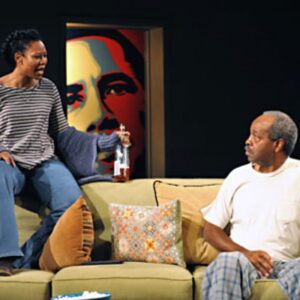
In 2010, at the festival’s sixth edition, playwright and director Robert O’Hara presented The Etiquette of Vigilance, his own dark riff on Lorraine Hansberry’s A Raisin in the Sun, which imagined the youngest of the Younger family, Travis, as an adult who has a troubled relationship with his own daughter. It was a perfect fit for the Garage Rep: a two-hander set in Chicago that’s in dialogue with the kind of classic the company was known for (so much so that Norris’s own take on Raisin, Clybourne Park, remains one of Steppenwolf’s biggest hits). But O’Hara noted that, at the time, his impression of Steppenwolf—and Chicago theatre in general—was that of a “closed space that was hard to get into.” Luckily, he had a friend in the literary department, Rebecca Rugg, to whom he sent the play, which was subsequently selected.
He found the experience refreshing, and thus began O’Hara’s relationship with Steppenwolf, which continued the following year, when he directed Christina Anderson’s Man in Love, about a serial killer in the 1930s who operates mostly undeterred because his victims are Black women. Anderson had just graduated from Yale’s MFA program—her last effort at being a working playwright after almost quitting to work full time at a law firm—and, much like O’Hara, said she saw both Chicago theatre and Steppenwolf as “insular” and “hard for new playwrights to break into.” But, also like O’Hara, she had a connection with Rugg, who taught at Yale and had seen a one-act version of Man in Love that Anderson presented while in the program.
Anderson credited O’Hara for creating a space that “protected me so that I could work on the play and really try to get it to what I thought it could potentially be,” saying that she found it very helpful to the process that both he and the actors were “very game” to trying new things during rehearsal. She says she came out of the process with “a play that I was very proud of,” and, perhaps more importantly, a vision of what she needs as a working playwright: “What I’m going to ask a collaborator to participate in, how I’m going to work with the actors in the room, how to navigate getting that feedback, how I talk about what my intention is.”
When Martyna Majok got the call from Steppenwolf that the company wanted to produce her play Ironbound at First Look, she said she remembers “sobbing by the Grand Army Plaza train station” in Brooklyn, in part for her excitement about the opportunity to see her long-gestating play about her mother’s immigrant struggles on its feet, and in part because it meant she would have a month of guaranteed housing; she had spent the years since getting her Yale MFA bouncing around New York sublets. Together with director Daniella Topol, Majok tackled the particular challenges of the play, which included the fact that it had to share a set with two other shows that took place indoors, while Ironbound is set at a bus stop. Majok saw the upside of this hurdle: “It was all so early in my career, it was like, ‘Here’s a limitation that’s being handed to you,’ and I was like, ‘All right, I’m going to make it work as something that’s going to be a creative provocation.’”
The Etiquette of Vigilance was never produced again; Ironbound received its official world premiere at Round House Theatre in Bethesda, Maryland, in 2015, while Man in Love premiered at Missouri’s Kansas City Rep in 2017. This was the point of the festival, according to Sobel: Steppenwolf purposefully did not claim the world premiere of the plays, so that if a playwright wanted to say that their show premiered at Steppenwolf, they could, but also, “If someone else wants to take the play from here and do it, and they want to claim the premiere that, they can do that.” Taking a cue from Humana—an inspiration for Sobel, as it was for Dixon—he devised a “professionals weekend” where artistic directors and literary managers from across the country were flown in to see the rotating repertory. It worked: “We did 15 plays in that in the first five years, and I think nine of them received productions elsewhere,” he told me. “It was really quite a high batting average in terms of getting the work out there.”
Blowing Up the Attic
At Washington, D.C.’s Studio Theatre, new space preceded the commitment to new work. In 2004, the company added two new spaces to its already existing two—but only programmed three of them, the thrusts, and mostly not with world premieres. When David Muse came in as artistic director in 2011, succeeding founder Joy Zinoman, he said that new work was not “part of the DNA” of the company. It wasn’t so much that new plays had “never happened at Studio,” but that “they happened rarely.” Muse also saw the potential of the mostly unused Stage 4—a black box in the attic that seated roughly 100 people—for experimentation (even though, he recalled, “We would blow the power out in there from time to time”). Thus was born Studio Lab, which was offered off-subscription and which the company’s marketing described as “stripped-down productions of world premiere plays, giving playwrights in residence the ability to work in an environment of collaboration and discovery.”
Among the playwrights who participated in Studio Lab was Lucas Hnath, whose Red Speedo had its world premiere there in 2013. A graduate of NYU’s Dramatic Writing MFA program, Hnath spent almost 10 years developing work in scrappy basements. He looked back on those days, when he was “making shows with stuff I got from the dollar store in whatever room I could get for one weekend for free,” as the time he developed his “theatrical consciousness”: an awareness of how to use all of the elements of the stage and embed them into the writing. Eventually his work made it to Humana with 2012’s Death Tax, which opened doors for him: The following year, he had plays at Soho Rep, Ensemble Studio Theatre, and D.C.’s Studio.
Studio was not, in fact, the only theatre interested in Red Speedo; a company in Chicago also wanted to do it, but they clashed with Hnath about who should direct, whereas, he told me, “What was great about Studio is they were like, ‘Who do you want to work with?’” His choice was another Humana connection, Lila Neugebauer, who had been a directing intern when Hnath got involved in the festival.
For anyone who knows the play, a cramped attic might not seem like the easiest place to program Red Speedo—but, as Lucas joked in our conversation, “I will always assert [that the play] does not require an actual swimming pool.” Understanding that it would not be possible to have one in the scrappy Stage 4, Hnath and Neugebauer turned to designer Mimi Lien, who had done the set for Hnath’s A Public Reading of an Unproduced Screenplay About the Death of Walt Disney, because “she’s really good at going into a theatre space and using that as the starting place to respond to and build a set that is integrated with it—she’s very smart about how to not impose something on the space.” This resulted in the kind of experimentation that Muse had been hoping for: the team changed where the audience entered into the space—from a stairwell instead of the lobby—and hit them with the smell of chlorine as they went up.
Overall, Hnath told me, Studio served as a low-pressure stage in the process of activating his theatrical consciousness: “It wasn’t as if [Studio] said, ‘You’ve got to figure out how to make the space work for this play.’ They had a great deal of faith that we would find a way.”
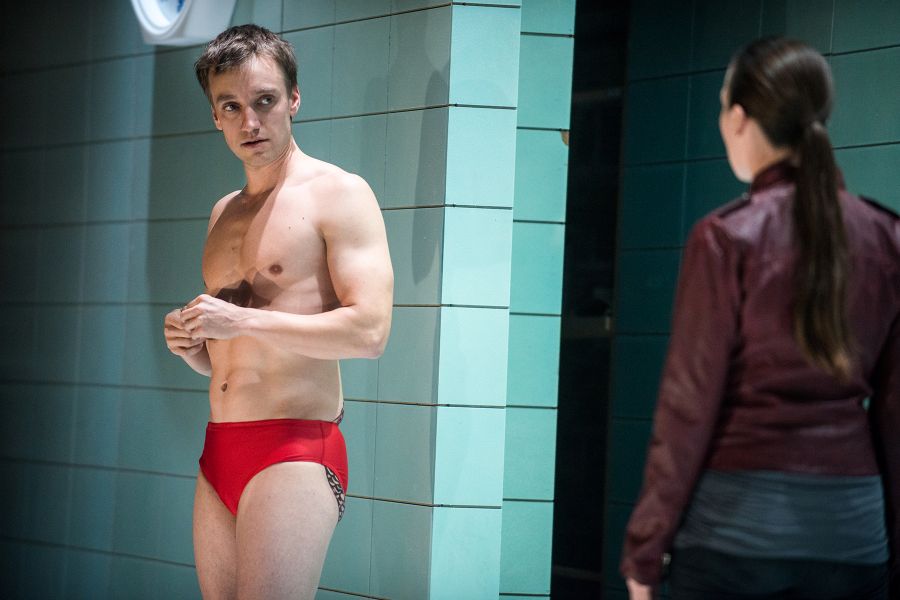
Muse told me he would also encourage playwrights to visit the building and “spend some time with the company, get to know the spaces, respond to our architecture.” Such was the case with Rachel Bonds, who, in 2013, had yet to receive a full production of her work. Through a residency at the Arden Theater in Philadelphia called the Writers’ Room—also created by Edward Sobel, after he’d left Steppenwolf—Bonds met Studio’s literary director, Adrien-Alice Hansel, which led to an introduction and Bonds’s first commission, directly from Muse. The result was The Wolfe Twins, an exploration of family grief and resentment set in a bed and breakfast in Rome, that she wrote with Stage 4 in mind, and which was accordingly put into production after its first draft: “It’s a four-person play in a unit set—I was like, ‘Let’s write something that would be successful in this theatre.’” It took less than a year for Bonds to see her play come to life, which meant that, throughout the production, she still felt connected to “the artistic impulse for me to write it” and “made working on it so much more invigorating.” She described her time at Studio Lab, collaborating with director Mike Donahue, as “one of my absolute best working experiences,” with a team of early-career actors and designers “who were working at the top of their game” in an environment that had “tolerance for risk.” She even joked, “I actually liked the show art—I never like the show art.”
Though Bonds credits The Wolfe Twins as a “launching-off moment” for her career, she now realizes she was a bit spoiled by the experience. “I thought, ‘This will surely happen again.’ It’s never happened again. No one’s ever done that play ever. Maybe it was just a once-in-a-lifetime thing.” Even the fact that The Wolfe Twins was greenlit after a first draft continues to be an outlier: “That never happens. Usually you’re subject to 15,000 developmental readings and 40 rounds of people who want to give you notes and then actually never produce your play.” Muse and Studio “put such trust in me as an artist, and that made such a huge impact on me going forward. It made me trust myself more. It made me feel like I could ask for things. It was amazing.”
Paying the Bills
Reporting this piece made me alternately sad and angry. I could see all the roads not taken: If the Off-Broadway theatre that almost produced my play Machine Learning back in 2018 had done so, would it have transferred to Broadway? Would it have won awards? Would I have gone on to write for television (the primary reason I moved to the U.S.)? Would I be working exclusively as a writer now? Ten years out of grad school, I feel that opportunity has passed me by. I had been burying that feeling, afraid to admit my dreams had failed—but writing this piece brought it all back up.
Here is the evidence that I, along with so many other playwrights of my generation, have missed the boat: Of the four programs I’ve covered above, three don’t exist anymore. The Guthrie New Play Program was the first to go, in 2008; as literary manager and resident dramaturg Carla Steen told me, it died a “natural death” as the Bush grant cycle came to an end and Michael Bigelow Dixon left the company. Because it was not part of the general operating budget, Steen told me that the Guthrie “tried to support the projects as best we could, as long as we could—and then, the economy tanked in 2008.” Due to the small seating capacity and the fact that the whole building works under union contracts, the space essentially loses money “just by turning on the lights.” Though the company continued programming the space until the pandemic, budgets after that point no longer allowed for such losses. Instead, the Dowling has become a revenue stream as a rental for weddings, opening night dinners, and business events.
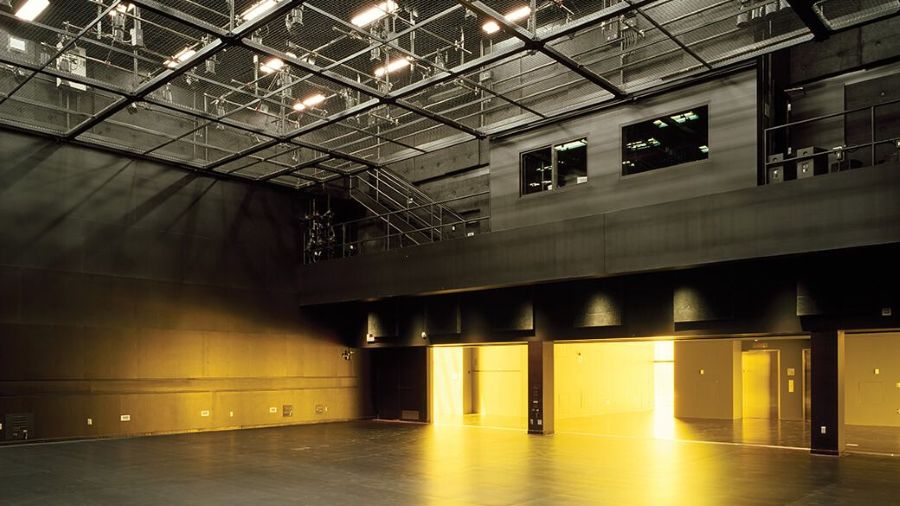
For its part, Steppenwolf’s First Look ended in 2015, the year after presenting Ironbound. Jonathan Green, Steppenwolf’s director of new-play development, told me that for all the outside productions the series spawned, the fact that only two First Look plays—Sex With Strangers by Laura Eason and The Fundamentals by Erika Sheffer—made it to the Steppenwolf mainstage meant that “it became difficult to demonstrate the return on investment.” He also noted the increasing costs of producing theatre, which similarly affected another big Chicago theatre, the Goodman, which from 2004 to 2022 produced new works in a similar fashion to First Look under its New Stages Festival, and has since then transitioned to readings. As for the Garage, it is now primarily a rehearsal space (it also hosts Rough House’s House of the Exquisite Corpse, a haunted house puppet show, every Halloween season).
As for the Studio Lab, The Wolfe Twins was its final production, in 2014; after that, the company continued programming in Stage 4 under the Studio X banner, which the company called “a consolidation of the kind of work we programmed in our Lab, Special Events, and 2ndStage programming streams.” Then, due to what Muse called “post-pandemic headwinds,” Studio cut way back on “off-subscription” offerings, “because when we ran the numbers, those were the productions that were significantly net negative.” Much like Guthrie’s Dowling, Stage 4 has primarily become a revenue stream as a rental space, and an occasional host for international work, including shows from the Edinburgh Fringe.
That these programs were money losers was brought up over and over in my reporting—even Roundabout Underground’s (now archived) history webpage contained a quote by Jill Rafson: “The great thing about the Underground is that the second I say, ‘Yes, we’re going to do your play,’ I’ve just lost the company several hundred thousand dollars.” As it did for all theatres, this reality eventually caught up to Roundabout after the pandemic. “When we finally reopened,” Rafson told me, “I got the news that this is not a time where we can just knowingly lose money the way that we sometimes baked into the budgets before.” Initially, the program scaled down to one production a year; then, in 2024, the Underground program turned into a writing residency that offered two playwrights “a multi-day workshop of the play, scheduled time at a desk in a shared workspace, and access to Roundabout resources and staff that they feel is helpful to their process and overall artistic development” every season, according to its website.
The company’s director of play development, Abby Katz, told me the residency was created as “a way that we could continue to have meaningful engagement with writers while we were not doing productions in the Underground.” The “while” in that sentence suggests the possibility of returning to production—something that incoming artistic director Christopher Ashley confirmed in a conversation with me. “Many of my most exciting evenings in a theatre happened in the Underground,” said Ashley, who will officially succeed interim artistic director Scott Ellis in the 2027-28 season. “So as I begin as artistic director at Roundabout, one of the highest priorities was getting the Underground back into production.” To start off, he said they’re committing to one Underground show per season, with the “hope that in the upcoming years we move back toward two.”
So the case for optimism is there as well: The Underground lives to fight another day. The Guthrie’s Dowling Studio also reopened last season for a production of George Abud’s The Ruins—though Abud and his director, Osh Ashruf, were responsible for raising a quarter of the production costs. The space closed again the following season, though Haj has since expressed hope to bring the Dowling back as a new-work showcase. Folks at the Guthrie, like all the theatres I spoke to for this piece, insist that even though they’re not currently producing work in their black box, that doesn’t mean the end of new-work development, which has continued to expand to other stages in the building. Steen noted that, in the first two seasons back from the pandemic pause, the Guthrie programmed three new plays on its main stages, while Green told me that Steppenwolf has “between like 10 and 12 active commissions” at any given time. Muse, who’s on his way out of the artistic director job, noted that Studio still commissions around “five artists a year to work on new things at Studio.”
The black boxes, in other words, are not the only places where new work can take place. (It should also be noted that other programs—including a few mentioned in this piece, like LCT3 or Second Stage Uptown—are still active.) Still, there is no denying that, as far as institutional support goes, the chances of an unknown playwright seeing their work come to life within anything that could be reasonably described as a “short time” after writing it have severely decreased in recent years. The phasing out of the Humana Festival in 2022, when the Humana Foundation changed funding priorities, alongside the closures of The Lark and the Sundance Theater Lab—not to mention the shriveling of the theatre-to-television pipeline that was funded, and then killed, by streaming—are often cited as factors that critically endanger the professional lives of up-and-coming playwrights. Steven Levenson—who, alongside his success with Dear Evan Hansen, went on to write the critically acclaimed FX miniseries Fosse/Verdon—talked about “a crisis happening in both” theatre and TV: “Those doors that used to be open to young people starting out are closing rapidly, and I don’t know how you get from not established to established.”
Not every writer I spoke with felt that being established means being stable: Robert O’Hara told me that he’s not so much making a living as “eking” out one (mostly due to the fact that he also directs). Bonds—who, like others I spoke with, has children, and therefore feels pressure to achieve some financial security for them—wondered, “Is anyone going to care what I have to say in five years? I feel really hazy about what the future holds, and scared. I’m trying to get more comfortable with feeling uncertain.”
Theatres are grappling with the same uncertainty. These programs were created in circumstances in which the companies felt confident they could see a future ahead; they were largely phased out when the future got foggy. As Michael Bigelow Dixon put it to me, institutions work under a constant pressure “to make things dependable, make things reliable, make things safer.” It makes sense: If a company closes, no one makes a living from it—so, when forced to choose between its mission and its survival, its leaders might feel like the latter is the only way to deliver on the former.
It should also go without saying that new work is not the only purpose of theatre, and that the cachet of the “world premiere” is often lost on the average theatregoer. As Muse put it, “I feel like I need to hold the perspective of most of my audience—regular people in Washington, D.C., who are coming in to see a play that they have never heard of by a writer they’ve never heard of, even if it’s been produced somewhere before. To them it is a new play.”
Building Our Own House
Last July, I quit my full-time theatre admin job and decided to give writing its last chance: It would pay the bills or else. It has not, and as I celebrate a year of freelancing, my savings are almost depleted. Working on this article crystallized for me the great unlikelihood of achieving the dreams I came to this country for—and which, as of the time of writing, I’ve made the decision to stop pursuing. I will find another professional path (whether in the United States or elsewhere, I’m not totally sure) that uses the talents God has given me and caters to the needs of the communities I’m part of. But I will no longer pursue the life of a working artist in America’s entertainment industry.
That doesn’t mean, however, that I will stop being a writer. Because this article also crystallized for me the truth that theatre is more important than ever. Not as a means of propaganda—to “change hearts and minds,” as the thinly veiled capitalistic desire to have art be useful for something often goes. I’m talking about its crucial role as a way to be human in an increasingly dehumanized world. Theatre is stubbornly resistant to “optimization” or “disruption,” because it is predicated on fundamentally human traits: connection, presence, manual labor. It was Levenson who reminded me of this, when speaking about why seeing The Language of Trees produced early on was transformative. “We’re not writing novels,” he said. “We’re writing blueprints for buildings, basically. And if you don’t see the building built, then you can have a beautiful blueprint, but it’s not the thing. The thing is what happens onstage with actors and an audience.”
A play is only realized in the moment it is performed, and the only way to truly make a play is the same thing required to truly experience it: to produce it. As my anger over not “making it” subsided, I started to see this whole thing differently: It’s not about success, or even about the sustainability of careers. It’s about being theatremakers, which we only are insofar as we make theatre, as opposed to just drawing blueprints. That shift is not in the hands of institutions—or, if it is, that’s because we let it be. If we have been separated from the means of production, it’s because we stopped choosing the leaky pizza parlor basement over the nicely renovated one housed inside the million-dollar building.
I asked many of my subjects what they thought was “the way forward” for the current generation of playwrights, and most, regardless of whether they were on the artistic or administrative side of the industry, said pretty much the same thing: Don’t wait for an institution to pick you—go and do it yourself. As O’Hara put it: “The world is not waiting for another playwright. The world is not waiting for another artist. You have to make your own space, because the world is not going to make a space for you. If that means making work in a basement or in a living room, then that’s what you have to do. You can’t wait for an institution to open up their doors for you.”
One of the current Underground residents at Roundabout, Liba Vaynberg, reminded me that “even William Shakespeare had to produce his own fucking plays.” Vaynberg wasn’t just spouting a Snapple factoid: She co-founded her own 501(c)(3), Anna & Kitty, with director Inés Braun, to produce her own work, which has so far spanned three plays: The Matriarchs (2026), Round Table, co-produced with Fault Line Theater (2019), and The Russian and the Jew (2018). She acted in the first two, also reminding me in our conversation that it is widely believed that Shakespeare played the ghost in Hamlet.
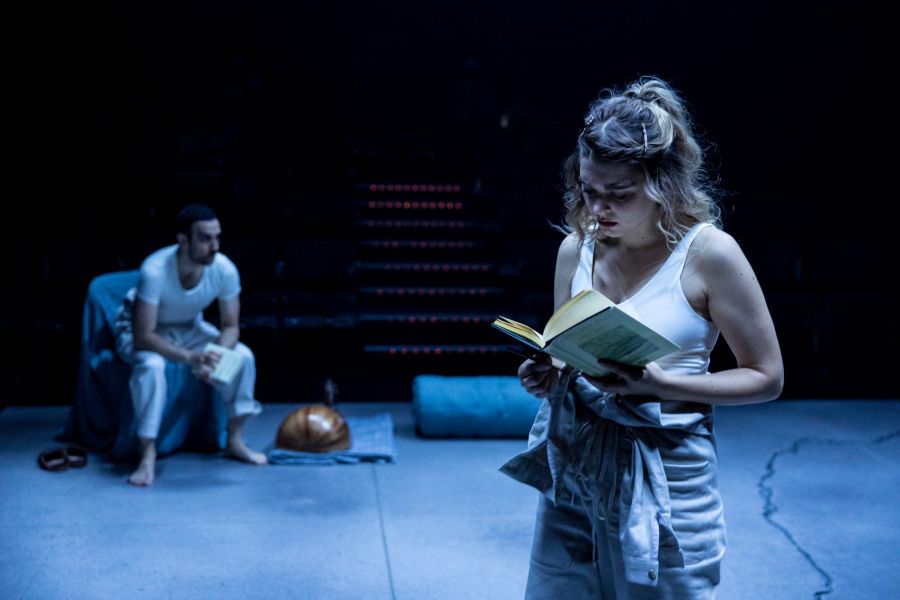
Another self-producer and multihyphenate is the aforementioned George Abud, who after sharing the fundraising responsibility for The Ruins (which he wrote and starred in), went on to produce two more shows: Tim McGillicuddy’s Fanny: A Fantasy in G (which he also directed) and an irreverent retake of The Threepenny Opera (which he adapted, directed, and performed in). He told me that some older colleagues who came to see Threepenny got very excited about it, telling him that “the revolution of theatre is going to go back to what it was in the ’70s: back to church basements, living rooms, small venues, and found spaces. Institutions might be imploding, and theatre will have to find its way underground again.”
That, to be fair, is not what I signed up for—nor is it the career for which my MFA prepared me. But the call is not altogether distasteful to me. Maybe playwriting is not my profession, but my vocation? I asked each of the playwrights what they would have done if they didn’t get the call from the theatre that selected their plays, if they were still slumming it out in their day jobs—would they still be writing? None of them ignored the financial realities, but they all seemed pretty uniform in their answer: If you’re a writer, you’re a writer. You don’t have a choice.
Hnath put it in the context of his teaching practice (he’s an assistant professor in the Department of Dramatic Writing at NYU). “Thankfully, it’s been a long time since any students have asked me this question of, ‘When do I throw in the towel?’ It’s a very sad question,” he said. “My response to that is: Well, what is there to throw in, really? The path I was on…I wouldn’t be able to stop writing. So whether or not it was actually supporting me is a separate question.”
I felt tempted to dismiss this from Hnath, one of the industry’s few successful playwrights—maybe he was idealizing things from a place of privilege. But then I remembered his 10 years of basements and dollar-store props. It’s been almost 10 years since I graduated. That whole time, all I’ve done is apply and submit and interview for the ever-shrinking pool of available spots at institutional theatres. The phone hasn’t rung in a while. I’ve given up on waiting for it and have decided to move on.
But I am a writer. And there’s a dollar store a couple of blocks away.
Francisco Mendoza is an Argentinian writer currently living in Brooklyn after spending several years in Brazil. His writing spans theatre, prose, audio, and the screen, and he also works as a freelance journalist, teacher, and marketing consultant.