
A central idea we’ve found ourselves contemplating at Cherry is that of authenticity. Alongside the three pillars—diversity, equity, and inclusion—that organizations throughout our society are working (with varying degrees of real commitment) to adopt, the casting world often adds “authenticity” as a fourth. (The website of the U.S.’s most significant casting service leads with “Breakdown Services champions authenticity and diversity in casting.”)
Since few forces are stronger than that of the United States-centric gaze, perhaps it’s worth restating the obvious: U.S. conceptions of race and ethnicity are constructed by us. And while they are no less powerful for that, when we apprehend a play written somewhere else, we have to take into account the context from which the play emerged. When a Mexican writer who has always lived in Mexico writes a play about Mexican people, to be performed in Mexico, she is not necessarily writing a play about a racialized minority culture. When one of her plays is performed in the U.S., the play may be expressing a different relationship to Mexicanness than, for example, a play written by a Mexican American set in Jackson Heights, whose characters’ ethnicity may powerfully mark them as outside of the dominant culture.
Given this perspective, some international plays seem to invite an approach to casting that might look inauthentic by U.S. standards. In 2020, the Cherry produced Hotel Good Luck by the Mexico City-based writer Alejandro Ricaño. Much of Ricaño’s work is set among privileged 20-somethings (the term “hipster” doesn’t feel wrong). In the original Spanish, the two characters in Hotel Good Luck listen to pop music from France and the U.S., and their names are Bobby and Larry. To put it mildly, it doesn’t feel like Ricaño is very invested in the “Mexican-ness” of his characters, at least as we might understand it. Rather, he seems to set this story in a space meant, perhaps, to transcend nationality. This was helpful to us, since the Cherry had no actors of Mexican descent. We cast a white actor as Bobby and a Black actor as Larry. We were keeping an eye on diversity, of course, but we mostly focused on who in our acting community had the required skills (Larry needs to be a musician) and what pair would best ignite the dynamic between the characters.

We faced a different situation in On the Other Side of the Sea, by the Salvadoran playwright Jorgelina Cerritos. The play is set on the shore of a dreamlike imaginary country, to which the character Pescador (Fisherman) has rowed up, seeking the papers that will give him permission to stay; Dorotea is the bureaucrat with the power to decide whether or not to furnish them. When Cerritos visited the Cherry for the play’s English-language premiere, she had seen many productions around Latin America of her award-winning play. In the talkback after our performance, Cerritos acknowledged that she had initially found it disconcerting to see a white actress playing Dorotea, a role she initially wrote to play herself. But she noted that as the show progressed, she realized that in the U.S., this story of immigration almost demands to be the story of a white bureaucrat and an immigrant of color (our Fisherman was played by a Black Latine actor). If the Cherry had had the ability to cast two Salvadoran actors, then, we might have erased one of the most powerful narratives—of overcoming mistrust of the “other”—that this beautiful play has to offer a U.S. audience.
Both Cerritos’s and Ricaño’s plays have in common that they are set in dreamily outlined spaces and use non-naturalistic narrative tools to explore questions that transcend the local. Plays with this kind of a wider viewpoint seem to provide an invitation to cast with a freer hand. What might we call this freer hand? An earlier stab at describing casting approaches, such as, for example, racially diverse actors playing members of a genetically nuclear family, was “colorblind.” I appreciate the hopeful spirit in which the term must have been coined, but in retrospect, it’s hard to imagine a more inapt metaphor than blindness for the care that has to be brought to these questions. What the newer term “color-conscious” may gain in feel-good qualities, it loses in specificity (even the most awful historical minstrelsy was nothing if not color-conscious). I’d propose that we simply speak of “non-literal” casting of race and ethnicity, consonant with the many non-literal but careful artistic choices that adventurous theatre artists might make in writing, design, and staging.
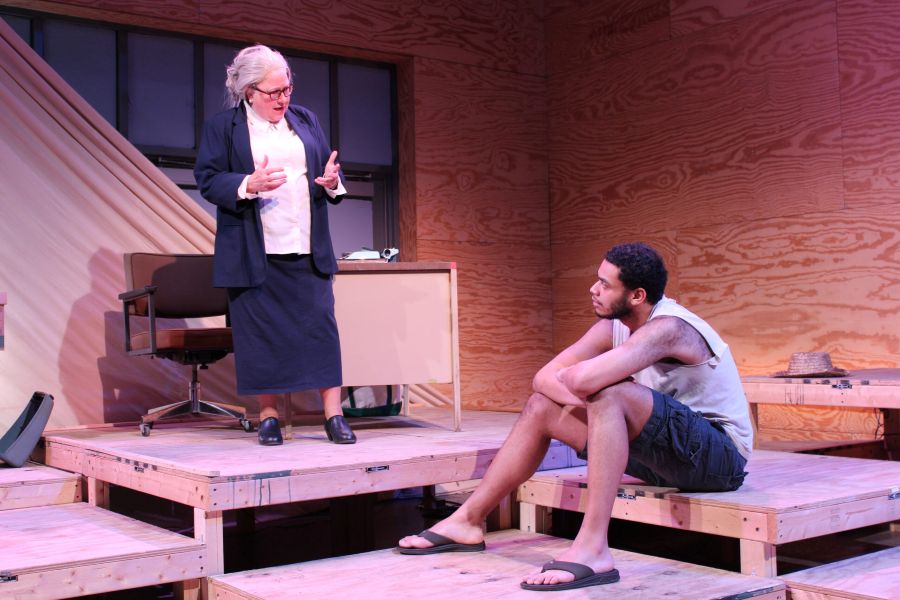
To explore another example: While Hotel Good Luck and On the Other Side of the Sea are set in non-literal geographies, in Freek Mariën’s The Wetsuitman, race and location are a hyper-specific part of the storytelling. The cast list includes 27 different roles, representing a wide range of specific different racial and ethnic identities. Since virtually no production of this play could adopt a casting principle in which every character is played by an actor sharing each character’s racial and ethnic identity, the structure of The Wetsuitman forestalls an approach of 100 percent “authentic” casting.
But eventually the play focuses on a Syrian nuclear family, and it was clear that a Cherry production would have no actors of Middle Eastern descent. Ought we to produce the play at all, if we could not cast it at all authentically? We took the question seriously. One source of reflection we consulted was the 2020 HowlRound article “This Is Not a Rhetorical Question,” in which the Chilena-Canadian playwright Carmen Aguirre imagines a small theatre company in Saskatoon, Saskatchewan, that might wish to produce one of her plays. Lacking the Latine (much less Chilene) actors to cast it authentically, Aguirre imagines, the company may not even approach her about the rights, for fear of causing offense.
Aguirre decides she’d prefer that her work be more often produced, if sometimes with less authentic casts. She describes some steps that a company not in a position to cast authentically might take as a “good start”: to make sure they are not overlooking culturally specific actors in their community; to be on the record that casting decisions are being made because of a lack of available local actors, not because of a lack of talent in that community; and that a cultural consultant be employed.
We also consulted the thinking of theatre scholars Patricia Ybarra at Brown University and Brian Herrera at Princeton. Both engage the question of non-literal casting in the context of schools, which—like small companies in small communities—comprise an important theatre ecosystem that works with circumscribed casting pools. In 2015, Ybarra, then the president of the Association for Theatre in Higher Education (ATHE), wrote a message to ATHE which is now posted on the website of Brown’s Department of Theatre Arts and Performance Studies. In it, she describes a Brown production in which a majority-minority cast tell a Seminole story in which, “although no one in the cast was Seminole,” there was an active principle of “coalitional casting,” in which “an act of becoming a culturally different person” can be an ethical “act of committing to the cause of telling a marginalized story.”
Herrera expands on this thinking in his article, “‘But Do We Have the Actors for That?’: Some Principles of Practice for Staging Latinx Plays in a University Theatre Context.” In it, he reflects on “an unofficial college tour” he undertook in 2014 to see five stagings of In the Heights in a range of educational settings. The varying degrees of success of these productions enabled Herrera to develop “Three Principles of Practice for Staging a Latinx Play within a University Context.” His first is linguistic fluency, which he defines as the importance of rigorous dialect training. (While this goal is an excellent one, I’m not personally convinced it will often be as achievable as Herrera envisions, given the rarity of even professional actors capable of sophisticated accent work.) Herrera’s second principle, cultural competency, reflects Aguirre’s recommendation of a cultural consultant, urging “the thoughtful use of dramaturgical techniques to address gaps in cultural knowledge” so as to equip “casts to productively engage the distance between themselves and their characters not as an embarrassing gap to be hidden, but as a productive space in which understanding might grow.”
For his third principle, Herrera expands on Patricia Ybarra’s concept of coalitional casting and notes that “coalitional casting addresses the persistent absence of actors of color…by inviting non-minority allies to leverage the privileged ubiquity of whiteness toward the cause of enacting an as-yet unstaged story.” To this point I would add that an even richer form of coalitional casting might be created when actors of color don’t share the same background as a character of color they might play.
In the end, the Cherry proceeded with a cast of five for The Wetsuitman, two of whom were white. In the case of this particular play, of course, it helped that the text actively investigates the ways in which our media portray stories of the “other.” The Cherry expanded on this aspect of the play by adding short lines of dialogue to identify the race, age, and other distinguishing characteristics of many of the characters as they were introduced. For example, the first lines of the play are:
i’m an elderly architect
i live near the edge of the village
In the Cherry production, these were spoken by a 30-something Black actress, and we expanded them:
i’m an architect
elderly
white (norwegian)
i live near the edge of a village
In several cases, we employed “reverse doubling,” in which multiple actors traded off to play a single role. In Part 2, for example, the role of the Corporate Spokesperson was played by a different actor in each of his three scenes, each actor wearing the same suit in a different size.
We took seriously the need to bridge our gaps in understanding, and we were fortunate to get to know Roula Jneid, who acted as our cultural consultant. Roula is a Syrian expat working with a nonprofit organization helping refugees settle in upstate New York. She attended rehearsals, provided insight on the stories told in the play, and became a great friend and champion of the production. She introduced the production to a Yemeni father and son, recently arrived in the U.S., who had had an experience of migration similar to ones portrayed in the play. The pair shared their stories over a powerful dinner meeting with the cast and creative team.

The above non-literal approaches to casting race were inspired more or less by necessity, but I’m not sure they always need to be. New York City offers perhaps the most casting possibilities of any theatre sphere in the U.S. And at least one NYC theatre company that also does international work sometimes also casts non-literally. The Play Company, working with Dan Rothenberg (of Philadelphia’s excellently experimental Pig Iron) had a multi-year collaboration with the Japanese playwright Toshiki Okada. Unlike the non-literal plays by Ricaño and Cerritos, Okada’s plays are set specifically in Japan, the characters are Japanese, and the writing might be thought of as hyperrealist. (His language maps startlingly well onto the disaffected young people we also find throughout European-descended world cultures.) The most authenticity-focused casting ethic might ask that these stories be told in New York by Japanese American actors. Alternatively, most U.S. casting offices might follow TV and film practice and consider it both necessary and sufficient to cast six actors of Asian, or part-Asian, descent.
In productions of two of Okada’s plays, though, PlayCo cast them according to something like the principles the Cherry found our way to. White actors were not the majority in these productions, but neither were Asian actors. Rather, PlayCo assembled casts that looked like New York City: a diverse mix of Asian, Black, Latino, and white actors. The focus was presumably on what ensemble would most vividly communicate the play’s dynamics to a U.S. audience.
Okada’s collaboration with PlayCo was long and successful enough that he apparently was pleased with this casting philosophy. When we keep in mind that these are not plays about Japanese American people generally, but about people specifically born, raised, and living in Tokyo, it seems unclear what type of authenticity would be provided by a cast of Japanese American actors, much less the “anyone of Asian descent” solution. Mightn’t such a “looks-based” approach, in which a group of Korean, Chinese, and Cambodian Americans, say, might stand in for Japanese people, simply be a new case in which U.S. theatre treats race as a costume? Herrera writes,
Coalitional casting does not assign a role because a particular performer might “read as” an ethnicity other than their own, nor does it do so because…a particular performer might “pass” as a different ethnicity.
Perhaps Okada and the PlayCo team were seeking actively to assert that, notwithstanding their geographic specificity, these plays too are meant to transcend questions of local culture. Perhaps many theatremakers from many contexts might think the same thing about their work.
Notwithstanding all of the above, the key fact remains that actors of color are underrepresented on U.S. stages and discriminated against in casting offices. An unquestionable virtue of a more “authentic” casting scenario is simply that it would provide more work for non-white actors. In her essay, Carmen Aguirre posits a powerful tool to ensure that non-literal casting does not simply devolve into another way to give more work to white actors. Aguirre posits that if her plays are to be cast in culturally non-authentic ways, their casts ought to fully reflect the racial and cultural diversity of the community in which they’re being performed (as PlayCo’s productions did.)
The example she offers: if a play of hers was to be produced with a non-Chilean cast in her hometown of Vancouver, about 40 per cent of the actors should be Asian. To apply what we might call “the Aguirre test” to U.S. cities: In any Chicago, Hartford, or Orlando theatre season, no more than about 30 percent of the actors onstage should be white. I believe Aguirre focuses here on a key yardstick that remains under-examined in the U.S. theatre. In circumscribed casting situations—small communities, educational institutions—non-literal casting can open up possibilities for diverse writing to get produced. But in big, diverse centers, the Aguirre test, partnered with non-literal casting, ought to produce an efflorescence of roles for non-white actors. It is time for the Anglo theatre to ask that every theatre company not already satisfying the “Aguirre test” be steadily working toward the day that they do, and to be casting “white” plays with racial non-literalness.
As a middle-aged white man, I feel some concern at contributing my voice to this conversation at all, though I’ll be pleased if this essay can provide a modest signal boost to the thinking that Aguirre, Herrera, and Ybarra have done on the question. My primary experience of minoritarian status is as a gay person, and that identity does give me a window into how unfortunate “inauthentic” casting can feel in terms of representation. I can confirm that it was not the loveliest aspect of my childhood to see gayness portrayed so regularly in media as a costume that straight actors could adopt, usually in a spirit of either bravery or mockery. (Even less that the roles were so often pervy villains.) It was nicer to see gay men portrayed as full human beings in mass-market films like Philadelphia and Brokeback Mountain, and yes, it would have been nicer still to see those roles played by openly gay actors. But to my eye the even better scenario is the current one, in which out LGBT actors like Cynthia Nixon, Neil Patrick Harris, Sarah Paulson, and Jonathan Bailey are regularly hired to play straight characters. As long as out actors like these are getting plenty of hetero roles, I can accept a world in which straight actors occasionally play gay roles.
And in theatre discourse overall, it’s hard to overlook the issue that, relative to the hopefully uncontroversial ideals of diversity, equity, and inclusion, authenticity seems to spur a lot of disagreement. Who hasn’t seen the heated comment section exchange in which one keyboard warrior argues that it’s uncool for a Mexican American actor to play a Puerto Riqueño role, and another asks whether that makes it offensive for an actor playing Oedipus not to have married his mother and killed his father. The very heart of theatremaking lies in embodying experiences not one’s own. So any project of “authentic” casting will sooner or later have to draw the line where it feels the authentic part is satisfied and the theatrical part can begin. One thing we can be sure of is that in no case will everybody be satisfied with where that line gets drawn.
Our Wetsuitman cultural consultant (and now friend) Roula expressed that she was deeply moved by our production, and grateful to the company for helping to communicate the play’s story to a wider audience. We were honored that she approved of our approach. Certainly, applying the lens of theatrical non-realism to the world of racialized casting would not work in every case. (For PlayCo’s third production with Okada, a small-cast play about the 2011 Japanese earthquake and tsunami, the cast was three Japanese American performers.) But if the Cherry’s experiences have led us to a broad set of casting principles, they would be:
1. Cast diversely, but not necessarily literally
2. Cast to communicate the dynamics of the story to your audience
3. Cast to fully reflect your community (a.k.a., pass the Aguirre test)
Perhaps an analogous idea to “literalism” in theatre is simply “realism.” If you read the marvelous plays in the book from which this essay is excerpted—and I hope you do!— you will know that the Cherry views neither idea with great enthusiasm. While the best plays can expose extraordinarily powerful truths, even the most truthful of “realistic” stories play out onstage via artful mechanisms of fabrication. Theatre should not aim to conceal this fact! What we call realism in theatre is, after all, not very much like reality, and many “realistic” plays may be rather less honest than ones that embrace the beautiful artifice at the core of our medium. In large part, it is the urge to escape the bonds of literalism that drew the Cherry to plays from other parts of the world.
I believe that the impossibilities posited by many of the scripts we produce, and the non-real spaces they move in and out of, allow each play to gesture to deeper insights than might be disclosed in a world of more realistic storytelling. The artistic moves the Cherry Collective makes tend to throw many aspects of authenticity quite out the window. But I hope that in spite of—even because of—that, they may be possessed of a profound and specifically theatrical truth.
Samuel Buggeln is the founding artistic and executive director of the Cherry Arts, as well as an award-winning theatre translator and one of the U.S.’s preeminent directors of new international plays.