“I’ve been writing toward this moment for a long time,” Iranian American playwright Sanaz Toossi told me over email over the summer, as hostilities between the U.S. and Iran ramped up again after a tenuous ceasefire. But she doesn’t just mean the current war, which began in February and shows no signs of a conclusion. “What is happening to our people right now,” she said, “has been happening for the last 47 years. It may shift in and out of the news cycle, but the brutality inflicted on Iranians at the hands of the Islamic Republic has been an unshakeable, constant reality.”
Agreed Iranian American theatre artist and vocalist Melory Mirashrafi, “We’ve been waiting for this war our entire lives. It is like this cycle that we all know so, so well, but also nothing ever prepares you for it.”
Until the recent conflict, Mirashrafi spent summers in Iran visiting family and the rest of her year completing schooling in the U.S. “It just felt like I had two homes,” she said. She said she also used to find working on Iranian-focused theatre projects in the U.S.—she directed Toossi’s Pulitzer-winning English in Boston at SpeakEasy Stage, and the same author’s Wish You Were Here in Gloucester, Massachusetts—to be a “beautiful balm.”
But as the U.S. and Israel’s bombardment of Iran continues despite ceasefires, there is a sense of heavy hopelessness seeping into the artistic practices of Iranian American artists. Working on these projects now, Mirashrafi said, leaves her feeling “hollow and shallow and not practically useful. For so long, it has been one of my only tools and access to creating immediate community around a topic. Now so many of us are incredibly burnt out, incredibly unconvinced that it is a useful practice.”
Indeed, diasporic Iranian artists are grappling with what they can do and whether their actions could make a material change in the conditions of our people surviving under war in Iran. We know that the act of making theatre itself is not direct action, even if there is power in bringing visibility to the beauty of our land and people. Sanctions and censorship in Iran means that there isn’t a straightforward way to send money, and even speaking out in the West carries potential danger for family back in Iran.
Although we’re about the same age, Mirashrafi and I carry vastly different experiences as Iranians in diaspora: My dad, who immigrated to Chicago as a student just before the Iranian Revolution of 1978-79, resisted talking about his identity, teaching his daughters Persian, or embracing cultural traditions. I’ve never been to Iran. In elementary school and beyond, Iranian history was only noted in the frame of war. We were Americanized, and to my father, I know, that meant we were safe.
That’s one small example of how Iranian Americans defy a monolithic identity. Diasporic Iranians have varying levels of rootedness in their culture, depending on their family’s desire to preserve it, and whether they still have family in Iran. For those in diasporic communities, there is a truth in the cliché of never feeling fully at home: We’re caught between longing for places our families were forced from and sometimes being misunderstood even in the places we’ve become adults.
And the stress isn’t just coming from the devastation, but also from the division. Toossi said she “was really angry with parts of our diaspora,” which resonated for me, as social media has further polarized those of us who feel guilty and helpless. It has seemed that only two camps of thought could exist: pro-war and pro-intervention, or anti-war and anti-intervention. But it’s more complicated than that, especially for Iranians in the diaspora. “I found myself at odds with members of my own family,” Toossi said. “I was pretty mean on Instagram. I voiced my frustrations publicly. Now I’m questioning how useful that was.”
There’s a certain kind of grief that feels buried deep, and is now being unearthed by the spectacle of U.S. and Israeli bombs dropping on our homeland. As Toossi put it, “We’re witnessing what decades of chronic homesickness and displacement can do to a people. It can manifest as venom and sorrow and a desperate search for certainty in an impossible moment.”
Deniz Khateri was making theatre in Tehran and had no intention of leaving the country. But her family, foreseeing political hardship, pushed her to pursue studies in the U.S., so she enrolled in graduate school in Boston in 2013.
“I had a lot of fun doing theatre in Tehran because the theatremaking process is very much based on devising, and very much based on everybody being included in the process,” Khateri recalled. These collaborative processes sometimes spanned one or two years of intensive rehearsal. On the other hand, she conceded, “Sometimes we didn’t even get to perform because of censorship, or we had to cut a lot of things.”
In 2022, Khateri was set to return to Iran for a production. But she decided to stay in the U.S. to honor an artists’ strike in Iran, which was launched under the banner of Woman, Life, Freedom in protest of the suspicious death of a Kurdish woman, Jina-Mahsa Amini, while she was in the custody of Iranian morality police. Still, Khateri wondered, “What can I do? Am I even in a position to do anything, because I’m no longer there? Whatever happens, I’m not the person who sees the consequences. I can only witness it, but I don’t actually feel the consequences, because that’s not where I live.”
Every room I have worked in as a dramaturg with an Iranian story at its heart has felt the impact of the strife in our homeland. For me, these rehearsals have become heavy but necessary spaces for learning and grief. Even amid the ongoing conflict, it can feel like we’re a part of a cultural awakening, as these rooms have included new-play development rooted in Iranian folktales (Majnun by Layli Rohani), a world premiere bringing beloved feminist poet Forugh Farrokhzad to life (My Name Is Inanna by Ezzat Goushegir), and a script humanizing language learning (Toossi’s English).
Lately, though, the toll of these rooms has been outweighing the benefits for me. The combination of low pay, long hours, and emotional labor made me feel myself drifting while struggling to sit with my restlessness. From a desire to explore more ways to gather and invite cultural learning, I founded BIYA BIYA Productions, hoping to reignite a creative spark I wasn’t getting from theatre.
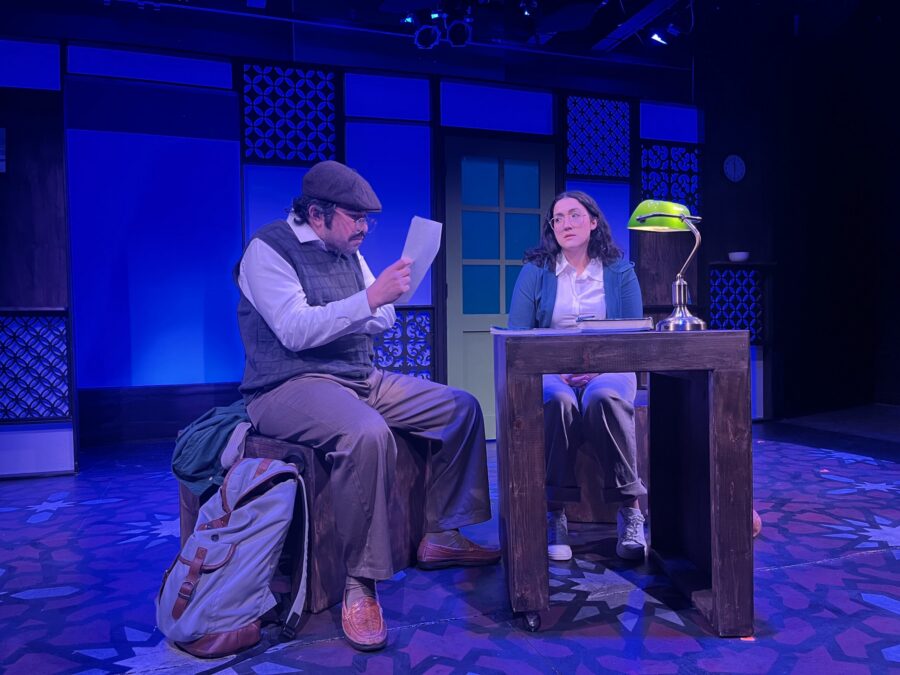
Playwright, mother, and aspiring film documentarian Nahal Navidar said she also navigates this push and pull in creating theatre. “I found I was feeling a lot of guilt during the production process for having this affirming artistic moment at the same time that my family in Iran is experiencing so much devastation,” Navidar said of her play, The Unknown Variable, which made its Chicago debut earlier this year. “To this day, I haven’t really brought up the play to them.”
Navidar described the play as a love letter to her dad. It loosely maps her life growing up in Iran until she was 6, when she immigrated to the U.S. with her mother and they waited for her dad to overcome visa issues and join them. Her partner, Jordan Merimee Navidar, and producer Jacob C. Shuler supported the first draft’s development, and after winning an independent artist grant from the Department of Cultural Affairs and Special Events (DCASE), Navidar was able to get it onstage with Chicago’s Momentary Theatre. What made it bittersweet is that while the team started rehearsals in November 2025, the play opened in January 2026—around the time 1.5 million Iranians took to the streets in protest and the Iranian government responded with deadly force, resulting in a high death toll (some estimates put it as high as 36,500), masked by an internet blackout.
“Creating in the United States as an Iranian artist—I can’t separate the guilt of having that privilege to exercise my voice and tell my story when my family in Iran doesn’t have that privilege, and they will be in danger for exercising that right,” Navidar said. “It was a very jarring experience to have the play up at that time.”
Navidar’s ambition as an aspiring film documentarian is an extension of her theatre practice, rooted in a desire to preserve memories for future generations. Since having her son Nima five years ago, the urgency of documenting family history has only grown for her. “I want my son to know his family’s history and for it not to be erased,” Navidar said, “and for him to understand and know intimately the beauty of Iran.”
Navidar had envisioned what it would be like to navigate difficult conversations with him one day. Then he stumbled upon Persepolis, by the late Iranian-French graphic novelist Marjane Satrapi, in a pile of books at their home and asked her to read it to him. Though she felt it was a little too adult for him, she opened it anyway and found the imagery deeply moving.
“Here’s this little kid who is learning how we express our emotions,” Navidar said. “He was pointing to pictures and saying, ‘Maman, how is she feeling? How is he feeling? Why is he feeling that way?’ I didn’t even have to read the words, but he could just evoke the turmoil that these people were going through in this time of revolution in Iran. I wasn’t prepared to have that conversation with a 5-year-old quite yet.”
The ongoing bombings have rarely been covered in detail by the U.S. media. Even as a journalist myself, the news I get about what’s happening in Iran comes directly from friends or their suggestions of who to follow on Instagram. But recently I’ve found new dinner tables where the subject is broached with conviction.
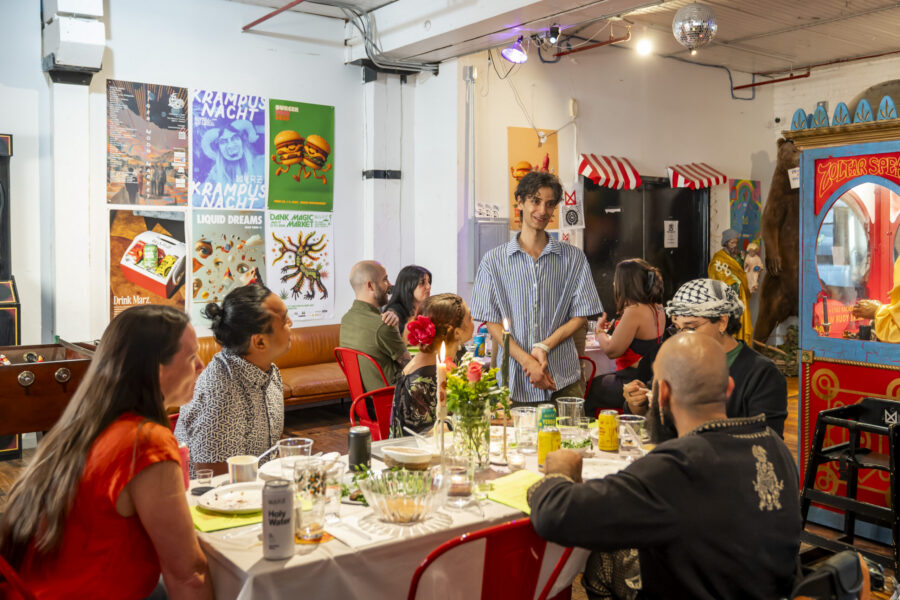
In Chicago, Co-Prosperity and the Public Media Institute began curating the program “Community Kitchen Dinners: Recipes for Survivance” at Marz Community Brewing. The Iranian Night was led by multi-disciplinary director and Iranian artist Hesam Salehbeig, and centered on solidarity and storytelling over a traditional meal. Salehbeig immigrated from Iran three years ago for their MFA, and appreciated the opportunity to nod to our culture of “sofrehs,” in which sitting around food on the floor, picnic-style, offers somatic grounding and connection to those around you. At this dinner, Salehbieg said they “saw many people that didn’t know each other become familiar.”
“That was one of the most important goals that we had in mind,” they said, “which was to bring people together. I think that’s simple to say, but it’s very, very difficult to make it happen, especially now that nobody has time. Being able to create that space for people to just be without any other attachments is really historical and cultural.”
Menus adorned with calligraphy and Persian mythology accompanied the meal and invited participants to engage with memories of comfort food. Notably, Salehbeig wrote a curatorial essay citing Persian voices across history who also withstood turbulent times. Though they also created art amid conflict, the poets Ferdowsi, Nizami, Rumi, and Hafez are not remembered for their “proximity to war, but for their devotion of love.” As Salehbeig wrote as part of the menus, “These traditions return to a simple insight: Love is not the reward for a peaceful world; it is what allows us to remain human when the world is not at peace.”
As we endure such turbulent times, reminders to both witness and take care of ourselves often seem at odds. Though Mirashrafi said she has taken a step back from theatre, she commends and is “in awe of any Iranian artist who is creating right now.” With censorship and war as exhausting constants, she believes that art-making can be “an immense act of defiance…that despite all of the destruction, there is simultaneously creation happening.” She quickly added: “If you are an Iranian artist and you’re reading this and you’re like, ‘I just can’t—I can’t do it right now,’ you don’t have to.”
The only “generative thing” Mirashrafi has created recently is music for her band Chera Chera, loosely translated as the plea, “Why? Why?” in Farsi. “There’s something about the indirectness of narrative that you can do through a song,” she said, that has allowed her to access some of the “deeper feelings” she’s swallowed in contending with ever-present global strife.
“The great tragedy of this intra-conflict,” said Toossi, “is that most of us—I’d go so far as to say almost all of us—are on the same side. We want the same thing. We want a free Iran where Iranians live with dignity. We want to be free of the humiliation and violence that have shaped so much of our recent history.”
More and more, I am drawn to creating space I believe my dad would have wanted to be in, despite his efforts to distance himself from Iranian culture: witnessing our stories onstage, tasting a sofreh of memories, moving to music. Big and small, public and private, cultural expression is how so many in the diaspora are committing to hope and to our preservation.
Yasmin Zacaria Mikhaiel (she/they) is a Chicago-based dramaturg, arts journalist, and cultural producer. She founded BIYA BIYA Productions to platform and pay diasporic artists. Follow them on socials @yasminzacaria, a.k.a. “dramaturgically it tracks,” @biya.biya.productions, and read their Substack, BIYA BIYA.