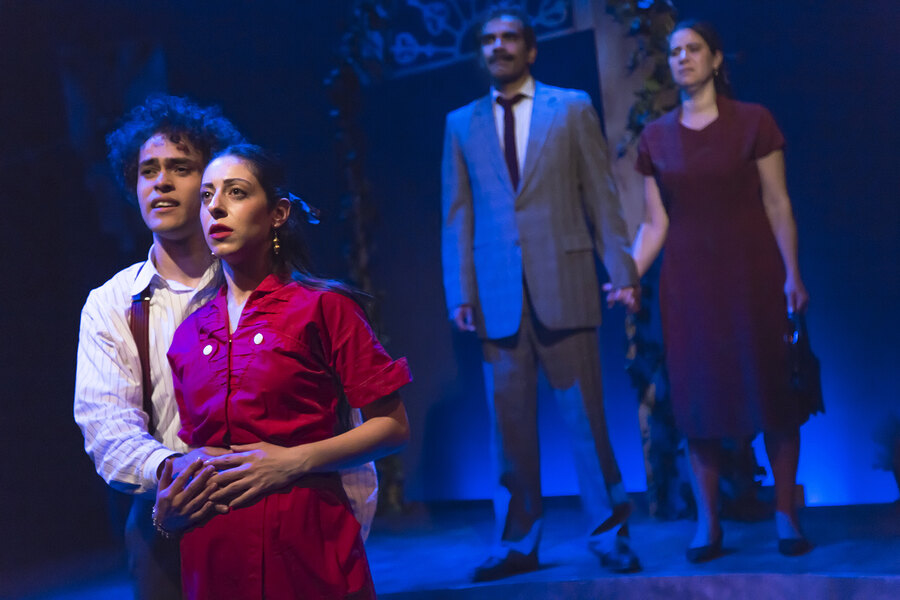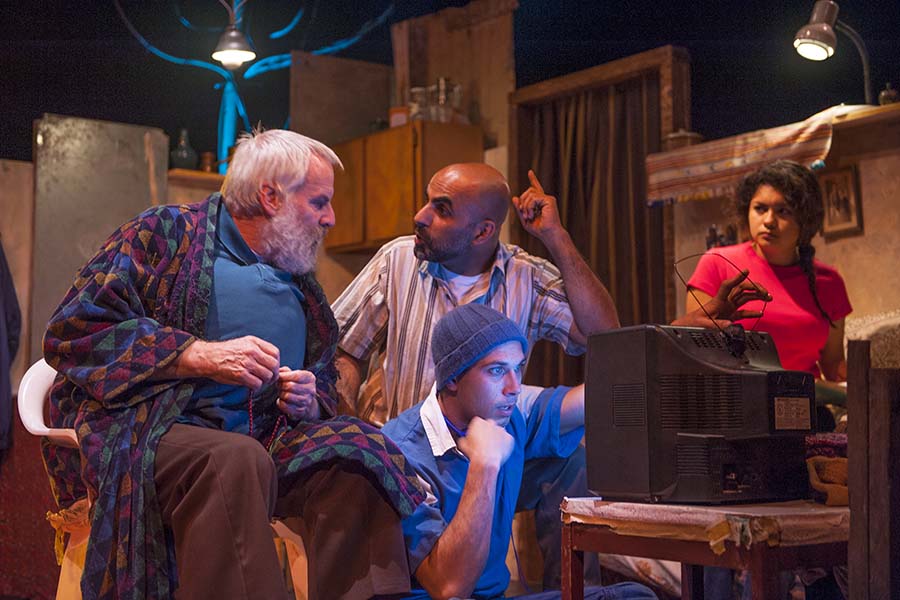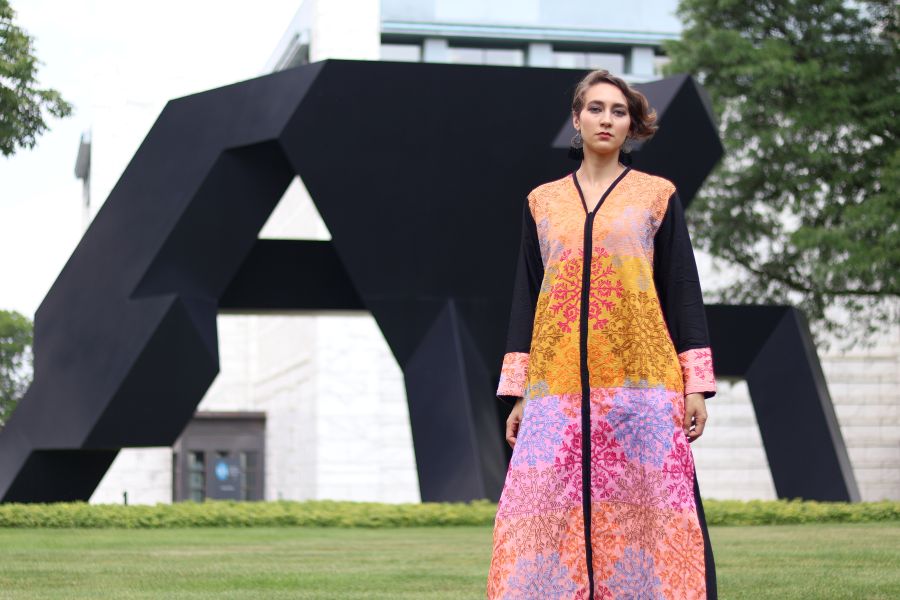
YASMIN ZACARIA MIKHAIEL: Your characterizing home as “ethereal” resonates with me, especially when considering the homelands that don’t exist anymore. Can you speak to the variations in culture that you’ve grown up with? As mixed-race and first-generation artists, there’s so much we pick up and put down as we navigate belonging.
NABRA NELSON: I’m very lucky as a biracial person to really have grown up half in each of the places where my family is from—my first eight or nine years in the United States, in California, and the next nine years in Cairo. I grew up bilingual as well, speaking Arabic and English. I grew up with a very strong rooting in both of my cultures and ethnic identities; I’m learning that a lot of [diasporic] American folks didn’t get the opportunity to have that equal experience of two cultures if they’re biracial or mixed race. That search for belonging has been a little bit easier on me.
There’s still that need to find a place, always being an insider and an outsider. But I feel so rooted in both sides of my family and both cultures that I grew up in and in the mix of cultures in between. It’s deeply influenced my artistic practice, especially as a writer. As a playwright, I write about identity at the intersection of different identities, because I’ve always been navigating a plethora of different ways of being, and have enjoyed that navigation. I have struggled with it, but also have felt very enriched by it. Those questions of identity are at the forefront of my artistic practice.
So many artists find the arts because of that yearning for belonging, a desire to find your people and express yourself. As a playwright and director, your career has also included a lot of administrative work. I’m curious how you balance being both artist and administrator. Have you faced challenges in holding both?
I just don’t think that there was ever a choice to do one or the other. As an artist, I was gonna find a time to make art. Honestly, it’s not even finding the time—it’s like, when I have time and expansiveness and room to breathe, I fill that with art. If I don’t, I still fill it with art. I stay extremely busy, but when I’ve had breaks, that’s when I start writing something new, or spontaneously make a short film, or paint something, just for the heck of it. As artists, we can’t stop, so we don’t.
I also consider the arts admin work I’ve done as a part of my artistic practice, especially since I’ve been really lucky to be in community engagement at regional theatres. Community engagement really is an art form. In my mind, it connects a lot to how I think of physics as an art form. People usually think those are completely different things, but in my mind they’re not. When you distill it down, they’re both deeply about creative problem solving. We’re using art to solve problems. That type of work makes my brain tingly—a problem-solving feeling that I absolutely love. Curating community engagement programs and navigating all of the little elements of arts admin and interfacing with people and with artists, thinking creatively about how these events connect with the art on our stages, is a way that I also practice my artistry.
I hear you on the breadth of skills that it takes to really exist and survive as an artist across your own practice, but also in support of finding audiences to enjoy that art. I’m curious what values keep you grounded in this work, or what guides what you say yes to and where you put your energy.
My guiding light has always been building community and creating positive change through the arts. However I can do that, I do it, and that’s why I’ve had so many roles. I’m not precious about how I do that. I don’t need to do that as a director or a writer or an administrator or a dramaturg, or whatever label I’ve had in the past. If that’s as an educator or as the person who gets your spreadsheet in order, I’ll do that. If a skill set that I have or can learn can contribute to that, I’m open.
At the core of what art can do is culture change—it’s what we’re in the business of. It is the thing that art does: Shift and change culture. We can use that for good or for evil. I take that responsibility very seriously. Those questions—of why arts right now, or what is an artist’s contribution to the moment, especially in times of distress and tragedy—just seem so obvious to me. Art is not separate. It is the only thing that actually defines what culture is, and thereby can shift what it is.
I’m so curious how that kind of commitment to culture change has been with you as you move through different companies. Can you tell me about your journey to Golden Thread? What has that looked like for you?
I’ve been doing theatre as a mixed-race person my whole life, starting in Egypt. For most of growing up, I didn’t consciously know I’m making theatre that’s culturally informed or culturally specific. But because of those given circumstances, as soon as I was in the new context of the United States, I started to realize that my approach is so informed by my background of learning in Egypt and being informed by my mixed-race identities. That contributed to what kinds of art I was interested in and to why I was so interested in community engagement.
I entered the regional theatre as a directing resident, at first at Milwaukee Rep, Santa Cruz Shakespeare, and Denver Center for the Performing Arts. But it was at Milwaukee Rep, where they were just starting their community engagement department, that I was immediately drawn to that work, and ended up getting hired to help start and build that department. This really did lead me to Golden Thread, in that what has been essential to my career has always been exploring how art connects to underrepresented communities within institutional spaces like regional theatres, and how this art can really build communities and shift cultures within the local spaces that I was working at.
What I realized was that the folks that have always been doing the community engagement work actually, sustainably, and authentically, and with the most impact, are theatres of color, and other theatres that come out of need. Culturally specific theatres exist because the community needs them. I was like, I want to work more in those spaces. So I left regional theatre and became a freelance artist. I focused my mission on working in what I broadly define as grassroots organizations, ones that come out of community, that are integrally rooted. I’ve been in community with Golden Thread for a long time, and in the MENA theatre community nationally for many years. I couldn’t have imagined this exact thing being in my future—maybe the far future. Golden Thread is such an institution. It’s the place I think we, as MENA theatremakers, look to as a guiding light. Now that I am in this particular position at Golden Thread, I’m still a little bit shocked and in a daze about that all coming to fruition. It is exactly at the core of what I was focusing my personal artistic mission on that I had coming out of regional theatre. There’s no better opportunity to do that than in this particular position, at this particular theatre, in my opinion.
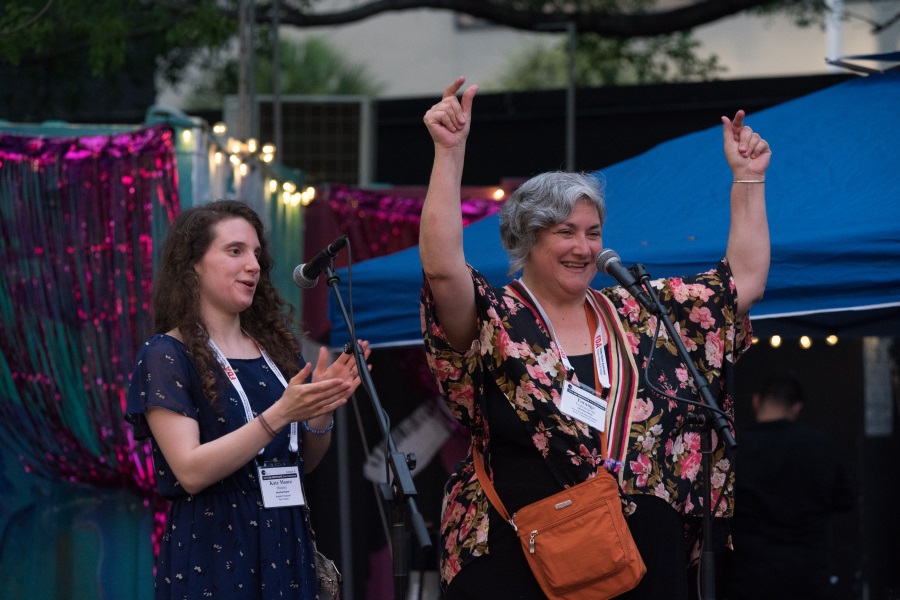
Golden Thread is celebrating 30 years of existence. It takes a lot for theatre companies to make it that far, and especially ones dedicated to SWANA communities, especially in the midst of ongoing global strife. I’m curious if there are any particular moments that cemented the legacy of this theatere company and what it means to our field?
There are so many examples before I even started my theatre career, but during my trajectory here there are two moments that stand out for me for Golden Thread. First is its role in the creation of MENATMA, the MENA Theater Makers Alliance; I have been in those conversations starting in 2019. That’s when I also met all the MENA theatre people, at TCG Miami 2019. I met everyone that introduced me to the greater national MENA theatre realm, including the folks at Golden Thread. We had a lovely time at the pool talking about coalition building across the U.S. MENA theatre. Golden Thread is at the core of MENATMA, and that advocacy work has been really important to me as an artist, especially with the MENA Bill of Rights.
The season for Palestine, of course, is one of those seminal moments in Golden Thread’s history and always will be. Responding to such a need in our global community and just stepping up and shifting the entire season to focus on Palestine in 2024 was such a brilliant and brave and necessary move. I just hope to be a leader that would make that shift. I’ve reflected on that since Sahar Assaf made that decision: I hope that I have that kernel in me. I think all artistic leaders should have in them the ability to make that kind of call to action from our community and from the world.
Building on that, what duty do you think artistic institutions and leaders have in addressing and responding to ongoing local and global issues?
That’s their job. Again, theatre is culture change, art is culture change. So if we need to change our culture, we each, as artistic leaders, have a responsibility to contribute to that in some way. I don’t think there’s any prescriptive way to do that. I don’t think that it’s like whenever some horrible thing happens in the world, every single artistic leader needs to do X. But whatever is happening, it’s so necessary to be in our consciousness, because we are contributing to the culture around us, what the community around us is and thinks and does. We have such power to mobilize people.
As a community engagement professional, I’ve thought of our theatres as the spotlight. We’re the ones who can shine the spotlight. We decide where the spot is shined, whether that’s what’s on our stages or with my community engagement work. It’s like, who are we inviting to have a spotlight? We have an audience. We have a stage. We have lights. We have publications that go out to thousands of people via email. We have mailing lists. We have so many ways of shining that spotlight. It’s very much a responsibility to decide where it gets shined. Having the consciousness of who does not have the spotlight or who needs it is our responsibility as artistic leaders. Period.
Are there other strategies that help shape how you respond to such difficult moments, or that help determine the urgency behind what decisions need to be made?
That is a great question. Maybe a strange answer to that question is remembering that it’s not that deep. We can change what we’re doing. We can just say something. We can open our doors. We can send an email. It may be strange to say that, but I think especially in institutions, for some reason, we’ve gotten into this mindset that there are certain systems that we have to follow and that we’re bound by. That we create a definition of what theatre is, consider that canon and truth, that it can’t be changed or broken. In fact, in those moments, [we need] to think differently, to think creatively about addressing a social or political or community issue that wracks our world, a war that shakes our world and our lives.
A genocide always shakes our world and shakes each of our lives. So if that shook us, why are we holding, white-knuckling, these definitions and systems that we made up? We made it up. We make the rules, and we can just do things within our resources as we wish. We can utilize these resources in ways that we want to. We can respond how we want. We can dismantle the elitism and preciousness and rigid structures that we have created around our institutions or our art form. Knowing this opens up so much possibility in those moments that require response. Simply look to people and look to community, and listen to them and respond to what they need. When the community tells you what they need or what they want, you can usually give it to them in some way, shape, or form.
I was actually kind of glad you didn’t ask specifically about the future of Golden Thread or my plans. So much of that answer is upholding legacy. It’s been done right. Previous leaders have done it right. We don’t have to reinvent the wheel. Of course, things will shift and change and new opportunities will come up, but that’s the artistic discovery process.
I got really acquainted with what artistic directors do as I worked in regional theatres. I came up with this belief many years ago that being an artistic director is a service position. It is in service to community, like an elected official. In my opinion, we should just be reflecting what the community wants. We should be listening to whoever we are “serving” and do that. I’m seeing that as the evolution of what this title means, as our theatre culture shifts from the auteur director to a real community service role.
Yasmin Zacaria Mikhaiel (she/they) is a Chicago-based dramaturg, arts journalist, and cultural producer. Learn more at yasminzacaria.com and follow them on socials @yasminzacaria, a.k.a. dramaturgically it tracks, or Substack BIYA BIYA.