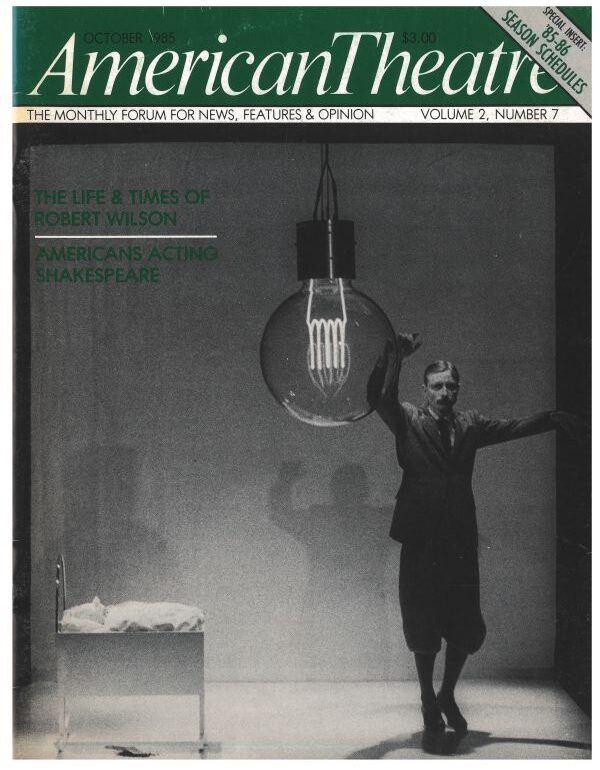
He is, it’s safe to say, the most celebrated and controversial avant-garde theatre artist in the world. Too bizarre for Broadway and too expensive for all but the most lavishly funded nonprofit theatres, Robert Wilson has developed his extravagant Theatre of Mysteries over the past nine years in Europe, most of it unseen by American audiences. Abroad he is the prince of images, surrounded by a nimbus of rumor and accolade, honored by art world intellectuals, the beau monde of Paris and Berlin and punk hopheads on the city squares. Now Wilson’s European exile is ending. His dreamlike, 100-minute fable The Golden Windows, which premiered at the Munich Kammerspiele in 1982, is due Oct. 22 at the Brooklyn Academy of Music, the latest evidence that Wilson, controversy and all, is coming home.
His American return was to have occurred two summers ago, with the single most ambitious theatre project of modern times: the CIVIL warS: a tree is best measured when it is down, a nine-hour, $7 million “planetary opera” assembled in six nations and planned as the inaugural work of the 1984 Olympic Arts Festival in Los Angeles. In a saga of failed entrepreneurial ambition worthy of Michael Cimino, the completed work was never presented. Instead, Wilson settled for a revival at BAM last fall of Einstein on the Beach, the four-and-a-half hour opera he co-created with composer Philip Glass in 1976. With its incantatory libretto of solfège syllables, counted numbers and stream-of-consciousness monologues, and Glass’s simple harmonies repeating and permuting at ear-splitting decibels, Einstein had sold out the Metropolitan Opera House twice at its American premiere. The sheer Wagnerian grandeur of last year’s Brooklyn event, the hallucinatory elation it generated, appears to have signaled the revival of Wilson’s fortunes in a country that for some years seemed unable to make a place for him. A few months later, a three-hour version of the German section of the CIVIL warS opened at the American Repertory Theatre in Cambridge, Mass., hailed by critic Kevin Kelly of The Boston Globe as an event comparable to Picasso’s Guernica and Stravinsky’s The Rite of Spring.
But the reemergence of Wilson in America has, if anything, only deepened the controversies surrounding his work. To scores of supporters in the art world, as well as increasing numbers of middle-class theatregoers, Wilson is the avatar of a new theatre consciousness, an artistic visionary creating works that must be experienced to be understood. Dodging the cultish reverence his work evokes, others admire a brilliant designer and showman whose willful obscurity is, for better or worse, part of the package. In contrast, to theatre traditionalists and the politically engaged, Wilson’s work can seem unutterably boring, irresponsible and pretentious beyond belief—“an artistic and human scandal,” the critic John Simon has written, a theatre “for escapees from thought, feeling and confrontations with reality.” In recent years, some formerly sympathetic observers have suggested that Wilson’s explorations into the nature of theatrical time and perception have devolved into a set of self-inflated clichés. To these detractors, Wilson has been blackmailed by his own vision into becoming a kind of artist-businessman, increasingly prone to grandiose designs, sacrificing the communal ethos and spiritual integrity that gave his theatre its birth—and with the CIVIL warS, finally creating a work touched by a truly Faustian madness.
For his own part, Wilson is ending his European exile convinced he can become for late 20th-century American culture what Verdi is to the Italians or Wagner is to Germany. And he’s fully prepared to take all the time in the world.
Born and raised in Waco, Tex., the son of a middle-class lawyer and a housewife who never touched him until the day he left for college, Robert Wilson grew up “knowing the drama of those who fight to conquer a language” (as one Italian critic put it). He may once have suffered from a learning disability, and still reads with awkward slowness; at age 17 he was relieved of an annoying tendency to stutter by a ballet teacher named Mrs. Byrd Hoffman, who simply taught him how to take his time. Given as a youth to strange dramatic gestures—he once recited an original poem called “Birdie, Birdie, Why Do You Bond So” at a school assembly—he was nonetheless a charismatic, popular figure at school, a fact attested to by the warm tributes from classmates that fill his high school annual. Wilson began a career in children’s theatre at the University of Texas; his vision would never depart far from the perspective of childhood, with its desire for fresh spiritual dispensation from the rigors of adult logic. At college Wilson majored in business administration and joined a fraternity, but dropped out not long before graduation, with nothing particular in mind. After studying painting for a year in Paris, he enrolled in an architecture program at the Pratt Institute in New York, where he began to focus his interest in performance and design into therapeutic work with brain-damaged and hyperactive children, as well as with the aged and terminally ill.
Wilson proved to be an extraordinarily gifted therapist, helping patients to perform simple, repetitive actions to stimulate their mental activity and increase confidence and self-awareness. Institutional authorities usually wanted their wards to become acceptable within the normal horizons of human life, but Wilson “encouraged them to do what they wanted to do,” he says today, “instead of trying to correct or teach.” Autistic children especially—those feral children of the psyche—seemed to him to possess a special innocence, an almost mystical insight. Fascinated by aberrant perception, Wilson intuitively suspected that abnormality is precisely what everyone shares.
Not long after graduating from Pratt in 1965, despondent over his failure as a painter, Wilson flew home to Waco, took a cab to a motel outside the city and administered himself an overdose of sleeping pills. This suicide failed; he woke up in a hospital and managed a release from a mental institution six weeks later. Returning to New York, committing himself to visions larger than a canvas, Wilson began to unite dance, the visual arts and his continuing therapy research into a style of theatre that would draw as well on the counter-cultural currents of the ’60s.
Joining an active theatre scene in the downtown Manhattan avant-garde, Wilson became the Pied Piper of a group of amateur disciples—“ordinary people, borderline psychotics,” critic Stefan Brecht has written—experimenting with meditative action, drug-induced creativity and the mechanical repetition of gestures and movement. Influenced by the time-motion studies of mothers and infants that reveal a range of emotional expression invisible to the naked eye, Wilson was investigating a world beneath the surface of consciousness—“the world you experience when you blink your eye,” he once remarked. Staging slow motion actions in strange and fantastic tableaux where objects might float in space or camels appear suddenly in drawing rooms, he discovered a sense of time fundamentally different from the rhythms of life—“time to think,” he said. By the mid-’70s, actors would be sewing alarm clocks into their costumes to remind themselves to leave the stage. Wilson’s elegant stage designs combined a child’s sense of fantasy, an architect’s sense of scale, and an entrepreneur’s resourcefulness: his first “silent” opera, The Life and Times of Sigmund Freud, marked the beginnings of a major reputation in the art world.
Although his performers were by and large untrained, Wilson had an eye for unusual and arresting stage personalities. In 1968 he saved an 11-year-old black orphan and deaf-mute from a beating at the hands of a cop; Raymond Andrews was considered wild and incorrigible, but Wilson discovered his astonishing capacity for remembering movement, as well as his ability to hear sounds with his body and to communicate with a voice that had never heard a spoken language. Wilson arranged for Raymond to move into his loft on Spring Street in Soho and began to create a new work around the boy. In a long series of workshops, members of Wilson’s Byrd Hoffman School for Byrds imitated Raymond’s sounds and movements, shaping elements of dance, mime and dream imagery into a three-and-a-half-hour mystery play.
When Deafman Glance opened in Paris in 1971, Le Monde called it a “revolution” seen only once or twice in a generation. “The miracle came about long after I stopped believing in them,” wrote the aged surrealist poet Louis Aragon. “The world of a deaf child opened up to us like a wordless mouth. I never saw anything more beautiful in the world since I was born.”
Hailed as a genius in Europe, guru to a burgeoning tribe of Soho artists and performers, the 30-year-old director moved into the ’70s contemplating works on an even grander scale, working within the dimensions of natural phenomena like dawn and dusk. Dressed in the plain dark sports jacket and horn-rimmed glasses of an insurance accounts executive, the six-foot-four-inch Texan with the whooping, shrieking laugh parlayed his new fashionability into support well beyond traditional theatre circles, attracting intense personal commitment from wealthy patrons in society, fashion and the visual arts. The Empress of Iran funded KA MOUNTAIN AND GUARDenia TERRACE (1972), a ritual set on an Iranian mountaintop that continued for 168 consecutive hours with a cast of 500. The following year, the Byrd Hoffman Foundation produced the 12-hour-long Life and Times of Joseph Stalin at BAM, with 144 performers and hundreds more working behind the scenes on a retrospective of all Wilson’s earlier work. The ballet of the ostriches, the turtle that took an hour to cross the stage, the chorus line of 60 black Mammies moving to the strains of “The Blue Danube Waltz”: Stalin confirmed Wilson’s reputation as the premiere avant-garde artist of the age.
Riding a wave of cultural chic, the Byrd Hoffman School remained very much alive through the mid-’70s, with its open movement workshops and an extended community of volunteers and workers that for a time contemplated forming a commune in British Columbia. Never afraid to be seen in the Emperor’s new clothes (he once spent 12 hours at a Yugoslavian press conference slicing onions and repeating the word “dinosaur”), Wilson nevertheless harbored ambitions that would carry him beyond the art world on to Broadway. Inspired, he said, by the light falling across an envelope and an overblown Victorian missal, A Letter to Queen Victoria (1974) had the lineaments of a real play, with shadows of characters and interaction between performers. Its co-author was a new presence at the Byrd Hoffman School: Christopher Knowles, an autistic teenage boy with a startling sense of the musical and visual textures of a language. “The Sundance Kid was beautiful,” Christopher Knowles announced to a very startled Broadway audience:
THE SUNDANCE KID WAS VERY VERY VERY VERY BEAUTIFUL
UP IN THE AIR
THE SUNDANCE KID WAS BEAUTIFUL
YEAH BOOM
|YEAH THE SUNDANCE KID WAS
BEAUTIFUL
YEAH THE SUNDANCE KID WAS LIGHT
BROWN BROWN
A KIND OF YELLOW SOMETHING LIKE THAT
BROWN A KIND OF YELLOW. (Curtain)
Knowles had been creating such writings, along with taped collages of radio programs, for months before meeting Wilson; he first appeared onstage at the opening performance of Stalin, and not long afterwards moved into the Spring Street loft space vacated by Raymond Andrews. Intuitively attracted to Knowles’ radiant innocence and shattered, schizoid caricatures of thought, Wilson began to create similar texts as “weather” rather than as any exposition of meaning, listening to television and scribbling down scraps of phrases and sentences; on one occasion he wrote a scene based on a Karen Black made-for-TV movie. Wilson allowed Knowles to write and co-direct The $ Value of Man for BAM in 1975. It was Wilson’s most concentrated work thematically, filled with parodic vignettes about money, greed and business, declaring the simple anarchistic message that everything should be without cost.
By unbinding the universe of language, Knowles had confirmed Wilson’s implicit views of the moral disinteredness of art. But Wilson’s decision to appropriate every area of theatrical sensation would lead him irresistibly toward a new kind of total theatre, a Wagnerian blending of the arts that represented, in the minds of some critics at least, a re-invention of spectacle for the late 20th century.
Robert Wilson and Philip Glass constitute an artistic collaboration made in heaven. Also well known in Europe and in the American art world, Wilson’s first partner of equal stature shared an architectural approach to form, an interest in the use of repetitive motifs and extended passages of time, even something of a mystical bent. Meeting every Thursday throughout 1975, they worked out an opera scenario based on Wilson’s drawings, and with a $150,000 Bicentennial grant from the French Ministry of Culture, rehearsed a group of singers and dancers from December to the following March. Less an opera than a four-and-a-half-hour, intermissionless masque, Einstein on the Beach grew as a vision of the titular physicist as child, man, violinist, mystic and father of the atomic bomb, conjuring images from the birth of relativity with the freshness and rapture of a dream.
Einstein opened at the Avignon Festival in France, then toured to Hamburg, Belgrade, Venice, Brussels and Rotterdam before sweeping into the Metropolitan Opera House in November 1976. Whole sections of the audience booed and cheered at random, and hundreds walked out, passing their ticket stubs to hundreds more who waited in the cold outside. The downtown New York avant-garde had stormed America’s cultural Parnassus and taken it; Wilson had finally arrived where he thought he wanted to be.
But at the final curtain, Wilson walked offstage “ready to commit suicide,” according to one close associate. The Einstein tour had been riddled with dissension—the mid-’70s collapse of the counterculture community, the big chill of careerism, petty jealousies, fights over program credits—and, according to some participants, the director’s tantrums and emotional manipulation. Rumors flew of drug abuse, long a presence in Wilson’s circles (in 1972 Wilson himself had been arrested in Crete for possession of hashish). But primarily there was financial disaster: despite raising over a million dollars to produce Einstein, the Byrd Hoffman Foundation, staggered by expenses at the Met of $90,000 a night, was in debt to the tune of $125,000.
Attempting to elude catastrophe, Wilson quickly arranged what he hoped would be a more commercial venture, I Was Sitting On My Patio This Guy Appeared I Thought I Was Hallucinating. A chattery, minimalist duet with Lucinda Childs, Patio reached Los Angeles and toured Europe but was largely reviled by critics. Vowing never to produce himself again, Wilson could find no theatres in America ready to assume the expenses of his aspirant masterpieces. His foundation nearly closed down, the Spring Street loft was sold to a boutique, and the man acclaimed as America’s theatrical visionary entered his years of cultural exile searching for scale equal to his fantasies.
With Death Destruction & Detroit, commissioned by the city of West Berlin in 1979, and Edison, presented in Lyon, Paris and Milan later that same year, Wilson’s fascination with spectacle and visual perfection reached new heights. Developed at the Schaubühne, a lavish state-subsidized facility, DDED became Wilson’s most deeply imagined work, its visual design inspired in part by Hitler’s architect, Albert Speer, and its secret subject the Nazi Rudolf Hess—a fact unnoticed even in Berlin. With his own sense of theatrical priorities, Wilson grew increasingly obsessive about detail. Nearly six weeks were spent lighting the Berlin show, most of it with actors in full costume and makeup while the director fussed impetuously over cues and focuses.
Professional actors brought a new precision to Wilson’s work, which grew increasingly cold, distanced, automatic; “Oh, you want us to be machines,” one performer reportedly complained. “I’m not afraid of that,” Wilson reponded. “There’s freedom in being mechanical.” Slugging from a bottle of vodka during rehearsals of Edison, Wilson would tell actors that their “motivation” become a vertical line; some didn’t know what characters they were playing until they read the program; at auditions, they had been asked to repeat the word “ravioli” for minutes at a stretch.
Despite the success of these works in Europe, Wilson did not seem content, cornering anyone who would listen to the same bitter harangue about being misunderstood in his homeland. Plans to bring DDED to the Met collapsed when Wilson insisted that lights be mounted in the stage. For a stretch of more than six years, presentations in America were limited to small-scale “chamber works” (including controversial DIA LOG events with Chris Knowles, which raised the issue of Wilson’s exploitation of a handicapped boy) and an infamous performance of Edison as a work-in-progress in Manhattan. Before an invited Edison audience that had shelled out $50 a ticket, Wilson kept bounding on stage to suggest a lighting change or to fine tune the position of an actor’s chin. When the audience began snickering and talking among themselves, Wilson shouted that he was “sick of this shit.” Muttering, “Fucking America! Fucking America!” between clenched teeth, he told his guests that if they didn’t like it, they should “go see Sweeney Todd or The Elephant Man.”
Divorced from the downtown community that had once sustained his work, reviling an audience that might have helped him to a new plateau, Wilson appeared to be losing the ground under his feet. But whether through the courage of conviction or supreme megalomania, he was already sketching ideas for a new spectacle based on the American Civil War—inspired at first by Matthew Brady’s photographs, then by the Industrial Revolution, and finally by “the whole last half of the 19th century,” Wilson later suggested. Shopping the idea at theatres in Houston, Paris, Munich and Hamburg, he at last found a sponsor conceivably powerful enough to realize his second coming in America: the Olympic Arts Festival, funded by the Los Angeles Olympic Organizing Committee and the Times-Mirror Foundation, set to open in June.
Meeting with the festival director, Robert Fitzpatrick, early in 1980, Wilson proposed a 12-hour multinational epic incorporating the labors of more than 200 artists from around the world: the CIVIL warS would be a history of civil strife, the story of mankind’s passage from war to brotherhood in 5 acts and 15 scenes, financed and created in Holland, Germany, Italy, France and Japan, with additional material contributed by the United The most complex theatre piece ever attempted, a work on the scale of Wagner’s Ring cycle or the court spectacles of the Renaissance, it would ultimately involve companion books, art works, furniture, video and film, along with radio and television adaptation. Of the top of his head, Wilson guessed that production costs for only a week in Los Angeles would reach $3 million. Defing America’s indifference, Wilson’s ambitions had reached critical mass: he was about to enter a tradition of American grandiosity that has sent numerous major artists down in flames.
While planning continued on the CIVIL warS, Wilson resumed work on a number of smaller projects in Europe, including The Golden Windows, originally conceived as drawings in 1979-80. Wilson titled the already completed work from a Laura Shapiro story he had known for years; the first workshops were conducted at La Mama in New York during 1980, and another series followed a year later. After two months in Munich during the spring, rehearsing what Wilson describes as “a clear visual logic and an illogical text,” The Golden Windows opened in May to an enthusiastic critical response, selling out its run to largely middle-class audiences. The Golden Windows was a work “about a deep, passionate, destructive love, about relations to children, and about existential fears,” wrote one critic at its premiere.
Buoyed by this favorable response, Wilson returned to the CIVIL warS that June, gathering more than 50 designers, writers, technicians and performers in Munich to begin work in earnest-mounting the annotated scenic drawings on a huge wall, building models, even blocking some of the action for a five- or six-hour run-through. The Olympic Arts Festival had extended an official invitation to the production, offering to provide up to 10 percent of the L.A. production costs and making it clear that no further financial help was forthcoming. Byrd Hoffman would have to produce what was shaping up to be some of the most exorbitant theatrical moments ever contemplated. Sifting all of human culture and history through his imagination, Wilson was fashioning a series of living tableaux that swept across continents and eons, a masque of humanity from prehistory to beyond
Opening on a plain in Africa at the dawn of civilization, shifting to a space station where a man and woman stand on ladders facing an enormous map of the world that divides while a chorus of voices sings in Latin (one of 14 spoken languages the work eventually contained), the CIVIL warS crests in a timeless landscape in which Ninjas fly through the air, giraffes talk and the Monitor and the Merrimac do battle; the world’s tallest woman crosses a cabbage patch with a dwarf in her hand, children fly a hot air balloon down the Grand Canyon and Madame Curie rides her bicycle in an underwater flower garden. Through fragments and echoes of history and myth-the cultural accretions of the world—the CIVIL warS had become a pageant of human civilization, a parable of a race fated either for apocalypse or redemption.
Sleeping on trains, eating in pensions and cheap hotels, flying from Frankfurt to Minneapolis to Tokyo to New York to Rotterdam to Paris, jet-lagged and chronically late for every appointment, Wilson entered a grueling schedule of fund-raising in the very process of creating the work itself. Thriving in a constant state of crisis, his extravagance grew impossible: If he wanted a lion on stage, then he would have a real lion; the opera stars Jessye Norman and Hildegard Behrens were engaged; for a time Wilson’s friend Richard Gere was scheduled to play Robert E. Lee as a samurai warrior. In studying Vanity Fair caricatures of Lincoln as a baboon, devil, nursemaid and juggler, Wilson thought David Bowie “someone appropriate to that way of thinking”; the director flew to Switzerland, where Bowie offered to do it for nothing plus expenses: $100,000 a week.
Perhaps that kind of money was possible with help from the CIVIL warS’s international fundraising committee, populated by the likes of Mme. Georges Pompidou, Willi Daume, Gloria Vanderbilt, Eric de Rothschild and Issey Miyake. Close to a million dollars was being raised in Germany; the Italian government committed a similar amount, the largest single contribution to an art work in its history. Just under $300,000 would be raised in Japan, two million francs from the Côte d’Azur, and another half million from the Dutch government and eight French co-sponsors. Working from its tiny offices in New York, the Byrd Hoffman Foundation would spend over a half-million dollars in fund-raising and pre-production alone. “We have the feeling in Europe, and particularly in Munich,” declared that city’s Commission of Culture, the CIVIL warS is one of the most important works of our century.”
In April 1983, rehearsals for Act I Scene B began in Rotterdam with a group of Dutch, American and German actors. In May, funded by the Japanese-United States Friendship Commission, Wilson worked in an art district warehouse on the Bay of Tokyo, collaborating with Talking Head David Byrne, various vanguard Japanese performers as well as Noh and Kabuki actors—the first time they had ever appeared together on stage. Virtually unknown in Japan, where the tax structure provides no incentive for arts donation, Wilson faced his greatest fund-raising challenge: “There was this tall Texan bursting into rooms and whooping and punching you in the arms,” recalls Adelle Lutz, his assistant director in Japan. “The Japanese would be dumbfounded. Everything would become quiet with Bob laughing like a crazy man.”
From Tokyo Wilson moved on to the Schauspiel in Cologne, where he worked with the first adult writer of his career, the East Berlin playwright Heiner Müller. Müller’s visual, imagistic text represented a departure from the random “weather” of Wilson’s own writing, and yet was nearly as resistant to interpretation; Wilson claims Heiner Müller “changed my life.”
In July the director was on to Rome, blocking the final act of the CIVIL warS for Philip Glass. Returning to Nova Scotia and New York to write a full opera for chorus and orchestra around the Rome staging, the composer would later contribute music for the Cologne section as well. In August, Wilson flew on to Rotterdam, then Japan, Los Angeles, New York and Minneapolis—sleepless, living day for night, wreaking epic insanity among those around him, behaving as if the entire world existed to serve his vision. “Bob was over the edge,” recalls Robert Applegarth, the project’s director. And Wilson was still short the millions needed to produce the finished work for five nights at the Shrine Auditorium in Los Angeles.
“I will say,” Applegarth adds, “that I never laughed more in my life.”
On Sept. 5, 1983, the Dutch act of the CIVIL warS opened at the Schouwburg in Rotterdam with an evocation of the four seasons. Only winter—with Mata Hari skating along a frozen canal—survived into the spectacle planned for Los Angeles; what proved to be the weakest of the five sections reopened successfully in Paris later that month. Wilson spent the next several months rehearsing in West Germany, cheered by news that the BBC planned a documentary on the completed work; the Cologne section premiered in January 1984 as an extraordinary reconfirmation of his gifts. With its opening image of the continents dividing, the red-coated soldiers marching in wave after wave across the stage, the Civil War campground visited by a merry Oldsmobile, the CIVIL warS ran for two months in Cologne to enthusiastic audiences. “I cannot do better work than Cologne,” Wilson announced.
Returning to Tokyo in January, with 11th-hour funding (from a Kyoto kimono manufacturer and a Tokyo burger outlet) raised by Madame Hanaemori, the Coco Chanel of Japan, Wilson staged a private premiere of the Japanese act at her swank fashion theatre downtown. The French section, scheduled to receive its public premiere in L.A., was rehearsed in Marseilles during February, with music provided by the British minimalist Gavin Bryars; it included a range of historical figures floating in the air, the giant staircase of the Paris Opéra underwater, Jules Verne’s Nautilus, and the duel of the Monitor and Merrimac.
Flying from Marseilles, smoking cigarettes for the first time in his life, Wilson somehow managed to lose a shoe on board the plane. Glass’s music—romantic in form and feeling, explicitly reminiscent of Verdi in certain passages—included a remarkable aria for Garibaldi; the mythical founder of the Olympic Games, Hercules, sang in a forest with the trees of all nations during the climactic final scene. Except for the connective “knee plays,” scheduled for Minneapolis in April, Robert Wilson had achieved what many people considered impossible: He had finished the CIVIL warS.
Disaster, meanwhile, was brewing in L.A.
Wilson and Applegarth had gotten almost nowhere toward raising the money to produce the finished work at the Games. Despite $1.4 million gathered from the Olympic Organizing Committee and the National Endowment for the Arts, the sale of Wilson’s drawings and projected box office receipts, another $1.2 million was still needed.
With the January deadline past, there was nowhere to go except to wealthy Angelenos and the American business community.
Yet Wilson’s work was almost completely unknown in L.A., where major sponsors had already contributed to the Games themselves. The one name capable of attracting large donations, David Bowie, was withdrawn in December due to other commitments. The sheer scale of the project, together with the prospect that it might not happen at all, was enough to scare off most potential donors, who in any event wouldn’t receive credit for major gifts because the Times-Mirror Foundation was the official festival sponsor. Wilson urged Fitzpatrick and the Olympic Organizing Committee to help fund-raise, arguing that the CIVIL warS was the only original work created specially for the festival, and that five nations had already secured funds to send their respective sections to America. Fitzpatrick replied that he couldn’t possibly give special help to one event out of 102 in the Festival. Wilson was in a weak position to force his hand—until February, he couldn’t be certain that the CIVIL warS would be ready at all.
Ten days before the scheduled Rome opening, Applegarth announced privately to Fitzpatrick that the completed work had no chance of opening. Fitzpatrick suggested that they present the Rome section and the “knee plays” alone, but Wilson adamantly refused, saying that it was impossible to leave any of the countries home. On March 30, Wilson and Applegarth issued a desperate last-minute plan involving simulcast satellite hookups to each of the five nations to be represented in Los Angeles. With the opening nine weeks away, Fitzpatrick felt there was not enough time to make the arrangements. On Saturday, March 31, he told the press that the CIVIL warS was finished.
“A crime against culture,” cried one Paris newspaper. “The failure of nerve in Los Angeles,” said The Wall Street Journal, “has resulted in a serious artistic loss.” “The problem is a lack of cultural policy in this country,” Wilson declared, before flying to Japan to bow apologies to co-workers and repay the Kyoto kimono manufacturer and the burger outlet. Blasting Los Angeles as “a second-rate cultural outpost,” he blamed the CIVIL warS’s failure on the L.A. Times, the Olympic Committee, and especially the private sector, which “was to support the Olympics. That’s Reagan’s philosophy, but they haven’t.”
What had begun as an act of Faustian ambition seemed, with hindsight, a Quixotic quest doomed to failure from the beginning. While the Olympic Organizing Committee counted tens of millions in profits from the Games, Wilson could do little but rail against the “corruption” of American culture, a culture that glorified in international competition but failed to support an equally grandiose fantasy of the brotherhood of man.
The “knee plays” linking the 15 scenes were produced post-mortem, opening in April in Minneapolis, with David Byrne shifting from Kabuki instrumentation to a New Orleans-style jazz. Portions of the German CIVIL warS were presented by American Rep this past February. But the completed work has yet to be performed. The Frankfurt World Theatre Festival plans to show the sections unseen in Europe and Avignon the unproduced French sections. And plans were recently announced to bring these international companies together with the Houston Grand Opera for a nine-and-a-half hour, $6.2 million staging of the complete work in Austin next fall, as part of the 150th anniversary of Texas’s founding as an independent republic. Whether Wilson’s quest will come to its conclusion in Austin remains to be seen.
We are all authors of our own dreams and many of our nightmares: The thought occurred at Wilson’s lower Manhattan loft on election night, as American democracy ushered in the second term of Ronald Reagan. Absorbed in Einstein rehearsals, Wilson had forgotten the fate of the nation; reminded of it, he shrieked aloud, rushing to his bedroom to watch a half-hour of television coverage. After Geraldine Ferraro acknowledged defeat, he returned to the interview to talk until four in the morning—not about American politics or cultural policy but the art of performers he admires. As the night wore on, Wilson’s conversation grew increasingly unrehearsed, darkness preserving the moral solitude in which phantoms of imagination breed. “I don’t sleep,” he explained, “because I feel I might
miss something.”
“I saw Dietrich 14 or 15 times in London,” Wilson was saying in his mild, pleasant voice. At three in the morning, a second bottle of vodka stood open on the table. “Every night, I watched her really carefully.” Visualizing the scene in his mind’s eye, he tapped out a pulse with his hand. “Ladies and gentlemen, Miss Marlene Dietrich-2-3-4, Spot-2-3-4, Enter-2-3-4, Downstage-2-3-4, Head, Cross. And you don’t cross until then. Every night, the applause the same place. The hand here, behind the dress, two steps down into the spotlight. Absolutely the same, the same lines every single night. It was so alive, so dangerous…something within this thing cut like a diamond, something spontaneous.”
Wilson carefully balanced a pencil on the edge of the table and continued. “She’d walk offstage to this electrical box where she kept a bottle of scotch. She’d…” And here Wilson mimed chugging from a bottle. “She’d drink a whole bottle of scotch every night and you didn’t see it. I took Sheryl Sutton [one of Wilson’s leading performers], and she saw four or five of these performances. I said, ‘Watch the space between her fingers, watch how she does that.’” Wilson gestured in the air. “It was like a wave through the theatre.”
On several occasions Wilson has launched into paeans about the space between Albert Einstein’s fingers; five years ago, he insisted that actors in Edison paint the spaces between their fingers with makeup.
“If I get, in the next 15 years, three major works…” he mused a moment later. Following The Golden Windows, Wilson plans to direct DDED Il, a kind of “life and times of Franz Kafka” written by Heiner Müller, at the Schaubühne in Berlin, its interior redesigned by Wilson himself with swivel chairs and a number of different stages. In February 1986 he premieres a production of Euripides’ Alcestis, with a prologue by Müller and a Noh epilogue, at American Rep in Cambridge; an original work for Tomasabura Banda and the Grand Kabuki, the first ever created by a Westerner, is in the planning stages, along with an opera on an Arabian Nights theme with Philip Glass. And there is the Austin CIVIL warS.
But beginning with the Medea operas he directed in Lyon last year—one with contemporary music by Gavin Bryars, the other written in 1693 by Marc-Antoine Charpentier—Wilson has come to acknowledge a theatrical universe beyond his own unmediated instincts. He now plans to approach a number of classical operas and texts: a Lear for Hamburg in 1987, Wagner’s Parsifal at La Scala and possibly Bayreuth, perhaps a Tristan in France in 1988.
No longer an artist revealing the hidden, subliminal impulses society has surged, the maker of the CIVIL warS has become a kind of surreal classicist, an entrepreneur of beautiful, expensive surfaces, promoting a vision of cultural policy that would combine the Western classics with his own work in a single repertoire. Millions of dollars to celebrate the space between a performer’s fingers on the canvas of the world—created by a man who once said that the most beautiful experience he ever had in the theatre was a blackface production of Showboat in Tokyo.
It is December, and on the opera house stage at the Brooklyn Academy the finale of Einstein is underway. In the interior of a spaceship, a boy in a glass case drifts through a trap door into smoky light, a woman in a glass coffin floats horizontally through the air, and singers and dancers move along a huge four-tiered wall of pulsing lights. Dazzling in its beauty—visually more ravishing than at the Met—Einstein is the talk of New York, seizing time along some spectacular frontier between the ordinary and the fantastic—“Like listening to a kite,” said Christopher Knowles before the show. (Once considered severely impaired, Knowles now lives in his own loft, pursuing a career as an independent artist and author. He is Robert Wilson’s greatest achievement.)
Suddenly, with Glass’s music burbling like the engines of some intergalactic spaceship, Robert Wilson appears onstage, racing back and forth along a diagonal line waving yellow flashlights in each hand. Dressed in all black, he seems to be dancing with a devil invisible to the rest of us, taunting and tormenting his hellish doppelganger like a matador. Throwing down one flashlight, then the other, he moves as if exhausted for a moment, staggering along the diagonal before galvanizing himself into another maniacal fit, his mouth gaping like a fish on the deck of a boat.
A gigantic scrim with a graphic illustration of an atomic explosion sails down to cover the proscenium arch, and Wilson continues to dance behird it like a wounded animal. Another dancer flies on wires across the stage while a soprano’s amplified voice punctuates the air with shrieking arpeggios. Another scrim is unveiled, this one covered with a dark, cloudy sky, and in a quiet final scene enacted on a bench, a banal monologue suggests the redemptive powers of love, the tenderness of a world moments from a meaningless, unimaginable apocalypse.
Wilson’s decorative tableaux have not entirely excluded the age-old subjects of the theatre: the confrontations between the individual and society, men and women, youth and age, the living and the dead. With the revival of The Golden Windows at BAM and American Rep’s world premiere of Alcestis, American audiences will be able to judge for themselves whether Wilson has shorn his theatre of its human mean-ings, or if he has succeeded—as he hopes—in creating environments that invite our own native responses.
But at Einstein’s tumultuous curtain call, reappearing on stage to prance ecstatically alongside his composer and cast, he seems less the future of American spectacle than a pure product of a cultural moment: In the depths of his own ambition and visionary spectacle, Robert Wilson appears a charlatan-saint, a naked celebrant of the madness and surreality of the American self.
Vision Quest
Once upon a time there was a little boy who worked hard each day in field and barn and shed. But every sunset he went to the top of a hill to see a distant house with windows of clear gold and diamonds. These windows shone and blazed so that the boy blinked to look at them. After a while, when the house was shuttered, he saw that it was actually a farmhouse like any other. Granted a holiday by his father, the boy journeyed to the house on the far hill, where he was greeted by a woman and her pretty daughter, a child his own age. The girl told the boy that he was mistaken about the whereabouts of his vision; she took him to a knoll behind the farmhouse and pointed in the distance to a house with windows of clear gold and diamonds. The boy looked, and realized it was his own house. He gave the girl his most precious possession, a red-striped pebble, but did not tell her what he had learned. Returning home, he saw the lamplight and firelight streaming through his parents’ windows. “Have you had a good day?” his mother asked him. “Yes,” the boy answered. “I have learned that our house has windows of gold and diamonds.”
Departing from this simple children’s story by Laura Shapiro, Robert Wilson’s The Golden Windows has no subject or story to tell; instead it is a fable of light and darkness, youth and age, repression and apocalypse that blurs the boundaries between painting, theatre and the furnishings of an imaginary world. The Golden Windows invites audiences to enter their own dreams and nightmares through the entire sensorium of theatrical experience—including either rapture or stupefaction, according to taste.
A young woman in white, visible through a scrim curtain with the title embroidered in gold thread, reclines motionlessly under a crescent moon; nearby, a man hanging by his neck from a noose softly whistles “A Bicycle Built for Two”; up a dark slope, a sentry box or house leans against an evening sky filled with stars. Fifteen minutes pass, the man speaks, the prologue ends. The first act opens with an older man seated on a bench, moving his hand from his chin to his lap for three minutes and repeating the phrase, “What seems to be the trouble? What seems to be the trouble?” Suddenly the door of the sentry box opens in a flood of golden light; an older woman solemnly enters dressed in black; the younger woman appears in the sky, the hanged man walks on stage and the older man crawls into the sentry box. The actors move with the remote dignity of Noh theatre, their voices drifting through the space like the random meanderings of memory—commonplace observations, snatches of anecdote and music, senseless, hysterical laughter. Time moves with exorbitant slowness; very little happens. At midnight the old man enters, hands the old woman a pistol, leaves—and a white stroke of lightning cleaves the night, a steaming rent opens in the earth, fans of light shoot up from the crevice, and one by one, huge boulders begin to fall in slow motion through the sky.
Robert Coe’s most recent play is War Babies, staged this year at the La Jolla Playhouse. His first book, Dance in America, will be published by E.P. Dutton in November.