A Quest for Truth and a Sense of Time
I first encountered Richard Greenberg‘s work in 1985, when I saw his comedy Life Under Water in a one-act marathon at the Ensemble Studio Theatre. Rich was a recent graduate of the Yale School of Drama, and mere minutes into the show I was dazzled by his writing—I knew I was in the presence of a bold, perceptive, biting, irreverent, and very smart playwright. Subsequently, in The New York Times, Frank Rich called the play “a full-bodied 45-minute work that marks the arrival of a young playwright with a big future.”
A couple of years later, I read Rich’s Eastern Standard, a comedy about yuppies with serious themes of the AIDS crisis, wealth disparity, urban disillusionment, and the search for authentic meaning. I loved it and immediately offered to give the play its New York premiere at Manhattan Theatre Club. The production, starring Rich’s close friend Patricia Clarkson, transferred to Broadway that same season.
Over the next three and a half decades, MTC became an artistic home for Rich, and we had the honor of producing a total of 11 world, New York and Broadway premieres of his plays, including one of his greatest works, The American Plan, on all three of our stages. (Our world premiere opened at MTC’s City Center Stage II in 1990, then moved to our larger off-Broadway Stage I, and had its Broadway premiere in 2009 starring Rich’s close friend Lily Rabe.) The piece, following a family’s struggle to move into the future while chained to their past, begins like a romantic period drama and slowly reveals itself to be a darker, more psychologically complex character study.
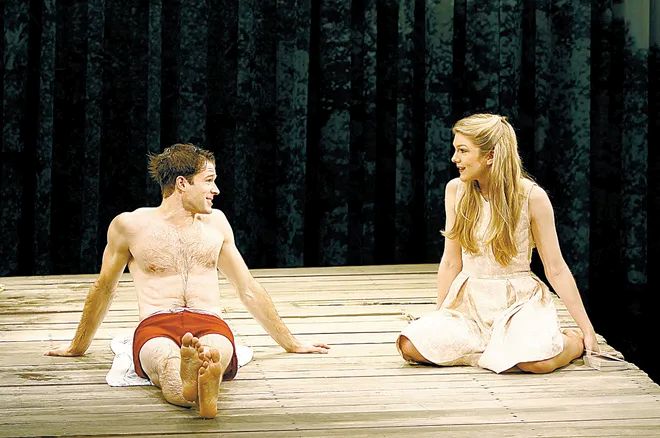
In 1997, we gave Rich’s complex and emotionally resonant Three Days of Rain its New York debut after it premiered at South Coast Rep. The story of siblings who reunite with their childhood friend to uncover secrets about their late parents’ past jumps back in time by 30 years between its two acts, exploring the ways in which memory, legacy, and miscommunication can shape our understanding of the people we love. It went on to be produced at the Donmar in London and at Steppenwolf in Chicago to great acclaim, followed by regional productions across the country and abroad.
When MTC opened our permanent Broadway home at the newly renovated Biltmore (now the Samuel J. Friedman) Theatre in 2003, I chose to present Rich’s brilliant play The Violet Hour as our inaugural production. This play captures the exhilarating—and often disorienting—moment just before the future arrives, following a young publisher opening a new publishing house with extremely limited resources. It beautifully embodies the spirit of embarking on a venture with immense promise. Each character teeters at the edge of transformation—personally, professionally, and culturally. The title itself refers to that moment at dusk when the world seems suspended between light and darkness—a metaphor for the characters’ potential and unknowable outcomes. The piece contains so many of the themes we had come to know as Rich’s signature, and I thought there could be no better omen for our ascent to Broadway.
My respect and admiration for Rich continued to grow as we worked together again and again. I had the honor of directing the last three of Rich’s plays we produced, and I treasured my experience collaborating with him on The Assembled Parties, a brilliant piece about the complications of a family uncovering the truth of its past. The story hinges on an act of deep kindness and compassion between two women, beautifully portrayed by Rich’s dear friend Jessica Hecht and Judith Light, who went on to win the Tony for her performance. I cherished the rehearsals for that show as the company and I delved into creating his complicated characters, peeled back the layers of this family’s history, and looked up the words in the script that we’d never heard before. Those days were followed by long nightly phone calls with Rich making cuts to the script and just plain schmoozing. It was one of the greatest joys of my 50-plus-year career.
Every play Rich wrote had the hallmark of his brilliance, and many shared a common theme: characters on a quest for the truth of unexplained, secret, or misunderstood events from the past. His fascination with time—not just as a backdrop, but as an active, compelling presence—was a central force in many of his plays. His characters are frequently caught between eras, haunted by the past or paralyzed by a future they can’t quite grasp. In other words, who we were, and who we became. But no matter the subject, Rich’s writing was always so beautifully accomplished, and his plays are marked by wit, compassion, insight and deep humanity.
I adored Rich, both as an artist and as a friend. We so often brainstormed, dreamed, and kvetched together over lunch at Blossom in his beloved neighborhood of Chelsea. I will miss him terribly, but I find comfort in knowing that his body of work now comprises such a large part of the American theatrical canon. He left an enduring artistic legacy, and his work will go on to entertain, educate, and enlighten many future generations of theatre lovers. I know that would mean the world to him.
Lynne Meadow, artistic director, Manhattan Theatre Club
The Supreme Romantic
In his first novel, This Side of Paradise, F. Scott Fitzgerald made a crucial distinction: “The sentimental person thinks things will last; the romantic person has a desperate confidence that they won’t.”
By this definition, Richard Greenberg was a supreme romantic. Among his contemporaries, he was the great heir to the sensibility of Fitzgerald, to whom he paid a kindred spirit’s homage in the underrated The Violet Hour. Greenberg’s characters, like Fitzgerald’s Gatsby, can escape neither the tidal pull of the past nor the tarnishing that time visits on luster, and his plays are steeped in a lyrical blend of hope and fatalism. The fatalism comes from an awareness that we’re all, well, doomed, ultimately; the hope is what flares in the darkness along our way to extinction, and the light it emanates lingers well into the future.
It’s the illumination that the inhibited accountant Mason Marzac, of Take Me Out, finds in the day-for-night brightness of an evening baseball game, and what the Park Avenue hostess Julie Bascov, from The Assembled Parties, sees as she toasts her dinner guests on Christmas day: “the holiness of shiny surfaces.”
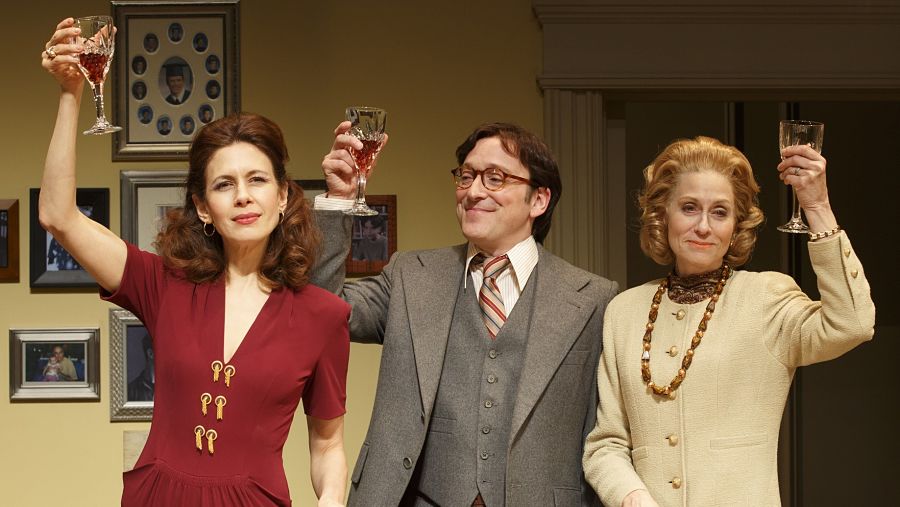
The Assembled Parties may be the ultimate expression of Greenberg’s romanticism: an old-fashioned, deeply charming play that is fully aware of its, and its deeply charming leading lady’s, status as anachronisms. It is part of Greenberg’s brilliance that he subverts even as he celebrates, in some of the most rhapsodic language in American theatre. I shall always remember Jessica Hecht, as Julie, describing the vintage dress she has on, which had been made by her mother: “It’s the record of an intention and—the joy of that!”
And how perfect that the last sentences of that play should be a dying woman’s words of affirmation: “Everything’s so…promising. Isn’t it? So hopeful.”
Ben Brantley, former chief theatre critic, The New York Times
Godrich and the Girls
Richard Greenberg was my friend. I’m not sure what else to call him, though the word friend is hardly sufficient, as any of his friends will tell you.
For the first seven years I knew him, it was as an actor and he was, quite often, my playwright. He would call and say, “Tell me what happened in rehearsal today.” (Directors love this, by the way.) Those were the days in which I would speak to him for hours and never allow myself to sit, for fear that my mind would slacken and I would be incapable of keeping pace. Conversation with Richard required every faculty. It was wise to have a dictionary handy.
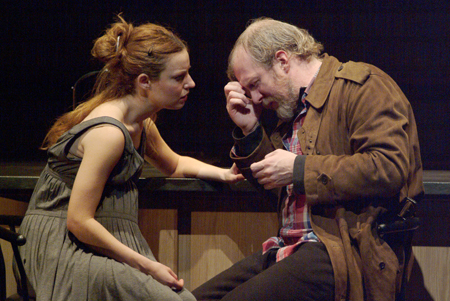
When I became a mother in 2008, he became a godfather and my daughter gave him another name: Godrich. Then the phone calls became daily and Godrich would say, “Tell me what your daughter did today.” He coined himself the chronicler of my children’s lives and committed to it as fully as he did writing. He remembered every detail, every turn of phrase, every line reading. He was not concerned about page count. Every day he would regift me an anecdote from an earlier period of motherhood when I was too harried and distracted to absorb much of anything. He delighted in the personality traits that revealed themselves early and reasserted themselves consistently. He delighted equally in the unexpected, the times his predictions were upended and the girls proved to be, like his favorite characters, mysterious.
Richard never married, but he was a devoted partner to many women. He was an insomniac, which also meant he was available. There haven’t been many times when I needed to talk at 4 a.m., but when I did, he answered by the second ring. He held each of my daughters the days they were born. He literally married me. He saw me through every break-up, disappointment, the loss of my mother. For 24 years, I had the blessing of sharing a life framed lovingly by a master of structure, theme, irony, and, of course, humor. Richard Greenberg never struggled for a laugh line.
In 2017, he went through a period of writing essays. He sent me an email titled “How I Think It Will Start”:
I said to Kate that I wanted to write about her girls but, though I have no qualms about co-opting their lives, I feel strongly that I should protect their identities, and I asked her what names I should give them.
Kate said to the girls, “If you could have a different name from your own name, what would you want it to be?” And they told her.
Kate stopped by this afternoon with her little girls, Sky and Unicorn, and we had a tea party.
Kate Arrington, actor and playwright
A Counterintuitive Liquidity
I think it was in 1996…

Patti Clarkson came to my apartment on West 4th Street with a new Richard Greenberg play. She said she was going to sit there while I read it, and that he had written the parts of Pip and Theo for me. I read it and immediately knew that the parts of Walker and Ned were the ones that I needed to play. Somehow I convinced Richard to let me do a staged reading—which had already been scheduled at South Coast Rep—as Walker and Ned. I said, “If I stink it up, I’ll play the other two parts, but please let me try to play these two.”
I guess the reading went well enough that he let me play those parts. And it changed my life—not so much in the success of the play. (It was a success; I still don’t know why it didn’t move, you couldn’t get a ticket to it.) It was more in the knowledge that if a part was well written enough, there was almost nothing you couldn’t do with it. As specific as Richard wrote, there was a liquidity to it that seemed almost counterintuitive. There was so much room to interpret those passages, even though they were almost surgically constructed. That freedom was a real discovery. I was lucky enough to do several more of his plays over the years, and it was always that way.
John Slattery, actor
Antic and Scabrous and Deeply Moving
The first play I saw by Richard Greenberg was The Bloodletters in 1984 and the last was The Perplexed on the eve of the pandemic. In between came some 30 others, almost all of which could have had the same titles. His work cut to the core of his characters, who never had easy answers for life’s questions but had brilliant retorts to deflect them for as long as they could.
In The Bloodletters, a teenage boy in suburban Long Island is imprisoned at home by an incurable ailment—he smells like “an old bathroom” (though it is hoped he might possess “a beautiful soul, like the Elephant Man”). In real life, Rich was known as a shut-in. Among major artists in the New York theatre, he may have been the least self-promoting. Though often tagged (including by me) as an urbane wit who diagnosed the id, self-delusions, and social mores of the contemporary upper middle class, in truth his work roamed too far afield in period, setting, and most of all in hair-trigger emotions to be glibly segregated in any genre. Rather than explain himself, he just kept writing, leaving behind many plays that are overdue for revival and reappraisal.
I might start with Eastern Standard (1988), a work of the AIDS era that was widely undervalued at the time in part because it contained zero agitprop: When a young man who looks like a million bucks cries out “I’m sick!” late in Act Two, that simple exclamation proves enough to light a blowtorch illuminating all that is repressed in a world whose hyper-articulate characters are “dancing on the rim of a champagne glass” in the Hamptons. Or maybe The Assembled Parties (2013), in which a sprawling, late-20th-century Jewish household on Central Park West is ransacked for its darkest secrets with endless compassion but no sentimentality.
Richard Greenberg’s best known plays, Take Me Out and Three Days of Rain, are themselves illustrative of his range. But fine as they are, they are far from the whole story. He leaves behind a vast canon unified by a voice, at once antic and scabrous and deeply moving, unlike any other. I have nothing but envy for new generations of theatregoers who will have the thrill I had when hearing him for the first time.
Frank Rich, former chief theatre critic, The New York Times
The Author’s Voice

I don’t remember when I met him first. I remember when I met him first in his writing: I auditioned in 1987 for a play festival called “Sneaky Feelings” which was constructed of 3 One-Act plays: The Frog Prince by David Mamet; Albert’s Bridge by Tom Stoppard; and The Author’s Voice by Richard Greenberg. I played a hunch-backed creature, a gnome, really, who lived in a closet and wrote the sweet letters a desperate, callow young man needed to woo his heart’s desire. I played a version of Richard. It was his voice: the author’s voice.
Years later, when Joe Mantello asked me to do a reading of a new play called Take Me Out I said yes, but as I read the play, I thought, “Oh, this is not my part. I’m not right for this.” But I did the reading and then I did the production. And I spoke in Richard’s voice. I’m not sure if every character in every play is the author, but Mason Marzac was Richard. I felt it in his wonder and his awe, his passion and mostly in his joy.
Whenever I was with Richard, I was afraid I wouldn’t be able to keep up with his wit. He didn’t make me feel that way—I did. I so loved his mind and his keen search for life’s profound hidden corners.
Denis O’Hare, actor