More. More theatre. More from theatre. I don’t want theatre to happen to me. I want to make theatre happen.
This longing for creative agency is what first led me to the Tectonic Theater Project’s Moment Work, a method of devising theatre that places power in the hands of its makers, created by the award-winning company that has brought the world Gross Indecency: The Three Trials of Oscar Wilde, The Laramie Project, and Here There Are Blueberries.
I had just shared this desire with my career and mindset coach, Melissa “PK” Tonning-Kollwitz, who had already signed up for Tectonic’s Summer Intensive. They nudged me to join. First I purchased Moment Work: Tectonic Theater Project’s Process of Devising Theater, devoured every page, and brought Moment Work exercises into my acting classes at Miami Country Day School. My students jumped in feet-first. Their excitement confirmed what I felt; Tectonic’s process might be the “more” I had been searching for.
Around the same time, I was invited to join City Theatre Miami’s Homegrown Playwriting Cohort. Suddenly I was making theatre both professionally and personally. The synchronicity was impossible to ignore. Were all these kismet moments leading me to the “more” I was looking for? I had to find out. So I joined PK and signed up for Tectonic’s summer intensive.
Tectonic’s Moment Work is designed to make theatre from the ground up by building “moments” with theatrical elements like light, gesture, sound, prop, and architecture before adding narrative. It’s an ensemble-driven, collaborative approach to making meaning. Now, a few weeks after completing the week-long training—five days in the Professional Development Intensive for Teachers, followed by a two-day Devising Intensive for Theatre Educators—I’m still unpacking the impact. Guided by longtime company member Leigh Fondakowski, chair of the Moment Work Institute and head writer of The Laramie Project, and advanced teaching artist Scott Barrow, we immersed ourselves in Moment Work not only as an artistic methodology, but as classroom strategy and as a philosophy of learning.
As an educator and an artist new to this method, I was particularly drawn to Moment Work’s emphasis on student agency. I’ve spent more than 20 years helping students find their voice, onstage and off-. I teach them how to interpret text, yes, but also how to create their own. Traditional methods often leave some students behind. Moment Work showed me how to reach them.
The Tectonic Summer Intensive affirmed this truth: We’re not just preparing students to perform theatre. We’re preparing them to shape the world. Devised work empowers young artists to create deeply personal, inquiry-based theatre grounded in their lived experience. At its best, devised work invites young artists to create deeply personal theatre, rooted in inquiry, and reflective of the world as they experience it.
What I found inside the theatre lab was a vision of education where process is sacred and meaning is co-created. Surrounded by generous, passionate educators, I saw what’s possible when we value curiosity over product.
Day 1-2: Why Devise?
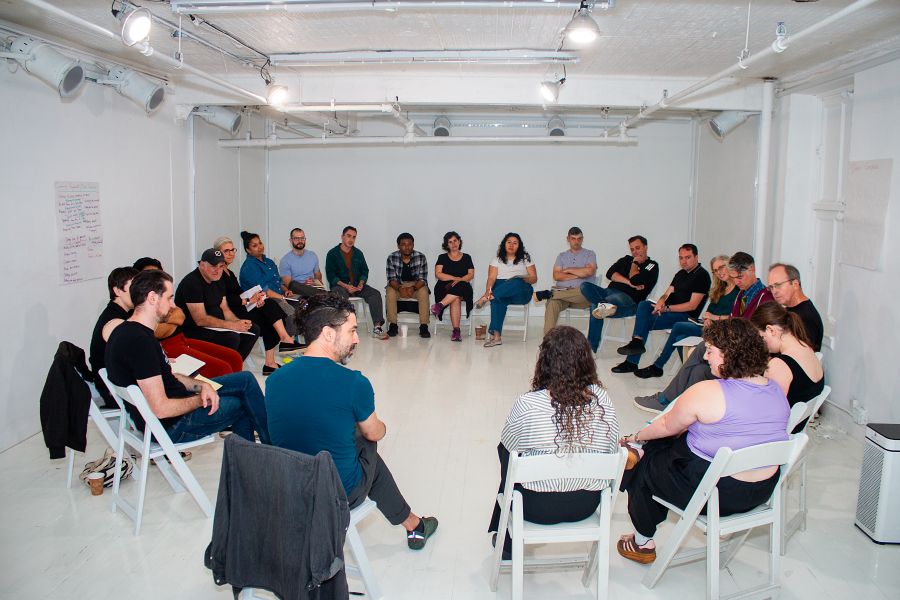
I have never experienced such a wide array of people all in one place: grad students, professors, middle and high school teachers, professional actors, and designers, all in the room, ready to play. Though the first five days were called the Professional Development Intensive, they consisted of copious amounts of silly play punctuated the conversation around pedagogy, and an endless amount of wildly intellectual conversation.
We established community agreements, including “Listening to inform, not to condemn,” and cultivated an “Idea Garden,” a space for “thought seeds” to grow. No hierarchy, no fixed outcomes. Just a room of educators and artists committed to discovery.
We focused on one element at a time, reawakening our childhood curiosity, and wondering: When did we stop asking questions? Why did we abandon our investigative imagination?
“It occurred to me just how much I’ve let go of this key tool in my toolbox as I transitioned from child to adolescent and then again to adult: my ability to investigate through imagination,” reflected Adithi Chandrashekar, third-year fellow at the University of Texas at Austin’s Michener Center for Writers. “Moment Work helped me look at world-building through the eyes of my inner child.”
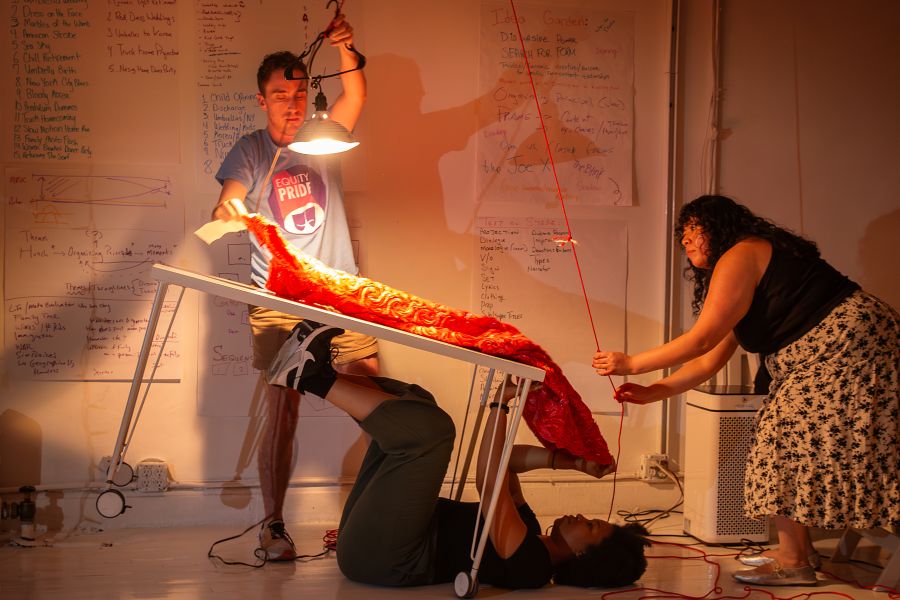
Moment Work encouraged us to consider movement without narrative, sound without dialogue, a prop that demands attention. This approach doesn’t decorate with theatrical elements; it activates them. In exercises like “I begin, I end,” we embraced impulse, silence, and juxtaposition. Everything became about “dehabitualization,” i.e., seeing with curiosity. No answers. More questions.
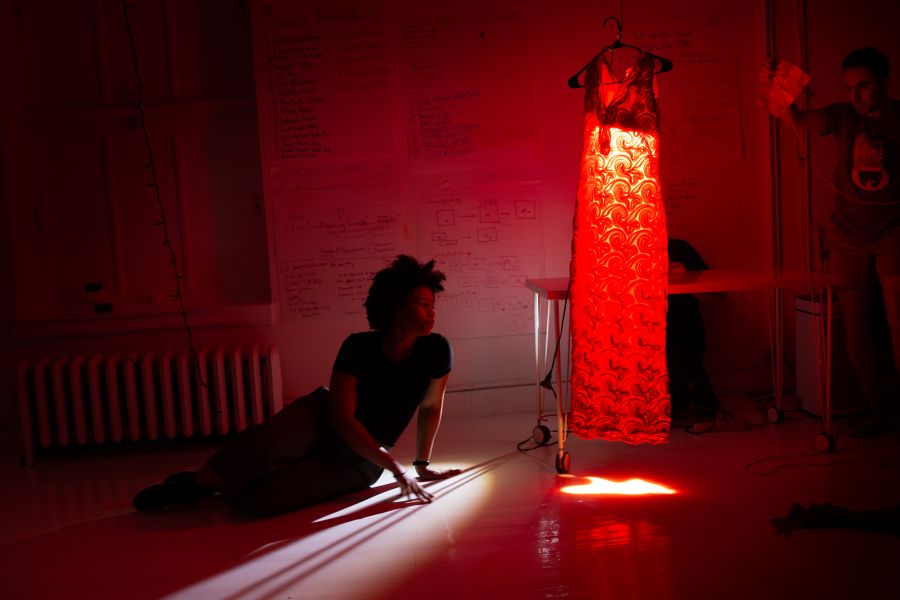
Lighting became a language; sound became a setting. Architecture in the room shaped relationships. As we layered on each theatrical element, moments of narrative emerged organically. Story emerged, but not a script. The emphasis wasn’t on storytelling just yet.

Day 3: Simple Addition
A new mantra took root: “Your job is not to make a play. Your job is to make a moment.” We were challenged to hold off the editor, to stay in generative mode.
In one pivotal exercise, we layered light, sound, and a single line of text. It was stunning to see how simple addition shifted everything. We then learned how to score our moments, examining structure, tension, and sequence. How long should a moment last? What changes when we remove sound? How does lighting focus attention or evoke mystery? These structural choices elevate devised theatre from exploration to craft. That’s a lesson I’ll carry with me as both a teacher and a maker.
“As educators, we’re often trained to lead with text or analysis,” noted Jason Peck, director of theatre at the Benjamin School. “But this process reminded me that story can live in stillness, in the angle of a light, in the friction between bodies in space.”
We studied the Organizing Principle, defined as the central question or impulse behind a piece. Moments don’t need to “say” something immediately; they respond to that principle and evolve alongside it. The Organizing Principle is a thread we follow.
At the end of day three, as we gathered to reflect, Scott said that as educators, we are responsible for giving students the tools to make their work. At the college level, actors should leave with marketable skills. Helping them create work is vital in building agency as an artist, rather than waiting for someone else to create work and hire them.
Moment Work can also offer a way in for many students who don’t see themselves reflected in traditional theatre. Said Nick Erickson, a professor at Louisiana State University, “Teaching theatre artists a Stanislavsky-based method toward their craft is still essential, but it is not enough. Actors also need to know how to be theatremakers as well. There they can find autonomy, confidence, grounding, and a sense of self. They find their voice.”

Day 4: Virtuosity and the Collective
By Day 4, we were no longer just a cohort. We were a company. We had begun to build a shared language through our moments, and now the focus shifted to something more profound: discursive power. Every element onstage, from lighting to a prop or a gesture, has the potential to “speak.” The question now became: What is being said, and how is it being said—not only through text, but through the complete theatrical vocabulary?
We explored how meaning can be constructed across moments, and how the chronology of those moments alters the story. Change the order, and you don’t just change the narrative—you generate new content. That’s the magic of devised work. Structure is not fixed; it’s an active, evolving decision that shapes understanding.
“In Moment Work, you are not trying to do anything, to be smart, or sophisticated, or funny,” said Fondakowski. “You’re simply trying to play and allow yourself to observe and be delighted or surprised. It is amazing, especially, to watch young people who might be feeling peer pressure or self-conscious in front of their classmates give themselves over to the task at hand. What can this light or costume piece do that I didn’t know it could do?”
A highlight of this day was the Virtuosity exercise, a talent inventory in which each of us shared a unique skill or “virtuosity” we brought into the room. One teacher created a moment by praying a decade of the rosary in two languages in under a minute. Another could fit their entire body through a wire clothes hanger. One performed magic card tricks, and yet another did a yoga headstand. The room lit up with possibility. This exercise introduced the sense in which an individual is an exciting and essential part of the collective.
As Jason Peck noted, “I’ve already seen how much more present and curious students become when they are given that kind of ownership. They stop waiting for permission and start following their instincts. It opens up something deeper.” The virtuosity exercise did just that: It showed us the power of giving an artist room to bring themselves into the room.
Day 5: Following a Hunch
Our creative muscles now warmed, we moved into more advanced territory: building toward narrative. But not in the traditional sense. Narrative didn’t begin with plot. It began with a hunch. A tension. A curiosity. We were each given an obituary for an unnamed person, from which we pulled themes and created moments. Text came last.
From the obituaries we read, we built organizing principles out of seemingly disconnected facts, then created three moments each, incorporating text. (We did not find out until much later that the obituaries we were given were all for the same man.) Then we sequenced and re-sequenced our moments, watching as different combinations yielded entirely new meanings. It was a thrilling reminder that form can drive meaning, not vice versa.
As we layered, contextualized, and sequenced, we began to see how a play might emerge not from a single author’s vision, but from a collaborative investigation. That’s what makes Moment Work so powerful in education: Artists are no longer waiting for someone to hand them a play. They are populating the room with ideas, shaping narrative from the inside out.
While it was exciting, this work was not easy. It felt frustrating, even. As hard as it was for me to fight my need to build a narrative, we were reminded that our job is not to know in advance but to try out a moment—just put it out into the room. As we created moments, we would inspire each other. We created our room’s collective language through moment work, one moment at a time.
The room became an archive of meaning.
This was our last day working with Scott Barrow. He left us with a challenge. As he put it, “I am thrilled to think about the forms and the new plays that the next generation of theatremakers are going to be creating. We are demanding that our students think outside of the box and create new forms and new ideas. That’s the legacy of Moment Work: We’re giving young artists the tools to create exciting and innovative work that we can’t even possibly imagine.”
It is up to us, their teachers, to cultivate that curiosity.
Days 6-7: On the Hunt
The final two days were led by Leigh Fondakowski, whose leadership brought depth. “The content is the ‘what,’ the form is the ‘how’,” Fondakowski reminded us. In Level III work, we shifted our focus from exploration to authorship. Research itself became generative. Inquiry became method.
We brainstormed like confetti, tossing out ideas, trusting something would stick. Moment Work became a mode of investigation. We learned to “mine” for meaning through guided questions and writing exercises. Leigh emphasized research as a creative act—not just gathering facts but locating entry points.
“In an era where it is nearly impossible to have all the students focused at the same time, Moment Work also becomes a tool for mindfulness, precision, and attention,” Leigh noted.
We learned that Level III is filtered through the maker. The playwright in me felt at home as Leigh led us through an exercise on choosing a subject. We worked in groups to gather sources to mine articles, books, interviews, etc. At this point, ideas began to emerge organically from the collective. We were reminded to listen to where the text would take root. We were on the hunt.
By Day 7, we weren’t just theatremakers; we were theatre investigators, shaping performance through every expressive tool at our disposal. We also explored the balance between table work and studio work. In our table work, we identified topics that piqued our interest in the research and reflected on them as a group.
“If we give time to exploring the forms, the time will always pay large returns in theatrical magic and innovation and delight,” Leigh observed. “We’ll remember why we love the theatre and how to ensure best that the theatre as an art form continues to grow.” Once we were up on our feet, we could test those ideas physically.
I must admit this was my favorite part of the process—so much so that I definitely would have loved to have spent more time with it.
In Conclusion: Power to the Process
I discovered something essential through this process: To empower story makers, you must first empower their teachers. Tectonic’s Moment Work sits at the intersection of pedagogy and artistry. It offers a platform for agency, collaboration, and truth-telling. As educators, we often ask: How do we help our students become better performers, critical thinkers, stronger collaborators? What if the answer lies not only in teaching existing plays but in giving students the tools to make their own?
Theatre educators are called to do more than stage plays. We are called to build platforms. To create spaces where young people can author their truths, challenge dominant narratives, and reimagine the world. Devised theatre, particularly through methods like Moment Work, offers a radical pedagogical tool: It places creative power directly into young people’s hands.
“Even within our abbreviated schedule, this experience shows that it takes time to form an ensemble, build a shared vocabulary, and create new work,” reflected Patrick Mark Saunders, a theatre artist and educator currently in the theatre and performance studies PhD program at University of Maryland, College Park. “Moment Work challenges us to embrace process.”
Affirmed Jason Peck, “Teaching students how to look, how to hold discomfort, and how to bear witness feels more urgent now than ever.”
“Moment Work has challenged how I think about theatre, how I make theatre, and now how I teach it,” reflected Melissa “PK” Tonning-Kollwitz. “It’s imperative that we remain self-reflexive and continue to question what we have inherited.”
As someone who has spent more than two decades helping students find their voices onstage, I found this experience transformational. I now carry this work forward with renewed purpose. I’ve always believed that theatre belongs to everyone. But now I see more clearly how the process itself can be the revolution. It can ignite a student’s sense of voice. My classroom will now include more questions, more moments, more freedom to fail, and more ways for students to be seen. More theatre!
This work isn’t easy. It requires rigor, patience, and trust. Tectonic Theatre Project’s work reminds us that devised theatre isn’t just about what we make. It’s about how we make it. And, most importantly, who we make it with.
And so we begin.
Cristina Pla-Guzman is an award-winning theatre educator, writer, director, and performer whose work has been recognized by the Tony Awards and Carnegie Mellon; Stephen Schwartz and The ASCAP Foundation; and Stephen Sondheim, the Kennedy Center, and the Educational Theatre Association. She is a fellow of the O’Neill Theater Center’s NCI and a TCG Rising Leader of Color. She has her Masters in Special Education, and a BFA from FIU. Pla serves on the board of trustees for the Florida Theatrical Association and is an endowed chair at Miami Country Day School.