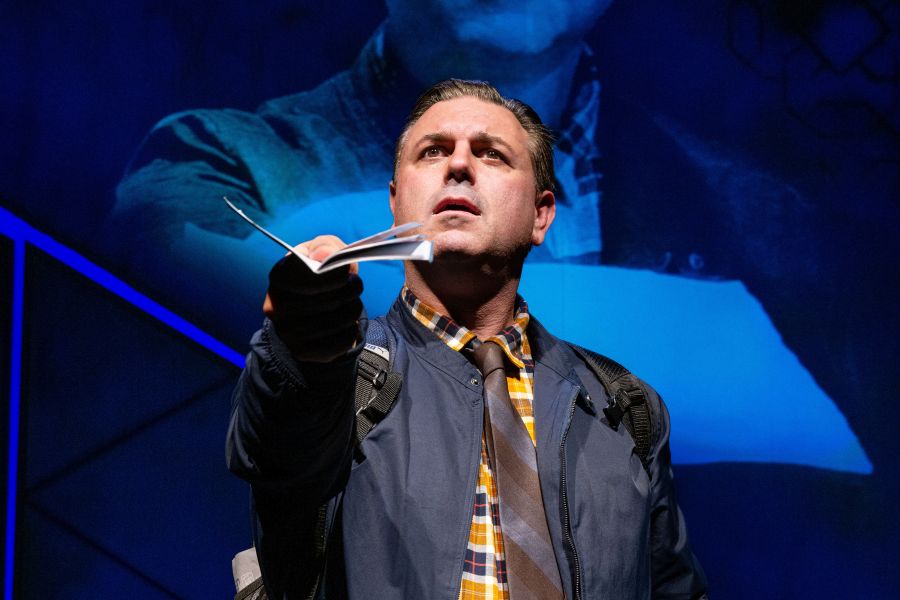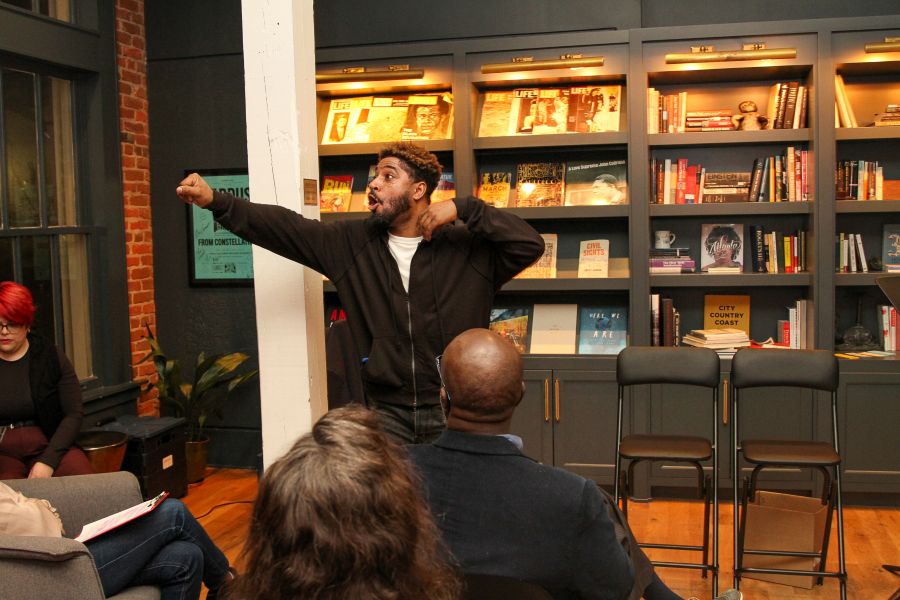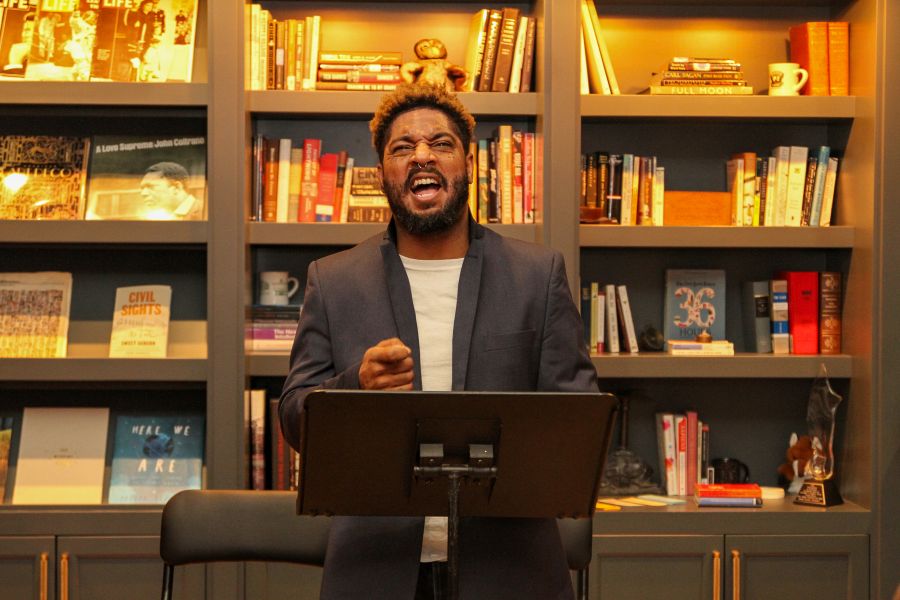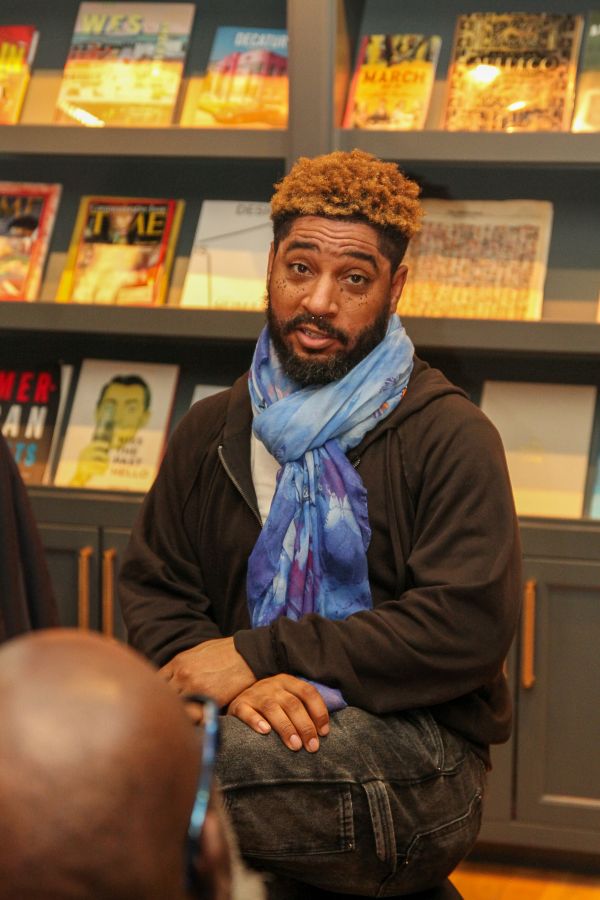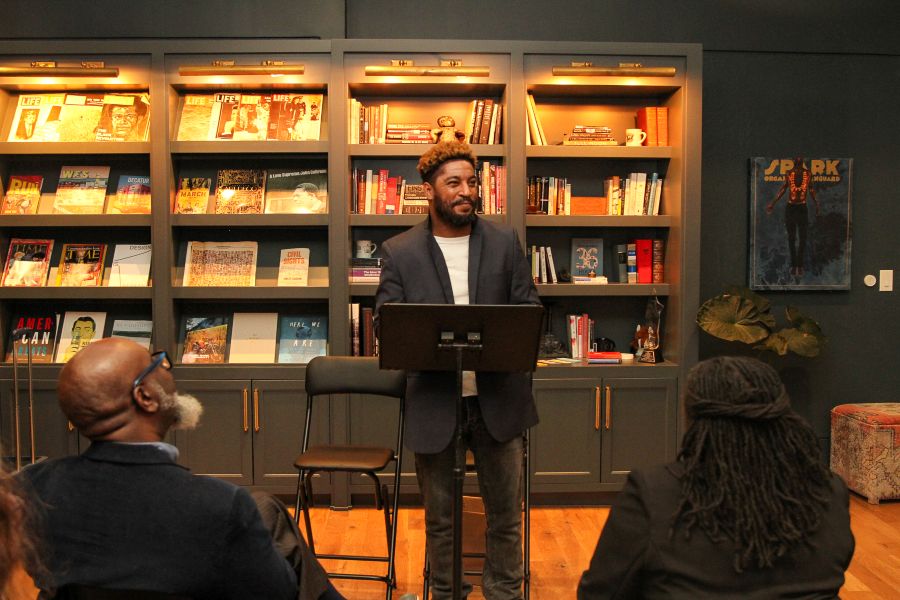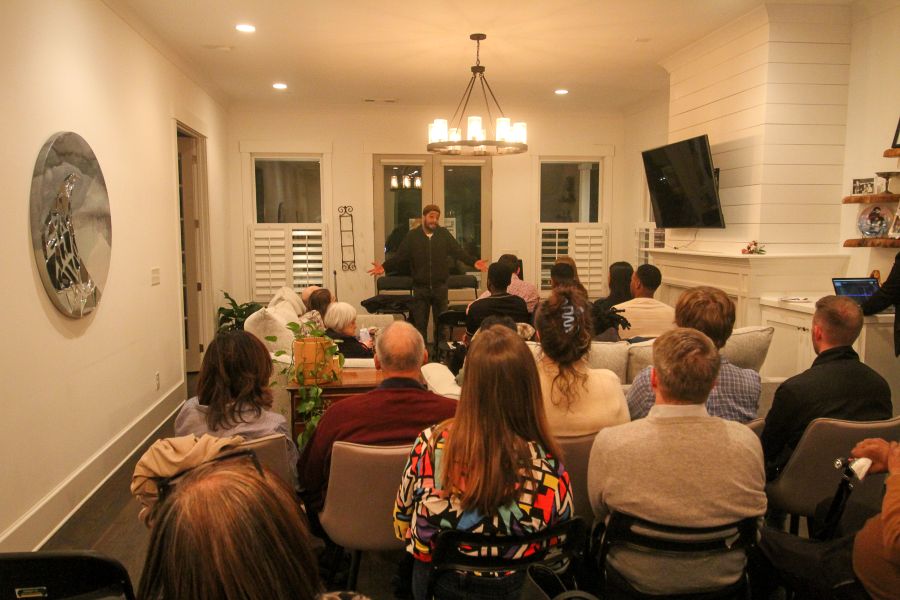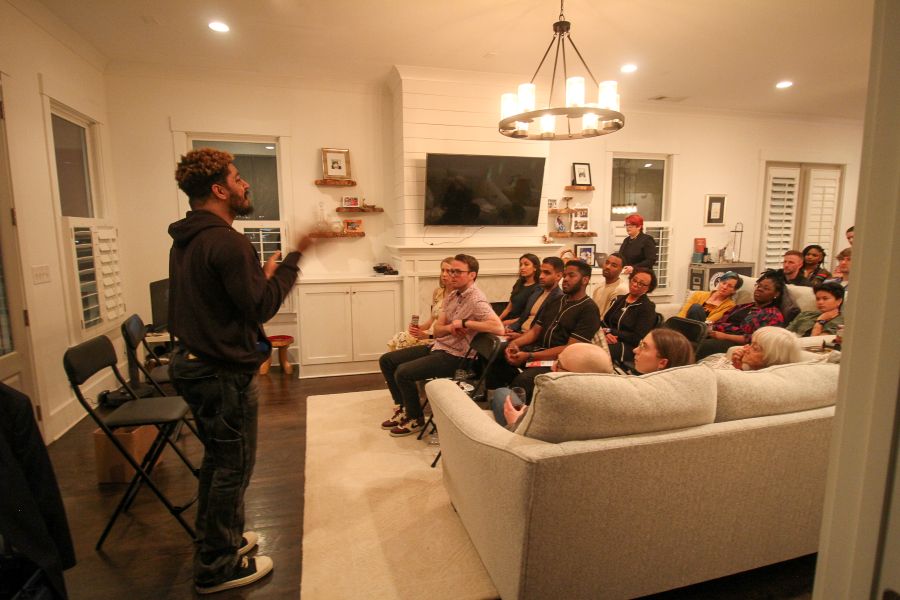
No weekend this spring was the same for actor Markell W. Williams. Headlining the Out of Hand Theater production of Amina McIntyre’s How to Make a Home could mean a Friday night in the Atlanta suburb of Snellville, 50 minutes in another direction in Marietta on a Saturday, and then a Buckhead synagogue gig on a Sunday. With the company’s Shows in Homes programs, venues are literally never the same during a run.
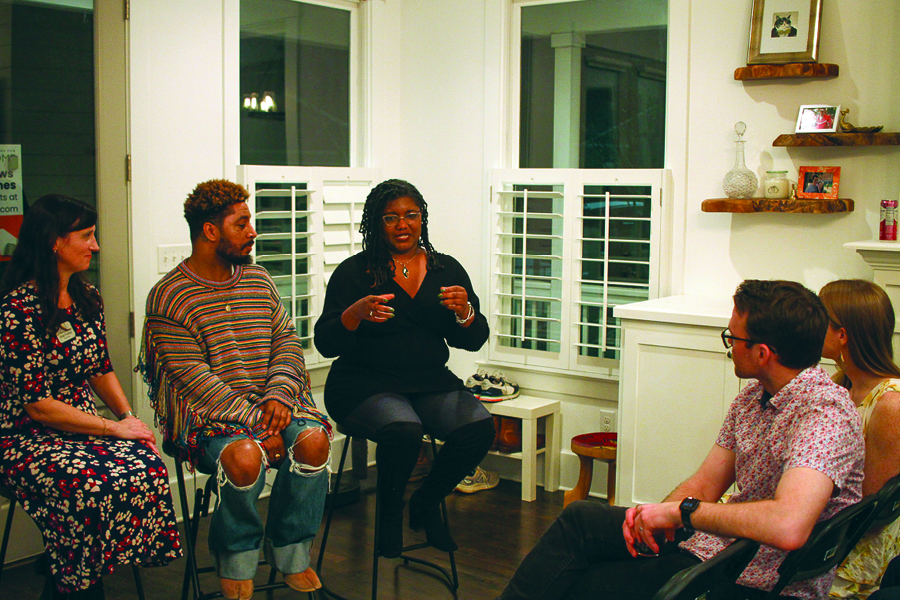
The annual Shows in Homes, now in its 13th season, has been designed to not only showcase meaningful theatre but to create dialogue and, hopefully, some kind of change. An original one-act play, featuring one performer playing all roles, is centerstage, mostly in houses, preceded by a cocktail party and followed by a talkback. This year’s play, presented in conjunction with Atlanta’s Partners for HOME (which works to end homelessness) and Mayor Andre Dickens, features a day in the life of a Black man experiencing homelessness, Antonio (Williams), an Army veteran in his mid-20s who’s struggling to raise his 8-year-old daughter Anika alone since his wife died. The production ran from March through the end of May in locations across Metro Atlanta, with more than 40 performances, multiple per weekend.
This year’s theme arose in conversations with Ariel Fristoe, Out of Hand’s artistic director and co-founder, when she began talking to major stakeholders and community members about the company’s 2025 project. Many stressed the severity of the homelessness situation; some told her that homelessness could be solved in Atlanta over the next decade, but that more advocacy was crucial. She found that even the CEOs she spoke with regularly—who theoretically should know better—had misconceptions about homelessness.
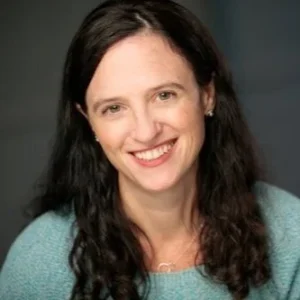
“When they think of it, they only think of the water boys or the people begging for change when you are waiting to get on the highway,” Fristoe said (though in fact the young men selling water by the side of the road don’t tend to be experiencing homelessness). “The reality is families and people living in their cars and people with full-time jobs, teachers, people living in extended stay places. It’s also about veterans and mental health and addiction. It is such a complicated issue.”
Even Fristoe, who prides herself on being informed, was surprised by the statistics, including the number of children who are without homes. Partners for HOME’s annual Point-In-Time (PIT) Count estimates there are 2,867 individuals in the city limits of Atlanta dealing with homelessness. Of those, 216 persons are under the age of 18, and 277 of them are 65 and older. While the numbers are below pre-pandemic levels, they’ve increased since 2022.
When Out of Hand put out a call for a writer for the project, Atlanta-born playwright McIntyre responded quickly. It was a subject she already felt close to, having previously served as a chaplain, worked with a homeless agency, volunteered with homeless shelters, and conducted workshops about shelters.
“As a playwright, I write about the stories we haven’t quite seen yet, especially around everyday life and Black life,” said McIntyre. “I really care about the human part of people, what the relationships are, where we live, and how we can heal by telling these types of stories, especially Southern stories. I feel we don’t get enough of them told well.”
She sees homelessness as widespread and getting worse throughout the country, and notes that with the rise in housing costs and rent, the various ways homelessness appears seem to be expanding. “It’s harder for people, who are having to consolidate or are being evicted,” she said. “People also are not able to buy houses or are losing houses because taxes and property values are going up, and because of unemployment and the cost of living.”
Fristoe had her own clear goal with this production. She wanted to put faces and names on individuals experiencing homelessness. “When you are in your car and see a homeless person—and you often see more men outside of shelters than women—I’d like people from now on to think, What if that man has a kid that he is trying to take care of right now? I’d like them to think about this person’s story and not just jump to the conclusion that this is someone who wants to be homeless or is unwilling to work. This person could have a full-time job or a family. There are so many things we do not know.”
For the artists involved, the job involves not only carrying the weight of the production, often by bringing multiple characters to life, but also quickly adapting to new spaces. Nikki Young, the company’s associate artistic director, served as the director and dramaturg for How to Make a Home and worked with McIntyre for nine months on the play.
The biggest challenge for the company was preparing the new script. A lot of evolution took place before the show started, according to the playwright. McIntyre knew she wanted to make the play’s central figure a Black male and to show his particular challenge in acquiring a housing voucher through Atlanta’s Continuum of Care system. “Being a father in a homeless situation is very different from being a mother,” McIntyre explained. “Typically the mother gets custody of children, so the shelters are more open to mothers, but not as much to fathers, especially those with a little girl.”
The fictional Antonio has also gotten sick and, with medical bills mounting, has been evicted. He doesn’t tell his mother-in-law or ask for help, however, because he has too much pride and wants to be self-sufficient. “We wanted to show that he is as good a father as he could be under the circumstances,” McIntyre said. “He doesn’t want his daughter to feel they are homeless. Even though he knows the situation is dire, he doesn’t want her to think that. He wants to make sure she has the best she can.”
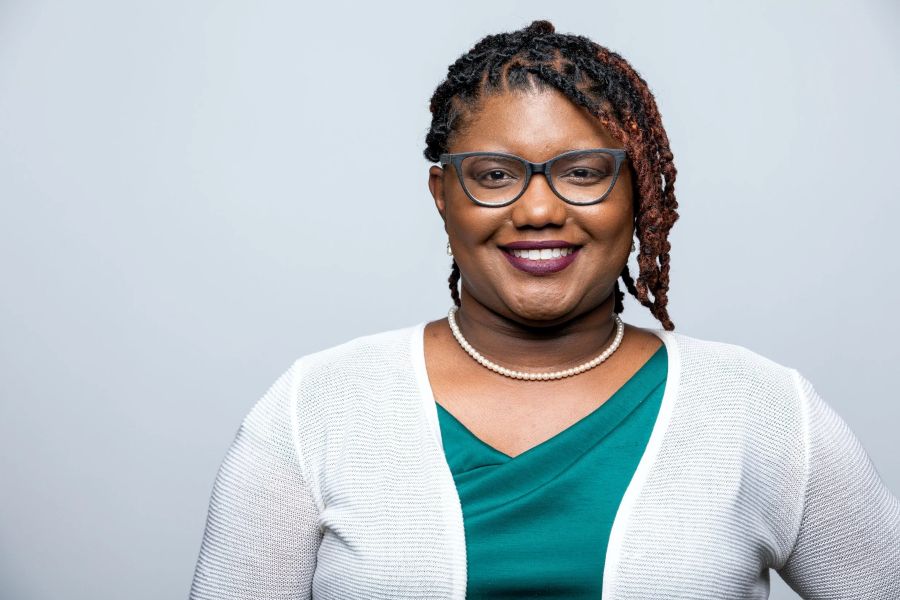
The playwright also wanted to make sure How to Make a Home included characters Antonio would see during a typical day: a social worker, a concerned teacher who once experienced homelessness, a white man experiencing homelessness and hoping to get out of the system, and a queer college student who has left his house and is now experiencing homelessness. From time to time, she would get feedback from Partners for HOME.
Crafting all the characters, though, took some time. Initially the play featured 15 characters, but McIntyre trimmed that number to 10, adding more definition to the remaining ones. Her research included accessing notes from when she was a chaplain, reading books about the history of homelessness, and conducting interviews with local agencies. She also talked to some individuals experiencing homelessness, though she would have loved to have had time to speak to more.
In retrospect, Fristoe feels the process didn’t make enough time or space for the script to fully develop. McIntyre only had nine months—rather than the full year Fristoe would have loved to have given her—and was also dealing with her own graduate school deadlines.
“This is an ongoing situation, and we’d love to get to the point where we give people a year,” Fristoe said. “We’re hoping to fix that problem. Next year we are planning to do a play that is already written, Lee Osorio’s Prisontown, and we are hoping that can help us get ahead of the curve.”
In other ways, How to Make a Home has been Fristoe’s favorite Shows in Homes production so far. At the first table read with all partners, five executive directors of organizations serving people experiencing homelessness were present. That had never happened before. “This is the real deal,” she effused. “Our mission is using the tools of theatre to create a more just world by making things with and for you, with and for the people who are doing front-line work. We are using the empathy-building power of storytelling, but how can we tweak it to make it as useful to you as possible?” Having all these organizations lined up and eager to help How to Make a Home was a blessing, especially considering there had been years where Fristoe and her team almost had to pound on their partners’ doors to get them to remember to send representatives to shows.
The talkbacks have also provided rich conversations and attracted different kinds of audiences, largely dependent on each night’s location. McIntyre has seen two different kinds of crowds: those close to the homeless agencies and their work, and others more distant from the situation. At some performances, patrons who have experienced homelessness have been in the audience. McIntyre recalled one patron going up to Williams, convinced he knew one of the characters the actor had just brought to life. Other audience members have indicated they are familiar with some of the play’s locales.
“The play does what I hoped for,” McIntyre said. “People see this is a real person we are tracking and that Antonio is a father trying to resolve this issue. Everyone here is a human trying to deal with a certain element of life now.”
Those discussions have become the cornerstone of Out of Hand’s work. The company never stages just theatre these days: It’s theatre plus information plus conversation. “The recipe is: art to open hearts, information to open minds, and conversation to inspire action,” said Fristoe. “We don’t do anything without all three these days, which means we don’t produce full-length plays anymore, because there simply would not be time for other things.”
She’s still a theatre person, though. On opening night, she wasn’t entirely sure whether How To Make a Home was firing on all cylinders.
“It achieved our primary goal in raising awareness and action empathy, but at first I could not tell” whether it was working as a piece of theatre, Fristoe admitted. But when she attended another performance recently, she felt more at ease. “It was such a pleasure to come back and count the laughs at the show and see the reaction,” she said.
Since its early start, when Fristoe and her friends were in their 20s “making crazy stuff,” Out of Hand now has a budget that’s four times bigger than when the company began. “Now we are one of the largest theatre companies in Georgia by budget size, and this is all we do,” Fristoe marveled. “People pay us to make these programs and deliver them. Never in my wildest dreams…
“We’ve always been small and scrappy and experimental, and now what we do is seriously valuable to our community,” she continued. “We can take community issues and turn them into an emotionally engaging story and actually have people sit down and share with each other while at the events and inspire people.”
If she started out questioning her career path, she has no such qualms now. Shows in Homes, she believes, “is the future of nonprofit arts.”
Jim Farmer (he/him) is an editor-at-large for ArtsATL and a contributor to Georgia Voice, The Atlanta Journal-Constitution and Atlanta magazine. In 2022, he earned first place from the National Arts and Entertainment Journalism Awards for Best Theater Feature for his American Theatre article “Immersive Theatre That Left Scars: Behind the Collapse of Serenbe Playhouse.”