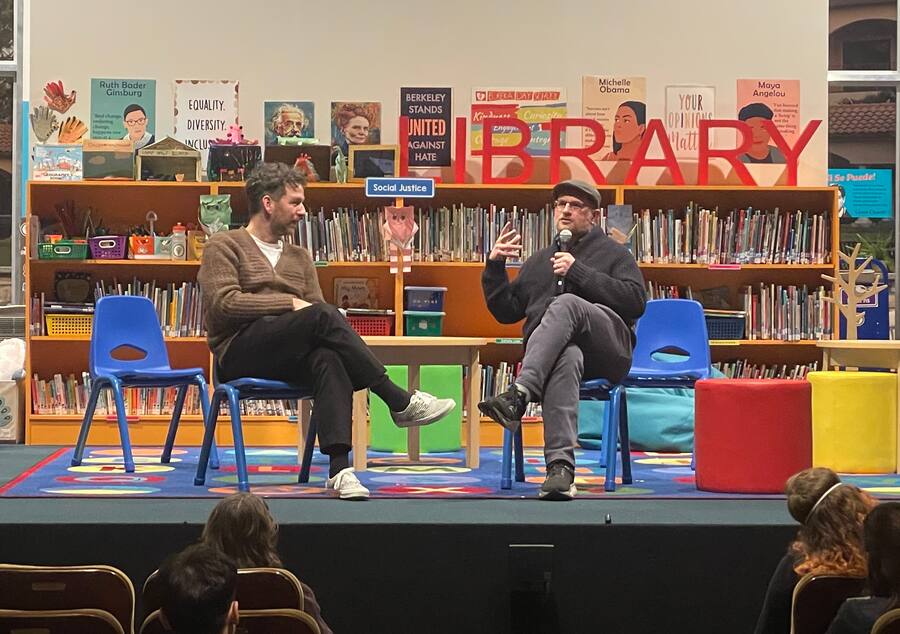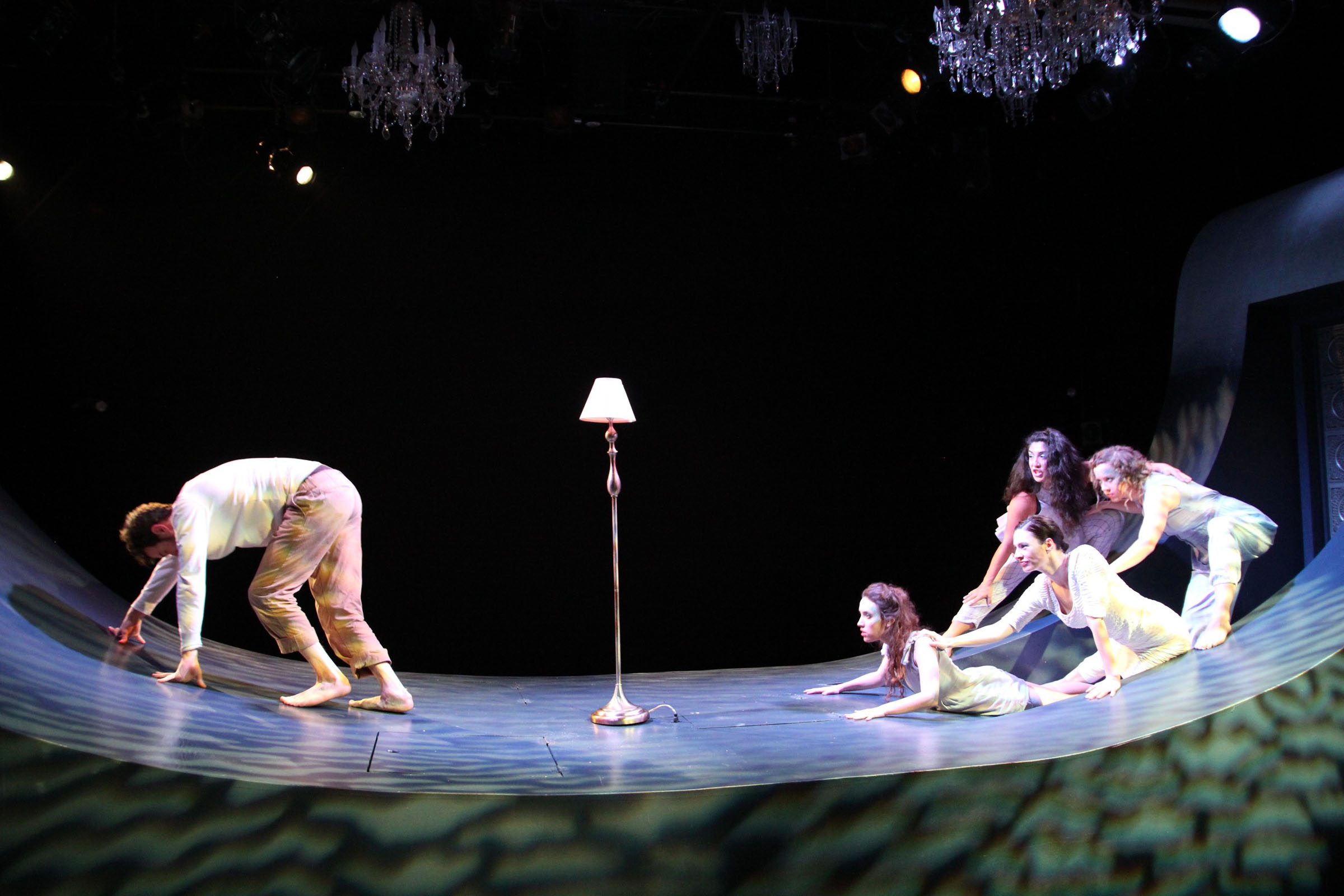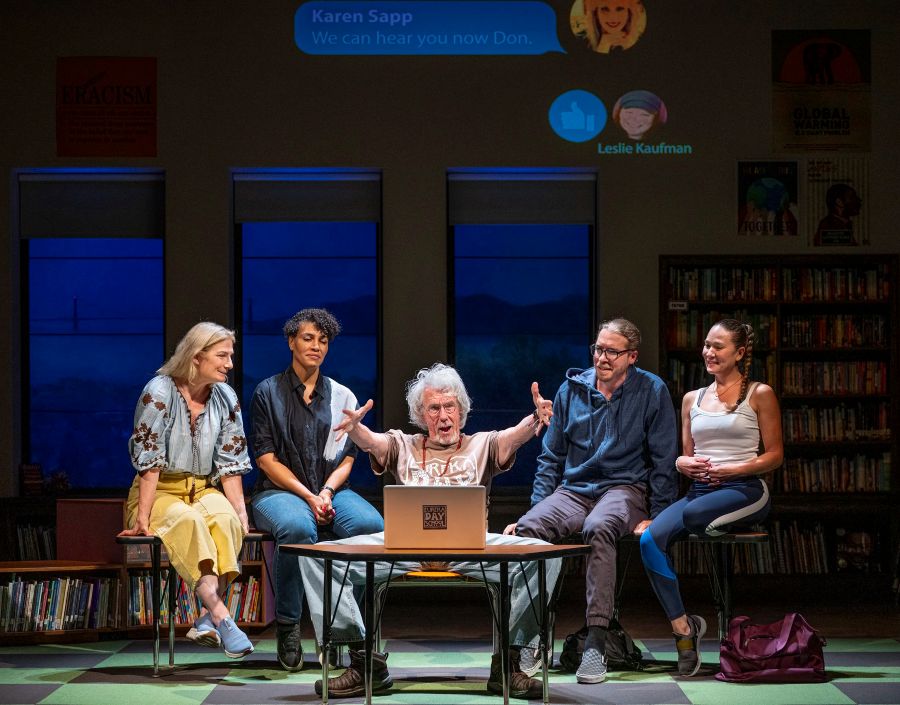
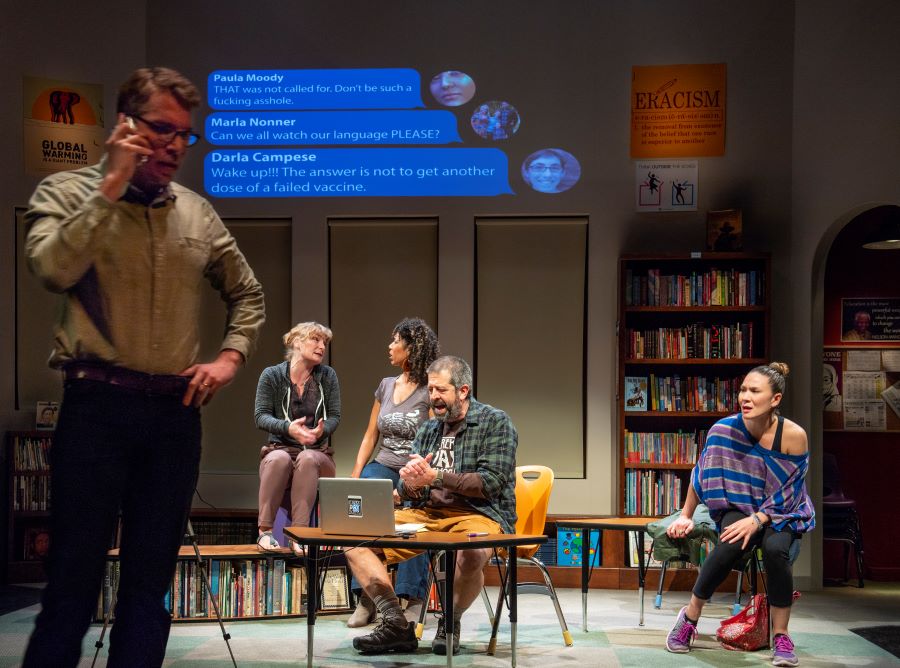
Jonathan Spector’s blisteringly funny, uncannily prescient Eureka Day had a triumphant homecoming of sorts this week. The play, about a private school riven by arguments over vaccine policy, is a local product down to its bones: Set at a private Berkeley day school and originally commissioned by Berkeley’s Aurora Theatre Company a decade ago, it premiered there in 2018 and went on to success Off-Broadway, in London, and last season on Broadway, garnering it a Best Revival Tony and a raft of regional productions in the coming season. (We published the full script in our Winter 2025 issue.) In fact, the new Bay Area production, which opened on Sept. 2 under the guidance of the play’s original director, Josh Costello, even has most of the original Berkeley cast and design team.
But, in a bitter twist, Eureka Day is not playing at Aurora Theatre Company but 20 miles away, across the Bay, at Marin Theatre—because Aurora, a venerable local company founded in 1992, doesn’t have a theatre space or a staff anymore. In early August, Costello released a statement and a video saying that their summer production of Lily Tomlin’s The Search for Intelligent Signs of Life in the Universe, starring Marga Gomez, “may very well be Aurora Theatre Company’s final production.” This followed an emergency fundraising campaign in the spring which, though it exceeded its goals, was not enough to stave off the theatre’s demise.
“We are still only at about half the number of subscribers that we had in 2019,” said Costello on a break from rehearsal a few weeks ago. That was the year Costello, a longtime artist with the company, became its artistic director, succeeding Tom Ross. It was a rough time for anyone to run a theatre, given the Covid pandemic and lockdown of the following years, but there were other local challenges as well.
“The cost of living in the Bay Area has just become out of control,” Costello continued. “We’ve had a hard time retaining staff. We’ve had a sort of revolving door for our managing director and marketing director and development director over the last five years, because it’s impossible to pay the kind of salary that allows somebody to really stay in a position like that at a mid-sized theatre like us in the Bay Area.” In all, he said, “The structural deficit was just too big.” (The hedged language of “may very well be,” Costello said, represents the hope of some board members that Aurora could be resurrected in a new form at some point in the future, but there’s no question that this is the end of Aurora as we knew it.)
It’s a huge blow not only for the artists who worked there—with an annual budget around $2.5 million, in pre-Covid years Aurora typically programmed six shows a season, often with substantial casts and design teams hired locally—but for the Bay Area scene in general, which has seen theatres both mighty (Cal Shakes) and small (Cutting Ball) fall since the advent of Covid.
“Aurora was so important to the Bay Area scene,” said Costello, who called it “the smallest of the professional theatres and the most professional of the small theatres. It occupied this really interesting middle ground, where you could see the best actors in the Bay Area up close: The front row is on the stage, and it wraps around three sides. It’s only four rows deep, 150 seats, so you’re always close, and it’s so intimate; it’s a place where actors could do really detailed, nuanced work. So actors loved working there. A lot of Bay Area actors got their first professional job at Aurora and thought of Aurora as their home, and did the best work of their lives there.”
Lance Gardner, now the executive artistic director of Marin Theatre, was one of those actors—in fact, he participated in an early reading of Eureka Day at Aurora, so the play was on his radar even before it had its local premiere, let alone blew up nationally. (He had once attended a private school in Berkeley much like the one in the play, and it all checked out, he said: “It felt like the most Berkeley thing you could possibly do—it captured the hypocrisy, the absurdity, and that was so thrilling.”) Gardner said he’s continued the ethos of local hiring at Marin, but shares the concerns of many at the shrinking of not only opportunities but of venues to create fearless new work.
“The problem is, when you lose the diversity of theatre—if you’re consolidating it among a few large professional companies, there’s a missing middle,” Gardner said. “You can’t experiment as much as you might otherwise, as you risk losing too many people.”
Spector, who moved to the Bay Area in 2006, expressed a similar worry.
“When I look out and picture what the landscape here looks like in five years, I think it’s really easy to imagine it no longer being what it was when I moved here, which was one of the big hubs of new work in the country,” Spector said. He can instead see it becoming “what a lot of mid-sized theatre cities look like, where you have one or maybe two big regional theatres, and one or two smaller professional theatres, and then a couple of community theaters, but you don’t really have an ecosystem of work that can support an artistic community.”
It’s a community, he noted, that not only gave him the original inspiration for Eureka Day but literally helped him shape the play. Watching a recent rehearsal in the Bay Area, he said, “Three of the five actors who did it originally are in it, and listening to them—even though so many amazing actors have done these roles, it reminds you how much when you’re first developing a play, if you’re developing it with actors, you end up writing towards those actors. There are just certain lines that land in a natural way in their mouths, because I was writing on some level with them in mind. “
Writing for Aurora’s famously intimate space had one downside, he noted. “Much to the bane of every successive production, I wrote it in a thrust,” said Spector. “Which was why it made perfect sense to have everybody sitting in a circle for much of the play. That works great in a thrust, but when you go to a proscenium, it’s a little more complicated.”
That minor detail hasn’t stopped theatres all over the U.S. from snapping it up; it will be among the most-produced plays in the 2025-26 season (our full list is in our Fall print issue and will be announced Sept. 18). It’s easy to see why: Though written before Covid and its distorting effects on the politics of vaccinations—in a slight but crucial post-Covid rewrite, Eureka Day is pointedly set in the pre-Covid era—the play has come to seem both eerily prophetic and something of a period piece, looking back to a time when vaccine skepticism was predominantly left-coded, not the official policy of a Republican administration. Despite that shift of partisan valence, Costello said, “The play has only gotten more relevant.”
And while its embrace outside the Bay Area is gratifying, there’s a bittersweet sting to that too. The proliferation of national productions, Costello said, is “just a testament to just how much wonderful work is happening in the regions. It’s just such a shame that there’s not support at the federal level, from foundations and everywhere else. There’s just not the support that organizations like Aurora need to be able to continue producing work like Eureka Day that goes on to further the national conversation.”
Rob Weinert-Kendt (he/him) is editor-in-chief of American Theatre.