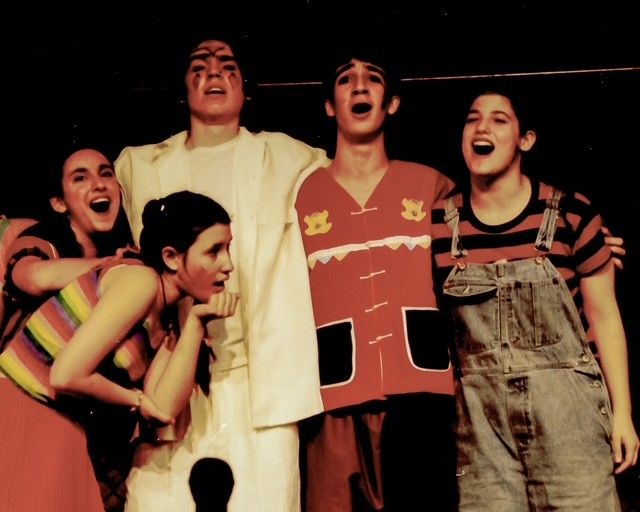
For her senior show, Meredith chose to direct A Chorus Line, the 1975 hit drawn from the real-life stories of dancers trying out for a Broadway ensemble. She enticed Lin-Manuel to be her assistant director with the promise that he’d get to choose the musical the following year.
“Lin was unclear whether he wanted to have that executive role or just be onstage doing what he was comfortable with,” Meredith says. “He was like, ‘I’m just an actor.’ I was like, ‘No, you have something to say. You can pick your show and do it your way.’” That persuaded him. “I liked the applause; I liked being a ham onstage,” he says. “I wanted that Conrad Birdie feeling. But Meredith said: ‘You’ve got more to offer. It’s not the dopamine hit of being onstage, but it’s incredibly satisfying in other ways. You’re going to learn a lot.’”
They started researching the musical a year in advance, and they interviewed student choreographers, music directors, and designers to build their team. Come November, more than 80 students crowded outside the chorus room to await their turn to audition. The parallels between their aspirations and the premise of A Chorus Line didn’t have to be spelled out.
When the directors met with their new company, they stressed the time commitment: Musical Rep required four after-school rehearsals per week, plus full-day sessions on weekends and over vacations. “Rep will be your life,” Meredith told the group. “It’s mine.” She continued, “We’re going to have fun, but you have to know when to be serious about your work. We have a show to put on. Every one of you will be onstage for the whole show. That should probably freak you out. But you can handle it. It’ll be so rewarding.”
For some students, the musical’s drama mirrored their experiences at school. “Hunter’s a frickin’ pressure cooker,” says Chris Hayes, who played a lead in the show. Students had to take multiple tests to get in, and once they did, they found themselves in an even more competitive pool—trying out for clubs, vying for leadership positions, preparing for college applications.
“The life of constantly auditioning was something we had from the age of 12,” Michael Frazer, an older student, says. “We felt like we were in A Chorus Line every day.” Not all Hunterites felt that way. Some remember a collaborative atmosphere where students supported each other, gaining the confidence and freedom to thrive in their areas of strength. For Lin-Manuel, the pressure varied across activities. He didn’t flourish academically, seldom getting As unless he could do a creative project, so he had no interest in competing for grades. With artistic leadership, though, he threw himself in. “There were departments where I really wanted the ball,” he says. “Lose spring break to go rehearse in a church basement? Fuck yeah! But show you my grade on the lab report? Fuck you!”
Now that he was writing and directing musicals, he didn’t have time to make full-length movies. But whenever he could submit a film for a class assignment, he would. For an American history unit in social studies, he decided to make a movie of the 1804 duel between Alexander Hamilton and Aaron Burr. His neighborhood offered all the locations he’d need to shoot. Outside his window, Inwood Hill Park preserved the city’s last natural forest, still looking much as it would have in 1804, facing the dueling grounds across the Hudson River. The houses where Hamilton and Burr had lived were nearby, too, in Washington Heights. He and Meredith walked around Inwood, taking turns toting his camcorder, as he figured out the shots. “The Burr-Hamilton duel always interested him,” she says. “He’d say: ‘That’s my neighborhood!’ But then he dramatized it. He would look for depth in these relationships.”
In Burr and Hamilton’s rivalry, he found another variation on the curdled friendship that Meredith had helped him to explore in Godspell with Jesus and Judas. And in Hamilton’s untimely death, he could hear an echo of his own fascination with talented figures whose lives were cut short: Brandon Lee, Jonathan Larson. He was also struck by learning that Hamilton’s son had died in a duel, defending his father’s honor on the same location where Hamilton would face Burr. “I remember there was some serious psychological stuff happening,” he says.
In Lin-Manuel’s shooting script, when Hamilton’s conflict with Burr escalates, Hamilton tells his wife, Elizabeth, that he’s been thinking about their son’s death. As Lin-Manuel imagined the scene, Elizabeth asks her husband not to dwell on the subject: “Dueling is a sin, Alexander.” That warning determines Hamilton’s choice: When he goes to meet Burr, he will not fire his shot. Still grieving his son’s death, he is nearly suicidal; he risks his own life rather than taking another’s. In the script, he writes a letter to his wife on the morning of the duel, narrating in voice-over the historical Hamilton’s own words: “Adieu, best of wives and best of women.”
Lin-Manuel never got to shoot the script. As he and Meredith walked back from the Dyckman Farmhouse, a man grabbed the video camera out of Meredith’s hands, jumped into a waiting car, and sped away. They’d been mugged. Without his camera, he couldn’t make the movie, so he submitted his script instead. Lin-Manuel remembers his teacher’s disappointment: The script turned history into personal drama, a complex chronicle into amateur psychology. “He thought that ‘Hamilton’s son died, so he was suicidal’ was a very facile explanation,” Lin-Manuel says. “And it was a little cliché. His son died in a duel, so he decided to die in a duel. It was that simple. I got a B-minus.”
❦
He needed all of his energy for the major endeavor of his senior year: directing the winter musical. Meredith had graduated and gone off to Yale, though they remained a couple. It was his turn to pick the show.
His dream was to direct West Side Story. Ever since Ms. Ames had cast him as Bernardo in Hunter’s sixth-grade production and his mom had rented the movie for him to watch, he had been captivated by the musical, which, with Stephen Sondheim’s witty lyrics, staged the question of where Puerto Ricans belonged. “It was the only show where I got to bring my identity to school,” he says. “Doing West Side Story in sixth grade and then directing it as a senior felt very full circle.”
The challenge of putting on a Romeo and Juliet-style musical tragedy about white and Puerto Rican gangs at Hunter was that the school didn’t have many Latino students. So, like the 1961 film, Hunter’s production ended up with mostly non-Puerto Rican actors playing the Sharks. The movie used brownface makeup and exaggerated accents, but Lin-Manuel worked to make his version culturally authentic. He had a secret weapon: the boundless energy of Luis A. Miranda Jr. That winter, his father often left the office early so he could show Hunter’s white, Asian-American, and Black students how to act Puerto Rican. “My job was to teach them how to pronounce the Spanish phrases with a Puerto Rican intonation,” Luis says. Lin-Manuel made him a worksheet of all the Spanish in the show, and they also brainstormed a list of Puerto Rican expressions the Sharks could shout during the song “America.” Under Luis’s tutelage, the actors practiced saying “Wepa!” and “Muévete!” Luis was glad to support his son’s effort to represent their family’s culture. “It was important to Lin-Manuel that they sound Puerto Rican,” he says, “even though they were gringos saying these lines.”
Meredith had shown Lin-Manuel that truthful storytelling was more important than perfect artistry and that supportive leadership could bring out the best in a company. “I felt like A Chorus Line prepared me,” he says. “I felt qualified to direct.” In the areas where he didn’t feel qualified, he trusted his collaborators. “Meredith was always a great teacher in that regard,” he says. “You have to delegate. The choreographers and designers are going to come up with something I didn’t see in my head.”
Student leaders were essentially ordering around their friends, and for some, it could be difficult to maintain authority. Lin-Manuel did it with enthusiasm. He started every rehearsal with improv games, nonsense rhymes, and rhythm patterns he’d picked up at after-school sessions with the Creative Arts Team youth program. When the cast had to learn tricky steps for the “Dance at the Gym,” he declared it National Mambo Week and brought in food and mambo-themed warm-up activities to keep everyone excited. (With hips that seemed to dance on their own, he nicknamed himself “Butt Brain.”) He roped the directing team into filming a parody video at his house to screen at the cast party; he called it Shmest Side Shmory. His natural exuberance became a motivational strategy. “There were diehards like me—I know I’m going to be doing it as long as possible—and there were folks for whom Rep is an extracurricular, so how do I make it fun?” he says. “When you’re truly doing something for the love of it, and you can’t hire or fire anyone, it’s really about a shared vision. It’s about how we can make something bigger together than we can on our own.”

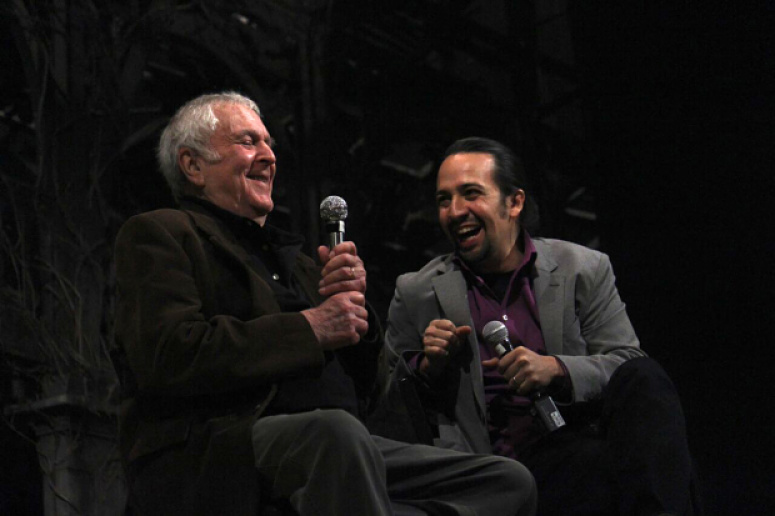
The biggest inspiration came one day at lunchtime in room 210. The cast and crew of West Side Story crammed into the windowless classroom. A few students dashed up from a Jazz Chorus performance in the auditorium, and when they arrived at the doorway, they froze. There, sitting in a chair, wearing a brown sweater, his gray beard trimmed and his hooded eyes aglint, was Stephen Sondheim.
As it happened, Sondheim’s writing partner on Pacific Overtures and Assassins, the playwright John Weidman, had a daughter at Hunter who was two grades below Lin-Manuel. She’d come home and told her dad that the senior who was directing West Side Story wanted to invite Sondheim to speak to the drama club. “Steve loved kids,” Weidman says, “and he had a real interest in teaching. I thought it might be something he’d enjoy.” He called Sondheim, who said that if Weidman accompanied him, he’d do it.
On the appointed day, Weidman met Sondheim at Hunter, and they walked into the packed classroom. As the director, Lin-Manuel was expected to ask the first question. Everyone looked to him. “All I could come up with,” he says, “was ‘What was it like?’” Sondheim looked confused. “What was it like?” “Yeah,” Lin-Manuel said. “What was it like making West Side Story?”
“Oh, I see,” Sondheim replied. For the rest of the lunch period, he told them. But rather than present the origin story of his triumphs, he gave the students a glimpse of his missteps. He shared lyrics that had been jettisoned, songs that were reordered, verses he wished he’d improved. He revealed that he’d written lyrics for the show’s famous dance prologue, but the choreographer, Jerome Robbins, decided he could convey the rivalry better through movement, so the words were cut. Sondheim explained that Riff, the leader of the Jets, got his name because he carried around a trumpet—or he did until the book writer, Arthur Laurents, asked him, “When was the last time you saw a gang member carrying a fucking bugle?” No more trumpet.
Masterpieces, the students learned, didn’t emerge fully formed from a single creator’s head. They were the product of collaboration, negotiation, and constant revision. Sondheim had taken the students inside the artistic process. “What he taught me was that the process was messy. It didn’t have to be perfect,” Lin-Manuel said. “That’s the first thing that pulled back the curtain on how to make a show.”
When the lunch period ended, Sondheim stood by the door shaking each student’s hand as they left. The Musical Rep crew felt validated: Sondheim had told them that he preferred the Broadway order of the Jets’ songs—first “Cool,” then “Gee, Officer Krupke”—rather than the film’s, and that was the choice Lin-Manuel had made for their production. Somehow, the deity had blessed their show.
After the opening-night performance, after the applause and cheers and curtain call, Una LaMarche, who played one of the Shark girls, spotted Lin-Manuel weeping in his mother’s arms. “The show was over, she went up to hug him, and his shoulders were heaving,” Una says. “Seeing a teenage boy in a public place crying out of joy and happiness just stayed with me. It showed how much it meant to him.”
To this day, Lin-Manuel says that his goal as a writer and composer is to re-create his Musical Rep experience. “I was a kid who figured out who I was in the context of the drama clubs at my school. I think a part of my brain is always just trying to make the best school play.”
From Lin-Manuel Miranda: The Education of an Artist by Daniel Pollack-Pelzner. Copyright © 2025 by Daniel Pollack-Pelzner. Reprinted by permission of Simon & Schuster, LLC.