Next week American Theatre unveils its always anticipated Top 10 Most-Produced Plays and Top 20 Most-Produced Playwrights lists (tune in here on Thurs., Sept. 18 at 4 p.m. ET to see it live), so it’s an occasion for accounting—and accountability. In this, the first edition of my new monthly column, I want to dig into one aspect of theatre data which is not usually covered by these lists but which has acquired a renewed urgency in a time of seeming cultural retrenchment: that is, the gender disparity among men, women, and trans or nonbinary playwrights. Is it still the case that cis men are getting the lion’s share of productions on U.S. stages, despite the fact that most playwrights (and theatre audiences) are women?

Our annual fall season preview listings are one place we can find out. As these listings comprise thousands of shows at hundreds of TCG member theatres, they’re the main source for our Top 10/Top 20 lists (for that count, we do supplement them with non-member and commercial theatres for optimal accuracy). For a few years we also used these listings to do a playwriting gender count (a huge volunteer effort, which is why we had to stop); the last year we did this was 2018, and you can see the marginally encouraging results here:

That count was a byproduct of my first issue as editor-in-chief, the “Gender Dis/Parity” season preview issue of October 2015, which looked at the persistent predominance of male writers from several angles, as well as tracing what progress had been made to counteract it.
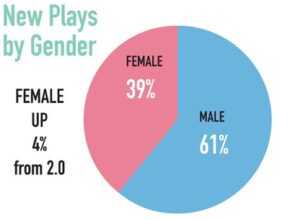
Meanwhile the organization the Lillys launched their own effort, The Count, which tracked numbers for both gender and race over several years; their last effort, The Count 3.0, covering the years 2017-2020, found numbers very close to our own: among new plays, 39 percent were by women, 61 percent by men. For the 2023-24 season, however, the Lillys announced that American theatres reached had gender parity (a New York Times interview with Lillys co-founder Julia Jordan clarified that this referred mainly to Off-Broadway theatres focused on new plays), and they in fact celebrated that milestone with a special event held at Playwrights Horizons in 2023.
So it was especially awkward earlier this summer when Playwrights Horizons announced an upcoming season of six plays, with only one having a woman writer, Jen Tullock, and even in that case co-credited with a man, Frank Winters, on the play Nothing Can Take You From the Hand of God (that two of the season’s playwrights are nonbinary but male-presenting didn’t help with the optics). Others noticed that the Roundabout Theatre Company, the nation’s largest nonprofit, also has a 2025-26 season with just one woman playwright, and that Off-Broadway’s venerable Classic Stage Company has planned a season with zero women playwrights. Some also took note of similar disparities in the seasons of other major theatres (the Goodman, for instance). The outcry was understandably intense; a contentious town hall was held at Playwrights Horizons, and my colleague Helen Shaw wrote a penetrating if inevitably inconclusive piece. Was the American theatre, like seemingly all of our culture and politics lately, slipping further backward into the death grip of patriarchy? Were all of the industry’s previous gains, little or late as they may have been, for naught?
As that controversy raged without answers, we looked to our season data to try to provide some. To gauge what might be thought of as “mainstream” theatre programming (and, frankly, to make it a manageable research task), we looked nationwide at theatres with budgets over $10 million (we included Broadway shows, typically capitalized at at least that number) and came up with three charts of the gender breakdown for the 2025-26 season: one showing gender percentages for just new plays and adaptations (defined as written within the last 10 years), another for all plays (no matter when they were written), and another for new plays at New York City theatres only.
The somewhat surprising results are in the charts below:
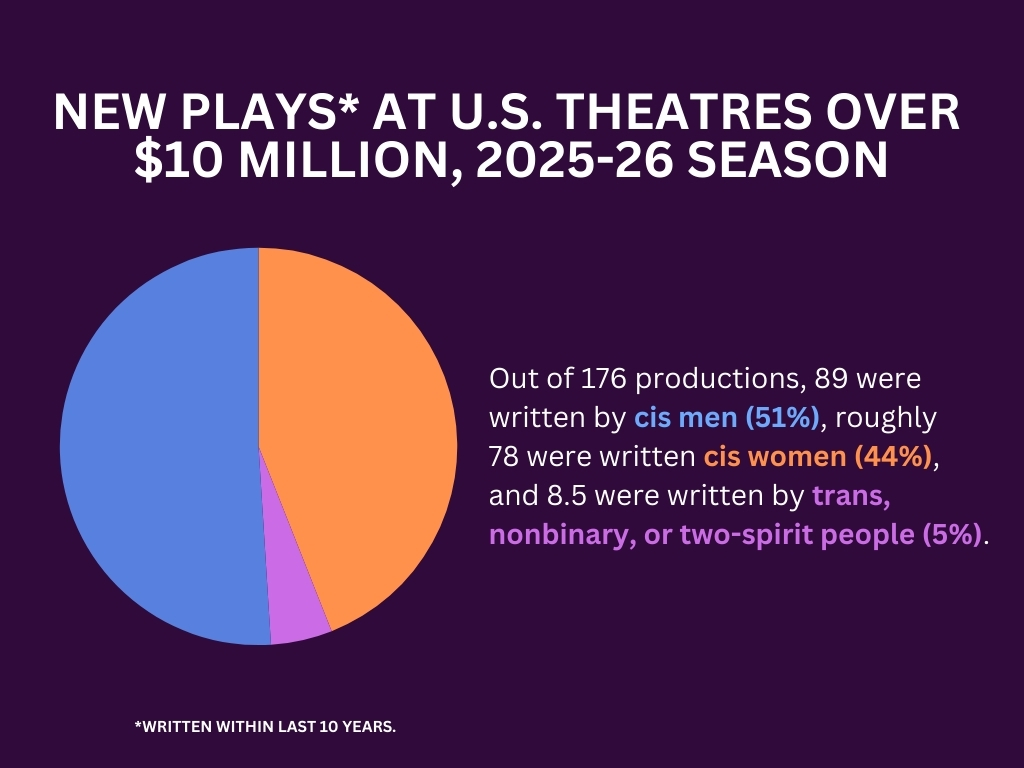
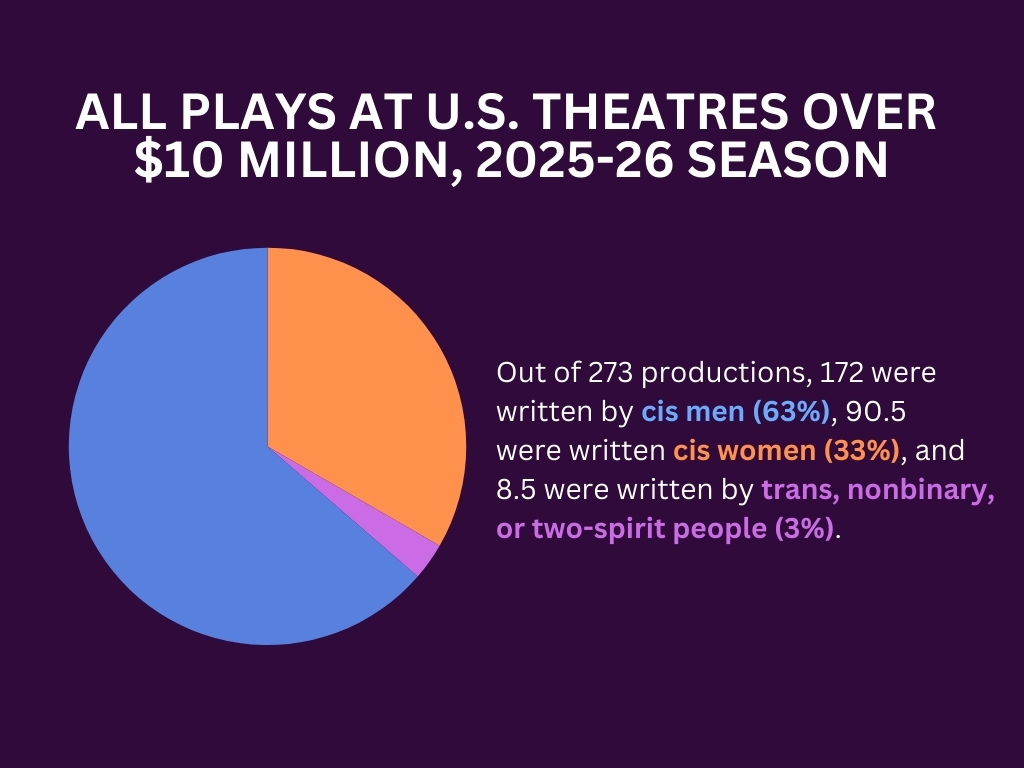
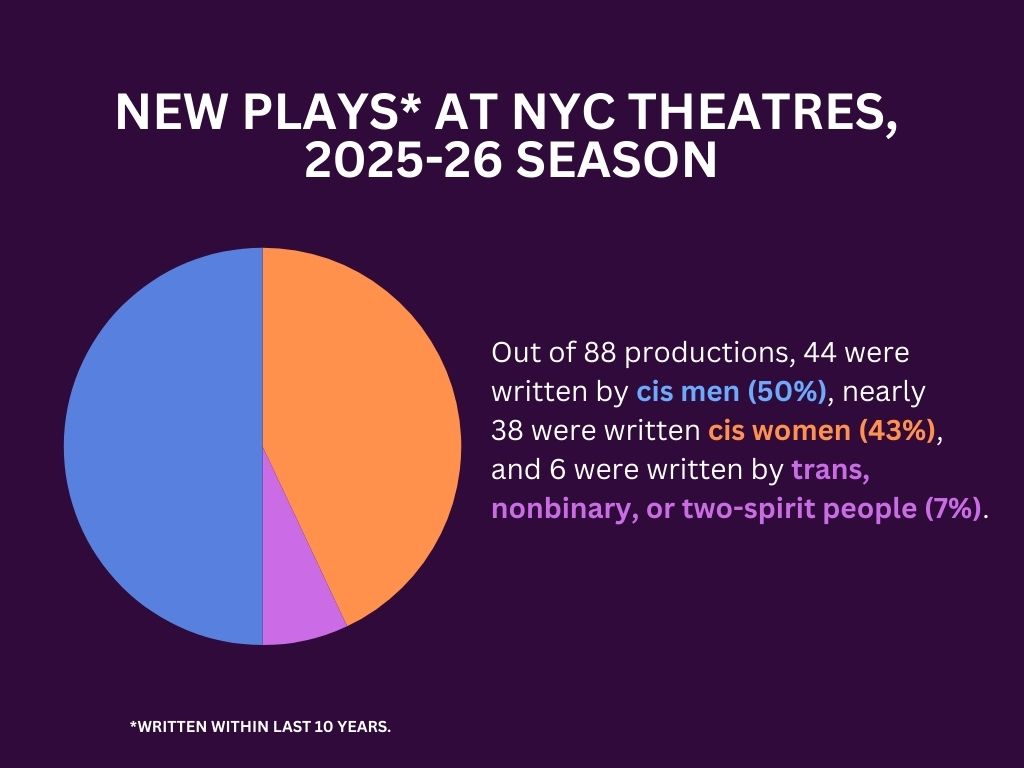
As you can see, the new-play results nationwide and in New York are very close to parity after all, while the all-play results, which include all the Shakespeares and Dickenses, are closer to the old 60/40 divide we were used to seeing about a decade ago. Of course, even that status quo represented progress at the time, given that in 2002 a study showed that percentage closer to 80/20.
So, problem solved? Not so fast. I showed these charts to Julia Jordan, who was impressed but not hugely surprised. She expressed concern about the familiar tendency to take a win for granted—i.e., that institutions may be tempted to think, “Mission accomplished, we don’t need to think about this anymore”—but did say that “the Big Picture has been massive, massive success.” That success, though, hasn’t happened by itself. It’s been the direct result of activism and pressure.
“This is what we saw with The Count,” she said. “We would have this huge surge of women playwrights, and then every couple of years it would go down 5 percent, 3 percent, then it would go back up as we got press or there was another event.”
In closing, she said, “What I want people to wrestle with is that the vast majority of people writing plays are female or born female. They are every color, they are of every ability and disability. They are so wildly over-represented among writers. So, sure, all-male seasons might happen naturally, based on talent and interest, but it’s extremely hard to believe that the same wouldn’t happen an equal number of times, or in reality much more often, that we would see all-female seasons.” Apart from women-only organizations like WP Theater, Jordan said, “I’ve never seen it. I probably have more carefully counted and looked at seasons across the country than anyone, and I’ve never seen it.”
These stats come in the midst of, and no doubt reflect, a generational change of leadership at U.S. theatres, with more women and people of color in positions of power (though not yet at levels representative of the U.S. population). As my colleagues Kelundra Smith and Gabriela Furtado Coutinho showed in their recent survey of theatre seasons along measurements of race and culture, much work has been done, and there is more work to do. As the last decade of public life in our fragile democracy should teach us: No achievement is secure. Progress must be intended and defended.
The Storm Last Time
I recently marked my 20th year in New York City, an ultimately happy move that I associate with another less happy anniversary: I remember sitting in a friend’s NYC apartment during the summer of 2005, watching TV news in horror as Hurricane Katrina submerged New Orleans and the U.S. government response fell shamefully short.
Now New York City’s iconic Apollo Theater, known primarily as a music venue but increasingly making its presence felt in the theatrical realm, is commemorating this terrible anniversary with “Echoes of the Storm,” a series of events Sept. 13-15, promising to explore Katrina’s “lasting impact on Louisiana, the country, and the disproportionately affected Black communities in New Orleans.” The weekend will include the reading of a full-length play, Kelley Girod’s The Faith Healer, about a Louisiana doctor facing a crisis; an evening of eight 10-minute plays, commissioned from New Orleans playwrights to reflect on the enduring impact of Katrina, which are slated to tour the U.S. and end up at Louisiana’s Junebug Productions next year; and a presentation of Spike Lee’s new docuseries Katrina: Come Hell and High Water (which kicked off on Netflix late last month). When it rains it pours.
What Else Is New?
One piece of data American Theatre uncovered when we did our own playwright gender counts was the finding that theatres in the U.S. are, possibly contrary to conventional wisdom, veritable hothouses of new work rather than mere revival houses or theatrical museums. You can see the numbers here: In a given season (albeit this was in pre-Covid times), roughly two thirds of all productions in the U.S. tend to be of new plays (which we defined as written in the last decade).
Even defining the term more narrowly to world premieres, there’s a lot of fresh material hitting stages across the U.S. this month. Here’s my best effort to gather info about all of them, in chronological order.
Color Theories, Julio Torres’s new monologue, billed as “equal parts comedy, theatre, and art piece,” started on Sept. 3 and runs through Oct. 2 at Performance Space New York.
Am I Roxie?, an autobiographical solo show by writer/actor Roxana Ortega, started performances at L.A.’s Geffen Playhouse on Sept. 3 and runs through Oct. 5, with Bernardo Cubria directing.
Cold War Choir Practice, Ro Reddick’s new play with music about a Black conservative and his family during the Reagan era, which had an early bow recently at Clubbed Thumb Summerworks, started at Trinity Rep in Providence, Rhode Island, on Sept. 4 and runs through Oct. 5, with direction by Aileen Wen McGroddy.
The First Lady of Television, James Sherman’s new play about Gertrude Berg, the real-life TV pioneer who created the sitcom The Goldbergs (the CBS series of the 1950s, not the ABC series of the 2010s), started performances on Sept. 4 at Chicago’s Northlight Theatre and runs through Oct. 5, with direction by B.J. Jones.
Worry Dolls, Maya Malan-Gonzalez’s play about two friends navigating middle school, started performances at Portland, OregonOre.’s Milagro Theatre on Sept. 4 and runs through Sept. 21.
Adolescent Salvation, Tim Venable’s play about three teenagers on a bender, started performances at L.A.’s Rogue Machine Theatre on Sept. 5, with direction by Guillermo Cienfuegos.
The Day the Sky Turned Orange, a new musical about climate change by Julius Ernesto Rea, Olivia Kuper Harris, and David Michael Ott, started performances at San Francisco’s Z Space on Sept. 5 and runs through Oct. 5. Commissioned by the San Francisco Bay Area Theatre Company (SFBATCO), it’s directed by Rodney Earl Jackson Jr.
Rabbits in Their Pockets, Kimberly Dixon-Mays’s play about siblings trying to put grief behind them, started at Chicago’s Lifeline Theatre on Sept. 5 and runs through Oct. 5, with direction by Christopher Wayland.
This Is Government, Nina Kissinger’s comedy about the real-time consequences of political disarray, had a recent workshop run at Pendragon Theatre in Saranac Lake, N.Y., and is now in its full-on world premiere production by New Light Theatre Project at NYC’s 59E59 (it started on Sept. 5 and runs through Sept. 28).
Ashland Avenue, Lee Kirk’s new comedy about a faltering video store, starring Jenna Fischer and Frances Guinan, started performances at Chicago’s Goodman Theatre on Sept. 5 and runs through Oct. 12, with direction by Susan V. Booth.
Blood Orange, Abigail Duclos’s new horror play about teenage grief and roadkill, runs Sept. 13-27 at A.R.T./New York, in a production by Et Alia Theatre, with direction by Vernice Miller.
Lady Patriot, Ted Lange’s new play set during the Civil War, starring Lange and fellow Love Boat alumni Fred Grandy and Jill Whelan, runs Sept. 6-20 at New York City’s Theatre Row.
House of McQueen, Darrah Cloud’s new play about the iconic fashion designer Alexander McQueen, with Luke Newton in the title role, opened on Sept. 9 and runs through Sept. 28 in a new space called Mansion at Hudson Yards in NYC.
This Is Not a Drill, a new musical by Holly Doubet, Joseph McDonough, Kathy Babylon, and John Vester about a fateful false missile attack alert in Hawaii, began performances on Sept. 9 and runs through Oct. 11, in a York Theatre production at NYC’s Theatre at St. Jean’s.
The Essentialisn’t, a new performance piece by and starring the versatile Eisa Davis, billed as “incorporating art gallery aesthetics with an electronic soul score,” and runs at NYC’s HERE Arts Center Sept. 10-28.
Can’t Run, Can’t Dance, Gregg Henry’s comedy about two women drawn into a smuggling operation, runs Sept. 11-Oct. 5 at New Jersey Repertory Company in Long Branch, New Jersey..J.
limp wrist on the lever, Preston Choi’s dark comedy about a teens on the run from a gay “conversion” camp, runs at San Francisco’s Crowded Fire Theatre Sept. 11-Oct. 4.
Mae West: The Comeback Tour will have three performances, Sept. 11-13, at Baltimore’s Theatre Project. Created by Fail Happy and Deanna Fleysher (the team behind the immersive comedy experience Butt Kapinski), it’s billed as an overdue return of the screen icon for whom the Hays Code was invented.
Maybe You Could Love Me, Samah Meghjee’s play about two high school best friends at a crossroads, runs Sept. 11-28 at Minneapolis’s Mixed Blood Theatre, in a production by Theater Mu.
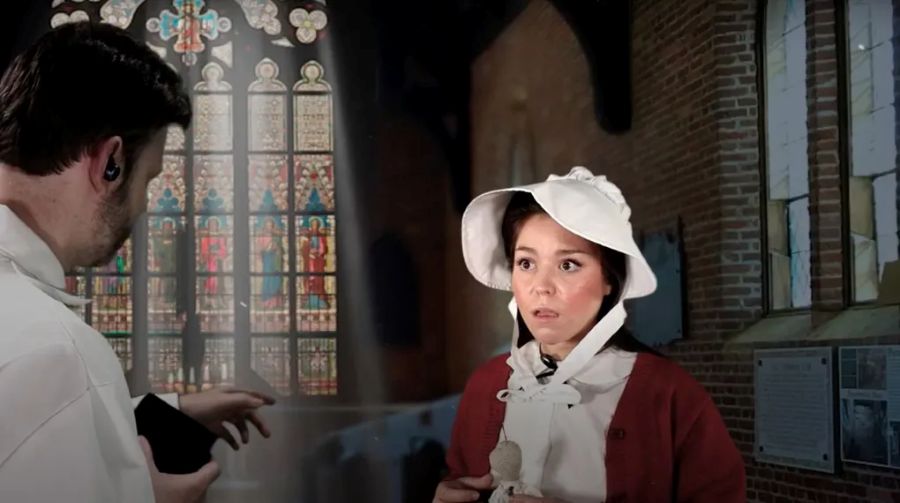
Wad, Keiko Green’s play about a young woman who strikes up a pen-pal relationship with a man on Death Row, runs at American Lives Theatre in Indianapolis Sept. 11-28. It’s a co-production with New Harmony Project, the new-play development hub that programmed Wad as part of its PlayFest Indy.
La Otra, a bilingual comedy about three Colombian sisters celebrating their father’s 80th, co-created by Tanaquil Márquez and Eliana Fabiyi, runs Sept. 12-28 at Philadelphia’s 1812 Productions.
All the Men Who’ve Frightened Me, Noah Diaz’s play about a young couple haunted by their past as they try to build a future, plays at California’s La Jolla Playhosue Sept. 16-Oct. 12, with direction by Kat Yen.
When the Hurlyburly’s Done, a new play by prolific writer/director Richard Nelson, marks the U.S. debut of Kyiv’s Theater on Podil, in a production that will be performed in Ukrainian (in a translation by Yulia Sosnovska). Interestingly, it’s a backstager set in 1920, not a play about current events. It’s at NYC’s Public Theater Sept. 16-21.
Manifest Pussy, Shakina’s new solo show, billed as a “a rock concert/standup special sacrifice” about her pilgrimage to Thailand for gender confirmation surgery, runs Sept. 17-Oct. 12 at San Diego’s Diversionary Theatre, with direction by Sherri Eden Barber.
The Unexpected 3rd, a solo show about aging, identity, and authenticity by Kathryn Grody (whose husband is Mandy Patinkin), runs Sept. 17-Oct. 19 at Malvern, Pennsylvaniaa.’s People’s Light.
Chicka Chicka Boom Boom, a new musical adaptation of Bill Martin, Jr. and John Archambault’s popular children’s book, written and directed by Nina Meehan, runs Sept. 18-Oct. 12 at Seattle Children’s Theatre.
Fancy Dancer, Larissa FastHorse’s solo show about her coming-of-age as a half-Lakota, half-white ballerina, runs Sept. 18-Nov. 2 at Seattle Rep, in a co-production with Seattle Children’s Theatre, with direction by Chay Yew.
From Here to Where, a musical of sorts (in fact it’s billed as “part lyrical sermon, part political exorcism, and part late-night jam session”) with a book by Umberto Crenca and music by the Gillen Street Ensemble, runs Sept. 18-Oct. 5 at Wilbury Theatre Group in Providence, Rhode Island..I.
Iranian Girlfriend, billed as SB Tennent’s “darkly comic performance installation about displacement, divorce, and survival in difficult times,” runs Sept. 18-Oct. 4 at Brooklyn’s MITU 580; it’s a presentation by New Georges of a production by Built4Collapse.
And Then We Were No More, a dystopian thriller by Tim Blake Nelson (who starred as Buster Scruggs and wrote the play Eye of God), runs Sept. 19-Nov. 2 at NYC’s La MaMa, with direction by Mark Wing-Davey and a powerhouse cast that includes Elizabeth Marvel and Scott Shepherd.
The Ruins: A Play Through Music, George Abud’s play about two master musicians meeting in an empty space to trade jabs and music and contemplate their mortality runs Sept. 19-Oct. 12 at the Guthrie Theater in Minneapolis, with direction by Osh Ashruf.
Saturday Church, a new musical based on the film inspired by the LGBTQ+ youth ministry at St. Luke in the Fields, opens Sept. 19 at New York Theatre Workshop, with a book by Damon Cardasis and James Ijames, music by Sia, and direction by Whitney White.
Another Kind of Silence, L M Feldman’s play about women who meet and fall in love at the wrong time, runs Sept. 20-Oct. 12 at Pittsburgh’s City Theatre. A bilingual play featuring English and American Sign Language, it features direction by Kim Weild and ASL direction by MoMo Holt, and kicks off a rolling world premiere that will take it to Colorado’s Curious Theatre Company and Austin’s The Vortex next year.
Rome Sweet Rome, the Q Brothers Collective’s new “ad-rap-tation” of Julius Caesar, runs Sept. 23-Oct. 19 at Chicago Shakespeare Theater.
A Lesson in Love, Nubia Monks’s self-billed “Black rom-com,” runs Sept. 24-Oct. 14 at Minneapolis’s Pillsbury House and Theatre.
Veal, Jojo Jone’s play about friends who meet after a coup ends with one of them named Queen of North America, runs Sept. 25-Nov. 2 at Chicago’s A Red Orchid Theatre, with direction by dado.
Ryan’s Pub Trivia Night, Alec Silberblatt’s play about a Pittsburgh trivia team, runs Sept. 24-Oct. 12 at Third Avenue Playworks in Sturgeon Bay, Wisconsin, with direction by Jacob Janssen.
Let’s Love!, Ethan Coen’s triptych of comic one-acts about the vagaries of modern romance, runs Sept. 25-Nov. 9 at NYC’s Atlantic Theater Company, with direction by Neil Pepe and cast that includes Aubrey Plaza.
you are seen, Bella Anay Hathorne’s dark comedy about a college peer support group for high-achieving women, runs Sept. 25-Oct. 19 at the Makers’ Space in Brooklyn, in a production by Murmuration Theatre Co., with direction by Emma McGlashen.
Otherkin, N.T. Vandecar’s drama about a subculture preparing for humanity’s end, runs Sept. 26-Nov. 2 at North Hollywood’s Road Theatre, with direction by Christina Carlisi.
Murdoch: The Final Interview has no playwriting credit (the press release simply says “written by unnamed source”), but imagines the media mogul’s last stand, enacted by Jamie Jackson and directed by Christopher Scott, opening Sept. 28 at NYC’s Theater 555.
Caroline, a mother-daughter comedy by Preston Max Allen, opens at New York’s MCC Theater on Sept. 30, with direction by David Cromer.
A New Global Player
New York City-based followers of edgy European theatre and performance now have a new place to look for it to turn up in the area other than at festivals like Under the Radar or Brooklyn Academy of Music’s Next Wave, or occasional appearances at Manhattan’s Armory, NYU’s Skirball Center, or PEAK Performances at New Jersey’s Montclair State University. Powerhouse: International, which launches Sept. 25 and runs through Dec. 13, is a new series spearheaded by producer David Binder (best known for De La Guarda and as BAM’s executive director during the tumultuous years 2019-2024), which will unfurl at Powerhouse Arts, a former transit power station in Brooklyn’s Gowanus neighborhood. The lineup is formidable, with highlights including Sibyl, a new chamber opera helmed by South African auteur William Kentridge (Oct. 8-11); the U.S. debut of Brazilian provocateur Carolina Bianchi in her controversial, self-medicating exploration of sexual violence with her troupe Cara de Cavalo, The Bride and the Goodnight Cinderella (Oct. 23-25); and a music series curated by Adam Shore, featuring among others Pussy Riot Sibera and Moor Mother. Also intriguing are a group of pieces that invite different kinds of community participation, including choreographer Mette Ingvartsen’s Skatepark, designed to create a community around skateboarding in the venue’s massive Grand Hall (Sept. 25-27); Kate McIntosh’s site-responsive live installation Worktable, in which participants are invited to enter a workspace space and make an artful mess (Oct. 4-Nov. 9); and The Imagining, a sort of dance party from choreographer Amari Marshall, closes out the series on Dec. 13.