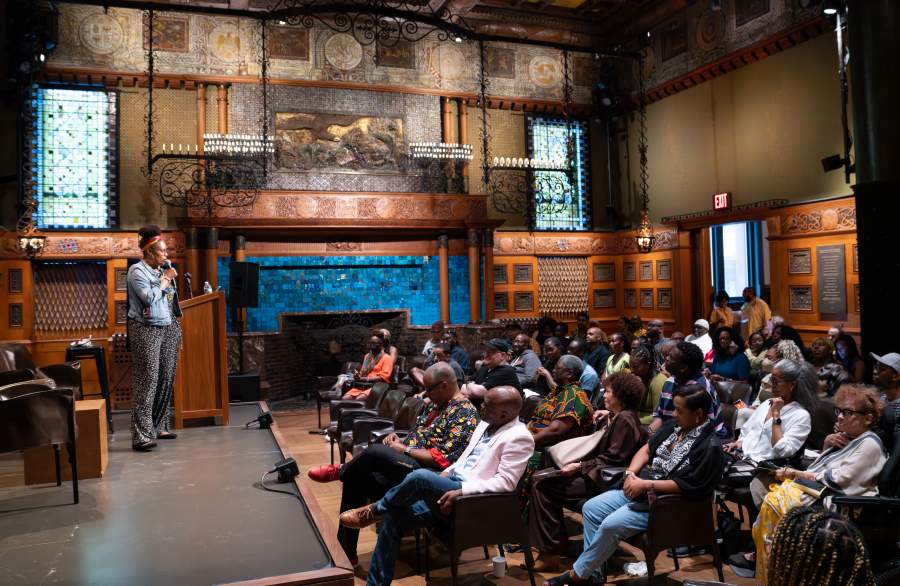
The salon, part of NBT’s 2025/2026 season entitled “The Alchemy of Return: Remembering is a Radical Act,” was also a critical continuation of their Catalyst initiative, founded in 2013 under the leadership of CEO Sade Lythcott and executive artistic director Jonathan McCrory to “address the social impact and historical complexity of Black theatre, as well as create a space for Black theatre artists and administrators to connect, ideate, and enact meaningful change.” A forthcoming full report commissioned by NBT and the Ford Foundation from playwright, director, and dramaturg Talvin Wilks will synthesize the findings of the Catalyst initiative.
(Full disclosure: I was employed in NBT’s production department from October 2023 to July 2024, but had no prior knowledge of or involvement in the Black Theatre Advance event.)
The salon’s first session kicked off with a solo performance by musician, artist, lyricist, and abolitionist Samora Pinderhughes on both keyboard and vocals. Pinderhughes’s soft, slow, jazzy performance grounded the space in a tone of rigorous artistry and thoughtful engagement that was characteristic of the whole event.
“What time is it on the clock of the world? What time is it in the clock of your world?” Nyong’o asked in his opening remarks, echoing a refrain from activist Grace Lee Boggs. The impact of time continued to be remarked upon, as Nyong’o was then joined by McCrory and Lythcott at the podium. McCrory highlighted a troubling trend: By one account, there were more than 200 Black theatre groups in NYC alone in 1968, but by 2013, it was estimated that the number of Black theatres in the entire United States numbered fewer than 90.
Lythcott emphasized the importance of publishing reports, such as the one being prepared for Catalyst, for posterity. She noted that while the oral history tradition is one crucial method of propagating Black cultural knowledge, there are some cases where “if we don’t publish it, we won’t matter.” I was reminded of recent attacks on the National Museum of African American History and Culture as Lythcott welcomed Dr. Mary Schmidt Campbell to the stage for her keynote.
“Black theatre is one of our most potent forms of public truth-telling,” Schmidt Campbell asserted, citing her own transformative experience seeing Melvin Van Peebles’s 1971 musical Ain’t Supposed to Die a Natural Death. Drawing from her own experience in the world of museums, higher education, and arts governance, she outlined three “pillars of permanence” as “assets” that must be cultivated while doing the work of institution-building.
She illustrated the first and most important pillar, human capital, by reflecting on the strength of the Studio Museum of Harlem’s staff development programs and advancement pipelines. She then went on to describe that protecting intellectual capital, the second pillar, begins with recognizing that preserving both the artistry and history of an institution “is an enterprise in and of itself,” and resourcing it accordingly, as Spelman College does with its “small but meticulous” archive, including materials on author Toni Cade Bambara. She then explained how cultivating the third pillar, financial capital, is “not something you do once and forever, you’re doing it all the time,” citing how she led Spelman College in a period where the institution’s entire business model had to be reevaluated 140 years into the history of the college.
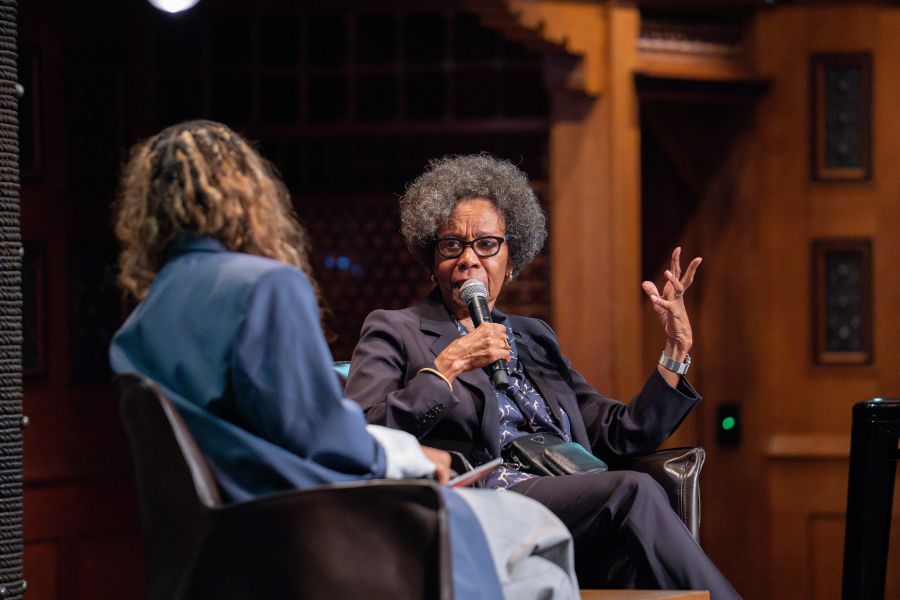
As Schmidt was rejoined by Lythcott for a fireside chat following those remarks, she recognized NBT’s founder, Dr. Barbara Ann Teer, for having a strong understanding of these pillars. The pair discussed the importance of reciprocity in emerging partnerships among Black theatres and other organizations, with Schmidt insisting that “the road has to go both ways.” Lythcott introduced a fourth pillar into consideration, cultural capital, noting that “oftentimes, you have to have to point to cultural capital as a real currency in these partnerships” in order to establish equitable collaborations.
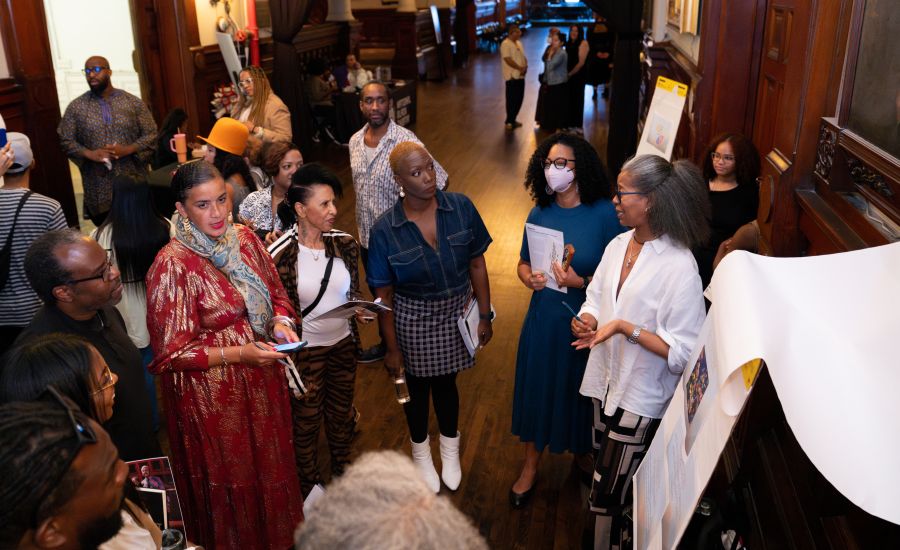
After the fireside chat, actress, playwright, director, and educator Nikkole Salter got us on our feet and connecting with each other in a participatory workshop on the notion of Black theatre “ecosystem building.” Using language and diagrams related to ecology, Salter asked us to form groups and identify what parts of our “ecosystem” felt like they were thriving, where there may be harm and a need for healing, where we see opportunities for interdependence, and what we might visualize for an ideal Black theatre ecosystem. Perhaps unsurprisingly, multiple groups, including my own, visualized a communal gathering over food, with a spirit of fellowship, care, and reciprocity. Patricia McGregor, speaking on behalf of her group, captured the intention well: “We want to operate like a potluck of intersectional liberation.”
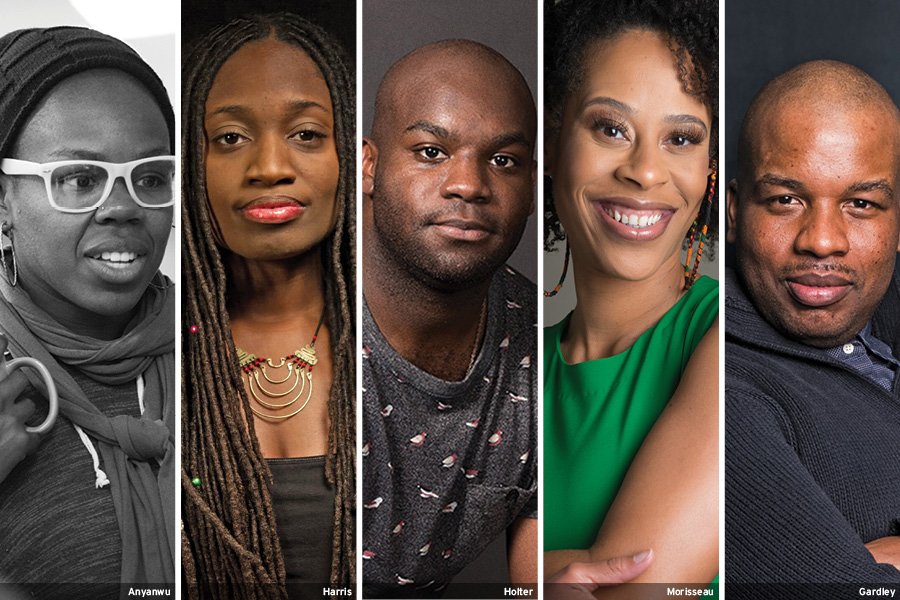
McGregor is one of six artists commissioned by NBT and the Armory to author manifestos that envision the future of Black theatre inspired by the proceedings at Black Theatre Advance, as well as a prior Catalyst convening held in December 2023 and their own vantage points in the field. The other commissioned theatremakers include playwright, director, and activist Ifa Bayeza; cultural strategist, artist, and facilitator Sage Crump; India Haggins, account director and head of audience growth at SpotCo; the Obie-winning artistic director of Baltimore Center Stage, Stevie Walker-Webb; and Tony-winning Broadway actress and producer Adrienne Warren. Their manifestos will be published later this year, and will also inform the full Catalyst report.
Following a short break, Imani Uzuri’s voice boomed throughout the Armory’s Veterans Room as the singer-songwriter led us in a processional hymn, “Bread of Heaven,” with a tambourine in hand, signaling the start of the salon’s second session. Nyong’o returned to introduce the next fireside chat between the Apollo Theater’s Executive Producer, Kamilah Forbes, and spoken word artist, writer, and cultural strategist Marc Bamuthi Joseph to discuss the current state of Black institutional theatremaking.
“A lot has happened since last we convened,” Forbes announced, referring to the December 2023 Catalyst gathering, before outlining some of “the brilliance in the state of Black theatre today, but also the challenges: In 2023, NBT was co-producing two works on Broadway, Purlie Victorious and Fat Ham. Prior to that, we saw a historic theatre season where, at least initially, every new play on Broadway was by a Black playwright. Funding organizations such as the Ford Foundation increased their support for arts organizations of color, including with a $2 million grant to NBT supporting the ongoing redevelopment project of their building in Harlem. And the premiere of Joseph’s own piece, Watch Night, was selected to inaugurate the new Perelman Performing Arts Center in November 2023. That same year, the magazine reported on multiple Harlem-based arts organizations making strides in the face of hardship, including NBT and the Apollo.
“And here we are in 2025,” Forbes continued, to sighs and groans in the room. Forbes cited the Kennedy Center’s elimination of their entire Social Impact team, including Joseph’s former position as the department’s artistic director, as one example of new and renewed financial, cultural, and structural threats to Black theatremaking in the current moment. The pair then touched on a variety of topics: the value of cultural currency and of “time-based art,” the notion of advocating for infrastructure and support for an entire ecosystem as opposed to just a single institution, creating a “home for danger” within Black theatre institutions, and envisioning a “post-fear economy” to support artists and their work at a time some are conceptualizing as a “second nadir” period for Civil Rights in the United States.
Reflecting back on the first nadir period—i.e., post-Reconstruction Jim Crow up through roughly World War II—Forbes noted that much of the Black artistic and cultural response didn’t originate within big institutions, but rather among “intellectuals working cross-intersectionally” in “smaller, decentralized collectives” to hold events such as salons, which were common during the Harlem Renaissance. She cited a resurgence of this kind of activity beyond just the salon format of Black Theatre Advance. I’m observing it too: For example, Sweet Tea: An Artist Salon, produced by new collective My Black Job Productions will be held in New York City and stream live later this month.
The second session closed with a participatory workshop called “Building a Black Theatre Bill of Rights,” facilitated by artist, scholar, and culture strategist Ebony Noelle Golden. Golden challenged us in small groups to come up with measurable, actionable steps to take to activate each of seven key rights for Black theatremakers, devised by Lythcott. Among them: the right to authorship and agency, the right to cultural context and respect, the right to equity and economic justice, the right to safe and nurturing spaces, the right to institutional accountability, the right to creative permanence and legacy, and the right to communal reciprocity. At the end of the workshop, brilliant ideas poured in from all over the convening for how to turn these rights into reality for Black theatremakers.
The third and final session opened with a solo musical performance by Nicholas Ryan Gant (NRG), who treated us to a few songs featuring live looping of his stunning voice before Nyong’o returned to the stage to introduce a keynote address, delivered by Ain’t No Mo’ playwright Jordan E. Cooper (whose new play Oh Happy Day! runs at the Public Theater in October).
“Now, I don’t know how many of y’all know about the summer of 1822,” Cooper began. “Two significant events happened that summer that I would like us to pay attention to.” He first described Denmark Vesey, a free Black man who, in the summer of 1822, led a failed rebellion among the enslaved people of Charleston, South Carolina, for which he was then executed, along with multiple co-conspirators. Though Vesey feared that the plot would be uncovered, he stuck to his guns regardless. Cooper then described how, that same summer, the African Grove Theatre, established by William Alexander Brown the previous year, put on a production of Shakespeare’s Richard III, featuring Black performers in whiteface, which appalled white New Yorkers. Despite police-backed demands to close the production, Brown and his company of actors proceeded with performances and were subsequently arrested.
Both men had proceeded with their plans despite the risk of violence, “some would say, foolishly,” Cooper declared with a leading tone. He then went on to praise their defiance, lauding their “intentional foolishness” in the face of white state violence deployed to protect political hegemony (i.e., the institution of slavery) or cultural hegemony (the “sanctity” of Shakespeare), and encouraging us all to channel that energy and “act a fool” the next time an institution dares pull the rug out from under us.
After his address, Cooper was joined by McCrory onstage for a fireside chat to discuss how love and grief show up in their artistry, how access to theatre creates pathways for new artists and audiences, and the nature of artistic lineage. Cooper, quoting a past professor of his, was particularly inspired by the idea that “you are a descendant of who you read,” and McCrory mused on both the liberatory potential and the sanity-stealing consequences of this idea, especially in the social media age.
Synthesizing many of the day’s insights into one last question, McCrory asked Cooper to reflect on a future, society, and world that he would like to see and build. Cooper spoke a few different concepts into the space before landing on a deceptively simple one: “I just think everything should be free.”
Festivities continued right outside the Armory’s Veterans Room with a post-event reception, where we continued to eat, drink, mingle, and dream into a Black theatre future that is free and accessible to all—and permanently so.
Adam Wassilchalk (he/him) is a Harlem-based arts writer, stage manager, and production manager from Austin, Texas. https://linktr.ee/adamwassilchalk