There’s the awkward silence. The comfortable silence. The tense silence. For every silence we can name, there’s a multitude more we can’t. Another Kind of Silence, written by L M Feldman, wants to give a name to each of them.
Feldman’s play has begun its National New Play Network Rolling World Premiere at Pittsburgh’s City Theatre (through Oct. 12), with direction by Kim Weild, with additional productions slated for Denver’s Curious Theatre Company next March and The VORTEX in Austin next May.
The play tells the queer love story of two women who meet cute among the ruins in Athens, Greece, while they’re both in committed relationships with others: Chap, who is hard of hearing, is an expat artist helping her Deaf partner, Ana, run their café, while Evan is a (hearing) writer traveling with her composer husband, Peter.
The character’s varied hearing ability is one reason the production has been bilingual, with both spoken English and ASL, from the start. But it has also been a way to depict the contrast between their internal and external realities. Each part is played by a speaking and signing actor simultaneously.

“Being able to have two different humans and bodies and cultures both play parts of a person feels like a really rich and accurate way of showing that conversation within a self,” Feldman said. “It creates opportunities for conflict and tenderness—a deep intimacy, even healing.”
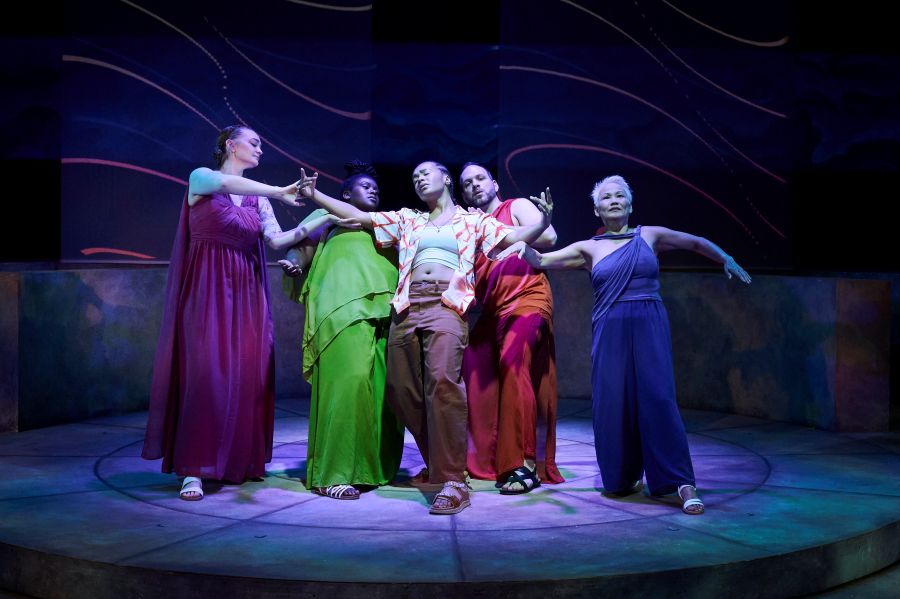
And since it’s set in Athens, the characters are trailed by a Greek chorus, smartly decked out in bright, billowy costumes (designed by Damien E. Dominguez) with ornate twists and folds that evoke traditional togas (or the Greek chorus of Disney’s Hercules, if you’re of a certain age). This chorus narrates both the play’s internal and external actions with a mix of signing and speaking in unison between scenes. Each member of the chorus also represents one of the lovers across the play, serving as a singular chorus to each.
These singular chorus moments, in which one actor signs while the other speaks, create an externalization of self that comes across effortlessly in performance. The chorus might represent a younger self, an ego, one’s internal desires, or a physical embodiment of internal tenderness, as Feldman described.
Indeed, the show’s four lovers interact with their choruses as much as they do with their lovers. In a tense moment between Chap and Evan, Evan’s chorus gasps when Evan says something she might regret. There’s a scene of flirtation between Evan and Chap when Chap’s chorus is enthusiastically giddy, a direct foil to Chap, who remains calm and collected, at least on the outside. These dualities add depth to the performances that don’t feel obtrusive, precisely because they’re bilingual and simultaneous.
It’s a rich performance and text to dive into, thanks in large part to the commissioning of what’s called a “gloss,” or a kind of ASL translation. With support from NNPN’s Venturous Theater Pipeline, director/performer Monique “MoMo” Holt was hired as director of artistic sign language (DASL) for the production’s run at City Theatre, and her main job was creating the gloss. Indeed, characterizing the gloss as a translation sells it short: A gloss considers regional dialects, visual gestural communication, and other forms of sign language in the translation, said Holt via ASL interpreter.
“It was very important to notate the appropriate sign that would be selected to fit the script, so that it was portrayed in the story correctly,” Holt said. “Sometimes the English is very fast-paced, and I had to think, get that translation into sign, and document it. It’s painstaking work.”
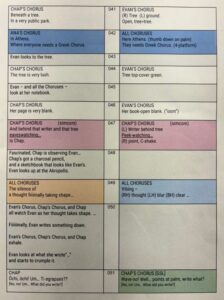
To the uninitiated, the gloss may appear more like a detailed database than a script per se. Holt starts with the English, translating a line or word into ASL, keeping in mind regional dialects, the character’s background, and even the setting. Holt worked with Evanthia Plachoura, a Deaf Greek woman from Athens, as the Greek Sign Language Specialist. Plachoura translated the printed Greek lines into Greek Sign Language.
Each line is meticulously documented through a written description, as well as video examples of each sign, conveying the visual and spatial language of every line, providing both a tool for actors on set and an archival record for future generations.
With the gloss completed before the first table read, “everything’s ready from the very start,” Holt continued. “So anyone—Deaf, hearing, hard of hearing—no longer has to feel they cannot connect to it. The language is there and provided, and they’re able to have that connection. It’s theatre for them, not for one or the other.”
When discrepancies or questions of sign choice arose, Holt had a clear role as DASL in rehearsal. Said director Weild, Holt was “tending to Deaf culture inside the world of the play. It’s about refinement. Translation is living and breathing and changing, just like any language.”
Holt, who played the role of Ana in previous workshops of Another Kind of Silence, appears at City Theatre in Peter’s chorus. To allow Holt to focus on her performance, City Theatre brought on an assistant DASL, Meg Dippold, who worked closely with Holt to refine show’s DASL practices. As DASL, Holt also worked with Feldman during the City Theatre run to continue to refine the gloss for future productions. Before the rehearsals begin at the Curious Theatre in Denver, the gloss will be updated to reflect changes that took place from the page to the stage in Pittsburgh, explained Holt.
The gloss not only creates the dramaturgical richness of dual languages; it also creates full access for Deaf and hearing audiences alike.
“Part of coming in with the gloss already set is trying to create an inclusive and equitable process so that the deaf audience members are having as rich, complex, integrated, resonant an experience of watching this play as the hearing ones,” said Feldman. Additional considerations, including the projection of open captioning onto translucent banners hanging from the set’s Grecian columns, create a production that’s mindful of access for everyone.
That access orientation only reinforces the themes of Another Kind of Silence: There are five different languages spoken in the play, including spoken Greek, Greek Sign Language, and open captioning, but the characters’ ability to communicate and understand one another still falls short.
In these moments, the Greek chorus appears, giving a name to a particular kind of silence: “the silence before a big conversation,” a.k.a., “the silence when you know you’re fucked.”
On the flip side, there are moments when characters are granted the power to connect despite language barriers. Chap’s partner, Ana, is Deaf, but in a scene between them and Evan’s hearing husband, Peter, Peter’s ASL chorus swaps in his place, with Ana reasoning that they’ve “earned a dream scenario where we can understand each other.”
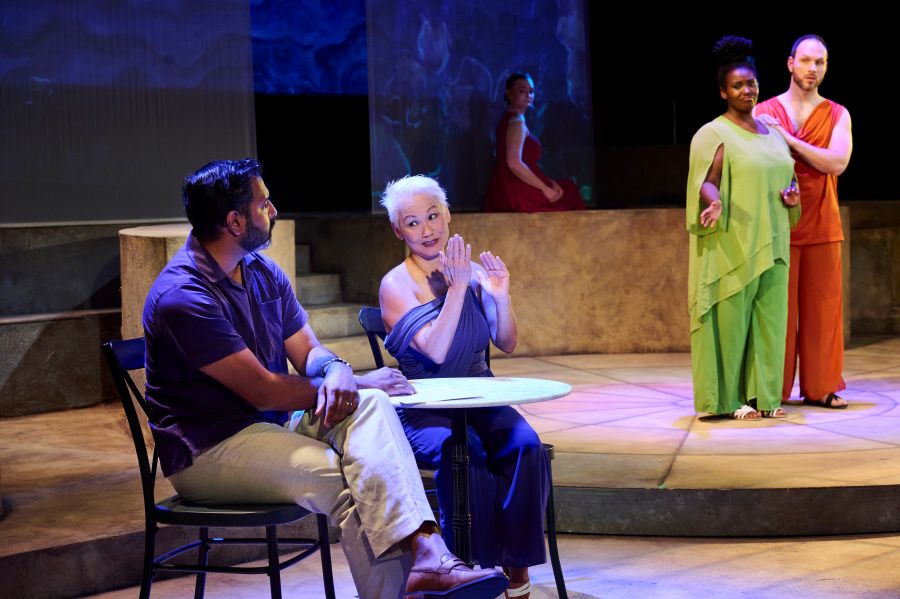
Spoken lines are stylized differently from signed lines, but all are timed to the cadence of the performances onstage.
“We’re close to over 5,000 cues,” said Weild. “It’s technical and complex, but if we’re doing our jobs right, it will look seamless, and every audience, Deaf or hearing, will receive the show.”
For Feldman, this technically complex performance in Pittsburgh is just the beginning. While the production will undoubtedly take new shape across its upcoming performances, they’re glad to have the gloss as a resource for their future casts. Commissioning a gloss can be a time- and capital-intensive process, but it’s a necessity when creating inclusive productions, said Weild, a SODA (sibling of a Deaf adult) with decades of experience in bilingual productions.
“If we really want to have an American theatre that reflects who we say we are,” said Weild, “it requires thinking about everyone who is an artist, their cultures, their languages.”
In one scene, just before presenting his latest symphony, Peter says, “May you find yourselves in it.” Said Feldman, “I keep coming back to that line. Have we built a play, and have I written a play, and have we created a production, where people can find themselves in it? Is there more we can do so that every person who’s watching it feels like that?”
Emma Diehl (she/her) is a journalist and critic. Emma was an inaugural member of American Theatre and Pittsburgh Public Theater’s Critical Insight fellowship.