Sasha Denisova, who based My Mama and The Full-Scale Invasion on her relationship with her real-life Ukrainian mother, spoke to Yury Urnov, who directed the play’s world premiere, a co-production of Philadelphia’s Wilma Theater and Washington, D.C.’s Woolly Mammoth Theatre Company.
YURY URNOV: Let’s talk about what’s changed, shall we?
SASHA DENISOVA: Literally everything has changed—except the war. In my life, in how I relate to the war, and in how Europe, the U.S., and even Ukraine relate to it, the war has been normalized. Bombings have been normalized. Thousands—hundreds of thousands—dead. I live in Europe. The play was written in October 2022, and then I added the “American” scene with Biden in August 2023, just before the premieres in D.C. and Philadelphia.
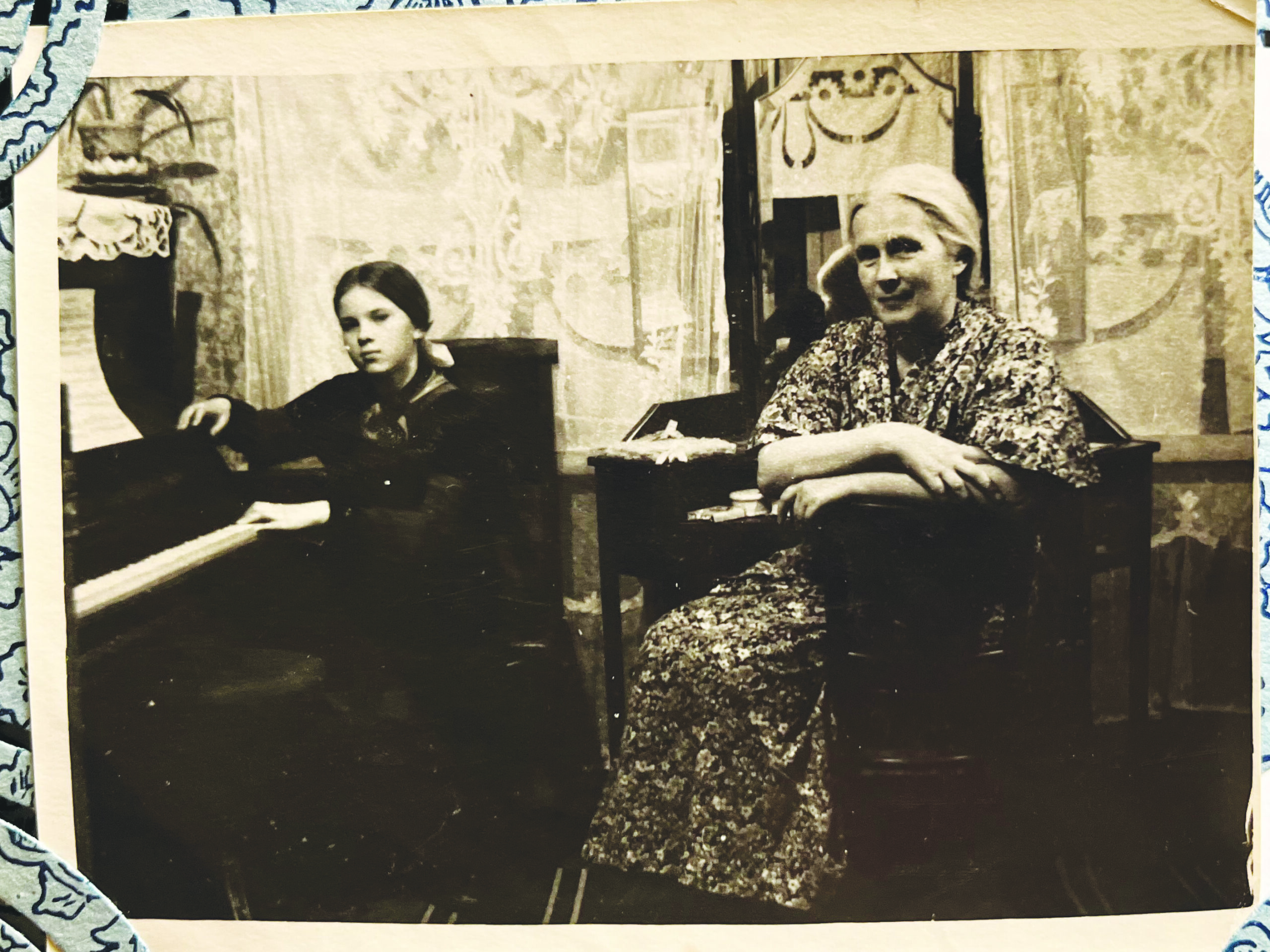
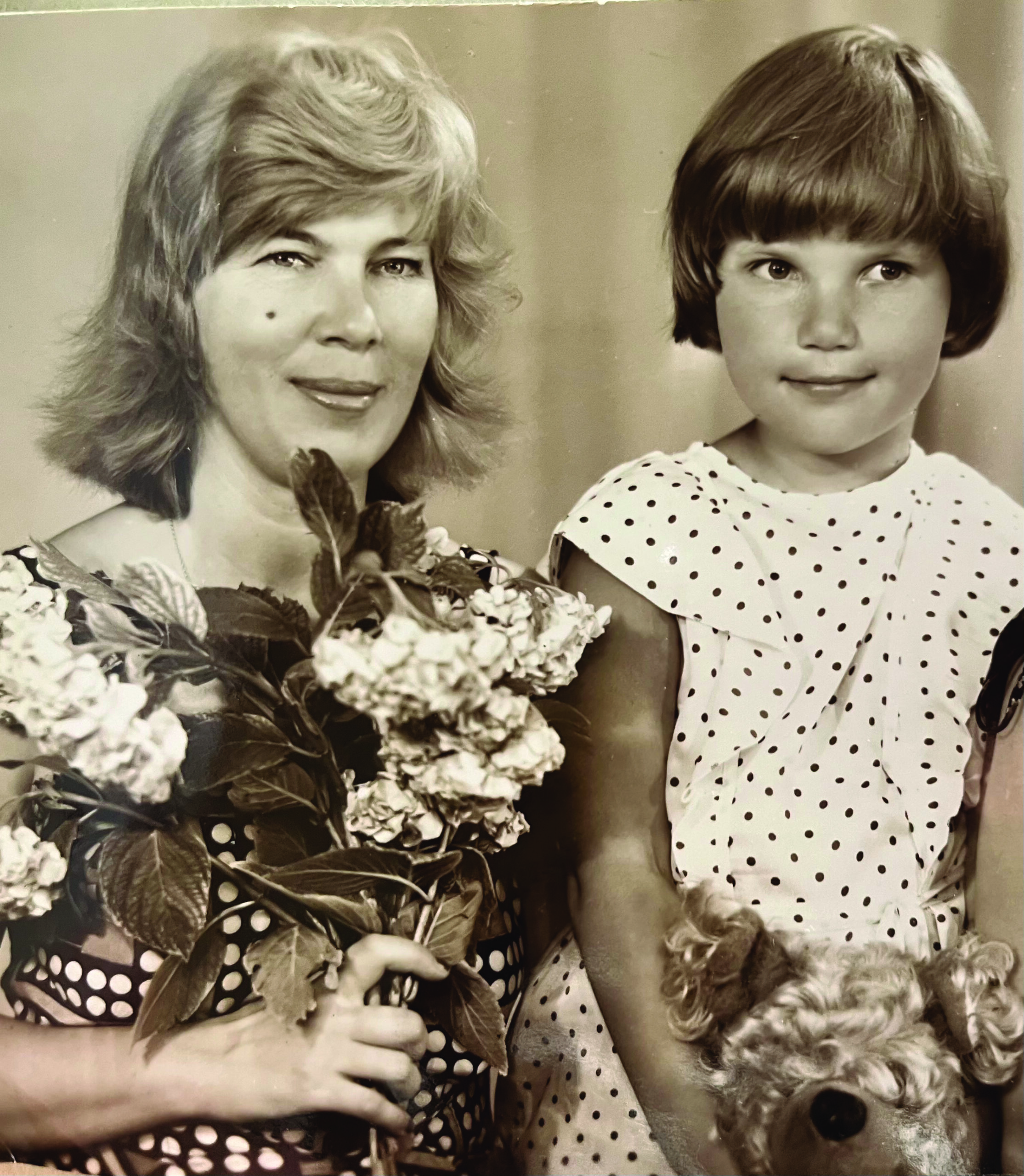
Here’s the paradox: What hasn’t changed is my mother’s attitude toward the war. Her stance is like a personal crusade. She’s over 80, and it’s as if her courage, resistance, humor, and stubbornness matter. As if every day, she sends the world a WhatsApp message saying: I’m still here. I’m still standing. It’s not because the play, or your production in particular, turned her into an artistic or symbolic figure, some kind of Motherland statue. She watched it politely. But the myth-making? That’s all her. She mythologizes herself.
Olga Ivanovna curses Putin daily, as routinely as brushing her teeth. Like a Buddhist, she makes stuffed peppers during/after/while the bombs fall. She watches Zelenskyy on TV like she’s receiving direct assignments from the president: Live. Don’t give up.
The war has been going on for a while, but the play is about its first days and your immediate response. When you reread it now, what do you think?
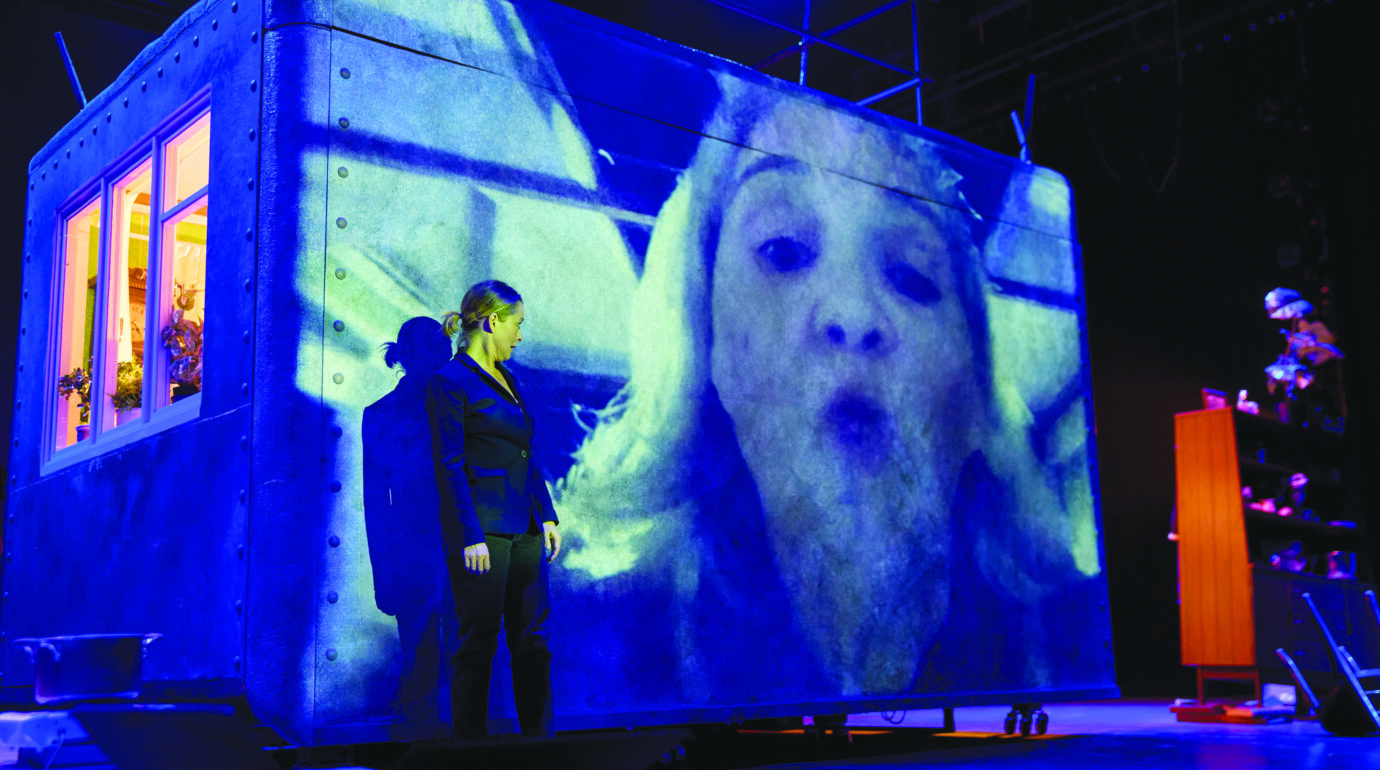
I suddenly realized my mother doesn’t fit into just one play. I need to write a book about her. Imagine how much Olga Ivanovna has said and done in the two and a half years since I wrote that play! How she commented on Holly’s dress—the actress playing her onstage. How touched she was that a video of her was shown in America and people applauded. I’ve been writing about my mom for years. Her language, her unbreakable logic—they astonish me. I even have a short story cycle called Ten of Her Birthdays. For years I sat at the table with her friends, typing everything on my laptop so I wouldn’t miss a single quote, and my mom would complain: “Sasha’s glued to that computer again.”
It feels strange to write about fictional characters when you know at least one real character so well. When the Soviet Union collapsed, she started selling goods at the market, dealt with gangsters, survived my teenage rebellion. Her life is Ukraine’s life: Soviet, post-Soviet, independent. Maybe it’s a writer’s task to explain what molecules we’re made of. Our resistance, our contradictions. But lately I think more about the lyrical side: how your mother can be so radically different from you, and yet feel closer to you now than when you were a child. And you to her. It’s strange, but it feels like acquired love, not the automatic kind you’re supposed to have for a parent. Like these two very different people—a mother and a daughter—finally love and understand each other.
How is your mom?
Sadly, she’s aging, and the war is draining her strength. But she still cooks a lot. She waits for Igor to come home from work—he brings the “catch,” the groceries, they unpack together, and she starts cooking. That’s what keeps her afloat. I was there recently. We sat down, lit up cigarettes, turned on Zelenskyy on the giant TV plasma screen. The apartment still looks like military headquarters. Three tablets. Ashtrays. And my mom says, outraged: “We need to do something about the apartment before it gets bombed!”
“What should we do with it?” I ask.
“Transfer it to your name!” says Olga Ivanovna. “Don’t you know how much property is worth now? The more they bomb, the more it costs!”
Three years ago I wrote this play, two years ago you staged it—and the dialogue still goes on. Every day. I can’t just delete it from my head or my life. I live in Barcelona, but I check on Solomenka the way people check the weather. Here’s another bizarre thing: My neighborhood, Solomenka—a quiet trainstation suburb where my great-grandfather bought a house in 1906—is now in the news every day. Bombed like it’s some Iranian nuclear lab. As if my mom isn’t stuffing peppers in her kitchen but building a dirty bomb for Putin. All this is happening while the play about my mother has just been published in UBU magazine in France. She’s become a book in Catalan in Barcelona. A German publisher is now expecting a prose manuscript about her. And now Yale’s Theater and American Theatre have printed my mom. “So I’ve made it into a magazine—thanks to you, my darling,” she says politely about her global fame.

You added the Biden scene while we were rehearsing in D.C. What would a scene between your mother and Trump look like? Want to share a bit of that?
Yury, if you really want something about Trump—well, I’ve just written a play about nuclear war. I’ve started worrying about catastrophes on a larger scale. What if it’s not just Ukraine? What if they hit logistics hubs in Rzeszów, Poland, NATO territories? What will Trump and Europe do then? Here’s a scene from the new play, Late-Night Fyodor. It’s between the main character, Fyodor, and Trump:
TRUMP: Hey buddy, is it true?
FYODOR: What exactly, Mr. President?
TRUMP: That it’s gonna be minus fifty?
FYODOR: Afraid so.
TRUMP: Jesus. What a disaster. Total disaster.
FYODOR: Yes, sir.
TRUMP: And the corn in Nebraska—completely gone?
FYODOR: Gone.
TRUMP: Even in Iowa?
FYODOR: Iowa too.
TRUMP: My voters are not gonna like this. They love their corn. Tremendous corn.
FYODOR: I know, sir.
TRUMP: Anyway, maybe we can do something. I don’t know. And my towers? Don’t tell me—
FYODOR: Gone, sir.
TRUMP: My beautiful towers. American icons. History. All gone.
FYODOR: Yes.
TRUMP: Goddammit. And how many people?
FYODOR: Two hundred million instantly. Five billion after.
TRUMP: Five billion. Unbelievable. I guess we missed something.
FYODOR: Yes, sir.
TRUMP: Anyway. I’ve got grandkids, okay? Chloe, Theo, Kai. Amazing kids. I don’t want them growing up in a bunker.
FYODOR: Of course, sir.
TRUMP: We should stop him. That son of a bitch. Anyway. I’m calling that crazy bastard. Right now.
How has the war changed you as a writer, as a person?
I had to run twice. First from Moscow, with just one suitcase, and then deeply missed my books and, honestly, a particular sweater. But my friends managed to collect and ship me my things.
The second time I fled from Poland, after a personal catastrophe—I broke up with my partner and moved to Barcelona. That was a year ago. Since then I’ve started a completely new life here. I’ve fallen in love with Barcelona itself, a city where people from many nations have fled from war. People escaped Franco by crossing the Pyrenees. Some fled the Nazis. Somewhere not far from here, Walter Benjamin took his own life in 1940 because he was denied a visa. Spain was his last chance. And here I am, seeing the war from this strange historical distance. My neighbors here are people who’ve also fled wars. Afghans who escaped the Taliban write Quranic verses in Catalan. Somali men sell knock-off sneakers on bedsheets. Syrians from Aleppo open kebab shops, teach Islamic studies or post-imperial ethics. And I—I’m trying to find myself in this colorful, multicultural, kind, and war-distant world.
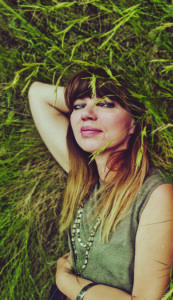
At first, I believed that art could respond instantly to reality—and that such artistic response might serve as cultural diplomacy. For the first two and a half years of war, I wrote and directed only about war. I wrote The Hague (a tribunal for Putin—staged in Poland, Bulgaria, Romania, France, the Netherlands, and in Boston), My Mama and The Full-Scale Invasion, and The Golem (a story about a meeting between a widow and an ex-wife of a Ukrainian intellectual killed at the front—about to premiere in Amsterdam). In Poland, I staged Six Ribs of Rage, based on verbatim stories from the first Ukrainian refugees who lived in massive hubs. Then I created Decameron: Love Stories During War, real wartime love stories told by young people who had been separated by the invasion.
Now I no longer believe in theatre as an immediate political tool. The idea of defending Ukraine through artistic protest—of screaming it to the world—doesn’t work the same anymore. Now I feel the need to work more systematically, more deeply. So I turned to books. For the past year, I’ve been writing The Hague, a novel about a girl living in the Mariupol Drama theatre who talks to an imaginary Putin. It’s part Diary of Anne Frank, part Jojo Rabbit. I spoke to real survivors: a child, elderly people, and the woman who served as the theatre’s commander. They lived there, under siege, during the bombing. That story stays with me: a commune of 1,500 people surviving 20 days in inhuman conditions, preserving human dignity, helping one another, organizing a field kitchen, a clinic, even a kindergarten. Until they were murdered.
The second book I’m writing is Sasha and Her Brain Run Away to Barcelona, a story about a woman over 40 who radically changes her life and finds love during the war. My Dutch boyfriend has no idea he’s one of the characters in that book. I always do that. It’s dangerous to be related to me or even just be my friend. My mother didn’t know she was being portrayed in a play staged in America. I told her only when rehearsals had already started, and I was standing between the White House and the Capitol. I figured it was time to confess.
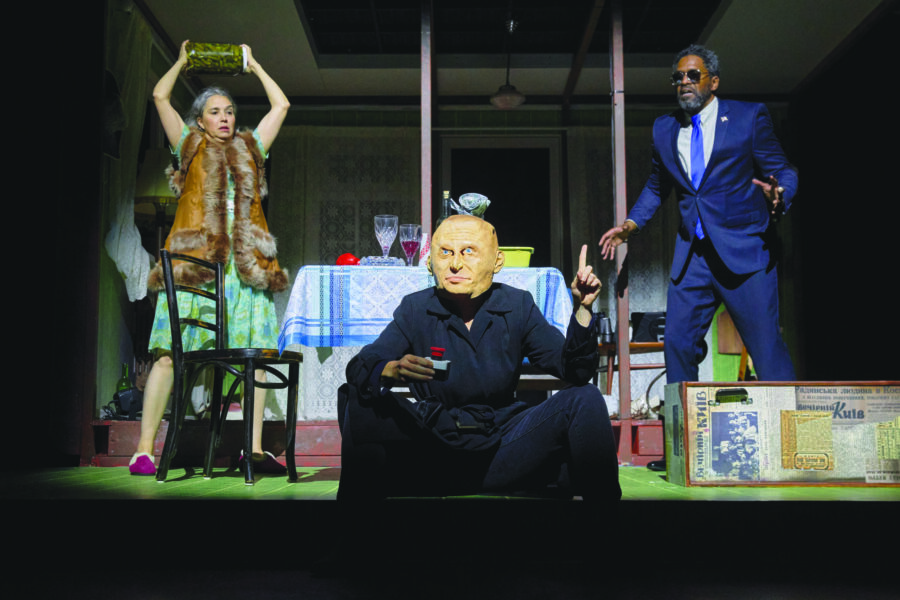
“Mom, please don’t be upset. I wrote a play about you. It’s very truthful. In it, you kill Putin—with a jar of pickles.” She was silent at first. But the next day, she said sternly: “And who plays me? Send photos!”
Honestly, there’s nothing better to write about than living people. That’s the whole point. That’s love—whether there’s a war or not.
The original version of this interview did not acknowledge that My Mama and the Full-Scale Invasion was previously published in Yale’s Theater magazine.
Support American Theatre: a just and thriving theatre ecology begins with information for all. Please join us in this mission by joining TCG, which entitles you to copies of our quarterly print magazine and helps support a long legacy of quality nonprofit arts journalism.