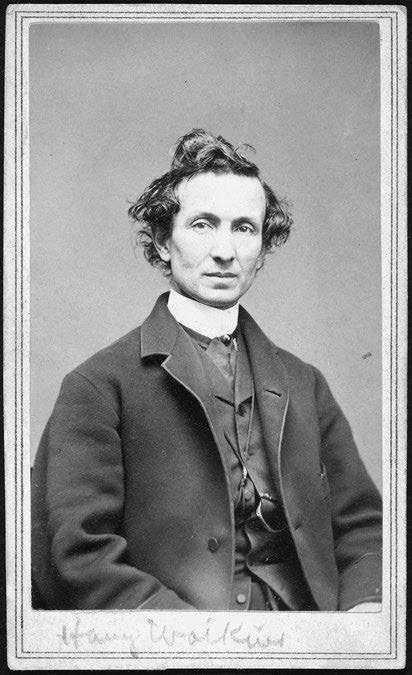
Most books about history begin with a question or puzzle that sparks the author’s curiosity. In 2008, when I first scrutinized Harry Watkins’s diary in the Harvard Theatre Collection’s reading room (a space that has since been shuttered), one question pestered me more than any other: Why had no one cared about Harry Watkins? The many citations of One Man in His Time by Otis Skinner and Maud Skinner demonstrated that historians knew about this mediocre actor’s diary, but apparently, no one had attempted to find it. As my research continued, I noticed that most of Watkins’s peers and colleagues had been indifferent about him, too. Why did they omit him from their memoirs and encyclopedias, initiating a trend of exclusion that continues to this day?
Despite these patterns of neglect, Watkins and his diary continued to haunt me. I felt compelled to learn more about this obscure performer, even though most of the histories I had read fixated on big stars, popular plays, high-profile venues, or noteworthy incidents. As Tracy C. Davis and Peter W. Marx observe, “Theatre and performance have two strong historiographic tendencies: to focus on hegemonic power and to detail anti-hegemonic subversion or revolt.” In other words, theatre historians tend to be attracted to subjects with obvious significance: artists who were widely known or remarkably innovative, or dramas with political or cultural resonance, or standout moments of social resistance or change.
But when we focus exclusively on exceptional lives and events, a lot gets left out of the story. Sensational, scandalous, or tragic episodes jump into the foreground, overshadowing the quotidian preoccupations that dominate the human experience. Scholars had cited Watkins’s diary (or, rather, the Skinners’ truncated, imprecise transcription of it) because the actor’s words illuminated some other topic of interest. No one had quoted Watkins because he was interesting in and of himself.
To be honest, sitting in the reading room in 2008, I wasn’t particularly curious about him either. Some of the most important, field-changing research I had read at that point explored questions about marginalized artists—Indigenous people, people of color (the global majority), people with disabilities, queer folks, women. In contrast, Watkins’s privileges, politics, and pursuits (white, male, straight, nativist, actor) held little inherent interest for me.
So, out of necessity, his lackluster became the subject of my research. If I were to focus not on what Watkins accomplished, but on how he lived and labored, what insights might emerge? What could this minor actor reveal about 19th-century U.S. culture—a culture as obsessed with fame, achievement, and celebrity as my own? Claudia D. Johnson and Vernon E. Johnson point out, “In the lesser-known autobiographies [of 19th-century actors] one can find information that is not available in the work of stars . . . reveal[ing] a seemingly accurate and ugly side of show business that many other show folk and theatre historians ignore.” Success is rare—especially in the theatre—so Watkins’s experiences mirror those of the majority, rather than the extraordinary. Could his account be valuable precisely because of his ordinariness, his obscurity, his run-of-the-millness?
In a 1935 poem, theatremaker Bertolt Brecht muses on star-centered approaches to history:
Every page a victory.
Who cooked the feast for the victors?
Every ten years a great man.
Who paid the bill?
Fortunately, since the 1960s, some historians have investigated the questions Brecht raises, offering insightful studies of “ordinary” people, commonplace practices, and forgotten events—among them, E. P. Thompson, Carlo Ginzburg, Robert Darnton, Laurel Thatcher Ulrich, Saidiya V. Hartman, Patricia Cline Cohen, Thomas Augst, Leslie M. Harris, Stephanie M. H. Camp, Jill Lepore, Paul Barba, Nicole Eustace, and Robin Bernstein. Their compelling insights and narrative creativity complicate both our understanding of history and our assumptions about how to write history. Rooted in meticulous yet also imaginative archival work, this scholarship has been variously described as social history, cultural history, microhistory, and “history from below” (though scholars debate who comprises the “below”). As such, it constitutes a distinct genre of historiography—a historiography rooted in authorial transparency, inventive problem-solving, and the elusive details of everyday life. In An Actor’s Tale, I pay homage to these scholars by offering what might be called an “alternative theatre history”: a study centering on workaday theatremakers’ routines and rhythms rather than the famous names, canonical plays, and exceptional events that tend to dominate histories of U.S. theatre and performance.
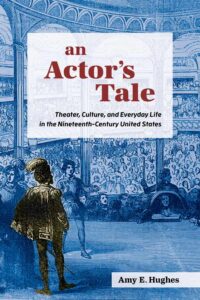
Although this book focuses on one person, it is not a biography. It is about neither Watkins nor his diary per se. It is an experiment in allowing a source, rather than a subject, serve as the epicenter of a historical inquiry. Discussing the differences between biography and microhistory, Lepore asserts, “Microhistory is founded upon [the]…assumption [that] however singular a person’s life may be, the value of examining it lies not in its uniqueness, but in its exemplariness, in how that individual’s life serves as an allegory for broader issues affecting the culture as a whole.” I examine the experiences of a single, relatively average person over a substantial period in order to see what gets sidelined in studies about texts or people with obvious historical significance.
Whether you know a little or a lot about U.S. theatre during the 1800s, you will encounter information in this book with which you are already familiar. But I believe this actor’s tale will productively augment and challenge what you already know, as it has for me. Maybe you are a reader who seeks quantitative or quantifiable evidence in their histories, someone who believes a certain (presumably large) amount of data must be available to substantiate an author’s claims. This book experiments with questioning those beliefs and boundaries.
I invite you to look at the 19th-century theatre through a specific perspective: that of a white, male, middling actor who made a modest living but who never achieved the renown he craved, let alone the renown usually required to become the inspiration for a book. Watkins belonged to overlapping circles of community: theatrical, political, fraternal, familial. During the intense years leading up to the Civil War—a period when questions related to slavery, women’s rights, and the expansion of national borders were on the public’s radar—he kept himself politically informed (and sometimes, he was politically active). He successfully sought membership in the order of Free and Accepted Masons to gain the social and professional connections he lacked. As a playwright, he leveraged other entertainment media, such as newspapers and dime novels, to attract audiences. Many scholars (including me) have studied stage adaptations of popular literature, but Watkins writes about myriad dramatizations of serialized stories, suggesting a symbiotic relationship between theater and print that has been understudied and misunderstood. From him, we learn how an actor’s success depended not only on talent but on the support, endorsements, and generosity of colleagues and spectators. We also learn how malleable, inconsistent, and contingent the definition of “star” really was. During the 19th century, there were many, many “stars,” but very few celebrities.
However, the most important revelation I have gleaned from Watkins’s lackluster is this: His life and career reveal how he and other middling professionals advanced themselves despite their “white mediocrity,” to employ Koritha Mitchell’s phrase. In her essay “Identifying White Mediocrity and Know-Your-Place Aggression: A Form of Self-Care,” Mitchell notes that the history and ongoing influence of white supremacy culture in the United States has resulted in different thresholds of excellence for people, depending on their racial and gender identities. She observes, “U.S. culture celebrates the success of straight white men—regardless of whether they embody merit—but discourages, diminishes, and/or destroys everyone else’s achievements, while insisting that evidence of their merit never existed.” Emphasizing the systemic nature of this phenomenon, Mitchell asserts, “This is more of a social problem than a personal one; it’s about American society’s low expectations and how those low expectations shape behavior. The culture is constructed to ensure that white people can be mediocre (or worse) and still benefit.”

Ijeoma Oluo underscores that gender oppression, especially male supremacy, is bound up in this dynamic as well. Describing white male mediocrity as both the “baseline” and “dominant narrative,” Oluo argues, “Everything in our society is centered around preserving white male power regardless of white male skill or talent.” I would add that, frequently, the existence of white mediocrity is unwittingly or willfully ignored by those who identify as white. For us, it masquerades instead as competence, normalcy, and legitimacy, because the privileges associated with whiteness must remain invisible, as Eduardo Bonilla-Silva, Bettina L. Love, Layla F. Saad, Derald Wing Sue, and others have pointed out. Robin DiAngelo observes, “much of white supremacy’s power is drawn from its invisibility, the taken-for-granted aspects that underwrite all other political and social contracts.” I argue that white mediocrity is one of these “taken-for-granted aspects” of U.S. culture. Obviously, for many people of color, white mediocrity is absolutely visible; “Evidence of it is everywhere,” Mitchell writes. One of the luxuries of being white is to remain oblivious to its many advantages, as Peggy McIntosh has explained. This may be a reason why white mediocrity, and the strategies people use to deny its omnipresence, are relatively understudied, both in the past and the present.
An Actor’s Tale illuminates the historical and continuous marginalization of people in the United States due to gender, race, sexuality, and/or ability by assessing how workaday white male actors adopt(ed) strategies to appear competent, talented, and legitimate despite their mediocrity. Watkins and his contemporaries not only embodied white mediocrity but also perpetuated the subtle violence at the heart of it. For example, they advanced themselves by currying favor and leveraging friendships with like-minded people in the theatrical community, thereby reproducing and sustaining the status quo. To obtain job security, they utilized, and sometimes weaponized, traditional casting practices—resulting in oppressive customs and conventions that still inhabit U.S. theatre culture today. They relied heavily on the labor, creativity, and sacrifices of women performers, very often within the context and confines of marriage. We learn from Watkins that early and mid-19th-century approaches to authorship, which involved copious cooperation and collaboration, differ markedly from our current ideal of the dramatist who writes alone; and we see that by the end of the century, many theatremakers abandoned these collaborative processes, adopting instead cutthroat strategies like sole proprietorship, entrepreneurship, and property protections, such as copyright.
During their time, Watkins and his peers embraced several cultural myths that allowed white mediocrity to persist and thrive: meritocracy, individualism, and the ideal of the “self-made man.” In 2025, numerous U.S. Americans continue to believe and promote these myths, even though they harm all of us, no matter how privileged or unprivileged we are. The notions of meritocracy and the “self-made man” disregard the overwhelming evidence that cultural and economic barriers prevent most people from enjoying equality and upward mobility—especially those who navigate the world as women, trans/nonbinary/queer people, disabled folks, and/or people of the global majority. Individualism belies the hidden but omnipresent reality of how radically interdependent we all are, not only with other humans but also local and global ecosystems.
Attending to white mediocrity allows us to see the insidious, continuing impact of yet another cultural myth: the American Dream. Watkins’s perennial frustration about his lack of success suggests he viewed mediocrity as a stigmatized state of being, even a form of abjection. This stigma, I argue, is one reason why mediocrity must remain unmarked, and unremarked upon, in cultures where whiteness confers privileges. In his study of diaries written by 19th-century clerks, Augst contends that by the 20th century, the “wishful lesson that character was the only capital one needed to get ahead” had firmly taken hold in the collective imagination of U.S. businesspeople. This idea captured Watkins’s imagination, too. He fervently believed he could achieve material and social gain despite his meager resources and unimpressive heritage. He aspired to join the upper echelons of his industry, and every time his career faltered, he despaired. He vowed many times to give up the theatre altogether, but he never did. Instead, he willfully and repeatedly ignored the obstacles in his way: his relatively narrow talents and abilities, his lack of connections, his status as a U.S.-born actor in an industry that favored English performers. He habitually blamed others for his lack of advancement, viewing their success as arbitrary or unearned. As Jack Halberstam observes in The Queer Art of Failure, “Believing that success depends upon one’s attitude is far preferable to Americans than recognizing that their success is the outcome of the tilted scales of race, class, and gender.”
These myths still circulate in U.S. theatre culture, sustaining a host of inequities. Of course, for more than 200 years, minoritized people have made and attended theatre in the United States despite myriad cultural, legal, and bodily threats. During the 19th century, enslaved and free Black Americans managed venues, produced plays, and offered other forms of entertainment in urban hubs like New Orleans and New York City; Chinese immigrants presented and patronized Cantonese operas in the global California that coalesced during the 1850s Gold Rush; and Mexican Americans performed in amateur and professional Spanish-language theatres in Texas, New Mexico, and elsewhere. These artists wrote plays, established theatrical spaces, staged performances, and served their communities not because of, but despite, the pressures exerted on them by white Americans and their institutions. Discussing the long history of white violence against marginalized people, Mitchell points out, “Violence pursues them because they accumulate achievements, and American culture is designed to remind everyone that accomplishment is meant for straight white men.” But mediocre white folks—the Harry Watkinses of the past and present—have resisted, suppressed, or simply ignored the excellence, solidarity, and resistance of artists of color by placing the myths of meritocracy and individualism at the center of whiteness itself.
As someone who identifies as white, I recognize myself and my ancestors in this history. I see the many ways we have been complicit in its unfolding, and I seek ways to remedy and dismantle it. Studying Watkins’s life has forced me to grapple with a host of discomfiting questions. Why do so many of us remember, commemorate, and celebrate “excellence,” even though definitions of excellence are inexorably shaped by whiteness? Is it because we are always feeling, and always fleeing, our own mediocrity? Is it the quotidian itself from which we run whenever we deprioritize a person like Watkins? (Even his name, with its short vowels and aspirant consonants, seems like an onomatopoeia of insignificance.) During the decade or so that Watkins has been present in my work, mind, and heart, my feelings about him have included (nonlinearly, often simultaneously) irritation, annoyance, shame, dismissal, cautious curiosity, reluctant recognition, acceptance, and ultimately—guided by social justice activist Cynthia Brown’s instruction “We must never throw anyone away”—compassion.
He was an individual who protected himself by adopting ideas and strategies that directly and indirectly harmed other people; and he was part of a system, living and working in a culture designed to reward his choices, quietly and invisibly. He also, like me (and perhaps like you), experienced his life as a series of meaningful developments, each one precious and grave. Halberstam observes, “We are all used to having our dreams crushed, our hopes smashed, our illusions shattered, but what comes after hope?” To disregard him is the easy thing to do. The harder, more unbearable thing is to recognize how much he and we are the same.
Amy E. Hughes (she/any), professor of Theatre & Drama (SMTD) and faculty associate of American Culture (LSA) at the University of Michigan, is a theatre historian whose research focuses on theatre and performance in the United States during the 19th century.