

There’s no denying that many theatres are feeling the pinch. “Locally, we’ve noticed a stark decrease,” said Julie McCormick, leader of finance and fundraising at Crowded Fire Theater in San Francisco. “We’ve lost many of the art funders in the region.”
But the story doesn’t end there. What pain there is isn’t being felt equally. Crowded Fire, for instance, was one member of a five-theatre cohort that received a $2.5 million grant from the Mellon Foundation to support its efforts in programming, culture- and community-building, and other innovations. Washington, D.C.’s Mosaic Theater Company, another theatre in that cohort, has seen a growth in foundation giving, according to artistic director Reginald Douglas.
Mellon has nearly doubled its performing arts spending since 2018, to $72 million, and several foundations said they are giving more money to theatres, not only to weather the current emergency but for the long term. The Boston-based Barr Foundation, the largest arts funder in Massachusetts, has doubled its arts budget since 2017 to more than $28 million, according to SueEllen Kroll, Barr’s senior program officer for arts and creativity. And New York City’s Scherman Foundation recently announced that it was doubling its payout for grants overall; while foundations must pay out five percent of their holdings annually, Scherman is doubling that, to 10 percent.
“Our board has been extraordinarily supportive as we continue to build our portfolio, so we haven’t had to eliminate anyone to add additional funding,” said Laura Aden, president of the Howard Gilman Foundation, New York City’s largest private funder of the performing arts, which is now granting about $30 million annually to nearly 300 grantees throughout the five boroughs (including Theatre Communications Group, the publisher of American Theatre).
After an increase in assets, the Paul M. Angell Family Foundation, which gives grants in Chicago, Cleveland, Detroit, and the mid-Atlantic region, has gone from $12.7 million in performing arts grants in 2024 to about $20 million this year, according to director of performing arts Mignon Stewart, who added that in the foundation’s hometown of Chicago, “There are a solid number of foundations stepping up to support performing arts, especially in this moment.”
Other funders told me they’re at least holding the line on funding this sector. “This is an industry that’s in constant transition, but our commitment hasn’t wavered,” said Bahia Ramos, vice president of the arts at the Wallace Foundation.
“Our funding has remained constant, and there has been neither a shift in our strategy nor a cut,” said Lane Harwell Sugata, a senior program officer at the Ford Foundation.
Sugata added that the foundation was “surprised” to be included in an April article by Helen Shaw in The New Yorker, which raised alarm bells about declining foundation support for theatre; in the article, Ford said it has actually doubled its performance-arts giving in New York City. Shaw’s article focused on shifts in funding priorities at Ford, Mellon, and the Doris Duke Foundation that have hit hard at established theatres like the Public Theater and Playwrights Horizons, as well as at regranting intermediary organizations like the MAP Fund, which moved money from foundations to smaller arts groups but has ended its national grantmaking program. Sugata did concede that the shift from regranting intermediaries to direct grants from funders has been one of the more significant trends in recent years (though he did not include Ford in this observation).

Likewise, Shaw’s article noted that Duke is still giving around $50 million per year, but is changing who it is giving to. (Duke executives could not be reached for this article, while Bloomberg Philanthropies and the Jerome L. Greene Foundation would not speak for this story.)
Some people I interviewed said that in 2025 foundations have been stepping in with more short-term funding to offset federal arts cuts. But SMU’s Ingersoll said that anecdotally what she has been hearing reflects a continuing slide. Both Di and Ingersoll agree that the decline is not being distributed equally.
“The losses are much more extreme among large organizations, while medium-sized organizations have a slight decline and small organizations are almost stable,” Ingersoll said. (This is true, they point out, across the entire arts world.) Added Di, “We think this is because there’s a sense that larger organizations are more resilient because they have investment income and more income streams.”
CTH’s Ty Jones noted that the bulk of federal relief dollars during the pandemic went to the bigger institutions. “There was a massive concentration of wealth,” he said, adding that those groups may already have had endowments, a luxury not shared by smaller organizations, who have also been hit harder by inflation. “So it makes sense for some of the bigger foundations to say, let’s make sure we have our eyes on these smaller institutions that have been around that are an important part of the performing arts ecosystem.”
Accordingly, Mellon is giving more to organizations that have not previously received money. Stephanie Ybarra, arts and culture program officer at Mellon, said that the shift in funding is ultimately “to the positive. We are being more inclusive of folks who have never gotten funding before, organizations to what we call the tiny tinies,” adding that many of those smaller organizations represent people of color or people with disabilities or are based outside New York. As one funder put it, “It’s important to recognize that certain voices have been unheard in the sector, and we need to figure out how to amplify those voices.”
Grantmakers’ Torres argued that these gains may not be significant enough to offset other funding losses at larger theatres. “Funding for smaller organizations and organizations representing underrepresented groups has grown,” he conceded, but, because the organizations are smaller, the dollars are as well. “Everything that I can see points to it being marginal in the grand scheme of things.”
“It’s justice work,” Ybarra countered. “If we believe that we are a healthier society when more people have access to the resources, then we must circulate the resources and we’ll get stronger for it.”
Ybarra traced the shift to the beginning of Elizabeth Alexander’s tenure heading Mellon in 2018, adding that many of the shifts at other funders have also been the result of generational changes at the top. “With leadership transitions come fresh and new ideas or new ways of approaching old ideas,” Ybarra said.
For instance, New York-based theatre company Pink Fang (formerly Ping Chong) just received a $900,000 general operating support grant from Mellon. They had previously received smaller amounts from Mellon through regrants, and received a direct grant in 2022 to fund their transition plans, but this new direct grant has put them in direct contact with Mellon. “That’s significant and transformational,” said managing director Jane Jung. Mellon also just made its first direct grant to the Latine-focused Intar Theatre in New York and its first grant to Cleveland Public Theatre.
“We need to be reaching ever further into the places that we haven’t been before,” Ybarra said, adding that by supporting artists and theatres outside of New York, Mellon is supporting the “ecosystem” that ultimately feeds the city’s stages.
As the largest private funder of the arts and the humanities, Mellon is “the good bellwether,” Ybarra continued. “We see our grantees proudly say, on Instagram or in a press release, ‘We got funding from the Mellon Foundation,’ and that means something. The imprimatur of the Mellon Foundation can catalyze more resources, financial and otherwise, coming into an organization, from foundations, but from individual donors too.”
But both Ybarra and Jung understand that some organizations feel like they’re losing out in a zero-sum game.
“Any change is going to feel disruptive and it won’t feel good to everybody, especially in a moment where everybody is scared of what the future holds,” Ybarra said. “To those who have benefited the most, it can feel like something is being taken away. But we are moving in a way that is more in alignment with our values and creates more possibilities for us.”
“I can see why it’s painful for some,” Jung added, but “the hope is that in the long run this is going to create a healthier and more diverse theatre world.”

Stewart said that the Angell Foundation has begun looking to fund smaller organizations and increase grant-making to Black, Asian, and Latine organizations. (They’re also aiming to provide relief to groups losing NEA funding and to provide more in multi-year general operating support.)
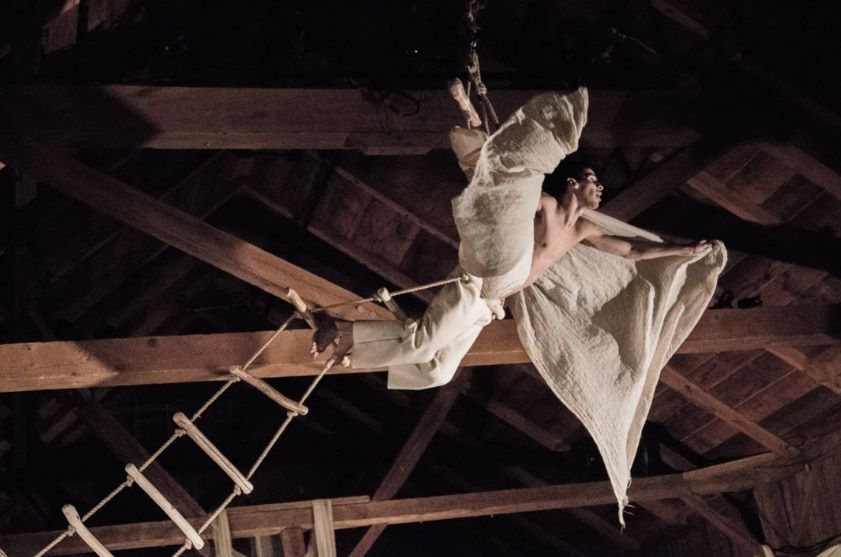
The Barr Foundation is expanding its horizons too. Said arts officer SueEllen Kroll, “We’ve also adopted racial equity as a value of the foundation, and that’s become an important lens in our grant-making.” While Barr was originally focused just on Boston, Kroll said the group has formed partnerships for regranting opportunities with smaller groups throughout the state. So while the foundation has long given money to the Huntington Theatre Company, Boston’s most prestigious theatre, for decades (their current open grant ends in December), they’re now also scouting an Iranian troupe that performs in people’s homes and are funding the Front Porch Arts Collective, a Black theatre group in Boston, and rural groups like Double Edge Theatre, which has a 120-acre farm and is the largest employer in Ashfield, Massachusetts.
“They’re working on a rebrand away from being just seen as a theatre and arts producer to thinking of themselves as a rural economic developer and a civic agent for the town,” Kroll said of Double Edge. “They want to take on a leadership role and even seeded an arts and culture center for the Indigenous community.”
Gilman, Aden said, made changes in 2019 to offer help to smaller organizations through regranting programs in each New York City borough, adding that many of those were companies of color. “We definitely saw an increase in the number of organizations of color that we funded,” she said.
The Wallace Foundation, Ramos said, is also funding smaller organizations and those representing underserved populations. “We’re looking for those who are not just presenting excellent art,” she said, “but who also feel rooted in their community and have an understanding that goes beyond seeing audiences as an object to seeing them as a community.”
CTH’s Jones said that while the foundations are actively seeking out smaller and more diverse organizations, it is still incumbent on theatres to get noticed. “It’s my job to be a squeaky wheel,” he said, which means going out to build personal relationships with program officers and, of course, producing noteworthy theatre. “We are doing the work to get the attention paid to us.”
Attention is being paid. The five-theatre cohort that Crowded Fire and Mosaic joined—alongside Cleveland Public Theatre, Boston’s Company One, and Perseverance Theatre in Alaska—did not initially come together to gain funding, Mosaic’s Douglas said. “What’s exciting is that it’s not product-centered—we’re not collaborating on a commission or co-production,” he said. The theatres’ leaders all believed in social justice and were seeking “connection,” as he put it. “This cohort allowed us to have a depth of conversation and resource-sharing by centering around a vision of making American theatre part of our communities.”
Crowded Fire’s McCormick agreed, saying, “We’re all coming to the table together, bringing wisdom and experiences. We’re all trying to solve the same problems in different ways.” There’s strength in numbers, she added: “Through our connections with the cohort, we’ve come onto the radar of foundations that never would have been aware of us or considered funding us otherwise. So that’s been an enormous boon for us.”
Douglas and McCormick both think this concept can be replicated by other theatres and foundations.
“It’s a great way to learn and experiment,” McCormick said, adding that the benefits flow both ways. “As a cohort, we’ve been talking to our local and national funders and have created opportunities for them to talk to each other, which is valuable.” She also said that sharing ideas and data among five different theatres in different communities creates more than five times the value. “There’s an exponential impact for our own learning but also for foundations.”
Many foundations are eager to learn as well.
“We see many organizations stepping up to maintain legacy grantees and the status quo,” said Ford’s Sugata. By contrast, they said, “We believe that we need more funders at the table embracing change, embracing transformation. Shifts like the one to more direct support for smaller and artist-led groups deserve close examination; we must recognize that funding shifts are needed to make room for new models and ways of working. This is not a moment to go backward.”
Stuart Miller (he/him) has written for American Theatre for more than two decades.
This piece originally stated incorrectly that the $900,000 grant Pink Fang received from Mellon was their first direct grant from a foundation. It also erroniously stated the the MAP Fund was defunct.