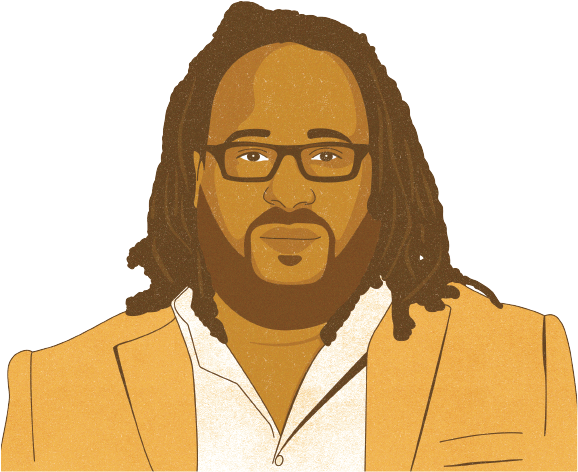
Ming-Trent has been seen frequently at New York City’s Public Theater and on Broadway, most recently in the Gypsy revival, as well as on TV and in film. Next up: his autobiographical solo show How Shakespeare Saved My Life, directed by Tony Taccone, set to play at Berkeley Rep (Jan. 23-March 1), Folger Theatre (June 9-July 5), and Red Bull Theater (September 2026).
What is the elevator pitch for How Shakespeare Saved My Life?
A teenager’s life is in danger. Just as he feels he might succumb to outside forces, he discovers a 400-year-old writer. He believes this writer could save his life.
What Shakespeare play have you been most drawn to, and why?
Shakespeare has been a tool of oppression for some, a gatekeeper writer for actors: “If you cannot do Shakespeare, you cannot act.” But the true spirit of Shakespeare frees the actor to be their true artistic self. Shakespeare is community building. He still inspires people from various backgrounds to sit in the dark together in a theatre. Shakespeare is a rule-breaker, and I’m a rule-breaker. I love tearing down the classical theatre’s ivory tower and using the scaffolding and bricks to rebuild a place where we are all welcome.
Are you seeing similarities in the way Shakespeare used language and the way artists like Biggie and Tupac used language?
Read Romeo and Juliet, then read Tupac or Biggie’s lyrics. Read them—don’t listen to the lyrics, read the lyrics. Shakespeare reported what he saw while walking the streets of London; Biggie wrote about what he saw while walking the streets of Brooklyn. If Shakespeare were alive today, he might be a hip-hop artist or in Hollywood writing action movies. Shakespeare is an urban writer/actor like me.
What’s the toughest part of crafting an autobiographical show?
The process of writing this piece has been challenging, rewarding, life-altering. What makes it easier is that I’m not writing this for me. I’m writing this for someone out there I haven’t met yet. My life was saved and I’m hoping to save someone else’s life. This show is a testimony. It seeks answers to questions we don’t have answers to, and it seeks the forgiveness I feel I haven’t earned yet: true transformational forgiveness, the lifesaving kind, the relationship-saving kind. Each night I perform this piece, I send a little prayer into the cosmos that I will find the power to forgive others and the vulnerability to allow myself to be forgiven. And, maybe most importantly, to forgive myself.
What advice would you give early-career artists about creating autobiographical work?
Don’t sit and wait to be chosen. Choose yourself! Make work that helps someone. Make something that can be a lifeline for someone out there who needs one.
What’s a piece of art you love that you feel doesn’t get talked about enough?
Stevie Wonder’s Songs in the Key of Life. I love Basquiat’s work, even more now that I know his journey and the similarities to mine and so many others. Jackson Pollock. Everything Suzan-Lori Parks—her work is unflinching. She teaches me what it is to be an artist. The writer Doug Wright should be talked about more, as well.
What’s the craziest thing you’ve ever done or seen on a stage?
Change clothes onstage. Never thought I’d do that, ’cause Lord knows nobody wants to see that. But the audience dug it!
What’s a recent moment that reminded you why you choose to do theatre?
When I was a little boy, I wanted to be a football player. My dad told me, “No! You’ll work in the community.” I hated that answer. But my dad was right. I’m a theatre artist for and with the community. I love that my dad was right.

Support American Theatre: a just and thriving theatre ecology begins with information for all. Please join us in this mission by joining TCG, which entitles you to copies of our quarterly print magazine and helps support a long legacy of quality nonprofit arts journalism.