Beneath the towering buildings at the intersection of Columbus and Lincoln Avenues in New York City last December, I found myself thinking about scale: of structures, institutions, and time.
Inside Lincoln Center, one of America’s most prized performance spaces, Mark Denning (Oneida Nation), the cultural consultant and dramaturg for Skeleton Canoe, asked the audience in a pre-show speech to measure time not in years, but in inches. He added that if Indigenous peoples’ time on this land now called America were counted in inches, it would stretch the length of three football fields.
As an Anishinaabe woman, I felt the weight of Denning’s question as something physical I could walk on and feel under my feet while watching the show for the second time. The first was when this full-scale iteration of Skeleton Canoe premiered at the Chicago International Puppet Festival in January 2025. Whether on the Council of Three Fires (Ojibwe, Odawa, Potawatomi) land in Chicago or on Lenape land in New York City, hearing the same story while feeling different land under my feet showed me that Indigenous people and stories can survive distance measured in either years or inches.
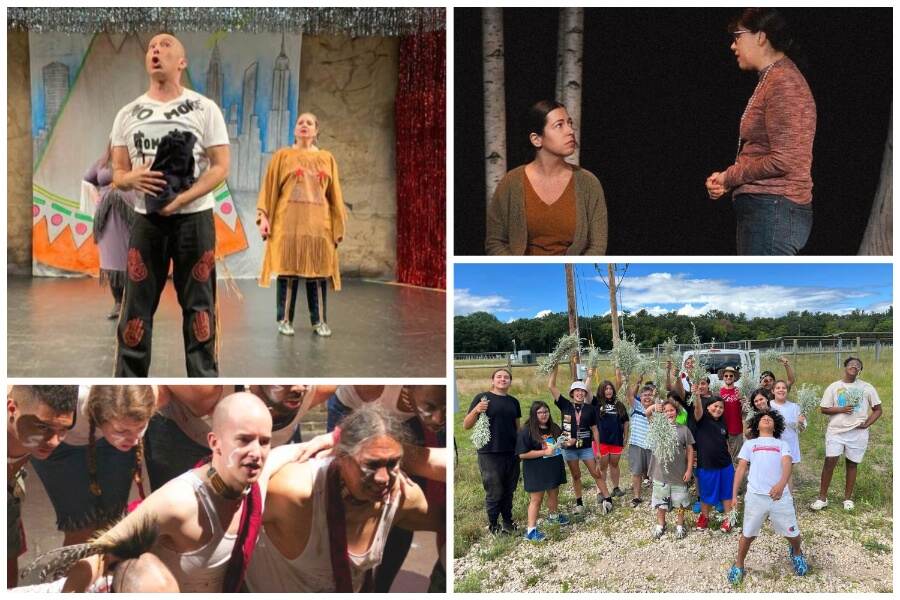
Written and performed by Ty Defoe (Ojibwe and Oneida) and the All My Relations Collective, Skeleton Canoe is an Anishinaabe (Ojibwe, Potawatomi, Odawa) centered show told through puppetry, dance, song, and story. It was performed in the Clark Studio Theater black box at Lincoln Center, which provided the intimacy it requires. Before the show, audience members had the opportunity to participate in a preshow “touch tour” where we got to engage with the show’s main puppets, designed and built by Chicago Puppet Studio. This experience, according to Defoe, was “intentionally designed with blind and Deaf community experiences in mind.” With an eager smile on my face, I petted the kingfisher bird puppet we would see later in the show, and felt the smooth head of the turtle puppet, held out to me by production stage manager Amanda Sayed (Cherokee/Choctaw). We got to see the puppet’s mechanisms up close, another manifestation of the intimacy that Skeleton Canoe invited us into.
Each of the six performances on that chilly December weekend invited audience members of all abilities and access needs to be involved in this story. At the show I attended, in addition to the preshow touch tour, the performance included an audio description of the show that played through audience headphones upon request. Other performances offered closed captioning, a relaxed performance, large-print programs, ASL interpretation, and culturally specific individual accommodations to ensure meaningful access for diverse communities.
In short, accessibility is not an afterthought in Skeleton Canoe, but part of its design and inviting nature. These choices align with All My Relations Collective’s broader commitment to non-prescriptive process and relational care through Indigenous storytelling. In a later interview, Defoe told me, “All My Relations works through true collaboration, and Skeleton Canoe is very much the result of collective authorship in practice. While I am the primary author of the piece—I wrote the text, shaped the story, and held the narrative arc—every decision was made in relationship. My process with collaborators is rooted in listening and responding.”
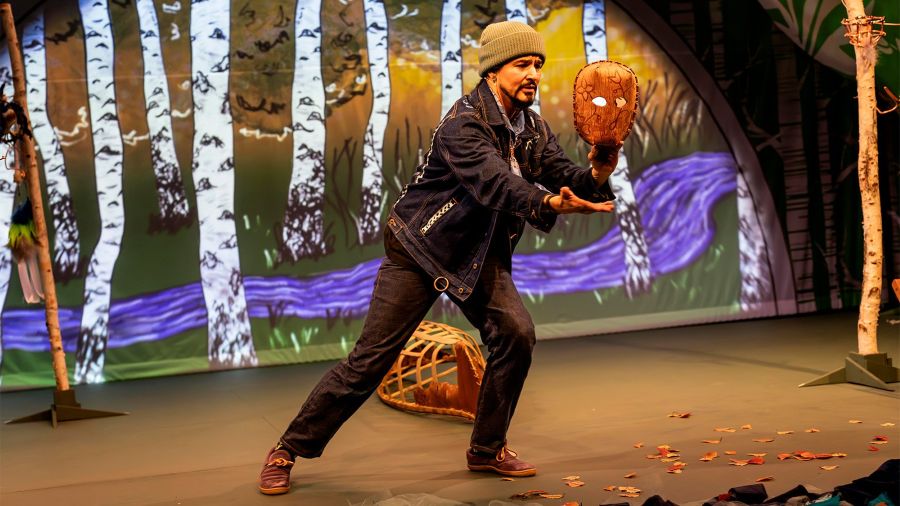
At the heart of Skeleton Canoe is Nawbin, whose name means “to gaze into wonderment.” A curious Anishinaabe child navigating loss, responsibility, and belonging, he is guided by Jiimaan (Ojibwe for “canoe”). Designed by the Great Lakes Lifeways Institute, Jiimaan is not treated as a prop or symbol but as a living relative of Nawbin and Anishinaabe peoples. The Nawbin mask, based on Defoe’s own face, registers wonder, fear, and emotional release with striking clarity as Defoe moves fluidly among characters throughout the show.
Defoe begins the performance by emerging from the audience, holding the Jiimaan canoe over his head. He is clothed in denim, with intricate stitched detailing designed by Lux Haac and sourced from Ginew, a Native-owned denim company. When asked about his costuming, Defoe said that “the fabric was then hand-painted with bleach florals to evoke woodland floral motifs. All accessories were sourced from New York-based Native fashion and clothing designers, including the ‘You Are on Native Land’ beanie by Urban Native Era. After resting Jiimaan on a hook upstage, Defoe hides four medicine bundles onstage, which we later learn are gifts that Nawbin’s ancestors left for him. Then a circular white drum appears in Defoe’s hand, as if he is holding the moon, as he begins singing to the rhythmic drumming about the history of the Anishinaabe people and Jiimaan, illuminated by calm, inviting lighting designed by Emma Deane.
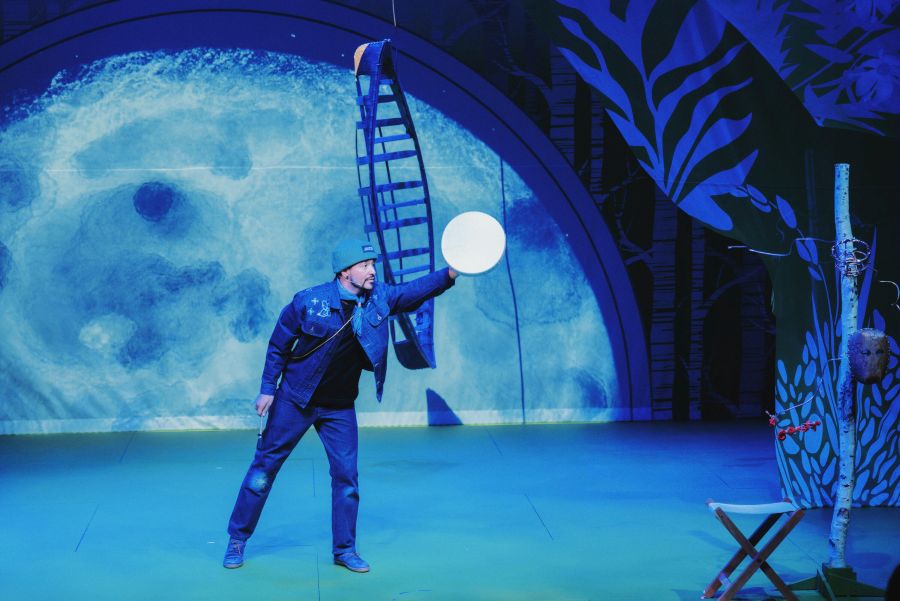
From the very beginning, the audience at the performance I saw became co-performers in the story, as we learned a bit of the song through a call-and-response initiated by Defoe. This is part of the show’s design: Skeleton Canoe is told not only through music, puppetry, humor, dance, and drumming, but also through audience engagement, as the performance moves fluidly among past, present, and future, reflecting a circular sense of time as rich as the moon hand drum.
The show transitions to projections of Nawbin’s family, with multimedia design by Katherine Freer and illustrations by Katrina Brown Akootchook (Oneida). Nawbin’s father is too busy, his brother is distracted by his phone, and Nawbin feels isolated in a fast-paced and pressured life. Nawbin accidentally breaks an oar that has been in the family for generations and runs away on a journey with Jiimaan, whom he finds at the bottom of a river, also lost. The prospect of being forgotten weighs on both of their spirits.
While some people’s minds might go to something dead when they hear about a “skeleton” canoe, Jiimaan instead brings life to the stage, as Defoe dances and transforms the space through four movements of trying to find four hidden medicine bundles, including giizhik (a medicine made from cedar). Defoe scatters these bundles—those ancestral gifts—across the magnificent set, created for a space of play and adventure designed by Tanya Orellana.
The show moves forward as we are introduced, one at a time, to four main puppets: a bright firefly, a rainbow fish that symbolizes pride and Indigiqueer/two-spirit/LGBTQIA+ endurance, a kingfisher bird, and finally a turtle activist grandma. Since I got to touch the turtle before the show, I connected especially with this section of the story, which asks questions like, “Nawbin, do you know your purpose?” and “What is a gesture of giving thanks?” The latter is asked to the audience as well, before Turtle leaves us with one final message: Never give up.
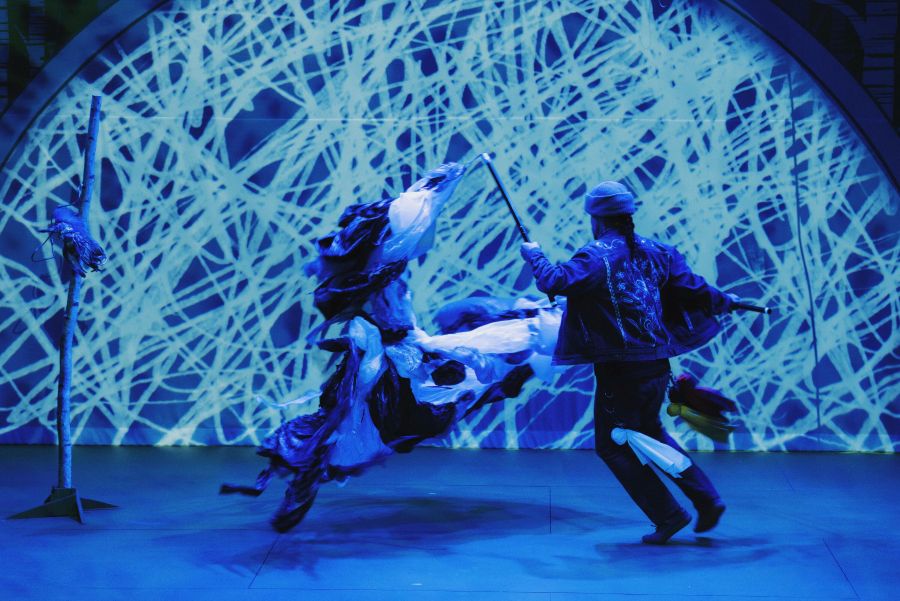
When Nawbin breaks the oar, Jiimaan does not lament the damage. Instead, he offers reassurance to Nawbin: You can always carve a new oar. This philosophy extends across the design. Katherine Freer’s multimedia work, Olivia Shortt’s original composition and sound design, and Emma Deane’s lighting collaborate to create a world that feels responsive rather than fixed. The white drum becomes a moon, a river flows at the front of the stage with pieces of litter stuck in its flow, and toward the end of the performance, Nawbin crashes Jiimaan in a storm made visibly from black garbage bags and tarp as Defoe becomes the eye of the storm with moving debris around him. Nawbin is scared, but the storm passes, as they all do, and Nawbin is reminded to have courage. Nawbin returns home to his family, who reassure him that he belongs with lines like, “Just because we were angry doesn’t mean we don’t love you.”
After this reconciliation, Skeleton Canoe ends the circle where it began. The white hand drum returns, playing the same beat that we learned an hour prior. Defoe echoes Jiimaan, reminding us that when things break, we can always carve something new.
Making this point literal, the show’s audience was invited to a birchbark carving workshop after the show. Members from the Great Lakes Lifeways Institute taught us to peel birchbark and transform it into a turtle pin or jiimaan ornament. The teacher told us traditional stories while we carved, in a truly joyous moment of Native and non-Native people coming together to create and listen.
When asked what he hopes audiences take away from this piece, Defoe said, “For young people, I want the piece to say clearly: There is wisdom waiting for you, and there are medicine bundles you have yet to unwrap. Everyone carries a gift. Everyone has something to offer. When I look beyond this production, I imagine Nawbin and Jiimaan continuing on—still learning, still listening, still reminding us that awe, care, and responsibility are practices we return to again and again.”
Leaving Lincoln Center, I thought again about Mark Denning’s metaphor of inches representing the years we’ve been here, and the three football fields’ worth of time my ancestors and other Indigenous peoples’ ancestors embody in this expansive metaphor. Ty Defoe and All My Relations’ Skeleton Canoe teaches us that Indigenous presence persists, and that we continue to grow metaphorical “inches,” not because we are uninterrupted, but because we adapt, repair, and persevere. Skeleton Canoe does not argue for Indigenous futurity; it practices it, reminding us that when things break, the work is not to mourn forever, but to carve again.
Sierra Rosetta is an Ojibwe dramaturg, playwright, and arts journalist currently completing a PhD in Theatre and Native American Studies at Northwestern University.