As An Ark opens, actor Golda Rosheuvel enters stage right and sits down in one of four chairs. She looks directly at you, maintaining deep, expectant eye contact. She smiles at you and nods understandingly. Do you smile back? I did. Almost involuntarily. A human reflex: subconscious mirroring.
Except it wasn’t Golda Rosheuvel smiling at me, at least not in person; not live. It was instead a pre-recorded, hologram-like projection, perceived through mixed-reality goggles sitting atop my head. The filmed actor made that same meaningful eye contact with every single audience member simultaneously. I was not special, though I was certainly made to feel that way.
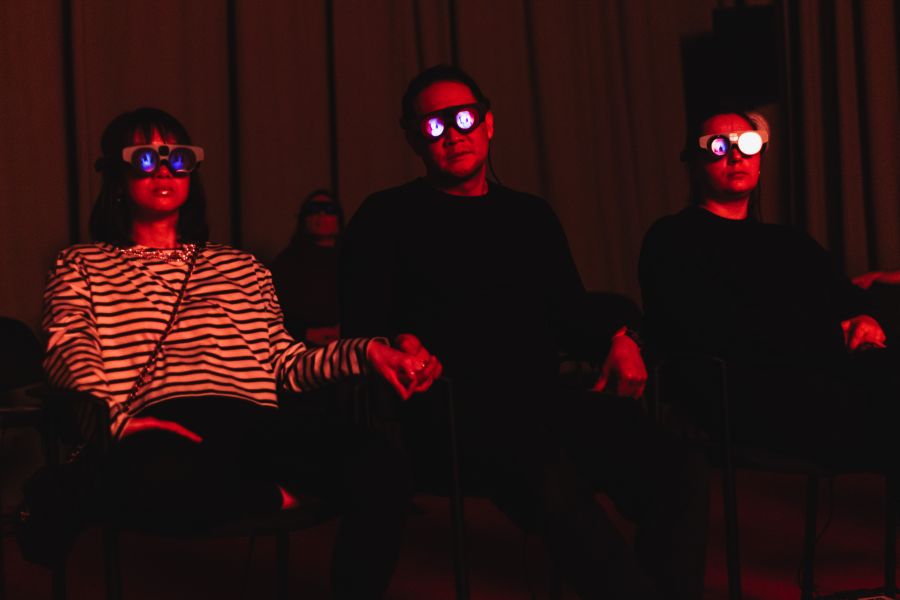
That intimacy is exactly what Tin Drum, the creators of An Ark, now at New York City’s The Shed, sought to achieve, using mixed reality as a means to draw us closer. And I do mean “us”: The Shed’s Level 2 Gallery has been outfitted with 180 seats, arranged in concentric circles, each fitted with a set of specialized mixed-reality goggles that project the play into the space immediately in front of us. The characters address each of us directly, ushering us into a sort of afterlife.
“The idea that you could enter a fictional dramatic world in which actors could engage directly with you in the second person is entirely unique to this form,” playwright Simon Stephens said in an interview. He took on the playwriting challenge at the request of producer and Tin Drum founder Todd Eckert, a creative pioneer in the use of mixed reality. It’s his third project using the headsets, following The Life, a looping Marina Abramović exhibition, and Kagami, a concert by the late Ryuichi Sakamoto recorded amid the acclaimed pianist’s battle with cancer and presented posthumously. Both pieces were billed as the first of their kind: The Life as the “first large-scale performance exhibit using mixed reality anywhere in the world,” and Kagami as “a new kind of concert.”
Eckert seeks to break further ground with An Ark. It’s his first—and ostensibly the first—play developed for mixed reality. It’s his first project billed simply as theatre, his first to use narrative, and his first to employ multiple actors: four, to be exact, including film and theatre stalwart Ian McKellen. It’s a development he attributes to advancements in mixed-reality tech.
“When we were doing the Abramović piece in 2020—rendering four people simultaneously? Forget it; you could never even imagine that. The fidelity was nowhere near as good,” Eckert said.
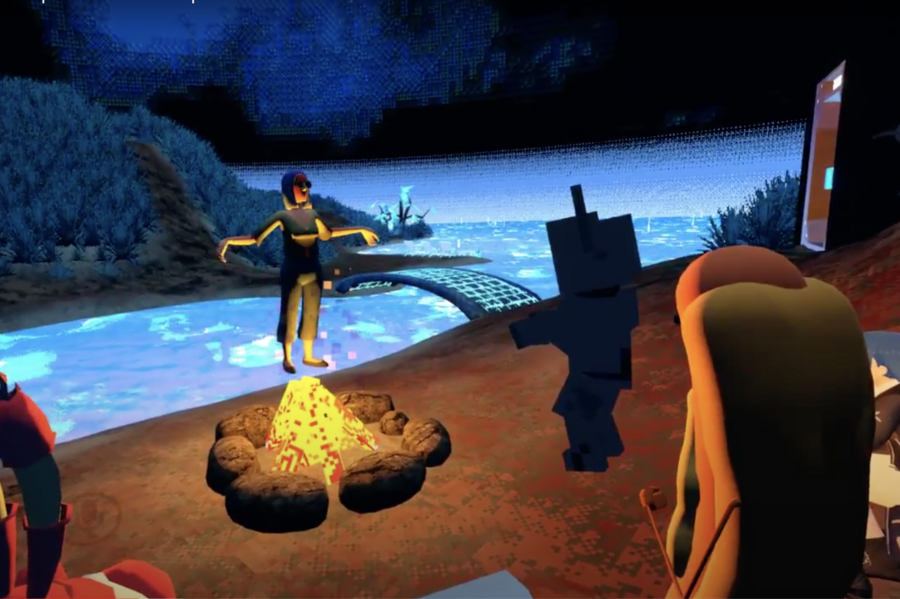
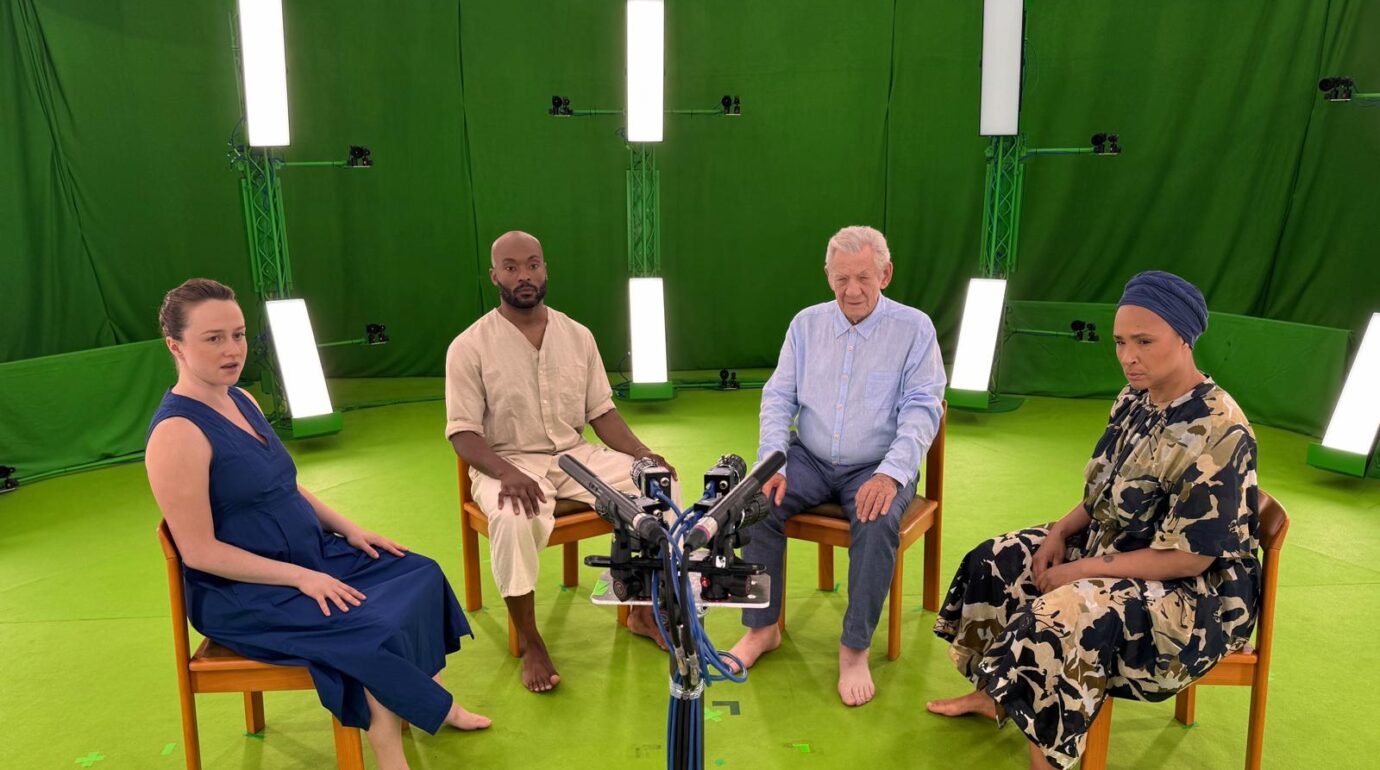
Still, while it has much improved, the tech still shows a few seams. Look closely at a projection’s hands or the place a hemline meets the floor, and visual artifacts become apparent. Faces take on a video-game-like, polygonal quality, and skin glows as if lit from within. An Ark leans into this uncanny-valley affect in its subject matter: Its four characters are there, they imply, to ease our transition beyond this mortal coil; an otherworldly, angelic quality fits the bill. Recorded using volumetric capture, the four actors sat in a green screen room, surrounded by multiple cameras to capture their performances at every angle, making a 3D rendering possible.
While the presentation of the material is wildly unique, much of the rest of the rehearsal process unfolded like any other, said director Sarah Frankcom. The actors ran the scenes, Frankcom and Stephens gave notes, they tweaked and reworked, then locked the script to record it for capture. The play was performed straight through, in one take. The capture employs no editing or camera cuts.
One difference between a normal play process and this one: no tweaking during previews. “We can’t change the performance, and that, as a theatre director, is not in my muscle memory at all,” admitted Frankcom. “We can fine-tune the experience, but we can’t change what the actors are doing. When we were doing the capture, it was like, we’ve got three or four opportunities to do this because we’re never gonna do it again.”
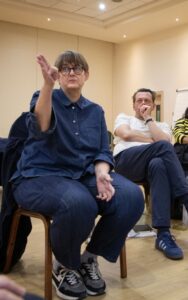
Still, the relatively familiar rehearsal and development approach was a reassurance that, though An Ark is taking a new shape, it can still be experience by audiences as a piece theatre, though Eckert understands the skeptics who aren’t on board yet. “I’m not looking to supplant anything,” he said. “I’m looking to create something that utilizes some of the understood tenets [of theatre], but then goes beyond them in a way not otherwise possible. Traditional theatre can exist without being affected, and we can create something new.”
An Ark is another entry into the age-old “Is it theatre?” debate, alongside the walk-through, actorless Viola’s Room (also presented at The Shed); immersive, highly variable productions like Sleep No More; the sound installation Blindness, also by Simon Stephens; and the pervasive Zoom theatre of the Covid era. That debate—and the curiosity it piques—is part of what has driven An Ark’s creative team. “Good plays are always an exploration of story and form,” said Frankcom.
Eckert is plenty used to convincing people to see it this way, including the initially hesitant Frankcom. “Initially I didn’t think I was the person for this, because I’m the least technological person that I know,” she said. “It’s been a journey of discovery.” She has relished the experience, she is quick to add. “There’s something about being right at the beginning of the journey with a developing form that’s quite exciting.”
For his part, Stephens—a prolific playwright best known in the U.S. for Heisenberg, Punk Rock, and The Curious Incident of the Dog in Night-Time—said he simply thought of it as a new venue to write for. “I’ve always been an artist who’s been inspired by architecture,” he explained. “I think a lot of playwrights write in a way that is a response to the architecture they’re writing for: If they’re writing a play for Lincoln Center, they would write it differently than if they were writing it for the Atlantic. I’m just writing for mixed reality.”
The actors also needed some reassurances before they signed on. In a film industry where archival footage, audio recordings, and CGI have already been used to create posthumous performances, and the specter of artificial intelligence raises the stakes still more, a full three-dimensional capture of an actor’s likeness could raise some hackles. “Ian wanted to know if I was looking to basically get his form so I could use it for something after he was dead,” said Eckert. “I’ve gone through massive legal protocols to make sure nobody can use any of the work I’ve made for anything other than what we created it for. It’s actually technologically impossible, and that’s by design, because, for me, the art is everything and it’s sacred.”
Eckert believes this so earnestly that he’s also worked profit sharing into the cast and creative team’s contracts. “They have percentages of profits, and I gave it to them in perpetuity because I believe they deserve it,” he said. “There aren’t rules for this medium, so we can do whatever we think is right.” That’s some consolation, at least, for the fact that this process takes the typical theatrical labor model of several weeks’ or months’ employment and compresses it down to just a few weeks of rehearsals and capture.
Thus reassured, McKellen was the first to go all-in on the tech. “I remember him putting the headset on and watching the Sakamoto piece with this wonder and childlike joy,” said Stephens. “I remember him turning to Todd and saying, ‘If Shakespeare was alive today, he would be writing in this form.’”
As the tech continues to improve and companies like Ray-Ban and Oakley attempt to make smart glasses the wearable tech of the future, Eckert remains steadfast in his commitment to a communal experience of Tin Drum’s work—that’s what makes it theatre.
“Tech companies have wanted to buy [my shows] and I have declined,” said Eckert. “The point is to show people that no matter how old they are, no matter what their orientation is, no matter where they grew up, somehow there’s a piece of art that is delivered to them individually but collectively, and it applies and it resonates with everybody.”
So if your hope is to watch An Ark alone on your couch, you’ve missed the point.
“What defines [An Ark] is the shared experience of the audience,” Stephens concurred. “We’ll take the headsets off and then we’ll leave together and we’ll be changed together. I think there’s something in the possibility of transforming a congregation of strangers that’s innately and unarguably theatrical.”
Jen Gushue is a freelance theatre writer with bylines in Town & Country, TDF Stages, New York Theatre Guide, The Hat, and more. They are also a supervising editor at Wirecutter.