“I do not see our work as a luxury but as an act of survival,” said Mustafa Sheta, producer and general manager of the Freedom Theatre in Jenin, when we met with him late last year. “When everything around us is being erased, theatre becomes a way to insist that imagination and collective memory still matter.”
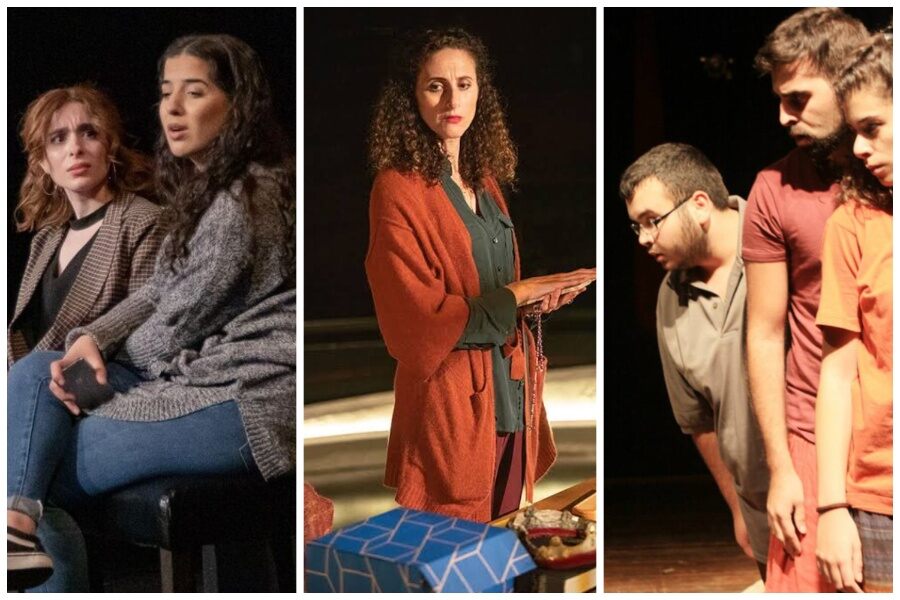
During a recent visit to Palestine (in this case, the illegally occupied West Bank and East Jerusalem), we spoke with theatremakers and cultural workers in Jenin, Ramallah, Nablus, and Bethlehem to find out how theatre might function amid an ongoing genocide.
The answers varied. What did not was the conviction, shared by everyone we met, that theatre remains a force for preserving memory and carving out democratic space within a repressive colonial system. Again and again, the question was turned back on us: “Can you imagine this?” ‘This’ meaning the unimaginable violence that Palestinians are experiencing today—the most lethal chapter yet in more than 77 years of dispossession and discrimination.
Entering Gaza is nearly impossible due to the total closure of what have become the killing fields of the coastal strip, where violence continues despite the U.S.-brokered ceasefire. The West Bank, while under a different kind of siege, is still accessible to some foreigners. The major cities of the West Bank are subject to a quieter but nonetheless deadly acceleration of ethnic cleansing and joint settler-army terror since October 2023. Estimates of the death toll in Gaza over the past 25 months—mostly by U.S.-made weapons—range from 70,000, including at least 20,000 children, to nearly 200,000, with many of those bodies still under the 68 million tons of rubble. During the same period, more than 1,000 Palestinians have been killed by Israeli forces and armed settlers in the West Bank.
It was in this context that we reached out to our Palestinian counterparts with a sense of urgency, but also with the nagging doubt that speaking about theatre under such conditions might seem irrelevant, even an unseemly luxury.
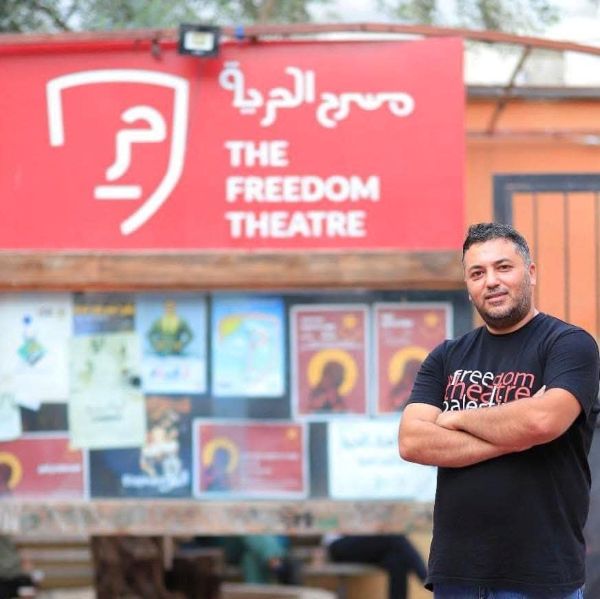
Sheta, himself a former political prisoner, brushed this aside from the jump. “Gaza needs food, medicine, and shelter,” he told us. “But humans do not live by bread alone. What sustains us and reaffirms our humanity is also the story, the word, the gesture. When a people’s culture is destroyed, their sense of self dies long before their bodies.”
Jenin: The Freedom Theatre
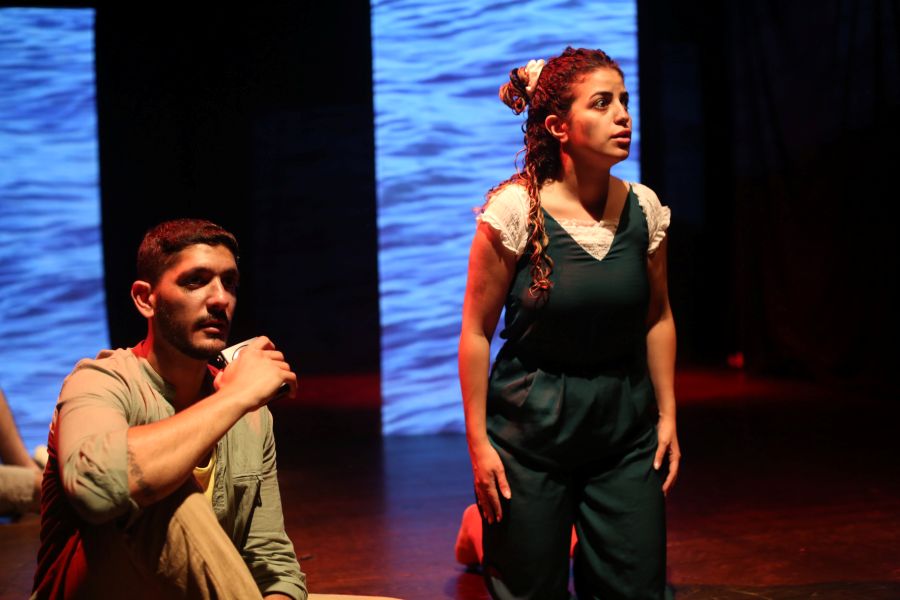
Founded in 2006 in the heart of the Jenin refugee camp, the Freedom Theatre has faced repeated closures, raids, and violence against its staff and artists. In 2011, one of its co-founders, Juliano Mer-Khamis, was gunned down in front of the theatre. In December 2023, Israeli forces raided the space again, arresting staff, confiscating equipment, and vandalizing the building.
Sheta, now 44, was among those arrested and held under “administrative detention”—without charge or trial—for over a year. “Behind bars, I realized that I had not left the theatre,” he said. “The prison itself became a cruel stage: the guards, the walls, the silence…all part of a play written by oppression. Inside that cell, I saw clearly that what we do at the Freedom Theatre is an extension of what every prisoner does: transforming pain into story, isolation into solidarity, captivity into consciousness.”
Released after 15 months, Sheta returned to find the main theatre badly damaged and unsafe. Still, the work continues in a smaller space in Jenin City. “Brecht said that art is not a mirror held up to reality, but a hammer with which to shape it. Theatre for us is not a reflection of our suffering; it is our means of reshaping it.”
Ramallah: ASHTAR Theatre
In Ramallah, ASHTAR Theatre was founded in 1991 by Iman Aoun and Edward Muallem, who also established Palestine’s first formal theatre training program for youth. Aoun, an actor herself, speaks with intensity about theatre’s transformative power.
“In 1987 the first Intifada erupted, and many youths were frustrated by the deaths of their friends and classmates who had been martyred by Israeli forces,” she told us. “Edward and I thought it was time to intervene and give young people tools to keep hope alive and to expand their horizons beyond the immediate politics. So theatre became a safe haven for them to grow and develop.”
ASHTAR’s current artistic director, Emile Saba, first joined the company at the age of 12. We sat with him and his colleagues last fall in ASHTAR’s spacious workspace, surrounded by the residue of past productions: books, playtexts, props, and posters. As Saba plied us with sweets and tea, he reflected on his long relationship with the theatre.
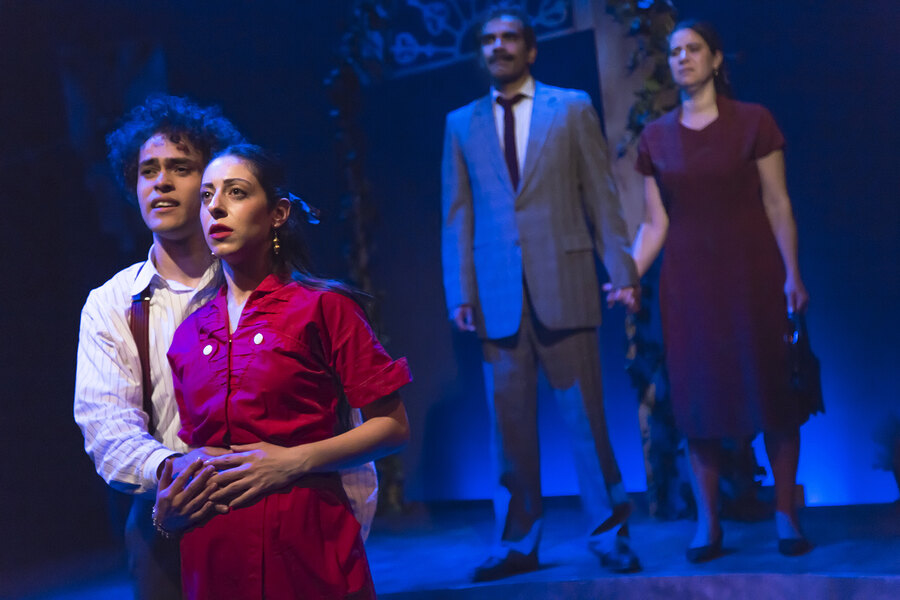
“I came into ASHTAR as a child, and I stayed as an artist, carrying the theatre with me as a place of memory and home,” he said. Now 36, Saba directed ASHTAR’s most recent production, Visions from the Center of the Earth (originally performed with the title Guernica, Gaza: Visions From the Center of the Earth). Commissioned by ASHTAR in the spring of 2024, written originally in English by the authors of this essay and later translated into Arabic, the play received its world premiere in Ramallah before traveling to Bethlehem later that year. “During rehearsals was the first time I dreamt about the war, about hands and arms coming out of the walls and windows, and children and blood,” said Saba. “Of course, the text is about genocide, but we did not want to compete with the images on TV or the internet. Sometimes realism onstage can dehumanize, even make a mockery of what’s actually happening.”
Instead, Saba’s production employed color and film to disrupt familiar tropes. “Together we created a concept that embraces a kind of hallucinatory realism,” he explained. “The five characters in Visions are not covered in ashes, wearing rags, and standing in rubble. That is what we expect to see. I wanted to create a fresh concept so that we can reimagine Gaza and its people in a way that gives true agency.”
The aim, he explains, is not to distract from reality but to create solidarity—to process collective trauma together. Despite their engineered separation from Gaza, most Palestinians in the West Bank consider themselves one with Gazans.
Actor David Tanous, 27, who plays the young father Antar in Visions, shared his own ideas on how to present trauma: “When I’m onstage…I want to present something that is trauma-informed, yes, but not trauma-inducing. So we actors didn’t cry on stage, but a lot of the audience members were crying.”
Konrad Suder Chatterjee, who came to Palestine three years ago and now works as communication manager and resource developer at ASHTAR, tackled the persistent question of the validity of theatre.
“Whenever people say you shouldn’t be doing theatre now, I am like, okay, what is the better way?” he said. “People decades from now will be looking for pieces of information about the genocide. Visions is a documentation of these times and of the imagination.”
For Chatterjee, theatre’s power resides in the body. “Theatre puts living bodies on the stage. Also at times dead bodies, but portrayed by the living. The theatre we make here at ASHTAR is a way of renegotiating political space, largely through the body. The living body denies its own destruction.”
ASHTAR is now preparing to present Visions in Jordan, Norway, and Greece. Yet travel itself is a battleground. When invited to perform in the U.K. in 2024, the actors were denied permits even to reach Jerusalem—only 12 miles away—to apply for visas. Daily life under occupation makes theatremaking precarious: military raids, settler violence, demolitions, the separation wall, and nearly 900 checkpoints.
Bethlehem: Alrowwad Cultural and Arts Society
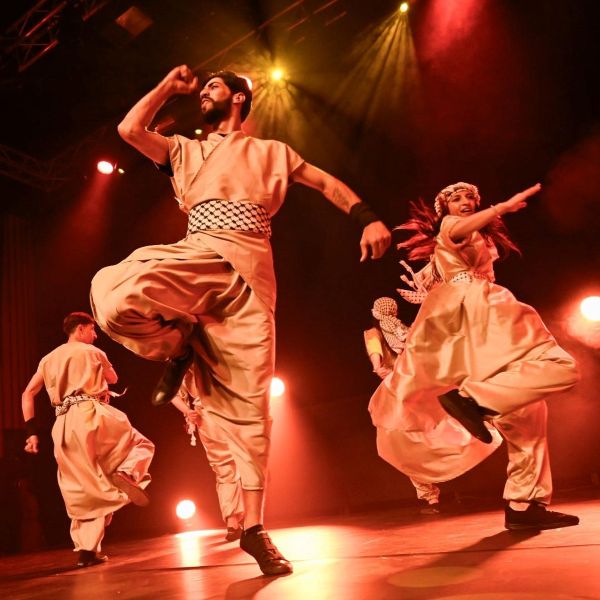
In Bethlehem’s Aida refugee camp, Alrowwad Cultural and Arts Society began as a theatre program in 1998. “I wanted to create a theatre where children learn to express themselves in a safe space,” said founder and director Abdelfattah Abusrour. “To make peace inside themselves, and then in the community. I wanted the children to be the stars.”
We sat with Abusrour, 62, in his brightly lit office. He grew up in Aida and has spent decades raising money to create two centers that offer theatre, dance, and visual arts for children and women. Nurturing youths, he emphasized, is central to Palestinian theatre. Over the past two years alone more than 200 children have been killed by Israeli forces in the West Bank; hundreds more have been detained.
In December 2024, the Israeli military raided Alrowwad, transforming it into a detention center for 24 hours. Blindfolded and beaten community members were interrogated inside a space meant for art. “Can you imagine this?” Abusrour said.
“The occupation attempts to make young people feel powerless,” Abusrour continued. “But when they step onstage, they feel their strength. Much of the theatre in the Global North is about entertainment, making us feel good about the present order, putting us at ease with war and occupation. But these lies erode our humanity and our connection with others. When we step onstage, mocking the occupation is an act of resistance. Laughing is an act of resistance. And in creating, the occupation ceases to exist inside our bodies. We do not deny it, but we do not let these colonial systems capture us or limit our spirit and presence.”
We also spoke with Abusrour about the ongoing censorship of Palestinian narratives in much of English-speaking theatre, especially in the U.S.
“Unlike theatre in the U.S. and Europe, we are not interested in this notion of ‘balance,’” Abusrour said. “What balance? Balance between the occupier and the occupied? This is how theatre is weaponized to conceal truth.”
Nablus: The Childhood and Tolerance Center
We also visited a new cultural center in the Balata refugee camp on the edge of Nablus. To reach the Childhood and Tolerance Center, we walked through streets so narrow one has to turn sideways to pass through. In a small room filled with the welcoming aroma of fruit and coffee, the center’s director (who asks to remain anonymous) told us that he was pronounced dead in 2003 after being shot by anti-aircraft bullets fired from an Israeli tank. “But I am still here,” he said.
He told us that more than 33,000 people live in Balata, making it the most populous refugee camp in the West Bank. At present, the center is raising money for a summer camp in France, where 15 youths will travel to swim, hike, and create work with other children—assuming they are allowed to travel.
“We need so much here, including light,” he said. “Seventy percent of the homes here do not receive direct sunlight. Can you imagine this? Most of the children here do not feel the sun on their bodies. We want to bring them to places where they can play in the sun.” It is a cruel irony that the Mediterranean Sea, only 50 miles or so from Nablus, is off-limits to West Bank Palestinians and has been for decades.
Gaza: Al-Bayader Theatre
Though we could not enter Gaza, we spoke by phone with Ali Abu Yassin of Al-Bayader Theatre there. The Saeed Al-Mishal Theatre, where he once worked, was obliterated by Israeli bombing in 2019. “The costumes, the laughter, the applause—erased.”
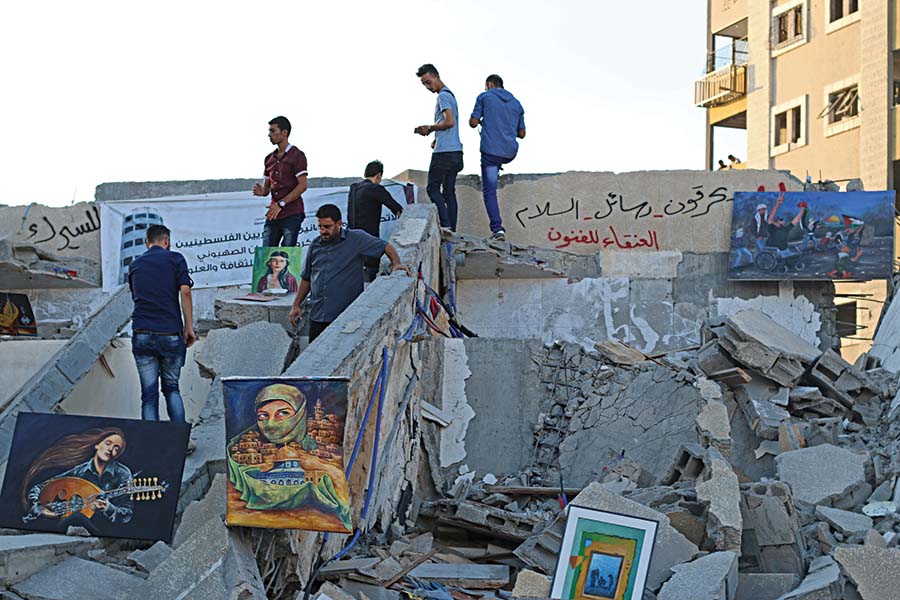
Abu Yassin, also a playwright and actor, told us that theatre practitioners in Gaza have no home now. “Even the streets have been destroyed,” he said. “Sometimes we performed street theatre, but now there are no streets left—only endless rubble.”
Abu Yassin’s house was bombed last year, and he and his family now live in what remains of the building. But he said there is hope in solidarity: “My extended family is the community of theatre artists around the world who have stood most firmly by me and my people, calling for an end to the occupation and war.” Abu Yassin vowed to keep working to make theatre possible against the odds: “As long as there are people in Gaza, I will keep performing—wherever theatre can exist. Even when I sleep, I create theatre.”
The theatre still being made in Gaza comprises activities and performances—puppetry, circus, storytelling—designed to lift the spirits of children traumatized by war, tens of thousands of whom have been orphaned, with thousands more rendered amputees. Last summer a festival called Donkey Day celebrated the steadfast donkeys that—amid relentless bombing, fuel shortages, and the deliberate targeting of ambulances—carried people, water, and the injured through the chaos. Each animal, led by a child, was adorned with ribbons and silky hats and paraded down a red carpet, turning survival into a playful but poignant act of theatre.
“For us, whether in the West Bank or in Gaza, theatre is also humanitarian work,” Sheta reminded us. “When a child writes a line of dialogue while drones circle above, that act becomes a declaration of life. When we perform in the ruins of demolished streets, we are not escaping reality; we are confronting it.”
At the end of our journey, we met with two former political prisoners (who must remain anonymous) who were released as part of a recent ceasefire deal. One spent 23 years incarcerated. The other became involved in theatre as a child and later as an adult.
“Can you imagine?” The phrase echoed again and again through the smell of cardamom coffee and cigarette smoke in every place we meet our friends and colleagues in Palestine. It is equal parts demand, plea, and challenge.
Emeritus professor Paul Rogers reported that Israel has dropped more than 70 kilotonnes of mostly U.S. explosives on Gaza—roughly six Hiroshimas.
“They can destroy our theatre buildings,” one of the former prisoners told us, “but theatre continues in our hearts and minds, recording and creating who we are.”
Before we left, we asked what gives him hope. The Israeli military killed his mother when he was a child. Last year they killed his adult son.
“What gives me hope?” He takes out a cigarette. Does not light it. “That we still exist.”
Naomi Wallace’s plays have been produced in the United States, the U.K., Europe and the Middle East. Awards include the MacArthur Award, Obie Award, Susan Smith Blackburn Prize, Fellowship of Southern Writers Drama Award, Horton Foote Award, Arts and Letters Award in Literature, and the inaugural Windham Campbell prize for drama. In 2025 Wallace was inducted into the Kentucky Writers Hall of Fame.
Ismail Khalidi is a Palestinian American playwright, director and screenwriter, and a directing fellow at Pangea World Theater. He has collaborated with Naomi Wallace for 20 years, including on the book Inside/Outside: Six Plays from Palestine and the Diaspora (TCG, 2015). An anthology of his plays, Until I Return: The Selected Plays of Ismail Khalidi (2025) is currently available from Bloomsbury/ Methuen Drama.
Reading list and resources:
40 Books to Understand Palestine – Literary Hub
Free Palestine Reading List – Haymarket Books
Gaza: Books on Solidarity, Resistance, and Hope – Verso Books
The Palestine Reading List – Decolonizing Palestine
The Palestine List – O/R Books
Palestine Reading List – Pluto Press
Institute for Palestine Studies
Jewish Voice for Peace – Resources and Toolkits
Institute for Middle East Understanding – Palestine 101 Fact Sheets and Explainers
Visualizing Palestine
Btselem: The Israeli Information Center on Human Rights in the Occupied Territories
Palestine Children’s Relief Fund
Middle East Children’s Alliance