I write for my mother because she gave me my voice.
I write for my ancestors and the sacrifices they made to make me.
I write for my city in a time when it’s hard to hear it speak.
I write so that I might know who I’ll become.
I will still write when it feels impossible to keep going.
These are just some of the words from poems written by young people over the past year, according to Mosaic Theater education and engagement manager Jacob Ettkin. In workshops at public libraries with hip-hop educator Tony Keith Jr. called “The Power of Knowing: John Lewis, Poetry, and Hip-Hop,” Black children in D.C.’s Wards 5, 7, and 8 were asked to reflect on changemaking, inspired by the late Rep. John Lewis. Part of a season-wide “Reflection Series” in D.C., Maryland, and Virginia, this effort has been part of the outreach around Mosaic’s new musical, Young John Lewis: Prodigy of Protest by Psalmayene 24, running at the D.C. theatre through May 3—engagement that is in many ways as much a part of the show’s significance and spirit as what’s onstage.
Working with schools, churches, and more has had its challenges, as it has involved the cooperation of more than 40 partners, according to Mosaic artistic director Reginald L. Douglas, who also directs the show. But it has absolutely been worth the extra push.
“The need for ‘good trouble’ is bigger than 150 people seeing a play in a black box,” Douglas said, using the phrase famously associated with Rep. Lewis. “That spirit needs to go outside the walls. We need theatre that is going to spark dialogue and activate people into action, inspire people who are losing hope, and offer lessons from the past that we can use today.” Added Psalmayene 24, colloquially known as Psalm, “The immediate audience is not the only community that a piece of theatre must engage.”
Ettkin described their consideration with Douglas as follows: “If the core tenet of this work is to make good trouble, what does that actually mean and look like in D.C., which has less of a voice than most major metro areas right now?” They ended up defining it through the lens of arts and activism in a “Mosaic way,” Ettkin said, and considered partnerships with communities all over the DMV.
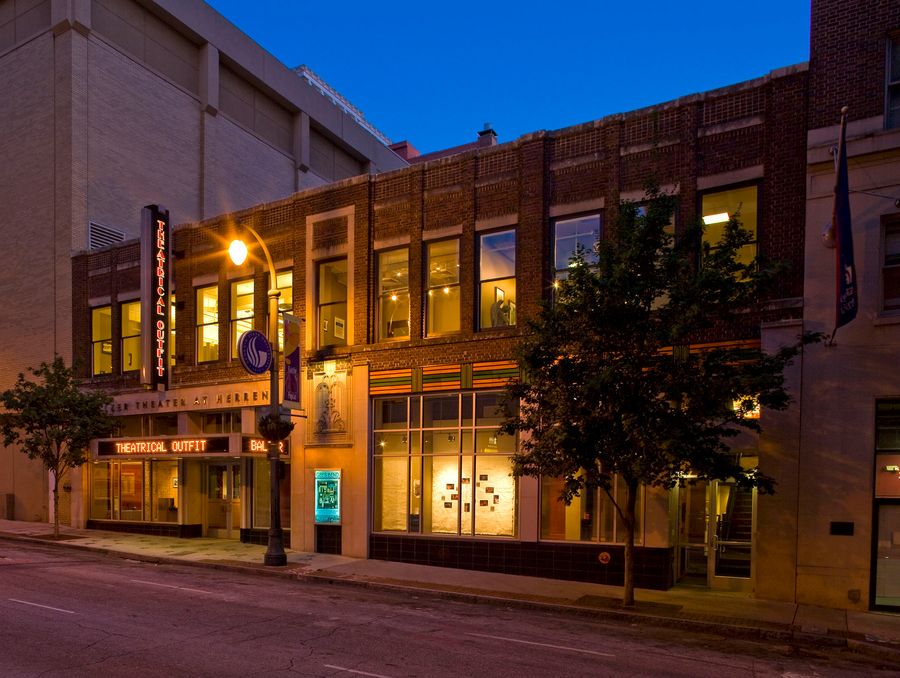
Of course, broad civic engagement aligns with Lewis’s life and legacy. In Young John Lewis, Psalmayene 24—Mosaic’s playwright-in-residence and H Street Oral History Project creator—follows the Civil Rights icon’s formative journey from ages 18 to 28, decades before he was elected to Congress from Georgia. The play was originally commissioned by Theatrical Outfit’s “Made in Atlanta” new works program and had its world premiere there in June 2025; a version of that production continues to tour throughout Georgia annually for schools and communities. It’s also separately being developed into a 70-minute TYA show with the Alliance Theatre, to be presented at the TYA-USA national conference this May. (Young John Lewis is not to be confused with Hero: The Boy From Troy, a musical by Nambi E. Kelley and Joe Plummer that recently toured multiple cities.)
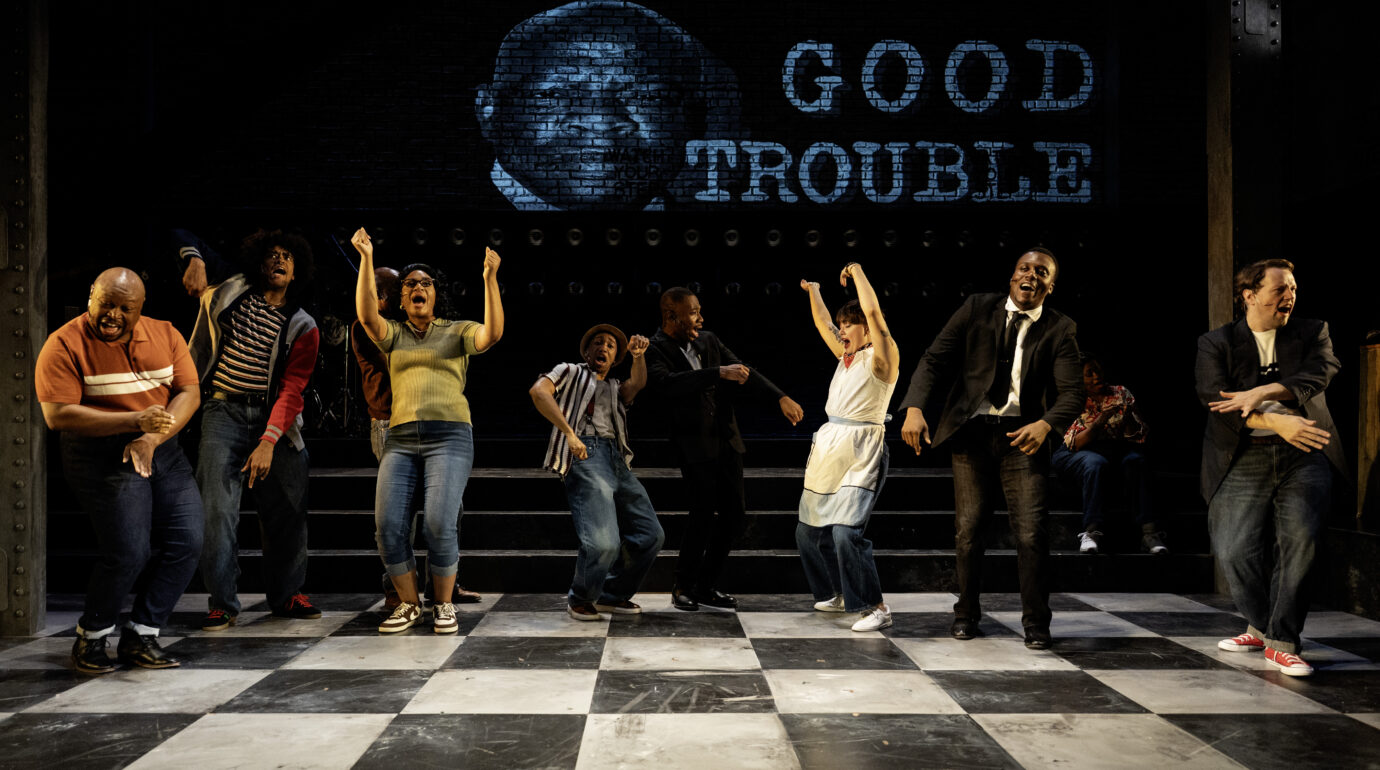
Bookended by the 1955 murder of Emmett Till and the 1968 assassination of Dr. Martin Luther King, Jr., Young John Lewis weighs whether peace or violence is more effective in shaping social change. It covers Lewis’s early years, from writing letters urging Troy University to desegregate, to his joining restaurant sit-ins with the Student Nonviolent Coordinating Committee (SNCC), the Freedom Rides, Bloody Sunday, the passage of the Voting Rights Act of 1965, and an eventual move into electoral politics thanks to Bobby Kennedy.
Alongside capturing their subject’s activist career, the writers felt it was important to capture Lewis the man as well. His mother shows up to say: “Be particular, John.” And his father dismisses “good trouble” as an oxymoron: “It’s like cold fire, it doesn’t exist.” In interviews with Lewis’s family, Psalm said he learned of Lewis’s love of dancing, sour cream donuts, and gentle nature.
“He had a big heart, and he was extremely sensitive, and that’s part of what drove him,” Psalm said. “He felt so deeply, and he was compelled to do something about his feelings. In a time of overwhelming catastrophe, John shows us a roadmap of how you can deal with those feelings, and then act and do something about what you think needs to change in a way that’s driven by peace, and in a way that is enlightened.”
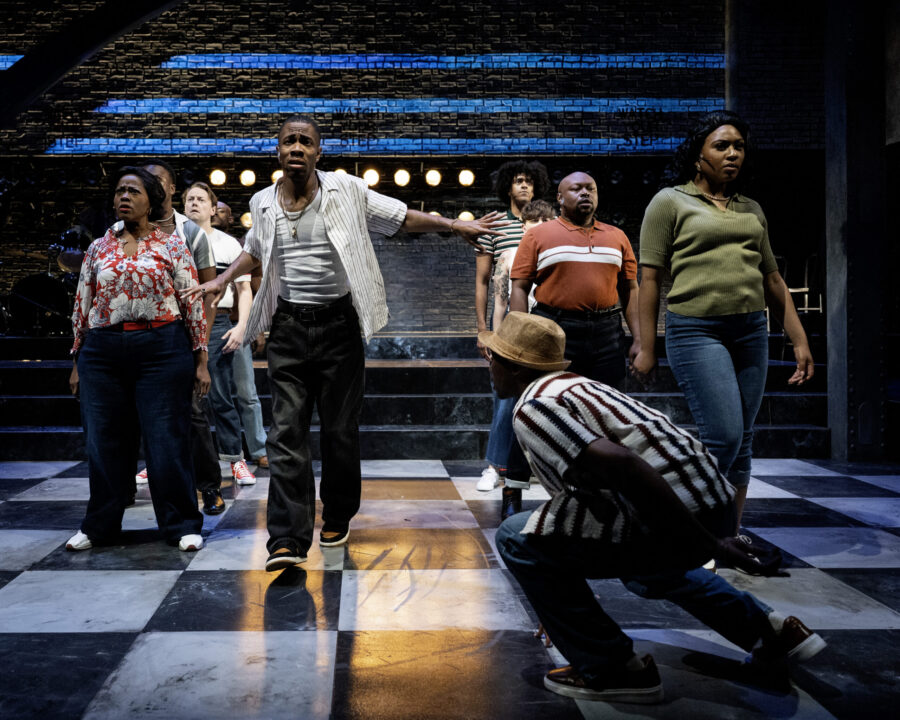
Somewhat confusingly, there are now three versions of Young John Lewis in the mix. The first includes Eugene H. Russell’s original hip-hop and gospel score, of which Russell released an album on Feb. 21. According to Alliance co-artistic director Chris Moses, the company is planning a trimmed TYA adaptation for the 2027-28 season “that we will remount every year so it becomes an annual tradition for Atlanta’s young people to remember this hero of ours.”
Mosaic’s current staging, though, has a new score by Kokayi, with go-go, soul, rap, and R&B styles. Douglas explained that Psalm “wanted to go in a different direction” for their staging. Though I haven’t seen the Russell version, having seen the Koyaki version, I can report that this Young John Lewis leans into the danger of the time it depicts, with music that amps up the tension.
In addition to the change of composers, there was some behind-the-scenes drama regarding billing, with Mosaic’s marketing for the show initially failing to mention the role that Atlanta’s Theatrical Outfit played in commissioning the show, an oversight that has since been corrected. Theatrical Outfit is based in Lewis’s district and located right across from the offices Lewis worked at, and the company’s artistic director, Matt Torney, noted the company had spent years developing trust with the John and Lillian Miles Lewis Foundation and Congressman Lewis’s family, especially his nephew Derek Lewis. Mosaic has partnered with the foundation for this production, and Theatrical Outfit has reinvested a percentage of ticket sales in the foundation to support Lewis’s legacy and youth groups that promote activism, nonviolence, and youth leadership.
What matters most, Torney said, is sharing the show’s lessons of integrity and conscience, because “the importance of the story is bigger than theatrical rights,” Torney said. He said that his company sees itself as a “launchpad, rather than as curators, of this story,” and hopes to connect with more Civil Rights leaders while they still can.
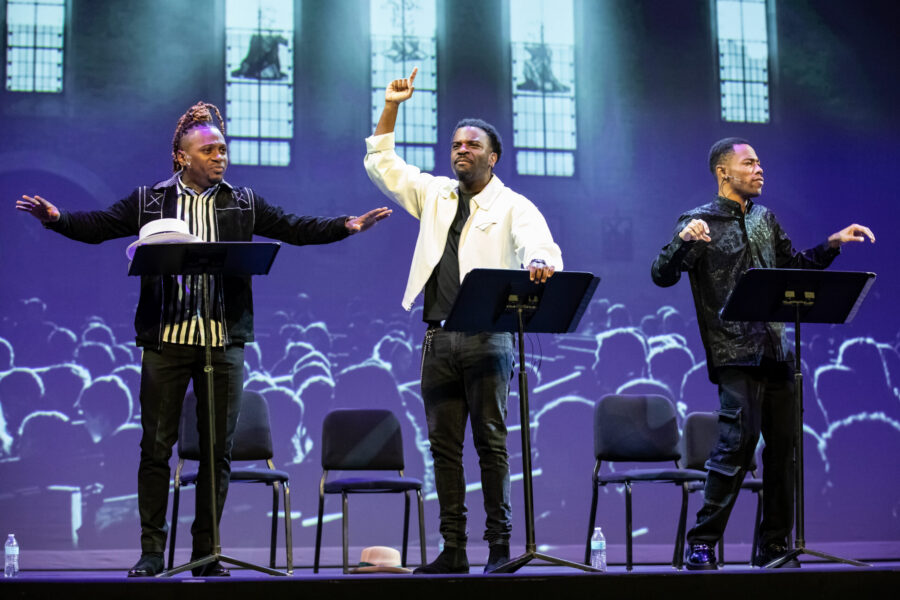
If the scores and even the scripts now differ, what the various productions have in common is community organizing. In March, Theatrical Outfit performed a concert version for 1,500 high school students at Atlanta’s Cobb Energy Center for the Performing Arts, with free tickets provided by ArtsBridge. “The feeling of transformation was extraordinary,” Torney said of that performance.
He became emotional as he described what it means for Atlanta audiences to see hometown heroes and Civil Rights activists from the ’60s portrayed onstage in a musical. “They put their bodies and their lives on their lines for that,” Torney said. “People painted them as hooligans when they were literally just standing across a bridge. It’s the action, the vitality of it.” Russell’s music, he added, isn’t “hip-hop for white people.” It has an “understanding of Atlanta Black history and gospel.”
Some original Atlanta cast members are now in the D.C. production, including Latrice Pace as Lewis’s mother and Michael Bahsil-Cook in the title role. Both participated in a Black History Month preview event at Maryland’s Creative Suitland Arts Center, home to companies like Joe’s Movement Emporium, dedicated to Black artistry. When artists get involved in communities, said Pace, “It feels purposeful. You can sit and read a book all day, but once you take the lessons that you’ve learned, actually apply them, and put them into action…the greatest lesson you’ve learned is the one you put in practice.” Pace said she hopes to lead prayer walks in D.C. once the show is up and running.
The events that have been most impactful, Psalm said, have been ones aligned with Lewis’s philosophy of nonviolent political action, pinpointing in particular Mosaic’s conversation at the synagogue Adas Israel on MLK Day. There Douglas spoke with Rep. Jamie Raskin of Maryland, who discussed his own relationship with Rep. Lewis in a conversation about civil rights across generations and religions.
Also at Adas, Ettkin set up a table for an open fair day where they brought recording equipment to collect folks’ John Lewis stories, because “everyone in D.C. has a John Lewis story.” Stories ranged from someone who ran into him at Busboys and Poets, to folks who worked with Lewis on the Hill and knew him when he did his Congressional sit-in after the Pulse nightclub shooting in 2016. Ettkin said they’ll continue to collect stories at the Good Troublemakers’ Festival on April 23 (see below), then share online by the show’s closing.
As Mosaic has gone into communities, Ettkin said, “the energy in these spaces has felt grounded, in a time when the city’s values seem to be threatened and communities are on front lines, walking to the metro and being met with National Guard presence, having spaces as a gathering point for people who share these values, working to better D.C. and fight for themselves. It’s restorative and generative.”
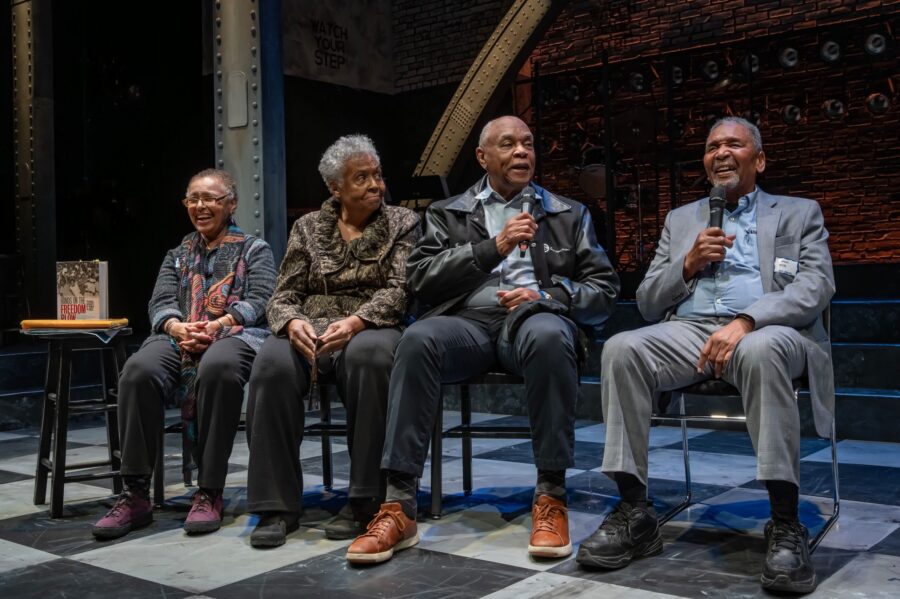
At an April 2 special performance celebrating “65 Years of Good Trouble,” Mosaic invited founding SNCC members Courtland Cox, Joyce Ladner, Judy Richardson, and Dr. Frank Smith, alongside Lewis’s speechwriter Brenda Jones, for a post-show conversation on SNCC’s legacy. They shared personal memories of their experiences in SNCC and with Lewis, and spread the word about their SNCC Legacy Project, digital project, and teaching toolkits. For Smith, who went onto a career in D.C. council alongside Mayor Marion Barry, Lewis was “one person who made something good happen in his lifetime, and left us a legacy that we can use to inspire other people.”
Added Cox, “While we didn’t all agree on the level of love and nonviolence, it took courage and deep belief to face the unmitigated violence that we had to deal with. I’ve seen John as a person who made a huge difference because of his fundamental beliefs and willingness to put his body on the line to make those visions a reality.” Ladner agreed: “John was a preacher at heart. He lived his beliefs as much as anyone I’d ever known. He could not be dissuaded easily.”
Richardson, known for her Civil Rights documentary Eyes on the Prize, had a few critiques of the production, feeling it didn’t show that “we were organizers” within communities, not just demonstrators. “The base of what SNCC is about is organizing grassroots leadership, organizing people who normally don’t have a voice.” She also wished more locals who helped guide and guard SNCC were included—Fannie Lou Hamer, Unita Blackwell, Mama Dolly Raines—and was passionate in sharing how many are still alive and organizing: “It’s not past tense.”
Others felt that the show captured “what we had to go through, all the stuff we had to deal with, the dangers that we faced,” Cox said. “It took me back 65 years, especially the discussions about voting vs. not.” He also liked that the show “didn’t deify John” and included Medger Evers, the four little Black girls murdered in Birmingham, Malcolm X, and more. As someone who was part of this history, he called it a “good history lesson.” On a more light-hearted note, Smith added: “John couldn’t dance, y’all.”
Still to come: a Millennium Arts talkback on arts and activism on April 12; a conversation with Psalm on April 18 on the dramaturgy of hip-hop theatre; and the Good Troublemaker’s Festival on April 23 at Eaton D.C., with D.C. History Center, with keynote speakers and breakouts to mobilize for a better future.
We all may know what we can take away from John Lewis’s example. But what might American theatres learn from how Young John Lewis was made and rolled out at Mosaic?
For one, Douglas noted that Ettkin’s role sits inside Mosaic’s artistic department, where their job is to creatively build collaborations, not focus on ticket sales. “They are genuinely engaged with the work,” Douglas explained. “They are a part of my creative process. That’s an important tenet of our success: that this is led by the artistic team, not the marketing and sales team alone.”
For Douglas, the musical’s call to action is what grounds all the work, both onstage and around it. “Right now, it is very easy to feel discouraged,” Douglas said. “By looking at our heroes from the past in their humanity, seeing them as nuanced, flawed, braggadocious, but also humble, scared, yet courageous young Black men and women, along with their allies, fighting against what truly were insurmountable odds and succeeding, is such a lesson we can hold onto. We need that light right now.”
Daniella Ignacio, a writer, theatre artist, and musician based in Washington, D.C., is a contributing editor of this magazine. She also reviews for Washington City Paper and DC Theater Arts.