AMY HERZOG: This play—it’s exquisite. I hadn’t read it before, so thank you for asking me to do this.
A.K. PAYNE: I really appreciate it. I wanted to talk to you because I read 4000 Miles, and it was the first impulse for writing this play. Plays often show me a structure that might offer something toward the process that I’m working on, and that’s what your play did for me. So thank you so much.
Oh, God, I can live another few years on that. Thank you. I do love a grief play. I was going to ask, where did this start for you? As you were starting to think about this structure, what came to you? Did one of these characters show up? Did the settings show up? I think you call it an abolition play. Did you know from the beginning, this is going to be an abolition play? How did you begin to create this world?
I knew it was about grief at the onset. I knew it was about grief and very intimate space. Some of my favorite theorists write expansively, bringing together so many different ideas: Afrofuturism in space, how to collaborate, how to create community. adrienne maree brown talks about fractals: how the small creates the large, how the small scale impacts how we are at the large scale. I was always curious about where people get their political ideas. How does it start with the personal, with quiet interactions, with the ways people engage each other in private space, and how does that expand outward?
The conception of Furlough’s really came from a curiosity: What is abolition at its core? Where does it come from? I think it comes from relationships with people. I was starting with this small relationship, two people navigating grief, and that hopefully being a model for a larger political movement in which people are not valued based on a single action that they did, or where people are able to have more restorative spaces in order to be accountable for their actions.

Did you instinctively feel this connection between grief and abolition? Did you always know that this was a line you were drawing?
I don’t know if I always knew. I don’t think I always know anything. Usually, there’s a very embodied energy that starts for me, a lightness of my breath when I feel an impulse to start writing something new. I was backstage, working on a show in tech for grad school, and I was reading 4000 Miles, and that’s when the impulse started for me. It was the characters themselves talking first, and then the links began to present themselves, like death and birth are parts of life constantly.
Abolition, to me, is about the end of one system and the birth of another. Abolition at its core started, of course, as this term for the end of slavery. What are the ends that are able to create new seeds for new beginnings for us in the present world? And how are these characters at a crux between their own ending and beginning? I’ve talked about the play being on the precipice of a lot of things: The characters are finding language for their dreams. They’re finding language for their identities. They’re making sense of the world around them, and full of this potential energy toward the future as they hope to build. I’m curious about where these characters would be in 2024, as it’s set in 2017. What is the world that they are hoping to usher into being, and how are the seeds that were sown launching us into today?
I love that this play is about cousins, which is not a relationship you see explored that much. In my life, it’s been a really important relationship. I’m raising a kid, and I see in her this kind of magic space that cousins occupy that’s not a sibling, not a friend, but something. How did you land there?
I was thinking about my own relationships with cousins. I was thinking about the ways the carceral system has impacted my family and communities. There are so many relationships in Black life specifically where people are your cousin, even if they’re not related to you. It’s like, “Oh, that’s my ‘play’ cousin, my sibling,” but the language is spacious in terms of family making and community making. I think that comes from these legacies of needing to make your own families, as families are being torn from each other, as families are being remade, people had to make new relationships. I was curious about how the cousin relationship feels both very close and very far, or it could do both. I was nerding out last year when in process: The parents were twins, and they’re not identical, but if they had been, Sade and Mina would have the same DNA as siblings. So there’s also this kinship that is formed through just how close they are biologically too.
They’re constantly negotiating. One way even to understand the play is these two people trying to answer this question: What exactly are we to each other? One of my favorite moments is when Sade is figuring out what she will be to Mina’s children. She wants to be called auntie, and she has a very specific, hilarious vision of herself as an auntie. But are they actually second cousins?
It also reminds me of how language is insufficient, right? I have so many aunts who are not biologically my aunts, but it feels more true to call them my aunts than to call them anything else. These characters are wrestling with the limits of language. There are so many words I’ve been finding as I’ve been doing family genealogy work: the first cousin, once removed, twice removed. Those feel so strange; it’s just my cousin. That creation of language feels dissonant, but actually, how do we create words and spaces that feel more abundant?
I couldn’t help noticing that Amina is an anagram of Amani, which is another beautiful play of yours. Is this part of a larger work?
All the plays I’m working on are in this kind of dance together. I think that Amina is an older, parallel universe version of Amani, or they could have lived in the same community or neighborhood, or Smith, who’s a character in Amani, could have been a neighbor to Uncle Edward. They could have been on the same path, or similar ones. I’m really excited by a universe of characters and a universe of Black peoples who are able to be expansive and be free and imagine freedom.
One of the things your play achieves is this sense that present Sade and Mina aren’t really the same as young Sade and Mina. It gives me the feeling that the past still exists, but present versions have evolved, so they might as well be different people. Or maybe that’s just how I feel about aging and life, that all our cells are replaced. We bear traces, yet there’s some discontinuity and failure to remember and connect the line.
Yeah, it’s almost like we are these palimpsests of all these different versions of ourselves. It reminds me of this idea—Saidiya Hartman is another theorist I love, who writes about the ways the past is constantly living within us. I’m curious about what it means to be in the present as much as possible, while holding awareness that the past is constantly present within me as an artist and within place.
How do you stay present while holding the past?
It’s a constant journey. I think it’s interesting to think about the searching being the point of it. I’m doing this project where I’m looking at my grandmother’s photographs and writing inspired by them. I’m trying to balance spending time with elders who are in my family now, and being present with them, while also looking at these old pictures that I found. My people have been in Pittsburgh since the early 1900s, but I found pictures back to South Carolina, which I didn’t know about, and that’s been really revelatory. It’s been extraordinarily special to hold the grief and also the possibility in the future and the present at once. Some people think about that as the blues; the blues music form does that, holding both the grief and the joy in one breath. I find that to be the way that I managed to do some of it. I’m trying to figure it out daily, but I’ve been grateful to be able to talk to the elders who are left in my family and spend time just getting to know them. That’s what I’m trying to do in plays too: Think about how the characters are deeply entangled, how the events of their past shape them now trying to imagine a future from their current position in the world.
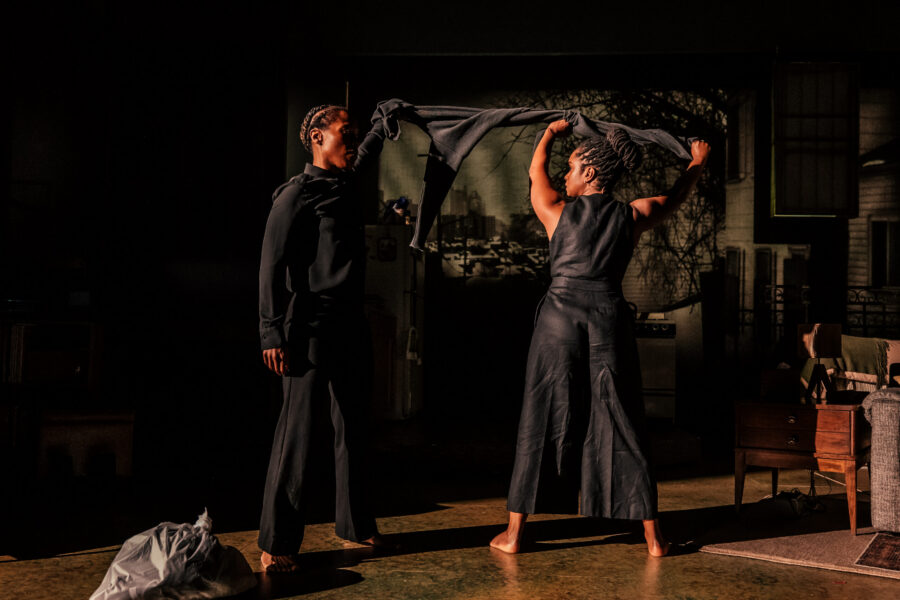
There are a few times Sade and Mina talk about the fact that they’re still wearing black, and what is and isn’t right to talk about when you’re still wearing your funeral vestments. I went through this major loss of my daughter a few years ago, and we had a few rituals to observe. We did a shiva. I cut my hair short, which was interesting, and I’ve kept it short since then, but there were very few things to latch onto in our culture. This is what you were saying earlier: Our culture is a little bit alienated from the sort of public ways of observing grief that most cultures have had in the past. At some point, I bought a pin that said “grief” made by this artist whose father was declining and had dementia. And it actually was kind of amazing, because some people would ask me about it, and I’d get to share, “I lost my daughter,” which otherwise was awkward when it came up in conversation accidentally, or if they clocked it, and then later something came up with my daughter. I’m sure I was talking to other people who were grieving and had no idea. This is one of the things that your play is doing, offering a completely bespoke ritual that these two women create together. That’s one of the meanings of furlough, a period of grief observed together.
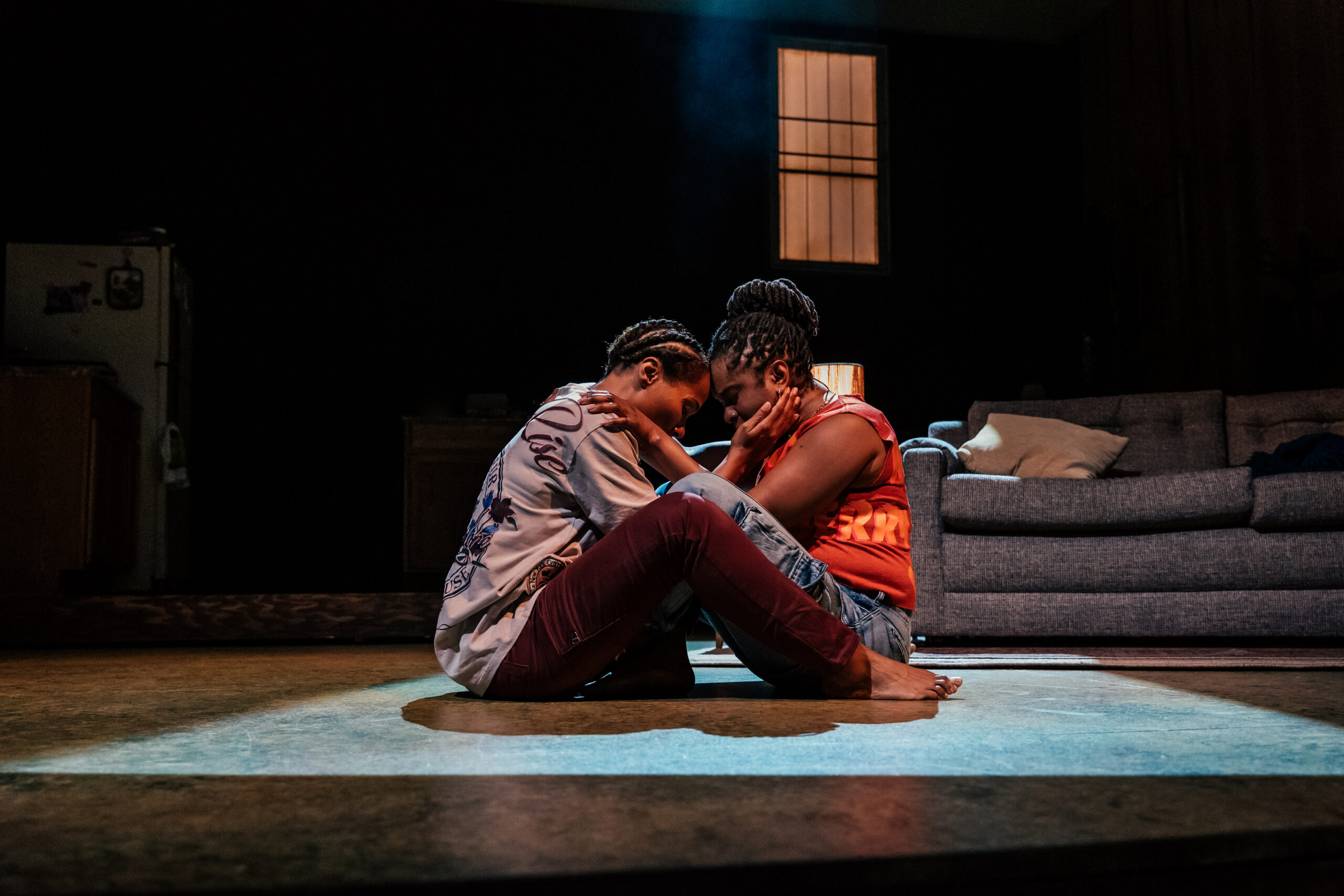
Absolutely. I think about the building of the blanket fort as a kind of public manifestation of all that they have managed to discover about what it means to build a grief ritual. I think about those short scenes from day three, trying to figure out, “What is the ritual we need to do to create some monument to this grief?” And they decide on it being the blanket fort, and the reading of the obituaries inside of the blanket fort, and watching The Cheetah Girls too!
I think about that all the time, just how many immense griefs people are carrying without language for it and without the space to be heard all the time in the midst of those things. And what would it mean if folks were able to have extended time to sit and to be, and find ways to memorialize that are not prescribed or only one thing that is given to each person? What does it mean to think about grief specifically for a community or for a person based on who they were and what they brought to the world? I feel these characters get a chance to do that, which is something that I wish for.
Yeah, it’s tricky, right? Because both of these characters are trying to be free from norms and expectations, in the way they envision building a community, and the way they envision raising a child. Maybe they don’t want to receive a grief ritual that’s been totally predetermined for them.
I think about these characters as being at the end of the world, or the end of their world, in the sense of their lineage and family. There’s nobody left above them at all, besides these parents they’re estranged from (mother and father, respectively). So many of the traditions that may have been passed down from a grandmother or from a great-grandmother, they don’t have anymore. They don’t have those things to hold onto. What they’ve been given is the script for how to do a funeral. Amina has been given that based on what she did for her father, based on maybe just what the funeral home said to do. But nothing that’s been passed down from culture, and I’m curious about that in these characters’ cases, the West African traditions that were lost in the transatlantic slave trade. What are the things that these Black American characters don’t have access to anymore because of those ruptures, but that may live in their bodies, and may be able to be evoked through their connectedness and through a similar mirroring ritual?
You just mentioned West African tradition, and this is a little bit of a leap, but I did find myself thinking about Greek drama a bit reading this play. Is that, in your mind, an influence?
The epic nature of myth and origin stories is at the roots. I think that there is a link between West African religious gods and traditions and Greek drama and the sort of gods that occupy that space. I just did a trip up part of the Mississippi River because I’m writing about it right now, and I was thinking about two Orishas who are part of West African religious practices, Ọya and Yemayá, and the ways that this play, in some ways, is this sisterhood, this twinning-pairing relationship—the epic and intimate nature of these two cousins trying to figure out what it means to tend to each other and also let themselves stand as independent beings.
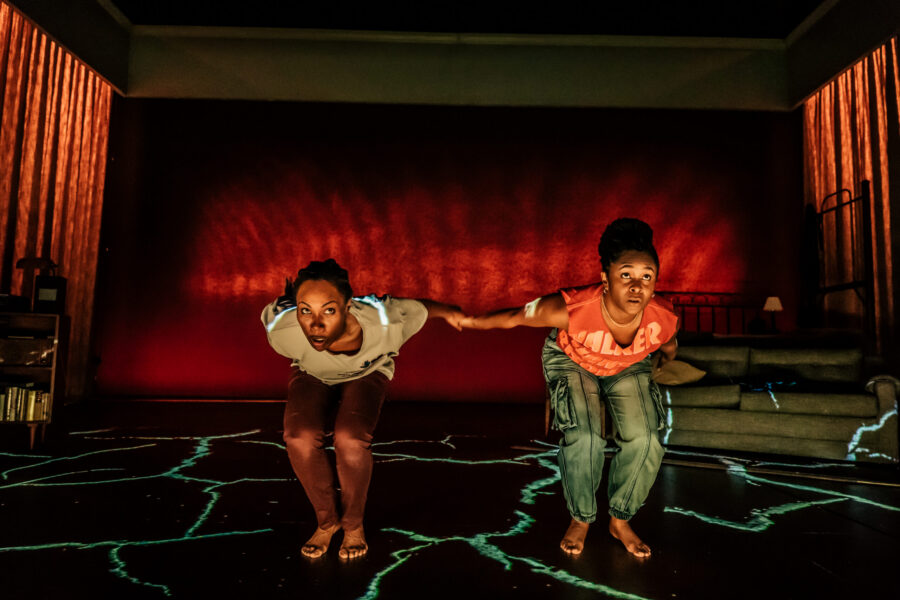
Did you set out to write something epic, or did it just happen in your quest to write something intimate and true?
I didn’t set out to write anything epic at all. I was so surprised by this play. I think I’m endlessly surprised by it, and I’ve been so grateful, because I’ve met so many people who have had similar stories around incarceration in their families and navigating grief in that space. I’d felt this illusion of, “Am I experiencing grief alone?” Not talking about it, and then sort of wallowing in this isolation.
Some of what we’re talking about is the relationship between grief and mourning—mourning being something you can do that has a kind of public element, whereas grief feels private in a kind of crushing way.
Yeah, for these characters, that’s new for both of them; they have not been witnessed by someone who also knows the person they’re grieving. That’s so distinct. There have been times when I’ve been grieving a loved one, but I’ve been away from home and not around anyone who knows them. It’s so jarring, that experience of wanting to reminisce on a story or say something, but no one around would have the reference point for that thing. Both of these characters, for the first time since the passing of their loved ones, are with someone who has a shared reference point. And yeah, it does something, because you’re able to be witnessed and able to grieve publicly, as opposed to solely in solitude.
Sometimes Mina and Sade are kind of arguing about who’s had it harder and who deserves more sympathy, and I was wondering if you ever struggled with that question as the playwright of finding the right balance between them.
Yes, I struggled with that a lot. It’s been a very emotional journey with this story, because it feels, in many ways, personal and fraught in terms of family and community. There was a point in the L.A. production where I just had such an intense, emotional moment where I was thinking, “I’ve been trying to make it even. I’ve been trying to make it so we can hear both of them clearly.” But the world isn’t that. The world doesn’t afford that. I have to give myself grace and trust that the work of trying to do this is enough. That was an important realization. It’s something I’m still wrestling with, both in life and the play: that the characters striving to see each other and love each other in the midst of their differences is enough. And then also that the point is not the comparison; the point is actually the connection. That’s what I hope that people take away from the play itself, is the space for them to connect, as opposed to the ways the world has tried to create these wedges between them based on its structures and violences.