TAMILLA WOODARD: When I read this play, I was just amazed by your weird, wacky, gorgeous imagination. There’s a kind of childlike audacity with which you write your characters. You can just feel them coming from a place that has no censorship, like it’s coming from this pure-hearted 12-year-old imagination, but through the craft of a writer who has great skill. It’s an unusual combination.
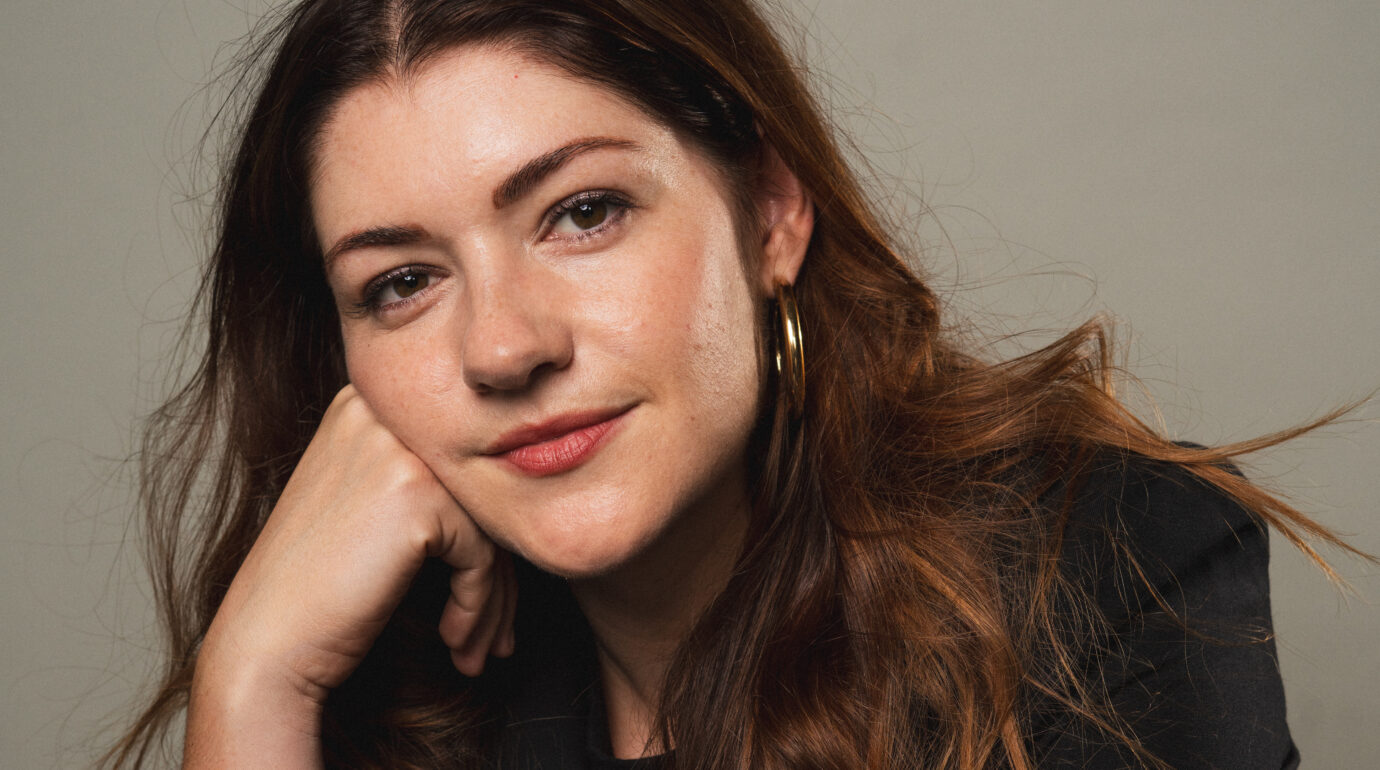
EMILY KACZMAREK: I take that as a huge compliment. I trace my origins as a writer back to when I was a kid. I was constantly writing stories. When I was maybe 10 or 11, my parents let me have the big Windows 95 desktop in my room. I would write my stories, up at all hours of the night. My mom also had this thing that she enforced when we were kids, I think just for her own sanity, called “quiet time,” where she would be like, “Go to your rooms for an hour. I don’t care what you do, as long as you’re not watching TV and you’re leaving me alone.” Those were the contexts where I really became a writer, alone in my room as a little kid. I think I still really connect to that playful kids’ bedroom inside of me when I write. I like for it to feel like play. If it ever stops feeling like play, I’ll be in trouble.
I always think you can find the author in the play somewhere. Amanda before the event feels like you.
When we had the first public reading at New York Stage and Film, my mom came, and she was very emotional afterward. I thought, oh, maybe the content of the play is too heavy. But she was like, “No, I’m overwhelmed because things about Amanda and the way she speaks reminded me of you when you were 9.”
I’ve been a teacher, but I’ve mostly worked with high schoolers. So to write a 9-year-old, I was really preoccupied with getting the voice right. She’s very precocious; there are definitely things she says because she’s heard adults in her life say them. But I also wanted to try and dial in the age, because there is such a difference between 7 and 10. It’s all very specific. So I did go back to some of my diary writings when I was 9 or 10. I recognized a certain lack of censorship then. I became very self-conscious and very self-censoring in my teenage years, but I think that 9 is kind of this prime moment when the essence of yourself is so clear. I really wanted that.
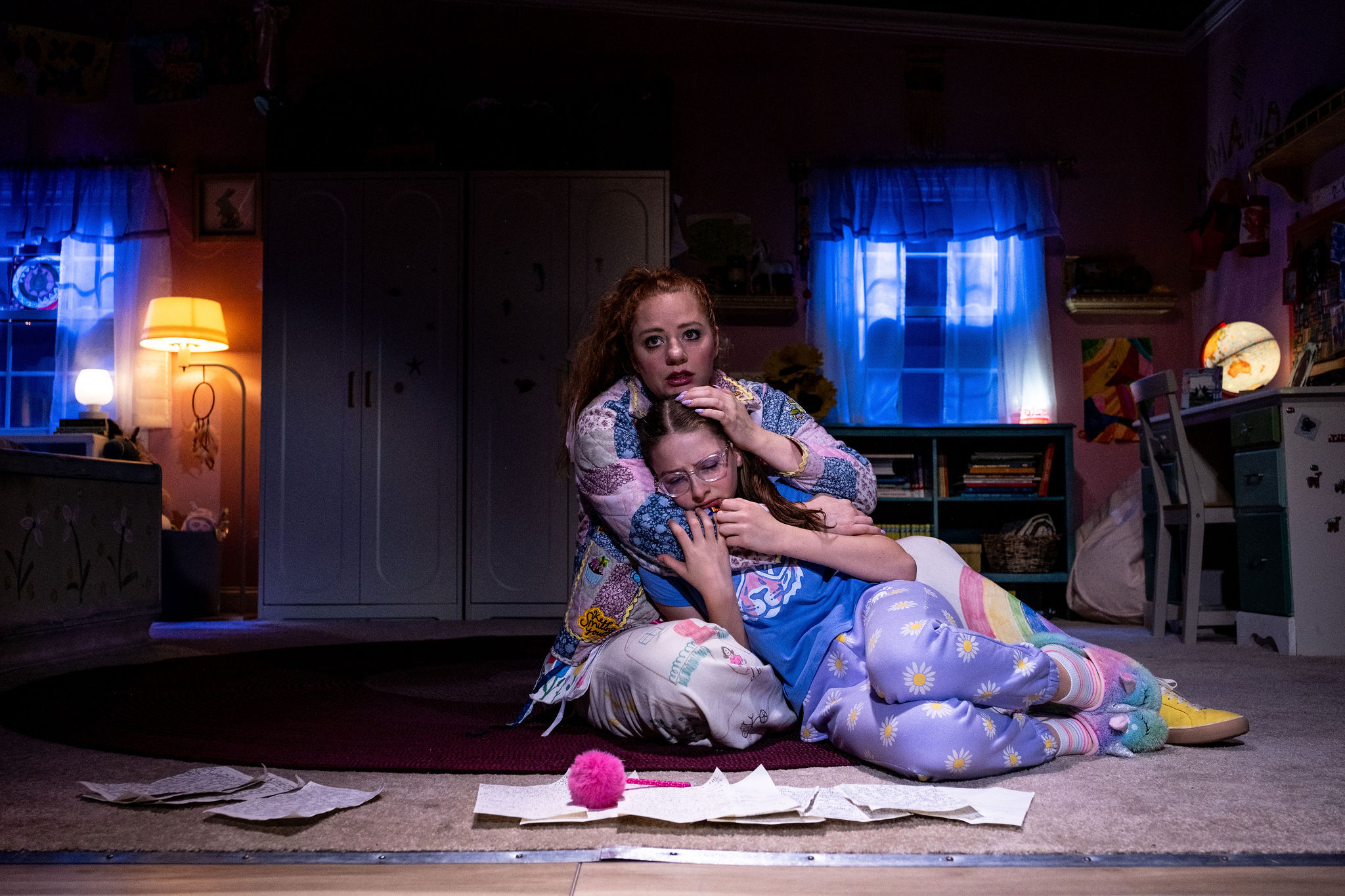
As artists, we keep trying to get back to that 9-year-old all the time, before the external voices become internalized. That is one of the things we mourn about Amanda: Has she turned a corner where this school shooting is going to reduce her humanity—this beautiful, expansive humanity that we know was there before, from her toys, from her American Girl doll, from her diary? To watch them try to come together and save her is so beautiful. I didn’t get to see the production, but it is so vivid on the page.
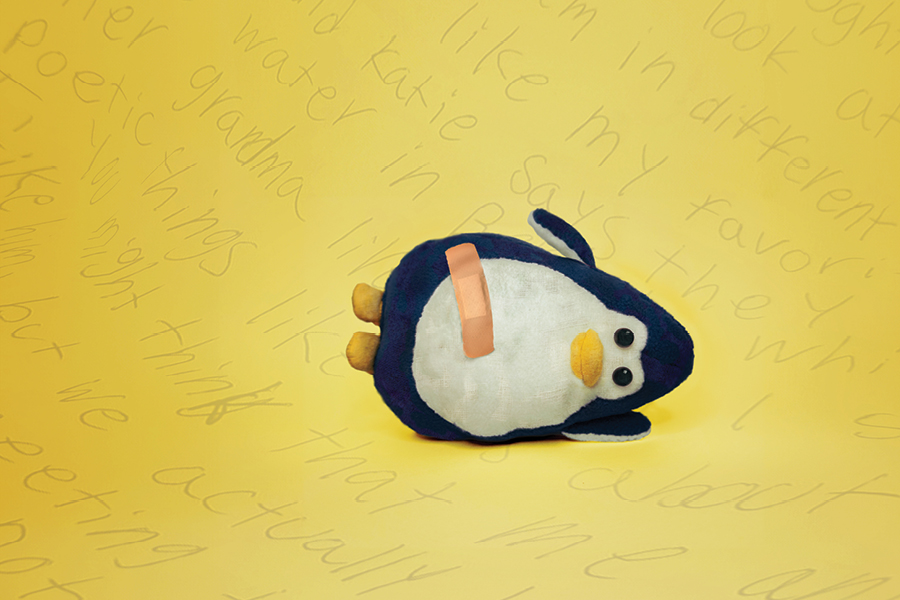
There were many sources of inspiration for this. I thought about the Velveteen Rabbit a lot. In that book, there’s the horse, who is the senior toy in the room; he’s very wise and very measured. But I was like, what if, in a situation like this, the most senior toy was not calm at all, was in fact very, very distraught, because this thing that has happened so shatters the natural order of what should be happening for Amanda at this time in her life, or ever. So the penguin is thrust into a situation that is not in the handbook, and is also struggling with Amanda’s natural growing pains—she is getting to the age where she’s starting to outgrow a certain kind of playing with her toys. That would be painful enough for him, but now he has to try and shepherd her through this situation that is just imaginable.
Why were you compelled to write this play?
This is a rage play for me, honestly. Every time there’s a school shooting in particular, but really, any mass shooting, I am—the phrase I would use is, psychically debilitated, sort of paralyzed. I think this is normal and rational; I don’t think we’re meant to be able to metabolize this scale of trauma in our faces all the time, this cadence of trauma. I just feel so much rage, because it is so deeply preventable and so senseless. It just doesn’t happen like this anywhere else in the world.
2018 was a particularly bad year for mass shootings. It was the year of Parkland. There was a really amazing reported series in The Washington Post by this writer named John Woodrow Cox, who wrote about survivors of school shootings and the impact on them. Yes, we know how many people lose their lives, but what happens to the people who don’t, who are nonetheless marked by it forever? He wrote about some younger children who were having to process these events. There was one little girl, 7 or 8, who wrote a letter to President Trump after a shooting at her school with a list of ideas for how to keep kids safe at school. One of them was, “Build schools in the shape of a circle with the playground on the inside so that no one can drive by and shoot at us.” I just remember when I read that—I mean, it’s tattooed on my brain—the idea that this very young child is having to apply her prodigious imagination, which is the right of every child, to this adult problem. I just was just so full of rage.
So I knew I wanted to write about this. But I needed the right framework for it, the right sort of conceit, because I was incredibly wary of writing like a quote-unquote school shooting play, an issue play. I just wanted to write about characters, and I wanted to find a way to center this child in a way that wouldn’t have her in scenes with adults all the time. I wanted to invert the power dynamic that exists in the real world, where children are completely at the mercy of adults. I was like, who could I put her in conversation with where she would have some power and agency? Once I had the toys, I was like, okay, I know how to I know how to do this.
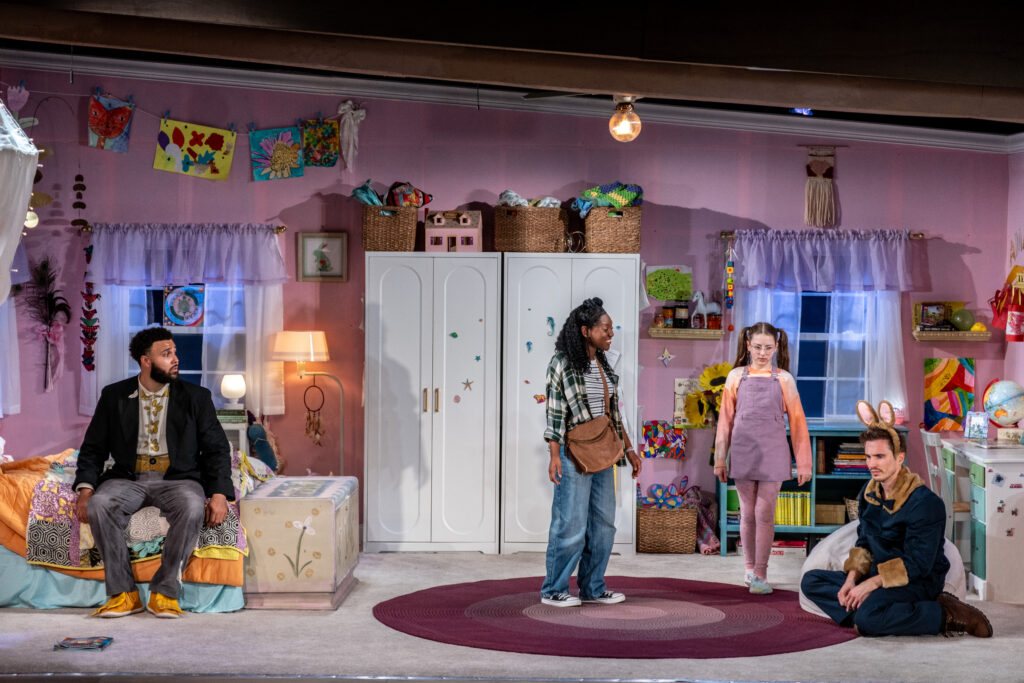
You’ve invested each toy with their own lane, their own psychological need: what she needs from them, and what they do for her in regular life. Then when we get to this emergency state, they’re trying to figure out, how do they answer to something that they can’t even imagine themselves? It’s really beautiful. It is also an act of faith. It seems to me that you are asserting the possibility of art as a force of healing—a portal for this child to heal their trauma, and reactivate their imagination.
Yeah. When it comes to trauma, imagination can be a blessing and it can be a curse; it can be a balm, and it can be a black hole. We see Amanda work with her imagination over the course of the play. I think she metabolizes this shooting very deeply, in part because she has such a vivid imagination, but also I also think imagination is the path out for her. Moreover, there’s something I’m trying to summon about communal, connective imagination. It’s only once Natalie is in the picture and there for Amanda to commune with that the rain becomes real, right? The last line of the play is Natalie talking about how it never rains in Arizona, and when it does rain, it feels like a miracle. That line for me is both hopeful—that there could be a miracle in this country where we decide that we don’t want to pay this price anymore, and that the lives of our children are worth more to us than access to these death machines—but also, I think it would take a miracle. Sometimes I hear that line and it makes me feel hopeful, and sometimes I hear that line and it makes me sad. It just depends on what the news has been that day, you know?
It is so true that artists are futurists. Somehow we see around the bend; sometimes the things we see around the bend are not good. Sometimes it’s like, if I can think it and imagine it, it’s probably on its way. I think we have to feel that way about the things we hope to fix, and certainly the making of art, the putting down of one’s thoughts, the activation of one’s imagination, is such a powerful force of healing. Lack of imagination is the thing that gets us in trouble.
100 percent. Obviously, I am very influenced by magical realism, and by futurism to a degree. Black women have really paved the way on that. I think about Octavia Butler and Toni Morrison, and their ability to render horror and hope sort of simultaneously, and to lace these like really grounded studies of social problems with magic in a way that feels revelatory, and that kind of lifts you out of the bleakness so that you can actually process it. That’s a real ambition of mine as a writer: to try and harness the conventions of magic or surrealism or futurism to say the things about the here and now that I need to say.
It’s all over the play, with the doll, with the toys, with the rain at the end, where Jen, the mother, who is pretty much on her own, is able to reach her hand in the room and believe also. That gathering of collective imagination is a really moving. I imagine that audiences were absolutely on the floor weeping at the end of the play, because it held so much.
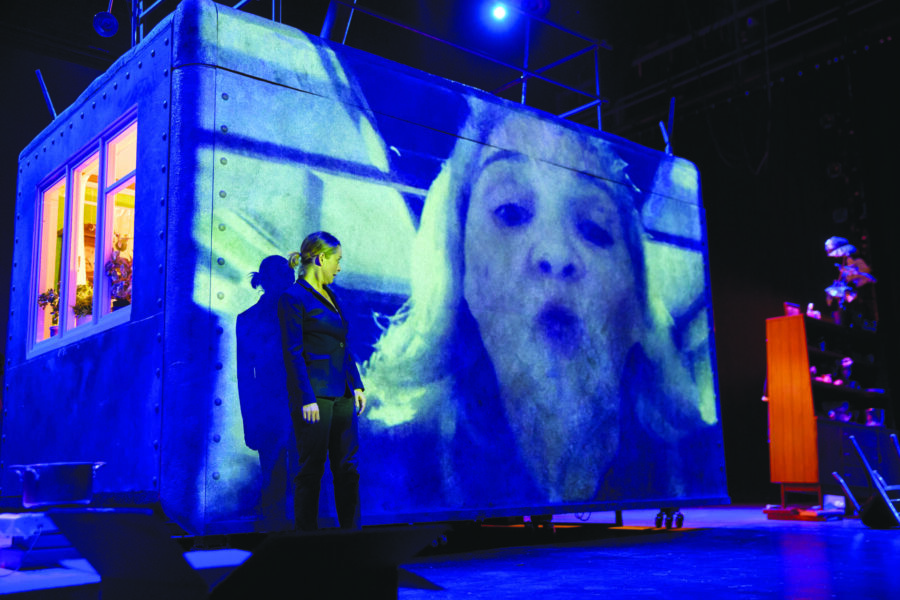
To Detroit Public Theatre’s credit, from the beginning, I was like, “It’s got to rain.” And they were like, “We are going to make it rain. We have never done anything like this before, but by God, it will rain.” Credit to them, and credit to our director, Jaki Bradley: It rained, and there was awe. It felt so redemptive at the end of this journey. You always learn so much when you hear the play, see the play, over and over, and one of the things I learned was: No one needs the rain more than Jen.
Obviously, when I wrote the play, I was kind of like: Okay, Jen is the character where I can place some of my adult anger and bewilderment. Now I’m partnered with someone who has kids, so now I have more access to, not a full parent role, but something adjacent to it. So that character, Jen, just landed for me really differently now that I have that. And I was like, she needs hope. She needs relief. She needs that cleansing moment.
We also always put a lot of care into making sure that there’s support for the child actor who’s playing Amanda, because that is a tall order. We had a really spectacular young actress named Cora Steiger do it in Detroit. She is incredibly mature and handled it really beautifully. But in doing the play, we often find that the adults in the cast actually need—I don’t want to say more support, but they have a different kind of a need for support, because the child actor is typically entering into a world of pretend and then stepping out of it, whereas adults are like, “Oh my God, I have two kids in school,” or, “Oh my God, did you see the New York Times alert that just came to all our phones?” They actually need a container sometimes to process away from the child actors. Because it is very real for them.
What do you hope for the play? What’s next for it?
We’re looking for our next production. I just want people to see it. I want people to be in a room together and experience it and talk about it. My ask with the play is for audiences to sort of set aside the political framing of this debate around gun control, the Second Amendment, yada yada yada—set that aside and sit with the cost to this one child and this one family and this one community for 90 minutes, and just let that inform the debate a bit. Because I think that the framing of that debate is very disingenuous. This is not a question of guns versus no guns; this is a question of the preciousness of human life versus machines, and unfettered access to machines. I just want people to know Amanda and know her mom and know her toys.
There’s another reason the toys are there. On one level, the play is about Amanda’s trauma and her needing to process and heal. But for the toys, they suddenly are living in this sort of reign of terror where they are suffering because of Amanda; it’s very much like, hurt people hurt people. I knew from the beginning that there had to be a toy that decided to leave the bedroom. I didn’t want to send the message that a person’s trauma entitles them to treat you any way, and the loving thing is just to take it. So I think there’s also hopefully a nuanced conversation around trauma and relationships, and how we care for each other, how we help each other heal—how we create boundaries around what is acceptable in the wake of trauma. I’m hoping that’s part of the play too. But certainly, the story is trying to get people to sit with the cost of this national fetish that we have.
I love that you use the word fetish. It does feel it’s like the idea of the right of possession versus the right of life. I’m curious how this played in Detroit versus the way it might play in my home state of Texas, where people have the right to open carry.
I’m curious too. That was one of the reasons I was happy that it premiered in Detroit as opposed to New York or L.A., because Michigan is a very purple state. This is not a settled question there. Detroit is a community that has different flavors of gun violence, and it affects different communities very differently. But I want it to go to all the places. I want to see how it lands in a community that holds that right very dear. Because I’m like, I get that it’s dear, but is it as dear as that little kid’s life? I think, in the world that they imagine, those things are not directly in conflict. But in the world of this play, they are.
The theatre, like sporting events or church, is a great place for us to find ourselves in a mixed community, to be in a conversation where we can have emotional access to someone else’s way of being for a tiny bit of time, and then think differently.
I think so much about the social responsibility of storytelling. I hold both parts of the equation equal: Like, it’s all well and good to have social responsibility, but if the storytelling is not strong enough to hold that in a nuanced way and in a way that doesn’t feel didactic, then it’s dead in the water, right? But I also believe that storytelling, especially now, is the only means I have to put my values into the world.