What can I say here about the annus horribilis of 2025 that hasn’t already been said? That in the world of theatre, things weren’t quite as bleak or unsettling as events and trends in politics and culture more broadly? Indeed, after years of painful contraction and post-pandemic-lockdown audience rebuilding, the U.S. theatre industry may be, if not in the full flower of recovery, in a slightly better place than it was a year ago.
Is that reason enough to celebrate? I don’t think so. Is it a time for taking stock, though? Of course. As is our annual wont, we are looking back on the 10 most-read stories we published on this site in the past year—and recommending 10 others we feel deserve more attention—to give us a picture of the year we just lived through. One thing you’ll surely notice: The national news landscape, which doesn’t often show up so prominently in our coverage, is a prominent feature (or is it a bug?) of several of 2025’s most attention-getting stories.
- Why I Left Kennedy Center. This searching piece by Nathan Pugh, who resigned in protest from his job as a copy writer at the Kennedy Center in March, also appeared in our Fall print issue. Pugh, who grew up in the Washington, D.C., area, writes about what the center’s programming meant to him and his family, and how the changes to the center wrought by the Trump Administration and its hand-picked deputies altered the institution’s character beyond recognition. All this was well before the current president recently saw fit to add his name to the building, leading to even more cancellations and protest.
- The Top 10 Most-Produced Plays of 2025-26. These annual lists, culled from all TCG member theatres, are always among our most popular stories, and understandably so: They give telling and timely snapshots of the industry’s tastes and economic priorities. This year’s, released in September as part of our Fall print issue, was topped by the bracing, communitarian musical Come From Away, the licensing for which only became available last year, and Eboni Booth’s finely rendered drama Primary Trust, both fresh and heartening choices. Elsewhere on the list, small-cast dramas alternated with larger-cast musicals—not a new national trend, to be sure, but one that reflects shifting audience preferences.
- New NEA Guidelines Require Compliance With Trump’s Anti-DEI, Anti-Trans Orders. In the early days and weeks of the new Trump administration, as DOGE and Russell Vought chainsawed through presumptively independent government agencies, and the nation’s “justice” department targeted colleges and law firms with ideological and transactional shakedowns, the National Endowment for the Arts—a Republican bogeyman since the 1980s—faced a reckoning in February when its guidelines for grants were abruptly revised to exclude any projects that purported to promote diversity or so-called “gender ideology.” Lawsuits, including some joined by our publisher, Theatre Communications Group, have since successfully challenged this language. But as you’ll see in two other stories below, this was just the beginning of the NEA’s problems in 2025.
- The Shows That Reloaded the Canon for the 21st Century. Inspired in part by the New York Times’s 100 Best Movies package, American Theatre surveyed hundreds of industry leaders, workers, and observers to name not the “best” plays and musicals of the past 25 years but the “most influential”—a distinction that is arguable, surely, but it was an argument we were willing to make (and have) if it meant the chance to lift up some of the most vivid and fascinating titles of the 21st century so far. The list—which we chose to cut off at 50—offers a telling portrait of an ever-changing art form whose impact, despite conventional wisdom, has reverberated strongly outside our theatre walls.
- Maybe, Maybe Not: A Casting Controversy and the Conversation It Started. One of the year’s thorniest controversies erupted over something that doesn’t typically get much attention: replacement casting for a beloved Broadway musical. The charming, haunting robot romance Maybe Happy Ending was the year’s most uplifting underdog story, winning the Best Musical Tony and building a passionate following entirely on the strength of good reviews and word of mouth. Then the producers announced that Andrew Barth Feldman, who is white, would take over the male lead from Darren Criss, who, like all the actors who’d played the role in the show’s production history, is Asian American (and in fact was the first with that identity to take home the Tony for Best Actor in a Musical). Weeks of protest and commentary ensued, but I was particularly happy to publish this thorough and circumspect piece by Daniella Ignacio in August, which among other things examined this contretemps in relation to the history of Broadway casting choices, particularly of actors of color, and the way these can set the mold for subsequent productions—a stakes-raising element of the discourse that I didn’t see aired extensively anywhere else.
- The Top 20 Most-Produced Playwrights of the 2025-2026 Season. This year’s crop was dominated not by the authors of the most-produced titles (Come From Away’s Irene Sankoff and David Hein, Primary Trust’s Eboni Booth) but by the Energizer Bunny of the American theatre, the prolific Lauren Gunderson, in her fourth appearance at the top of this list. Most impressively, she reached this height not on the strength of any single title but with no fewer than 12 titles. We spoke to Gunderson, as well as to Sankoff and Hein, for our Offscript podcast in September as she was in the midst of previews for a new musical version of her popular two-hander I and You. It was then that she told us, by way of explanation for her extraordinary productivity, “It’s hard to stop doing something that you take joy in.”
- NEA Abruptly Pulls Arts Grants on a Massive Scale. The endowment’s troubles continued in May, when, in a sort of Friday night massacre, hundreds of U.S. arts organizations received boilerplate emails from the NEA withdrawing pending grants and terminating existing ones, in amounts ranging from $10,000 to $100,000, earmarked for production costs, educational programming, new-work development, artists’ pay, and more. Coming just days after the Trump administration officially announced its aim of eliminating the NEA altogether (see the next story), this precipitous action hardly seemed unrelated. Two weeks later we reported on how theatres were coping with the sudden budget shortfalls; though many didn’t rely on NEA funding for the bulk of their budgets, the summary withdrawal of government support is having repercussions well beyond the bottom line.
- Trump Proposes Elimination of NEA and NEH. Republican administrations and lawmakers have had these endowments in their sights since the culture wars of the 1980s and ’90s, but Trump was the first president to propose their complete elimination in the budgets he released in 2017 and 2018, during his first administration. As we all have been unhappy to learn, many things that were only notional or nascent in Trump’s first administration are in full flower in his second, so when he released a budget in early May that put the NEA, the NEH, and Corporation for Public Broadcasting on the chopping block, there was good reason to fear the worst. So far, though, the NEA has survived, with chairman Mary Anne Carter reconfirmed as its head last December. (The NEH has also survived, though in drastically reduced form under chairman Michael McDonald, while the CPB was recently fully dismantled.)
- Life and (Near Death) in Broadway’s ‘Swept Away,’ One notable casualty of the last Broadway season was this ambitious musical about shipwrecked 19th-century whalers. With music by the Avett Brothers and a book by John Logan, it got strong reviews (including a Critic’s Pick from The New York Times) but did not find an audience, closing after just 48 performances in late 2024. This first-person essay by the show’s star, John Gallagher Jr., published in late April, partly reckoned with that disappointment but went much further, exploring the vertiginous ups and downs of a physically and emotionally draining gig, in which the life-or-death onstage stakes were mirrored by Gallagher’s own offstage struggles. His bittersweet conclusion: “If you’re in a show and you want to know what that show is about, I recommend closing the show, because that’s what the show is about…In death, the show was more alive than ever.”
- What Happened to the U.S. Nonprofit Theatre Movement? The headline may have seemed like clickbait to many commenters, but it well described this excerpt from Seth Gordon’s new book, Crossroad in the American Theatre, for which the author—a former managing director at Cleveland Play House and the Repertory Theatre of St. Louis, who now teaches directing and theatre management at the University of Oklahoma—chiefly interviewed artistic leaders at nonprofit institutions about the state of the field. In this chapter, however, he summarized his conversation with folks who advise and consult artistic leaders from positions of big-picture advocacy and questioning (Douglas Clayton, Seema Sueko, Todd London, and Stephanie Ybarra), and who offered tough and searching food for thought about the priorities and programming of U.S. nonprofit theatres.
Of the 200-plus stories we posted in 2025 (not including our podcasts), we also launched new editors’ columns (Goes to Show from me, Sightlines from Jerald Raymond Pierce, and Dramática from Gabriela Furtado Coutinho) and continued our ongoing Role Call and Know a Theatre features. The following were some stand-alone pieces we’re particularly proud of which captured some of the trends and voices of a memorable year, listed in chronological order.
- Show and Telemachus: Joseph Medeiros’s Journey Through ‘The Odyssey.’ In January we kicked off the year with one of the strangest and most intriguing stories I can recall assigning. In Douglas Corzine’s report on one actor’s obsession with performing Homer’s great epic in its original Greek (starting with the first four chapters in a six-hour rendition at NYC’s Theaterlab), we travel from a cozy basement in Ridgewood, Queens, to performances attended by Odyssey translator Emily Wilson, who tells Corzine she hopes to attend Medeiros’s 24-hour reading of the entire work one day. Talk about an odyssey!
- The Fires This Time. January’s devastating wildfires in Altadena and the Pacific Palisades took a toll on the city of Los Angeles in ways both measurable and profound. In this panoramic reported essay, Amanda L. Andrei reported on the fires’ impact on theatre workers in the Southland, from the destruction of Theatre Palisades and Altadena’s Public Displays to efforts by local theatres to provide support as donation centers and to offer free performances. Andrei also looked beyond the immediate timeline, quoting About…Productions’ Theresa Chavez as saying, “I feel that Indigenous knowledge is where some of the answers lie to part of this conundrum…I pray we can find balance as a human society with the earth.”
- Your Call Is Very Important to ‘Lennox Mutual.’ Virtual and/or telephonic meta-theatre wasn’t invented during the COVID lockdowns, but it sure feels like it took off then, from 600 Highwaymen’s A Thousand Ways, Part One: A Phone Call to Helder Guimares’s The Present. In this beguiling report by Jerald Raymond Pierce, we learn about a strange (still ongoing) immersive experience from Candle House Collective, structured around 20-minute ostensible customer service calls with representatives of the “Life En-Surance” company of the title. In fact, these are actors who’ve rehearsed and trained from a massive text to shepherd callers through increasingly individuated experiences, in what its creators liken to “learning to play a game that plays you back.” To play’s the thing, after all.
- Charles Strouse, Jedi Master. If you haven’t checked them out, our regular In Memoriam features, for which we typically ask theatre artists to pen eulogies to beloved colleagues who’ve recently passed, are beautifully intimate time capsules of theatre history and personal storytelling. My favorite this year (among many strong contenders) was this tribute to the composer of Annie and Bye Bye Birdie by composer-lyricist Jason Robert Brown, who managed to write something dishy and funny while also humbly honoring the genius of a man he called “an ideal Golden Age Broadway Composer, someone who could write funny, write heartbreaking, write toe-tapping, write ferocious, and make each score its own perfectly integrated universe.”
- Nidia Medina & Lou Moreno: There’s No Place Like Intar. Talking to artistic leaders is among the pleasures of my job, but seldom have I felt as inspired about the stubborn persistence of theatre—particularly scrappy, culturally specific theatre—as I did after speaking in June to the outgoing and incoming artistic directors of Intar Theatre, Lou Moreno and Nidia Medina, respectively. Without shying away from the challenges this tiny Hell’s Kitchen theatre has faced and still faces, together they gave me a memorable picture of what surviving and thriving can look like: Doing the work and grounding it in a community. Easier said than done, but these two convinced me it indeed can be done.
- Extreme Vetting and Extraordinary Ability. This eye-opening report by Miriam Felton-Dansky was part of our Summer print issue, “Immigrant Imaginations,” which, as that title suggests, shone most of its light on theatre work created by immigrant artists in a time of increasing, and freshly empowered, xenophobia. In reporting on not only the latest barriers that have been thrown up between international artists and U.S. theatres, but also on our nation’s long-standing, culturally biased treatment of foreign-born artists, Felton-Dansky offered a reality check for future advocacy and activism: namely, that lifting Trump-era restrictions will only be the start of a more humane and reciprocal system of international arts exchange.
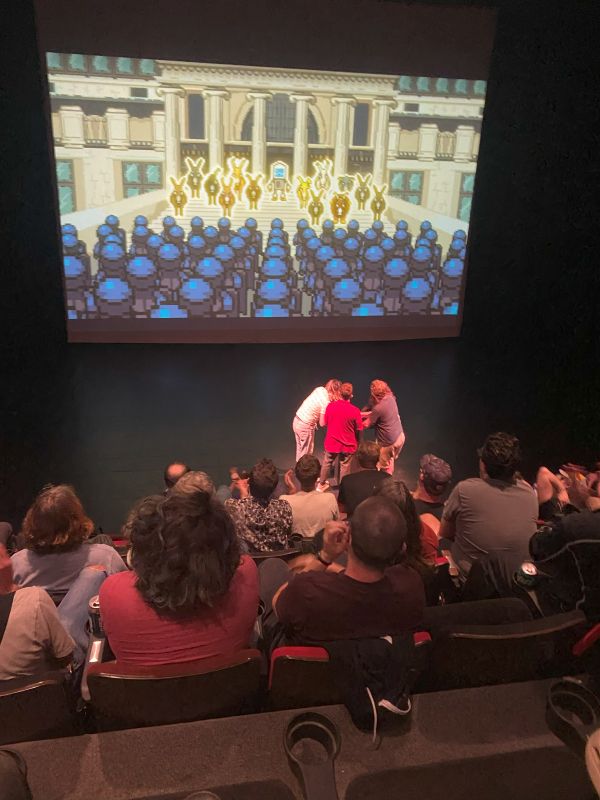
- No Bystanders at Philly Fringe. Our festival coverage got kicked up a notch this year, in part thanks to funding from Critical Minded that helps pay for critics of color to attend and report from new-play fests and other theatre convenings. This September sampler of the Philadelphia Fringe Festival by Pria Dahiya, a practitioner-critic who also participated in our Critical Insight partnership with the Pittsburgh Public Theater, was a pure joy to read, ricocheting from bespoke immersion to soul-rattling dance, from bewildering durational video game theatre to disturbingly saucy clowning. A great piece of criticism will help you picture a show you haven’t seen; Dahiya’s is one of the few that has lodged some of those pictures in my mind as if I have seen them. (Other highlights from a year of festival coverage, if I may: Adam Wassilchalk’s kaleidoscopic tour of the new Williamstown Theatre Festival, Amanda L. Andrei’s bracing report from Manila’s Virgin Labfest, Daniella Ignacio’s thorough survey of the National Alliance for Musical Theatre showcase, Gabriela Furtado Coutinho’s inspiriting coverage of TYA/USA, David Cote’s sharp look at Poland’s Contakt Festival, Miranda Purcell’s survey of La Jolla Playhouse’s Latinx New Play Festival, Yasmin Zacaria Mikhaiel’s disarmingly personal take on South Coast Repertory’s Pacific Playwrights Festival, my take on the still-going Contemporary American Theatre Festival.)
- Artistic Directors Should Create Space, Not Control It. Val Day, who heads New York City’s multi-venue complex 59E59 Theaters, came to us in October with this remarkably clear-eyed essay, in which she lays out a light-touch leadership ethos that resonated not only with a lot of practitioners but with other artistic leaders as well. “I’ve come to see my role not as shaping the work itself,” she wrote, “but as shaping the space where it can happen. My job isn’t to make art. Instead, I’m here to safeguard the conditions in which bold, surprising, artist-led theatre can flourish.”
- The Fall and Rise of Private Funding for Theatre. In the kind of complicated piece of reporting that The New York Times would put in its News section but tag as “Analysis,” Stuart Miller sought to uncover the truth about trends in private funding for theatre—largely assumed, and reported elsewhere, to be declining. As Miller discovered, the answer to the question “is private funding for theatre down” depends on where you look and how you count.
- How to Survive a Dictatorship, the Theatre Artists’ Way. Our fearless digital editor, Gabriela Furtado Coutinho, has pushed American Theatre to include forms of writing that haven’t typically been on our radar. That was true of the literary anthology we compiled for the “Immigrant Imaginations” issue, and it was definitely true of this piece, part of our Fall print issue, which used a narrative non-fiction approach to tell the stories of three historic theatremakers who resisted oppression with their art. Using vivid second-person, present-tense language, Furtado Coutinho conjured the spirits of Germaine Tillion, Augusto Boal, and an anonymous Korean composer to serve as guiding lights through the darkness we’re all facing—but don’t need to face alone.