Andrew Barth Feldman’s casting as Oliver in Maybe Happy Ending, the Tony-winning musical about a romance between two South Korean helperbots by Will Aronson and Hue Park, has been on my mind since the news broke—not only because it sparked wider industry questions about intent in authorship, impact in casting precedents, and representation for AANHPI (Asian American, Native Hawaiian, or Pacific Islander) artists but because, as a Filipina American contributing editor here, I’ve been pondering what role I might play and what American Theatre could add to the conversation. What seems to be most productive is to first consider the facts, then weigh questions of authorial intent and casting precedent (not only for this show but for any other “universal” show that features people of color), and finally, consider the pros and cons of the online discourse.
What Happened
Feldman, who is white and Jewish, is the first replacement for mixed Filipino actor Darren Criss, who recently made history as the first Asian male actor to win the Tony Award for Best Leading Actor in a Musical. Feldman is also currently dating the show’s other lead performer, Helen J. Shen. Many Asian American and Pacific Islander (AAPI) artists have spoken out, including Six’s Kay Sibal, Erin Quill, B.D. Wong, and Telly Leung. Conrad Ricamora started a new “Right to Be There” scholarship fund for Asian male actors pursuing BFA degrees, announced on July 28. On July 30, the Asian American Performers Action Coalition (AAPAC) released a statement in which they shared “profound disappointment” at MHE’s decision to cast a non-AANHPI actor.
AAPAC noted MHE’s South Korea setting, and the Broadway cast of AANHPI actors in all but one of the roles, “creating a rare opportunity for AANHPI actors to play both leading and supporting roles in its original Broadway cast and setting the precedent for future productions,” they said. Instead, “a different precedent has been set; one that de-emphasizes cultural specificity and the opportunities for a far too often excluded population of actors that come with it. If the intent has been to show the story’s ‘universality,’ we are reminded that though we have long been expected to view white stories populated by only white actors as ‘universal,’ stories about people who look like us that are populated by people who look like us are rarely considered universal enough. It is the same perception (conscious or not) that once made ‘yellowface’ accepted as the status quo and continues to justify ‘whitewashing’ today.”
Even with historic AANHPI Tony nominations and awards this season, it’s still “a time when our histories are being rampantly erased, censored, and banned, and our stories colonized” and “when we need more intentionality, not less,” they continued. “We are acutely aware of how much representation matters, as does intent vs. impact.” They urged the producers to “consider the ramifications of their actions, no matter their intent.”
On July 31 at 1 a.m., Aronson and Park shared a statement on the MHE Instagram acknowledging that they’ve “heard how strongly people connected to that representation, even if that wasn’t our original intention, and how this casting decision has re-opened old wounds.” They said they wanted to create a show that would become “part of the American musical theatre canon—a modern-day Fantasticks, able to be comfortably performed by anyone, anywhere,” and “a show in which every role could be played by an Asian performer, but without the intention that the robot roles always would be.”
Later, Helen J. Shen, who has been “struggling to hold multiple truths in me that seem to contradict,” spoke out about her experience of the backlash. “I acknowledge that we can’t control how the show is received and the impact that it has had. The vacuum of A/PI stories that don’t center around pain or tropes wanted to be filled by this show for our community,” they wrote. “I am excited to champion more A/PI works, the way that community has championed Maybe Happy Ending. I am also excited to see work that has a completely different take than Maybe Happy Ending, that can contradict itself, that can be many things, proving that diaspora is a tapestry, not a monolith.”
Authorship Above All?
Do impact and context trump authorial intent? Aronson and Park have said that the robots didn’t and don’t always have to be Asian: The production posted photos from workshops with white performers and non-AAPI performers of color, including Denée Benton, Corey Cott, and Hailey Kilgore. In an L.A. Times interview, they shared that they found that the South Korean setting was more clearly conveyed with Asian actors in the leads. Still, Aronson and Park maintain that they’ve tried different casting and came to Broadway with the roles still “ethnically undefined.” A casting breakdown that circulated on social media reveals that May 2024 standby audition appointments listed Oliver as “Asian,” though they returned to “any ethnicity” after that call.

For Broadway, as well as in a 2020 production at Atlanta’s Alliance Theatre, the team made the choice to cast almost every actor as Asian (the exception is a jazz singer named Gil Brentley, clearly written as a white American recording artist). It is in this incarnation that Maybe Happy Ending has been embraced as a rare show with Asian characters that is not about “being Asian” or any tropes of hardship or striving; it shows Asians in both a dystopian family tragedy and a joyful adventure, and is set in Asia. AANHPI artists have accordingly latched onto it as a beacon of empowerment, and the show’s marketing (until recently) also championed this representation as a selling point. Does the impact of a show’s casting—both on audiences and on the artistic community—matter, or does it not? Perhaps this impact isn’t enough to trump the authors’ intent, but they should certainly be aware of it.
Of course, a play’s creators have the initial say on how their show should be performed. But they may not always have final say, in that they can’t control when a show grows to mean more than they may have intended. To what extent do we respect authorial intent if the authors come from a mindset of wanting to make an “American” musical? Given the chance to have an actor of “any race” play a character, especially in a show with international reach, how can we trust it to not to default to white—which kind of defeats the point of “any”?
Dead Precedents
For me, the issue comes down to the “maybe it doesn’t have to be”—the notion expressed by the authors that “every role could be played by an Asian performer, but without the intention that the robot roles always would be” (italics mine). I don’t think I’ve ever come across another situation where the story is 100 percent Asian but the characters maybe don’t have to be Asian. As an Asian American performer who has done my share of the stereotypical work we’re often compelled to do (my brother was in the 2015 Lincoln Center revival of The King and I; I’ve played Christmas Eve in Avenue Q), this resonates beyond a single casting decision. It speaks to a lifetime of trying to be seen, heard, and understood in an industry not built for me. MHE’s producers described the decision as “embracing infinite and exciting possibilities in casting”—phrasing reminiscent of the rationale for opening up historically white roles to actors of color. But giving a white actor a role initially played by an actor of color feels like the opposite of that.
AAPAC’s statement points to the precedent-setting power of casting choices, especially when authors don’t codify original casting in the script. Examples nearest to my heart on that point are Chip and Marcy in The 25th Annual Putnam County Spelling Bee, originated on Broadway by AAPI actors Jose Llana and Deborah S. Craig. In community and regional productions, though, I’ve never seen an Asian Chip, and I have only seen an Asian Marcy once, even though Marcy is clearly written as an Asian overachiever perfectionist from a Catholic school. The erasure of Marcy’s original Asian-ness over the years has made me think, I’ll never get to represent being an Asian Catholic overachiever for my younger self—that part of me doesn’t matter.
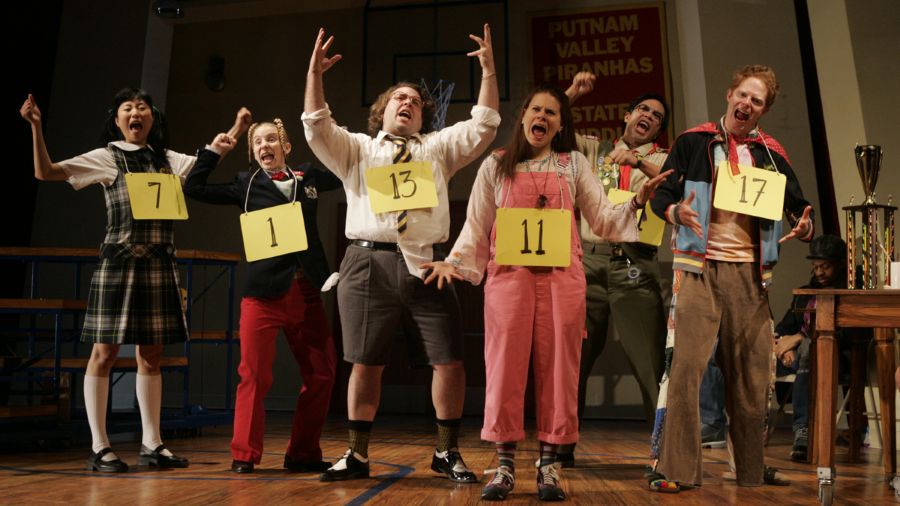
I also think of Eurydice in Hadestown (Eva Noblezada), Dawn in Waitress (Kimiko Glenn), Heather Duke in Heathers (Alice Lee), Gretchen Weiner in Mean Girls (Ashley Park), Jenna and Michael in Be More Chill (Tiffany Mann and George Salazar), Pythio and Mopsa in Head Over Heels (Peppermint and Taylor Iman Jones), and the Laureys of the most recent Oklahoma! revival (Rebecca Naomi Jones and Anoushka Lucas). Though these roles weren’t necessarily written for performers of color, these productions all originated these roles with actors of color, which set a precedent. Is it better when these precedents are respected? For actors of color who had the chance to go up for these roles, the answer may be yes, and future casting decisions often align (though not always).
The divide between shows continually cast in non-culturally-specific ways and those that aren’t seems to be about cultural context, history of oppression, and lasting reclamation. As Kay Sibal—who stars in the consistently multiculturally cast Six—put it: “There is such scarcity of people who look like us onstage compared to other groups. We are an underrepresented group. When there was a role that was originated by somebody in our community, regardless of if that role is a robot, if that role doesn’t actually talk about race…if that role has been originated by somebody who is an AAPI actor, that’s a big win for us, because of the scarcity that we live in. If we lived in a world where there wasn’t such scarcity of roles or representation for us, we wouldn’t be upset.”
These examples are different from roles where it is blatantly obvious that they must be played by people of color because they were written for them—even if the original casting didn’t recognize that. We’ve thankfully gotten past racist yellowface, blackface, redface, and brownface, with years of progress in casting authentically. No one seriously argues about casting AANHPI actors in The King and I or Latine actors in West Side Story; Jonathan Pryce’s casting in Miss Saigon was arguably the pivot point for this practice (though hardly the last example).
The question about Maybe Happy Ending is: Are these helperbots the kinds of roles in which actors of color just happened to be cast in the original, like Spelling Bee, or the kinds where they absolutely must be cast that way, like The King and I? The picture wasn’t clear—until it was clarified by the authors. Despite how it may have looked and felt to many, their intention was not chiefly representation.
Losing the Plot
Unfortunately, I think we need a new treatise on Internet outrage in a really weird, difficult, and painful representation situation. There have been comparisons of this controversy to the time Okieriete Onaodowan was briefly cast in Natasha, Pierre, and the Great Comet of 1812, followed by the abrupt announcement that Mandy Patinkin would take the role, only to have both actors withdraw and the show close early. This is different in at least one way: Feldman is coming into the show following its success at the Tonys, while Great Comet was struggling and reaching for a box-office boost. What is similar: These are both situations in which the problem is more complicated than producers simply being racist.
A few takeaways from the online discourse:
Consider nuance, context, intent, impact, and history. Ask: What is the intended story? How does casting support it? What does it have to be and what should be the precedent? What could it be and what expansion is acceptable, given not only the story the authors want to tell but histories of exclusion for actors of color? We should discuss precedents, listen consciously, and build better futures. At the same time, we can hold our truths and express genuine hurt. This backpedaling does hurt. It is taking away space that felt like it was given to us, in a world where opportunities for Asians—Asian male actors in particular—are limited.
Be respectful to the company while still voicing concerns. Sending hate comments to Helen J. Shen is not the move; some of the pushback has indeed gone too far. In this sense, I agree with Strange Loop author Michael R. Jackson, who offered a vociferous critique of the backlash, pointing out that “while artistic criticism and disagreements are more than fair game…the unabashed attempts to manipulate public sentiment with racial emotional blackmail is one of the darkest and vilest developments I’ve seen in theatre in a long time.” There’s been so much understandable public outrage, but bullying or spreading vitriol under the guise of racial trauma indeed disrupts progress. At the same time: Voicing legitimate concerns about representation in public channels is absolutely valid.
Support MHE’s AANHPI artists, so that MHE finds a way to continue to tell the story it has become. All this outrage runs a genuine risk of taking down a show that has created space for, and still employs, artists of color. “I fear the online discourse has lost the plot,” MHE standby Christopher James Tamayo shared. “In trying to highlight a larger issue, it is inadvertently undermining the very thing we want to hold dear and preserve for opportunities for all of us.” Indeed, though the authors clarified that the show was not primarily about Asian representation, it serves no one for this to go down in history like Natasha, Pierre, and the Great Comet of 1812 or Jagged Little Pill. If we want to build a world where we get more Broadway shows championing AANHPIs—especially specifically AANHPI stories—this show needs to survive.
Whatever happens with Maybe Happy Ending, this is a moment in musical theatre history we are not going to forget. The pain and the reconsideration it has brought up will be with us for a while, and not just on Broadway. Maybe someday the battery life of these conversations will run out, but it doesn’t look like that day will come soon.
Daniella Ignacio, a writer, theatre artist, and musician based in Washington, D.C., is a contributing editor of this magazine.