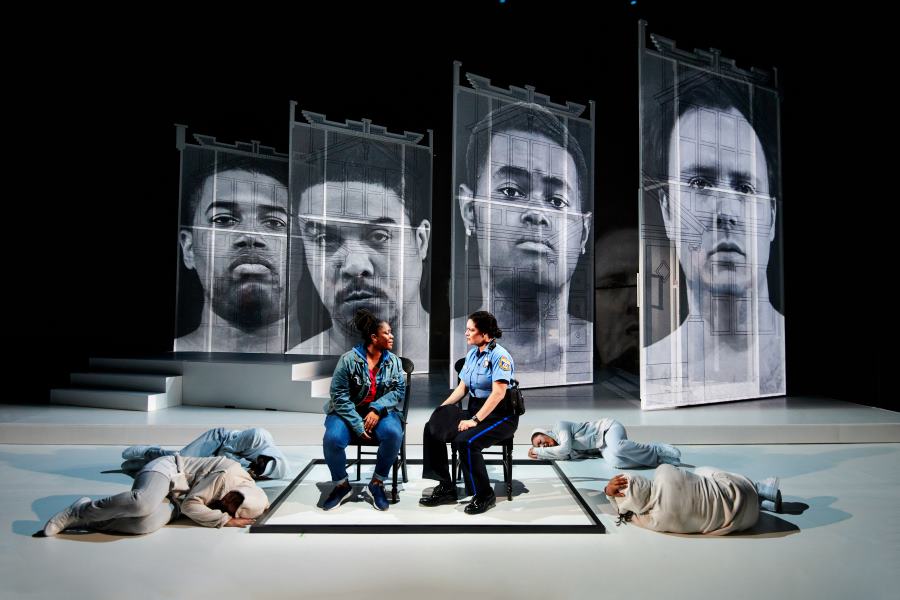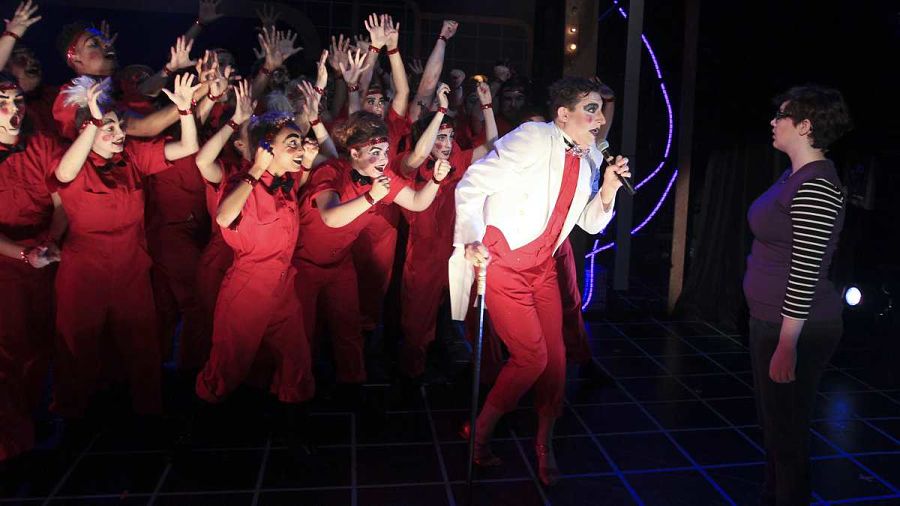
At the 29th Philadelphia Fringe Festival, now running through Sept. 28, the city itself is both audience and performer. Programming director Mikaela Boone describes the festival’s mandate as creating “a place where Philadelphia can meet the world and the world can meet Philadelphia.”
What I saw there, in a recent six-day sprint, was a city meeting itself. In conversations, crowds, bonded by hours spent together in dark theatres, audiences sought connection. This wasn’t accidental: Every piece I encountered was participatory in some way, challenging the comfort of passive observation and forcing audience members to confront not just performers, but each other.
The scale of choice was staggering: This year’s festival features more than 320 independently produced shows across 90 venues. These offerings are concentrated across five themed festival “hubs”—fringes within the Fringe. In my limited time, I was only able to see works presented in the four venues programmed by one of those hubs, Cannonball. Other festival hubs were delineated by genre—the comedy selections of Dumb Hub, the self-explanatory Circus Arts Presents—while two others, Studio 34 and Sawubona, are connected to venues.
FringeArts is the organizational body presenting the festival. This year, they programmed nine performances throughout the month of the unjuried festival. I tried to balance that curated lineup with a representative sample of independent work in the dozen offerings I took in.
Curated Delicacies
My first stop? The Private Theater, in a residential neighborhood in the Northern Liberties. The empty, peaceful street was a welcome relief from the crush and chatter of the Fringe opening reception I had attended, where the fringe-theme cocktails I downed from the open bar, titled “Human Evolution,” had devolved me. I was open to new experiences. Perhaps even spiritual ones.
It was there that I awaited Spiritual Experience, a show that bills itself as a “uniquely intimate theatrical experience”—i.e., a private performance with seating for just two audience members that I in fact witnessed alone.
A ringtone chimed inside the house when I dialed the secret phone number. The number was sent to me in an email the night before, with a request for drink preference and allergies. A soft-spoken man opened the nondescript door and gently welcomed me to sit. A whiskey sour and ambrosial honeyed biscuit were set just for me.
I can’t say more about what transpired. Privacy, secrecy, and surprise are essential: to disclose any of the piece’s one-of-a-kind, bespoke theatrical mechanisms would spoil its surprise. “I do have concerns about the veil of mystery being broken,” playwright Adriano Shaplin admitted to me with a sheepish smile, “but I also want the show to run forever.”
What I can say is that Spiritual Experience could serve as a baptism into the Philadelphia aesthetic, a.k.a. shoestring maximalism—a style director Rebecca Wright characterized as “a muchness and a scrappiness simultaneously,” or a talent for doing a lot with very little. Headlong Dance Theater, New Paradise Laboratories, and Pig Iron Theatre Company are just a few who reflect this style, which has become central to Philadelphia’s theatrical identity.
Spiritual Experience is one of three Philadelphia-born shows in FringeArts’ curated season (alongside 1812 Productions‘ La Otra and The Bearded Ladies Cabaret.) Supporting ambitious and risk-taking work by local artists is one of FringeArts’ priorities, programming director Boone stressed. “We want to retain local talent, to show them that there’s a trajectory here to develop new work, and that there’s an audience open to new experiences.”
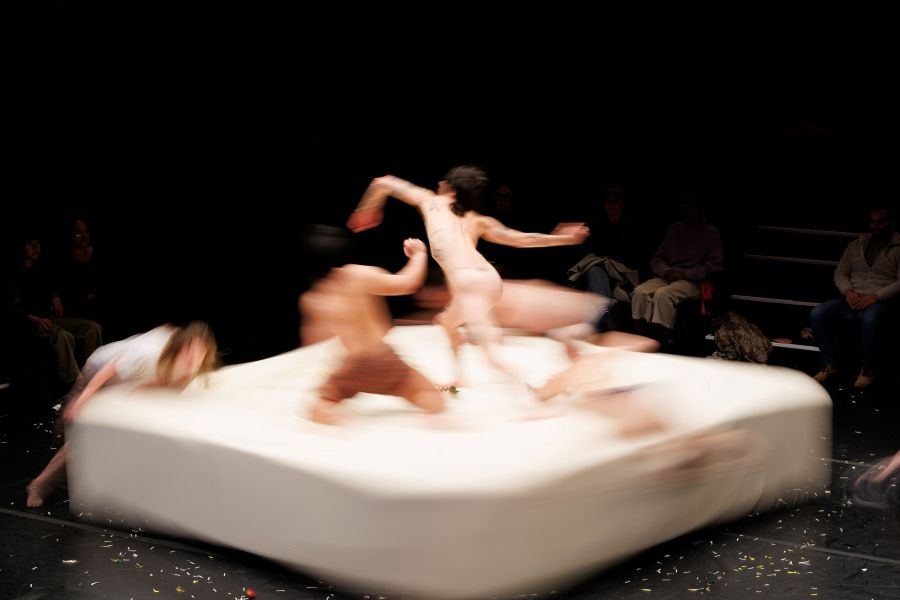
My next curated offering was Faye Driscoll’s Weathering, performed in FringeArts’ 300-seat theatre. It’s a shape-shifting beast of performance, dance, theatre, and endurance that has continued rattling in my bones since I saw it.
Indeed, the last time I was this shocked senseless was when I saw Kent Monkman’s epic painting mistikôsiwak in the main lobby of the Metropolitan Museum. Driscoll does with movement what Monkman does with paint: bold anachronisms within rigorous formal composition. Is this how it felt to be one of the first to witness Pina Bausch’s Rite of Spring? Where Bausch brought audiences into fearsome empathy with a sacrificial victim, Weathering infects each of us with that same primordial dread.
The dancers share barely perceptible micromovements across a groaning, mattress-like platform. But this is the Fringe, so the audience isn’t spared scrutiny: We sit on all four sides, fully visible to the performers and one another. Toggling my focus between performer and audience, I caught impressions of shock, frustration, boredom, and reverence, all in witness to a sustained feat of endurance—a living sculpture.
Gestures accumulate: Spritzes of clove-scented water hit us once, twice, again, in some secret sequence. Driscoll actively participates in the piece, in a way I felt certain was improvised—until I returned the next day and watched it unfold with identical precision.
The piece loses nothing on repeat. If anything, it passed too quickly the second time around. I was moved to tears when one dancer left bite marks on another’s side, precisely along the bruised outline of the bite marks from the performance the night before.
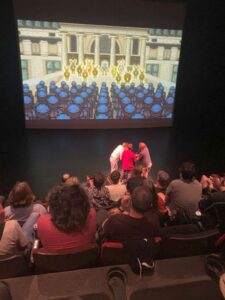
To round out my sample of FringeArts selections, I committed to asses.masses: nine hours of participatory video game theatre, a phrase I never imagined writing. The Fringe has a sense of humor, I’ll give them that: Though performed in the same venue as Weathering, in asses.masses, audience members are the ones performing the endurance test.
The show, designed by an international team led by Patrick Blenkarn and Milton Lim, bills itself as an interactive video game about unemployed donkeys organizing for labor rights. For my part, I would describe it as a nine-hour experiment in whether people who carry tote bags can maintain revolutionary fervor longer than it takes for their parking meter to expire.
The beauty of asses.masses lies in its refusal to explain itself. We received no instructions beyond, “This is interactive.” The nine-hour commitment was daunting, even with four intermissions and the included meals.
During my brief stint at the controller, the game’s two-dimensional Stardew Valley-esque graphics suddenly exploded into 3D, Grand Theft Auto-style realism. The subsequent gameplay had such joystick sensitivity that I developed sudden and embarrassing motion sickness. I retreated to the lobby and went cheeks-full-chipmunk-style on the complimentary popcorn.
Even from the cheap seats, asses.masses allowed me to observe makeshift democracy in action. I watched strangers negotiate power, time, and narrative agency with the same earnest effort the donkeys were using to organize their labor revolt on screen.
Intermissions stretched as long as we collectively allowed. Conversation flowed naturally between attendees. Should we chase the game’s Easter eggs for more details? Stay focused to finish as quickly as possible? Will it ever even be over?
Bleary-eyed, we filed back into the theatre. New systems organically emerged. There was a handwritten list of audience members who wanted to play, informal time limits, gentle peer pressure. At some point, audience members began voicing the different characters. As you can imagine, we took turns. The crowd demonstrated remarkable consistency of voice for different characters. We defined our own intersubjective myths, performance existing only because we collectively enabled it. We poor players constructed the world.
Theatre that demands we surrender entire days is a radical alternative to our hyperaccelerated culture. Durational works don’t just ask audiences to slow down; as Kate Kremer put it in a HowlRound essay, they ask, “What conditions make life unlivable? And do those paradoxically heighten one’s sense of aliveness?”
A Visit to Clown Town
By my third day at the Fringe, I had ditched my established itinerary completely and surrendered to my favorite implement in the critic’s toolbox: peer pressure. These forces brought me to a humble weekday 9:30 p.m. performance at the Louis Bluver Theatre at the Drake, the smaller of two theatre spaces built and operated by InterAct Theatre Company. (The Drake is one of four venues presenting programming for the Cannonball hub of the Fringe.)
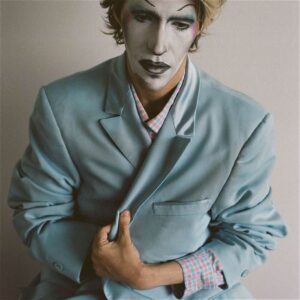
I was there to see some Nepobaby Psychodrama. The premise: Playwright/performer Jacob Peter Kovner (a real-life scion of a billionaire) stages a Freudian therapy session/humiliation ritual for his grotesque clown alter ego to exorcise his privilege. The audience is cast as his abusive rich family, forced to chant, “You’re a disappointment!” and “This isn’t real art!” as he indulges in exquisite self-flagellation.
Kovner slithers through the audience in a sewer-green carapace studded with cash, babyishly begging, “Pay? Payyyyy? PAY!” He implores the audience to peel off the very real dollar bills glued to his costumes—hundreds, maybe thousands of them.
It’s uncomfortable, funny, and perversely generous. Trauma becomes literal currency. What might seem like self-indulgence plays instead as campy Theatre of Cruelty.
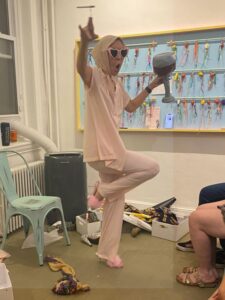
If only I had some of that cash on hand when I attended Haute Glue by surrealist clown and local genius Rose Luardo. Everything in Fairmont House Gallery was for sale: silicone boobs for $50, a giant crab couch for a thousand, prawn pillows priced per shrimp.
A small gallery in the Northern Liberties, Fairmont House describes itself as a home for the “multi-passionate, multi-disciplinary creatives” of Philadelphia. Opening night packed the gallery wall to wall, with crowds spilling into the street. In the tiny, unpopulated back corner of the gallery, now the stage, Luardo stripped to nude stockings and put on some massive, jiggling silicone breasts. With her mastery of these mammaries, she proceeded to motorboat lucky members of the audience. Then she cycled through the extremities of womanhood just to make us crack: mothers, ballerinas, Philly oldheads railing against South Street gentrification, a film star ever so slightly suck-suck-suckling a cigarette.
At some point she blessed the crowd with scented water—redolent, in every sense, of Weathering. An apotheosis of shoestring maximalism.

Daniel Maseda’s Be Good! With Paulette is a solo character comedy hour built on a flexible premise: a performer avoiding the stage on which he’s supposed to perform. Maseda’s overly polite, malapropism-prone Paulette recalls Mr. Bean’s bumbling physicality, while his dark punchlines catch audiences off guard like an early John Mulaney. He sent the 5-year-olds in our audience into rollicking giggles. Given its success in Philadelphia, Edinburgh, and D.C., don’t be surprised if Be Good! comes to a city near you.
And here I was thinking these three shows had pushed the limits of clowning. But with clowning, the limit does not exist. If I was a virgin to clowning before my arrival, I left Clowncuterie the whore of Babylon.
Alex Tatarsky was begging to get slapped. She taunted the grey-haired, middled-aged man seated in the fold-out chair directly behind me. After all, he had just been slapping her ass pretty hard. Alex/the-clown-that-is-Alex spoke like a scared, sexy baby, pouting “Pretend my face is my ass, like my ass cheeks are my face cheeks, and, like, hit my face like you hit my ass!”
The middle-aged man gamely tapped her on both cheeks. That wasn’t enough to satisfy this hungry clown. “There’s literally, like, industry people here! Do you think they’re convinced by that?! Hit me! Actually hit me.”
It felt like minutes, though it was probably seconds—stress and the scent of expired sardines had muddled my sense of time—and then the man acquiesced. SLAP! Tatarsky screeched and recoiled: “How could you?!”
Choking with laughter, I tried to come up for clean air but the room was thick with the scent of sardine brine, B.O., and Doritos. Has something ever been so funny it made you feel sick? Was I going to pee or vomit? I had a strange feeling that both would be encouraged.
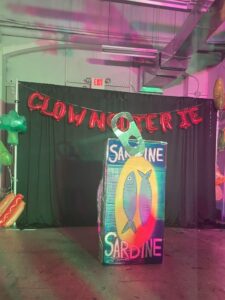
Bodily functions aside, it was a full circle moment. Diep Tran opened her 2017 report on the Philadelphia Fringe Festival for American Theatre with a review on Tatarsky’s one-woman show Americana Psychobabble. Many have written about Tatarsky; I’ve wanted to be one of them for years.
Tears ran down her face (her tears were fake) and mine (mine were real, and from laughter). “I was trying to write a grant application”—now she was in a panic—“but I couldn’t because my fingers were hot dogs!” She bit down on her hot dog-fingers, soaked in ketchup and tears. This was all before she assembled a peanut butter and jelly sandwich directly on her hair. Her set was around 15 minutes.
Many more Philadelphia clowns shared food-inspired work at Clowncuterie. Alyse James’s clown, Chris Fartley—again, a series of words I never thought I’d type—offered a bizarre multimedia sensory overload I’m still not sure was even comedy. It felt like Hugo Ball’s Dadaist poetry reborn via TikTok and spat out via clown. (James Gentile did the videography and audio for the piece.) Then Francesca Montanile Lyons fed me chips and performed an abortion on a bag of Doritos. Wet Betty, Kayo Kenshin, and Caresse Deville delivered sexy, drag-inflected sets: spaghetti lapdances, costume flashes, music medleys. Finally, the evening’s host, Queen Conch, delivered the only finale that could be appropriate for an evening of such grotesque gastronomic Gesamtkunstwerken: a burlesque number as a sardine.
These clowns have ruined traditional theatre for me. Now I know there’s this other art form where someone can build an entire piece around you on the spot. Degradation and transcendence can be the same thing. The audience can be the show. I don’t know how to go back to sitting politely in the dark after watching someone sing through mouthfuls of tinned fish.
Participation Trophy
Asking the audience to participate during a performance can complicate the perceived hierarchy between the performer and audience. But this can also create hierarchies within audiences themselves.
To put it simply: “Participatory” can quickly become “Men Talking.” I noticed this dynamic again and again across independent offerings with male lead artists, and even during asses.masses. In the first hour, nearly all the characters on-screen were being voiced by male members of the audience. But the unstructured participation of the video game meant we all held full responsibility for all individual and collective choices. Attempts to adjust audience behavior would have undermined asses.masses’ central themes, though I can’t say the same for all the participatory work I saw. But the juice is worth the squeeze. I’ll take the risk of being mainsplained over obligatory silence in a heartbeat.
Furthermore, the participatory nature of so much of what I experienced wasn’t just an artistic choice—it was economic necessity. When you can’t afford elaborate sets or massive casts, you make the audience do the work. This constraint creates something more valuable than spectacle: genuine connection.
I felt this connection with some Pig Iron students I befriended. I was driven all over the city in a clown’s car—different from a clown car, but not by much. To make room for me to hitch a ride in the backseat, two life-sized skeletons, a rubber chicken, a large papier-mâché cigarette, an inflatable pool toy, a set of oversized styrofoam dice, and (of course) red nose all had to be extricated from the backseat of the tiny sedan.
It was as funny as a dozen circus clowns emerging from a miniature buggy. In both premises, our expectations of a mundane situation are subverted with an absurdity of too-muchess.
Philadelphia Fringe is like a clown car, and not only because it is chock full of clowns. The festival offers audiences abundance in a time of scarcity. It’s time to get audiences to see more performances that cost less instead of less performances that cost more. There’s always more space. I’ll happily ride in the trunk.
Pria Dahiya is a theatre director, critic, and video artist working in Washington, D.C., and Pittsburgh. She was a 2024 Critical Insight Fellow.