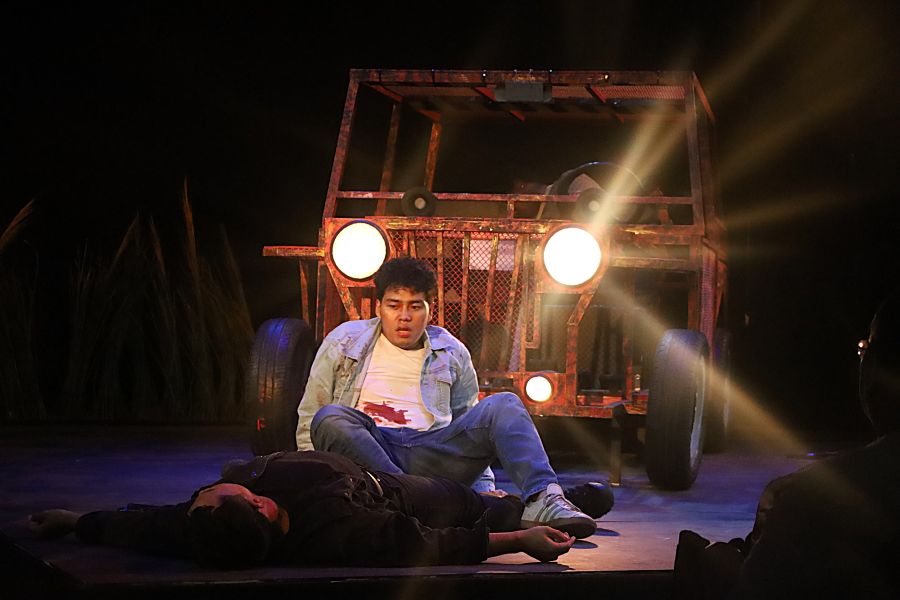
“Living overseas, I found myself in a position of being both an outsider and an insider,” observed Tokyo-based Filipino playwright Herlyn Alegre at the first session of the Playwright’s Fair at the Virgin Labfest (VLF). I sat on the third floor of the Tanghalang Ignacio Gimenez Black Box Theater with attentive attendees—many of them venturing into playwriting themselves—as Alegre described the physical, emotional, narrative, and critical distances she encountered in Japan and how they influenced her stories. With respect to her Filipino identity and relationships, she noted, “Writing for the Labfest helped me discover where I stand.”
Indeed, for Filipinos in the diaspora, watching the 15 works that unfolded at VLF’s 20th edition June 11-29 in Manila came with a sense of both familiarity and discovery: a bridge to the emotional landscapes of Filipino society and a creative space for sharing stories among distant homes.
Mounted by the Cultural Center of the Philippines (CCP), Tanghalang Pilipino (CCP’s resident theatre company), and Writer’s Bloc (an independent Philippine playwrights’ collective), VLF is an annual festival held in Manila during June that showcases “untried, untested, and unstaged one-act plays.” As festival co-founder and playwright Rody Vera described its origins: “The whole concept at the time was, don’t be afraid to fail.”
This year’s iteration included 12 new productions and three “best of” revivals from the previous year, in addition to staged readings, workshops on Philippine theatre craft, and fellowships in playwriting and dramaturgy. This year’s theme, “Hinog,” has appropriately multiple connotations. It literally means “ripe,” but, as festival co-director Tess Jamias explained, “It’s the end of a cycle, but also the beginning of a new one. It’s ripe for the picking, but also it’s also these seeds that start a new fruit.”
“In a way, this year is a celebration of the legacy of the Virgin Labfest,” shared co-director Marco Viaña, who also noted that of the 12 new plays, eight were from new VLF playwrights, the most they’ve had at once in their two decades of the festival. As restrictions from the pandemic lifted and the Philippines held elections, “There was a lot of misinformation, so we thought that theatre could be the antidote to that disinformation and misinformation.”
New works gave people a sense of hope, courage, and calls to action. As Tanghalang Pilipino artistic director Fernando Josef observed, “They’re looking back in history and figuring out what in Philippine history still happens today, and what might still happen if you don’t expose the ills.”

Take, for instance, Joshua So Lim’s medical drama Pagkapit sa Hangin (These Breathless Hands), remounted from last year’s VLF. At the height of the Covid Delta variant surge in the lone public hospital on an unnamed island, two nurses (sympathetically trepidatious Elora Espano and steely Wenah Nagales) and a doctor (a forceful Tim Castillo) must decide how to distribute limited oxygen to elderly patients. Director Jose Estrella brilliantly drew out the fear, exhaustion, ethical dilemmas, and anger of the caregivers in a way that reverberated beyond the island setting. I could easily imagine similar conversations taking place among Filipino nurses in the United States, where Filipinos make up 1 percent of the population yet comprise 4 percent of the nursing workforce—and where nearly a quarter of nurses who died from Covid complications were Filipino. Hearing the lilt and lyricism of the Filipino language in such a pressurized situation—as well as witnessing the stony silence of tampo, a cultural behavior akin to the silent treatment—felt like a glimpse into the Filipino condition beyond national borders.
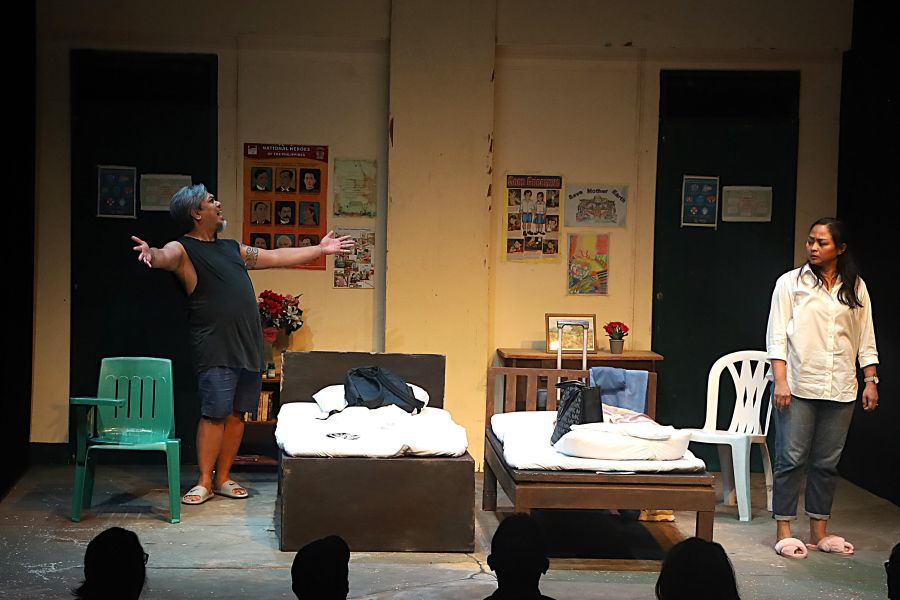
Rolin Migyuel Obina’s devastating The Late Mr. Real, also set during the early pandemic, featured a couple separated—both emotionally and physically—in adjacent hotel rooms that served as quarantine spaces. Yet with Maynard Manansala’s masterful direction and Wika Nadera’s simple and ingenious set of two beds pushed together, a physical wall wasn’t necessary to reveal the barriers between ex-husband Boyet (a playful yet tragic Roi Calilong) and ex-wife Raquel (a resolute Shé Maala) as they discussed the future of their teenage son: Would he stay in the Philippines with Boyet, or immigrate to Canada with Raquel? And how would this move shake this already fragile family?
It’s a familiar lived story among diasporic Filipinos, giving rise to the “1.5 generation” phenomenon of folks who immigrate before or during their early teens. This origin story was referenced in the two other Playwright’s Fair talks, which featured Filipino American theatre groups Bindlestiff, Circa Pintig, and Fil-Am Arts detailing their efforts to collaborate with VLF and cultivate Filipino theatre in their respective cities of San Francisco, Chicago, and Los Angeles.
“I hope we continue to center the lived experience of Filipinos here,” said actor Nic Feliciano during the Bindlestiff panel, “because we wouldn’t be thriving in the world without the values, struggles, and successes of Filipinos here. It’s a wonderful opportunity to honor and bring these stories back home to bridge the gap, and to remind everyone in the diaspora that we are only going to be as good as our kababayan [fellow Filipinos] here are.”
Indeed, Bindlestiff has been honoring and bringing stories of Filipino heritage and history to the United States—as well as translating and developing new plays—for 36 years, and in one of the few black box theatres remaining in San Francisco. In 2016, they launched their first Tagalog festival of plays from VLF, complete with English surtitles collectively translated by members of the Bay Area’s Filipino American community. They hosted two more bilingual festivals before the start of the pandemic, then continued virtual programming that blended Tagalog language classes and playwriting.
“We call it the epicenter of Filipino American theatre,” said Allan Manalo during the panel. Previously the managing and artistic director from 2008-12, he co-led the company with his wife, the late Joyce Juan-Manalo, a producer and designer originally from Manila (other panelists dubbed the Manalos “the most iconic love team”). Through Juan-Manalo’s work, Bindlestiff cultivated transnational relationships among VLF, theatre companies, and individual artists in the Philippines.
“Our community is hungry to hear about life here in the Philippines,” he added. “To hear voices of young modern Filipino playwrights is such a revelation for so many of us in the diaspora.”
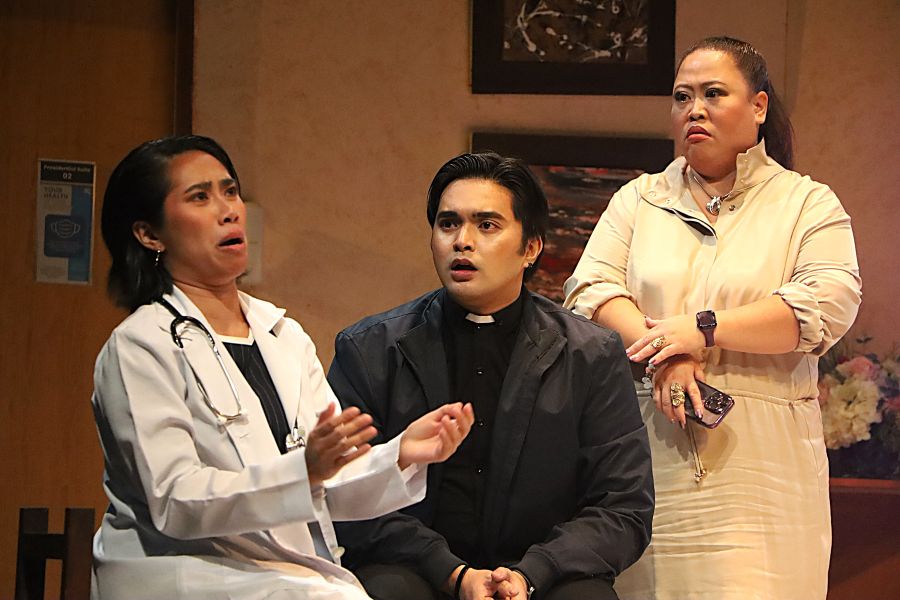
I certainly felt my hunger for Filipino theatre nourished. I howled at the antics of the political family in Siege Malvar’s Presidential Suite #2, directed with maximum hilarity by Johnnie Moran. In this scathing satire, a hospitalized senator’s adult children debate how their mother’s coma could make or break their political careers. And my skin crawled during Ivan Villacorta Gentolizo’s Unang Araw (First Day), tightly directed by Cholo Ledesma and inspired by the story of the Davao Death Squad under the Duterte administration. (It was especially timely given the spring arrest of the former Philippine president, and with whistleblowers now seeking asylum in the United States.)
I sympathized with the tensions among Filipino children and parents: Ryan Machado’s Don’t Meow for Me (Catriona) tackles caregiver syndrome and stress, especially when emigrating from the Philippines could mean a chance for a better life. Ade Valenzona’s Polar Coordinates wrestles with the difficulty of revealing one’s authentic self and dealing with outbursts from relatives, revealing Philippine values around shame, guilt, obedience, and romance. It’s telling when the most dramatic action in a play is a parent simply apologizing; I found myself close to tears on more than one occasion as I watched these Philippine family dynamics play out. Indeed, seeing these shows and more over the three weeks felt like rehydration—a restoration of personhood and community through art, humor, provocation, and beauty.
During the final Playwright’s Fair talk, “Mula sa Midwest Hanggang sa Westcoast: Teatrong Pinoy sa Chicago at Los Angeles,” director and playwright Giovanni Ortega gave an overview of Filipino American theatre that clarified the way Filipinos, like so many immigrants and displaced people who travel to the United States, were stripped of their humanity and reduced to labor. This theme was also emphasized in the staged reading of Allos: The Story of Carlos Bulosan, which focused on the Filipino American writer and activist known for his novel America Is in the Heart. Commissioned in 2011 by East West Players and initially a self-performed solo show, Allos appeared at VLF as a staged reading directed by Ortega but with Ian Segarra in the title role and Johnnie Moran, Nelsito Gomez, and Adrienne Vergara filling out the ensemble.
Both events sparked questions about Filipino and American identities, as well as perceptions of a growing divide between the diaspora in North America and those in the Philippines. Had Bulosan disavowed his Filipino identity and traded it in for an American one?
“Did he cast it off?” asked an audience member after the Allos reading. “At the end of the day, you’re American, so where is the Filipino? By declaring [an American identity], do you lose the Filipino [identity]?”
“Being a 1.5 immigrant,” Ortega answered, “I consider myself both.”
Ortega went on to explain a sentiment he had observed among other Filipino Americans, especially those born in the United States: “There’s this thing of not being Filipino enough, and also not American enough.” With regards to those feelings of division and insecurity, Ortega said, “The answer is to continue the conversation. It’s important to connect with the conversation, the call to action, and out of that discourse, ask, how can you collaborate? That’s where the magic happens.”
Those collaborations are already in motion, as evidenced with the reading co-produced by VLF and Circa Pintig. Ortega also announced that submissions for the second annual Chicago Filipino American Theater Festival will be open to anyone of Filipino descent to submit scripts in English and Philippine languages. Likewise, Bindlestiff announced the launch of the Joyce Juan-Manalo Scholarship, with $5,000 to be awarded for the next five years to Filipina American and Filipina theatremakers (rotating annually between artists in the United States and the Philippines).
Rody Vera also named language learning and translation as another way to connect. “One way to bridge the Filipino Filipinos and the Filipino Americans is in the language,” he said, “even if it has to go through subtitles.” Especially with interest from other Asian countries in both attending VLF and creating similar theatre festivals in their own countries, there is incentive for English-language availability.
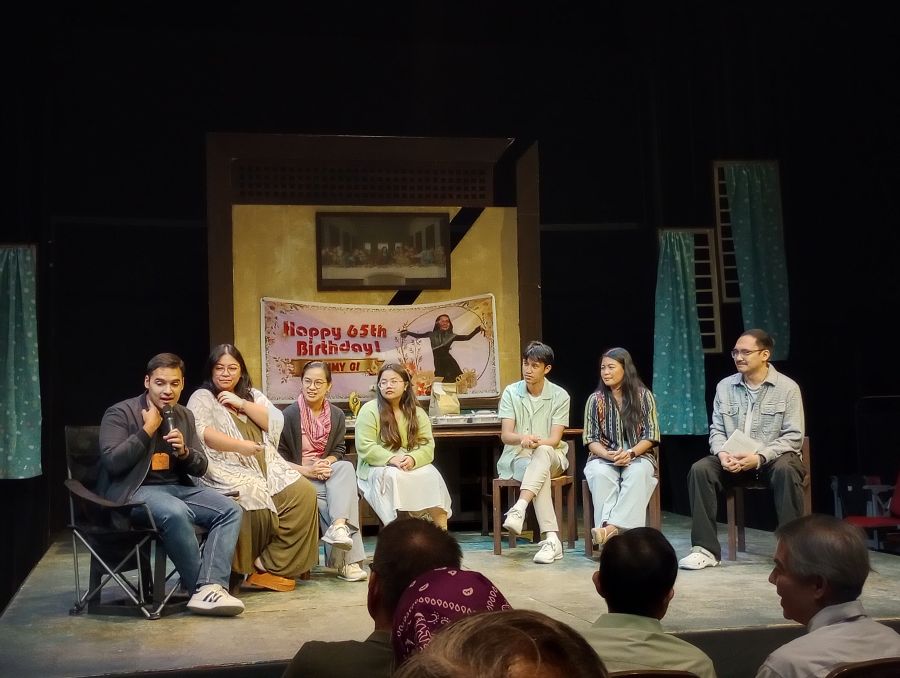
Simultaneously, VLF also champions the Filipino language and encourages other regional languages: Scripts submitted in English are given assistance to be translated into Filipino. Plays are also anthologized and published for greater accessibility.
Vera talked about an “informal movement of Filipino Americans trying to go to their roots,” and observed that while conducting an interview with a Filipino American for a creative project, “I came to the conclusion that the first thing he really needed to do was learn the language.”
In many ways, this feels in line with the ethos of Virgin Labfest, i.e., not being afraid of failure—indeed, having the courage to fail, all the better to eventually succeed. If there are feelings of inadequacy and insecurity, why not bring those to the theatre? Why not see these feelings through plays and process them through a rehearsal room? Through the uncertainty, what kind of beauty and presence might reveal itself?
My lasting image of VLF came from a small yet powerful moment. The Bindlestiff crew gathered on the third floor of Tanghalang Ignacio Gimenez, greeting and chatting with the staff and other attendees before their talk. One of them emerged from the crowd to embrace Allan, an old friend from decades ago. Their exhales of recognition and gratitude were palpable. Witnessing them close the space between them, I could feel my wish for the Filipino diaspora and the role of theatre between homelands: that regardless of decades and oceans, we could converge in one space to share a connection and be transformed.
You can submit for the Chicago Filipino American Theater Festival can be found here. Applications and information about the Joyce Juan Manalo Legacy Fund can be found here. Submissions to VLF for individuals with Filipino citizenship open in February; updates can be found here.
This project/research is supported by the Asian Cultural Council, whose mission is to advance international dialogue, understanding, and respect through cultural exchange activities in Asia and the United States.
Amanda L. Andrei is a playwright, literary translator, and theatre critic based in Los Angeles. She is also an Asian Cultural Council Fellow, 2024.