Immediacy is a core theatrical value, perhaps the supreme one: The irreducible live humanity of the art form puts nothing between performers and audiences but air. There are other kinds of immediacy, though, that theatre doesn’t always partake of: the sense that what’s happening onstage is real, literally unmediated (or close to it), and the sense that what’s being depicted on the stage has a direct relation to what’s going on in the world outside the theatre doors.
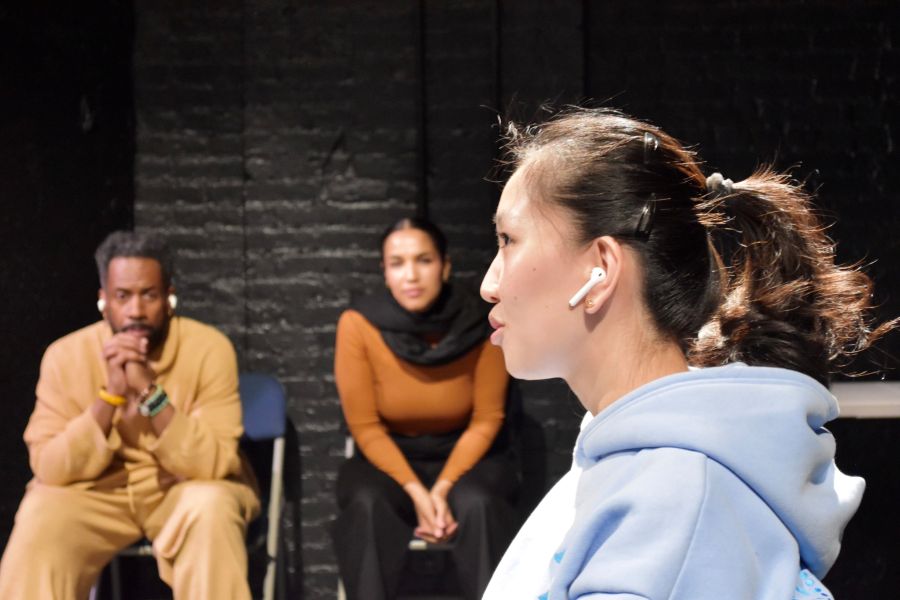
All three kinds of immediacy are on offer with the Verbatim Salon, a free monthly event that’s been popping up since the spring at New York City’s Theatre Row (the next one is tomorrow, Wednesday, July 16, at 7 p.m.). Using in-ear technology that feeds them recorded audio, actors sit on a simple stage and enact recent interviews about folks’ interactions with the U.S. immigration system: a longtime Afghan refugee who volunteered to become a translator during the U.S. war in her home country; a Mexican banker turned Vermont farm worker; a Ukrainian woman trying to get a foothold in America, where people may be “nice, but they’re not friends.”
The project of the American Playwriting Foundation (also the people behind the Relentless Award) originated with Scott Illingworth, a director and professor at NYU’s Tisch School of the Arts. He had earlier worked on a project about the war in Ukraine using the in-ear verbatim method, and, since last November’s election, was looking for a way to address one of the campaign’s—and the nation’s—most contested issues.

“I started thinking, we’re having very uncomplicated conversations about what it means to be an immigrant in the United States,” said Illingworth. To both contextualize and humanize the stories of actual immigrants, he thought the in-ear verbatim technique could be a way “to present, in a really simple way, these individual stories and have conversation with the audience about what they’re hearing and how it resonates with them.” Over time, this practice could “build up a kind of constellation of stories about what it means to be an immigrant in the United States in the 21st century. Those stories would be provocative and internally contradictory, and would ultimately lead to something quite vast and much more complicated than the way we’re tending to talk about this subject.”
At the salon I attended in June, actor Kyle Cameron played the aforementioned Ukrainian woman with disarming openness, and Camila Moreno gave the moving testimony of that Mexican banker-turned-farm worker. In a high-wire duet that had the tense excitement of a chase scene, Anzi DeBenedetto played a young Chinese immigrant talking about his experiences navigating both the authoritarianism of his home country and the vagaries of the H1B visa lottery in the U.S.; he performed his subject’s speeches in their original Mandarin, while Dela Meskienyar played his somewhat harried English interpreter. It was riveting, and revealing, theatre on a subject that was on everyone’s mind, as the occupation of L.A. had begun the week before amid a flurry of nationwide reports of violent ICE raids, illegal kidnappings and detentions, and worse.
David Bar Katz, American Playwriting Foundation’s founding artistic director, admitted some initial skepticism about the in-ear verbatim approach when it was proposed. Then he saw it in action.
“Having the experience of this kind of occult séance, of a real person being channeled in real time, where the words and spirit of another person are somehow present in the room with the audience and the actor—I was blown away,” Katz recalled. “It’s such a special way of addressing these issues going on, and it’s pure theatre.”
Katz confessed a familiar distaste for most political theatre: “It usually sucks when it’s written with the idea, ‘Oh my God, we’ve got to write something about Trump and fascism.’” By contrast, the work of the Verbatim Salon, he said, is “so organic and in a way simple, yet the complexity of what’s happening onstage is so theatrical, and again, almost supernatural.”
Many of the interviews are conducted by Illingworth himself in the New York area, but some have been done by the actors themselves and have ranged as far as California for their sources. (Those sources, by the way, are kept scrupulously anonymous for their own protection; the original audio tracks are even stored in an overseas server.) Illingworth edits them all to roughly 15-minute excerpts, in a process that Katz affirmed “is a kind of playwriting.” Said Illingworth, “I’m trying very hard not to edit internally when I can avoid it; I try to preserve stretches of things, including pause length,” though occasionally an actor will ask him to create a transition between what feel like clear edits. Illingworth uses a program called Descript, in which edits to the transcribed text automatically edit the audio as well; he credits playwright Lucas Hnath, who used Descript to create Dana H., for turning him onto this time-saving tool. This nimble set-up allows interviews to hit the stage within weeks (for the theatre, that’s basically immediately).
Though the in-ear technology is a new wrinkle that makes both that quick turnaround and a kind of hyper-real transmission of voices possible, this work is grounded in a tradition that includes docutheatre like Tectonic’s The Laramie Project, the verbatim theatre of the Civilians, and the meticulous interview reconstructions of Anna Deavere Smith. Illingworth cited another giant, Studs Terkel, whose Hard Times: An Oral History of the Great Depression, inspired Illingworth as an example of “what it means to document a time.”
Along those lines, I was struck at the June event not only by the first-rate work onstage but by the thoughtful, searching discussion that ensued among the audience, led by the evening’s facilitator, Dela Meskienyar, after each excerpt. One person mused about how the Chinese tech worker’s clear-eyed recollection of the “white paper” protests against strict Covid restrictions in China made him wonder about the relative efficacy of protest in the U.S. Another, an international student, talked about how unwelcome she’s been made to feel except to the extent that she can afford college. “They’re happy to take my money, but they don’t want me here,” she said.
While no admission is charged, every salon audience is encouraged to donate to the evening’s featured organization (tomorrow night’s is the Center for Constitutional Rights; June’s was Catholic Charities Immigrant and Refugee Services). “It’s a kind of civic conversation and exercise,” said Anna O’Donoghue, the foundation’s literary manager and artistic producer.
Have any of the original subjects of these interviews attended the salon, I wondered? Some have, Illingworth told me. He recalled one “Dreamer” story in particular. The interview—with a person who was brought to the U.S. at age 6 but didn’t find out they were undocumented until they were in high school—was so long and complex that Illingworth split it into two 15-minute sections, each performed by a different actor, with a discussion between them. That Dreamer came to the salon to watch it, but he did not come alone.
“He had never said some of the things to his parents that he talked about in the interview with me,” Illingworth recalled. “So he invited his parents to the salon to see his story be told by somebody else. He felt like it was a way for them to hear the things he wanted them to hear.
“That is not something I would have imagined when we started it,” Illingworth continued. “But it’s become clear to me that there is a desire for space that feels safe and anonymous, where folks feel like someone else taking up the mantle of their voice gives them a voice they might feel afraid to have.”
I’ve seldom heard a better description of what theatre can do. Finding something that theatre can do at a time when even many of us with privilege feel powerless and fearful feels like an urgent—even immediate—necessity.
Rob Weinert-Kendt (he/him) is the editor-in-chief of American Theatre.