Adil Mansoor spoke with Caden Manson, director of multimedia ensemble Big Art Group and his grad school mentor at Carnegie Mellon (now Theatre Program director at Sarah Lawrence), about Amm(i)gone and its unique genesis.
CADEN MANSON: This project has so many unique elements and histories about it. I want to touch on some of those. I think the best place to start would be for you to talk about its development path.
ADIL MANSOOR: The idea started to crack open in 2018; I started to dream about the work in grad school. What I knew is that I read Antigone and it moved me, and I was convinced my mom would like it. I brought up the play to her, and she liked it beyond any scope of my imagination—like, she was so into it, and she was asking me questions, she was enlivened and excited. I think about that phone call all the time. I brought up to a classmate, “I think I want to do something around Antigone with my mom.” Sarah Lyons, my classmate, was like, “You must immediately start doing this.” It felt like this tiny snowball that has rolled all the way to 2025, and here we are.
It’s taken on so many iterations. It’s been a 15-minute piece in a classroom. It’s been experiments in a lab with other actors. It’s been a virtual production. It’s been a small suitcase show. Now it lives and breathes very much as a solo performance work where I contend with the artistic process my mom and I had in our attempt to translate Sophocles into Urdu.
I think the interesting part about this process is what you just said: the different iterations, and how they’ve moved among different economies and different communities. I wonder if you could speak a little bit more to that and how it unfolded.
The first memory that sparks is December 2018. As a cohort, we were going to the NPN, the National Performance Network Conference, in Pittsburgh. I remember our homework assignment was to do this one-minute pitch in front of 300 people. I was like, “I don’t have a pitch, I don’t want to do this.” And you were very much like, “Pitch Amm(i)gone.” I was not planning to move the work forward in that way. But I wrote the one-minute spiel and got up in the room, and I remember feeling the room change as I talked about it. I felt it, and I was like, “Oh, this feels cool. There’s something resonating here with a lot of folks. I need to pay attention.” That moment just kept going.
What was true, even at that stage, is that I kept having this problem—or not a problem, but a reality—that it felt easier to talk about the work than to make the work. That kept being true; I was like, I just want to talk about my mom and about Antigone. I didn’t know that you could just do that, that lecture performance had a history, and that many people have done versions of what I’m trying to do here. Slowly it became, like, “Oh, I can just talk about the dramaturgy of it.” That’s when it really became something special for me.
Two other milestones: Ben Pryor, who’s been producing the work in Pittsburgh since 2019, saw a 15-minute version in the Bronx, and his response was, “Adil, you are such a bad actor, but you are a great teacher, and you seem like a really thoughtful son. Stop pretending. Be the thing!” That’s when I gave up having a script. I had a two-page lesson plan and I had objectives: that the audience will fall in love with my mom, and that the audience will feel complicated about the love they have for my mom. Instead of anchor paintings, it was my mom’s voice and the Antigone text. So it entered this pedagogy place, which served it really well for a long time.
The last milestone came when all of a sudden theatres like Woolly Mammoth and Long Wharf and PlayCo were interested in the work—it makes sense, because it’s Antigone, right? It’s an access point that’s really open to a lot of different kinds of theatres, and it’s a theatre nerd play. But Woolly wanted me to share the work 30 times, with a six-performance-a-week schedule. I could not do a two-page lesson plan that’s 30 percent improvised every night; it just wasn’t sustainable. And this other thing was happening: Because it was improvised, and my life kept changing, there were moments where I wouldn’t live my life because I was afraid it would dramatically hurt the play. So that’s when we settled on: Let’s freeze the script in 2023 in terms of time. And let’s write a script. That was really hard, but now there is a script, and I have taken vocal classes. I’ve learned how to breathe, and now it lives in a script place that feels sustainable.
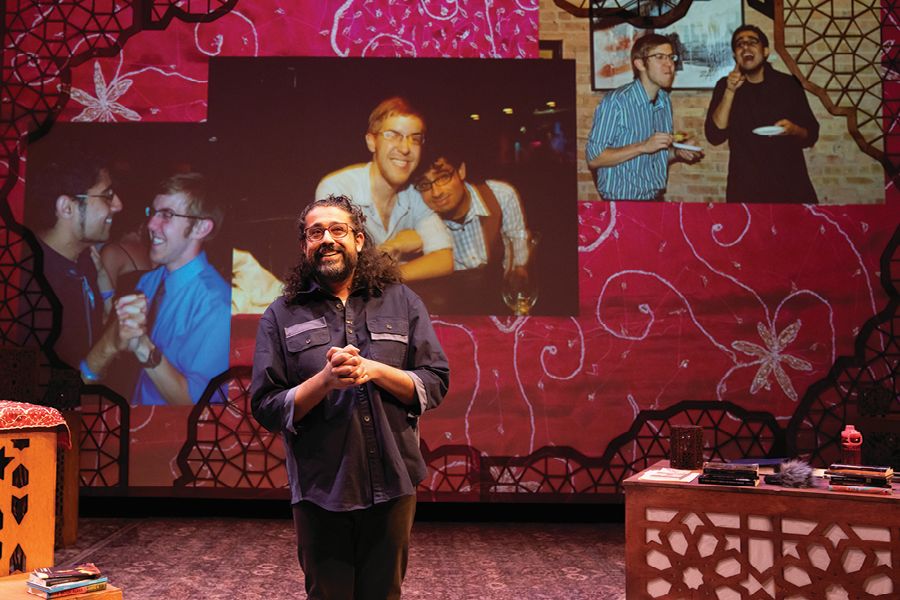
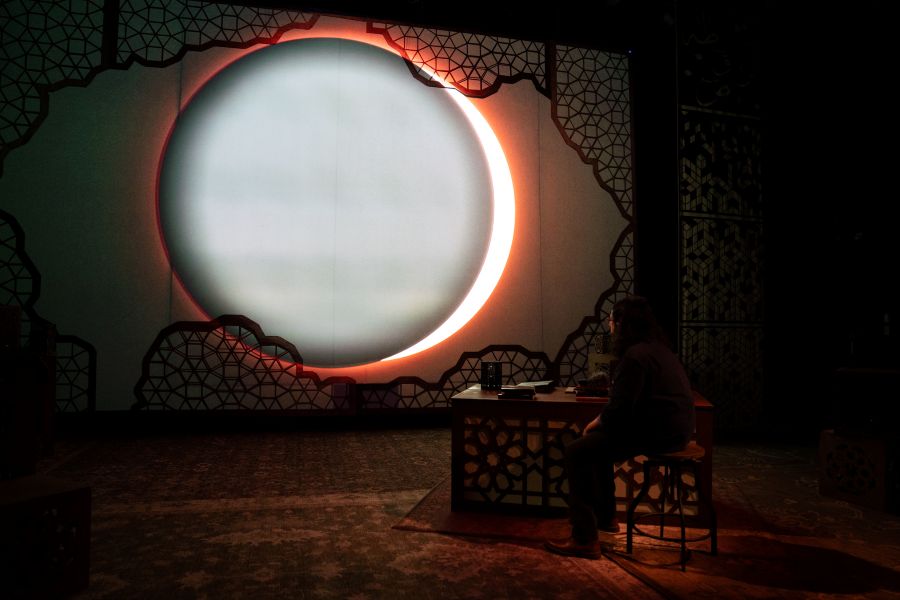
I can see how it thrives inside of a regional theatre system, and I can see how it thrives inside of the contemporary performance or touring artist world. It has this embodied presence of you, and this concrete documentary theatre approach to it. The politics of the body that’s being talked about is actually there in the space with you; it’s there inside the images and the video and the recorded sound, which is gorgeous. I also see it thriving inside of regional theatre because the story is so strong. The way it’s spoken about is evocative and uses the audience’s imagination; it does the thing that plays do, and it does the thing that post-dramatic work does at the same time. So this work straddles performing arts venues, regional theatre, educational spaces, and also, for lack of a better word, community spaces that aren’t directly connected to arts or theatre spaces.
Oh yeah. I think that’s about the ways these different institutions have brought audiences together, curating audiences for the work, in an exciting way. It’s really special when I get to share the work with Urdu-speaking audience members; there’s something so amazing about people getting to hear my mom’s joke and laugh at it in her language, instead of having to wait for me to translate it. That’s a magical moment. Every theatre I’ve worked with has had the intention of getting Urdu speakers in there, of getting BIPOC folks in there, Pakistani folks, Muslim folks. At the same time, it’s balancing, how do we also get queer folks and theatre nerds? How do we curate an audience at all those intersections and more?
In New York, PlayCo, the Flea, Woolly Mammoth and Kelly Strayhorn all partnered to bring the work to life. We converted a Flea dressing room into a prayer space, we had an Eid celebration, a queer Muslim playwright panel, and multiple drag shows. In partnership with all the theatres, Carolina Đỗ and Sher Jamal Stone, the community engagement team at PlayCo, did incredible work building programming around Amm(i)gone with care and rigor. This production has helped me understand how the piece can live its best life.
In Boston, The Theater Offensive, an organization centering queer and trans people of color, partnered with the Pao Arts Center in Chinatown to present the work during Pride weekend. Amm(i)gone sits right in the intersection of all those communities. The national tour is being co-produced by Kelly Strayhorn Theater, a Black and queer contemporary performance presenter in Pittsburgh; Woolly Mammoth in D.C., a nationally celebrated theatre which presents all kinds of work, often experimental, but usually scripted; and PlayCo, an Off-Broadway company specializing in translation and global theatre. Those three companies coming together, with different missions, have all found home in this one text. Watching these three companies figure out how to work together has been pretty special, and I think this kind of mutual aid collaboration is one of the ways forward for our field. There is something powerful about museums and theatres and gay clubs and high schools all partnering together to bring this play to life.
What are some of the lessons you’ve learned in that collaboration process?
All of the institutions we’re working with think about contracting and human resources very differently. Just the way artists are contracted, how resources are allocated, is really different in New York than it is anywhere else, and it’s really different for a presenting touring company than for a producing regional theatre company. It’s not like one is better than the other—they’re just different models. What seems to be true, at least in this one example, is that because all three companies have an ethic, and they deeply care about the artists, they’re looking at all their models to figure out, what’s the best model for this group of people? We keep breaking the mold, because we don’t fit anywhere. The design team has been with the show the whole time, as has Lyam B. Gabel, the co-director, who I met in graduate school in 2018. Joseph Amodei, one of the two media designers, was on the project in class. They’re the ones that helped me figure out what to do with my computer when I pulled it up in the classroom in 2018. Joseph and Lyam now have a baby, so there was a six-month-old in our rehearsal room. It is chosen family in the most incredible way, and that kind of team needs to be supported in a really specific way. It’s been really amazing to watch theatres confront their differences, and because everyone has an intention of care for the people, even when it’s hard, it leads to something that I feel really proud of.
That’s really exciting. It reminds me of the way, in the academy and universities and colleges, a lot of times there’s this conflict, a binary going on inside of the curriculum and the ethos, around the idea of traditional vs. experimental, playwright-driven vs. post-dramatic theatre, right? There’s always this fight. And in spaces where I’m chairing things, I’m always like, “I don’t understand what you mean by traditional or experimental.” I do understand economies—the economy of a new play vs. a sort of post-dramatic piece—and how those things develop and work. That is the conflict. How do we support our students who want to do a little bit of this, a little bit of that, or all one or all the other, and adjust the way we talk about space, money, time, and people to support those artists? I feel like your project brings it to the forefront for institutions to really grapple with and find solutions. How do we make a space for everyone and bring people together? Your practice is really robust; you do a lot of things, all around the same values and mission. I see you in educational spaces; I see you in new-play development, directing new plays or directing readings inside the regional theatre system. I see you in the contemporary performance space, in arts venues and touring venues, in social justice spaces. Can you talk about your practice?
It’s such a special gift to hear it back—to hear someone else share what they’re witnessing. I really feel seen and grateful. This was something that we talked about in school a lot. What are the questions that keep you awake at night? That was a prompt in our classroom all the time: What is making sleep impossible for you? The work isn’t trying to answer those questions; it’s trying to ask them. I also remember at one point being like, “Well, then, why theatre?” And I remember, this is how I left that conversation: It’s a specific tool set. We have a specific kind of obsession, where we spend a lot of time on something together. We know how to work collaboratively. We understand rehearsals that go for hours and hours and hours. We can go at the same verb 15 different ways. And the folks who are interested in that kind of making, coming together to ask a question together—that, to me, is the heart of it.
It’s almost cheesy, but a thing that I think about in my teaching all the time is: I never want to ask a question I know the answer to. I’m never going to ask you, “What year was that painting made in?” I can Google it; it doesn’t matter. But if I ask you, “Okay, that painting was made in the ’80s; what does knowing that do to the way we understand the work?” I don’t know the answer to that question; I don’t know how people are going to answer that question. That is fundamental to my teaching practice.
What is the space you’re trying to make with this piece? What is it doing?
I’m making a space for me to rehearse having a conversation with my mom that I have fantasized about for my entire life. I’m grateful to be in a room with anyone who has loved people with different beliefs from their own. If you’re able to articulate that you love someone across a difference, and that love is still really powerful, I’m really interested in how you make it to tomorrow. That is a space I’m excited to be in with people.
Just last night, we had a smaller house than we’ve had in a while, and everyone was leaning forward the whole time. It was a quieter audience, but just about to fall out of their chairs. Near the end of the show, I usually get emotional, but I had a coughing fit, so my energy was different, which is okay—and the audience leaned in even more. I had three people choking on their snot in the third row; at some point they looked at me and I went to wipe my tears, and they were like, “Us too!” They talked to me: “We need a break!” I just looked at them, and I broke from the script, and I was like, “I see you. We’re in this together. Let’s move through this.” Whatever that space was between me and those three people, I can’t totally articulate it. That was exciting. That felt like a place to be alive.
There are a lot of coming-out plays and movies and literature. I don’t think I’ve ever been to a not-coming-out play. You know, your play has an inciting incident, it has the catharsis, but it doesn’t have a resolution. How do you sit with that? And how do you help an audience sit with that?
I’m grateful to hear someone witness that. I tell the audience what the inciting incident is in the first three lines of the play, then the opening is character exposition—we learn about the characters, and then there’s a climax or event. The creative team still approached the event like we would with any other play. We talked about, okay, whose play is it? What’s changing? How do we design toward the moment of change? What transforms? And we’ve built our design with the event at the center, like any other play.
But, exactly as you’re saying, when other plays might head toward resolution, that’s not where we can go, because it’s my real life. And the questions I’m asking in the play are not resolved. Instead, where we go is: How do I walk off of this stage, go to my dressing room, change my clothes, go home, and go to bed? The last three moments of the show are set up for me to put myself back together with humor, softness, nostalgia, and spirituality. And I share that with the audience, hoping we can all sit in the hard feeling together, without falling into despair.
My favorite thing to hear after the show, when I spend time in the lobby with audience members, is when folks tell me how much they love my mom, like, “Oh my gosh, she’s a badass,” or, “She’s so smart,” or, “The musicality in her voice is beautiful.” That makes me so happy. The other thing is, I’ll walk out of the theatre and I’ll notice someone across the street calling their mom. We had this wonderful audience member, a queer parent, bring their sixth grader to the show a week ago, and the sixth grader and the parent were articulating how this was a moment for the sixth grader to understand their grandparents. That was next level.
What are you working on now? Can you talk about it?
I am in a lot of new-play development rooms right now. I just worked on Malaika Fernandes’s play Mulaqat, which is trilingual: Urdu, English, and Marathi all in one play. It’s so powerful, about three generations of South Asian folks and diaspora folks in America. I’m about to work on a play called Beige in America by Humaira Iqbal, a wonderful solo work about South Asian British experience in America. Another play I’m really excited about is Horsegirl & Cowdaddy by DJ Hills; it’s a tender rural story about a trans girl who’s never ridden a horse.
And then, I joke about it in the show, but I mean it: I’m trying to dream about a project about my father. My father died 10 years ago. I’d love to figure out how to collaborate with him. It’s just a bunch of messy ideas in my head, but someday I hope to make a play about and with my dad.
I have one more question before we wrap up. What is your wish for the American theatre?
I wish the American theatre would imagine all the ways it might stand in solidarity with people. I wish it would dream endlessly about supporting trans folks, immigrants, and the Palestinian people. I wish the American theatre would recognize its power to advocate for those pushed to the margins. I wish the American theatre would truly embrace its role in protest, in public memory, and in shaping change.