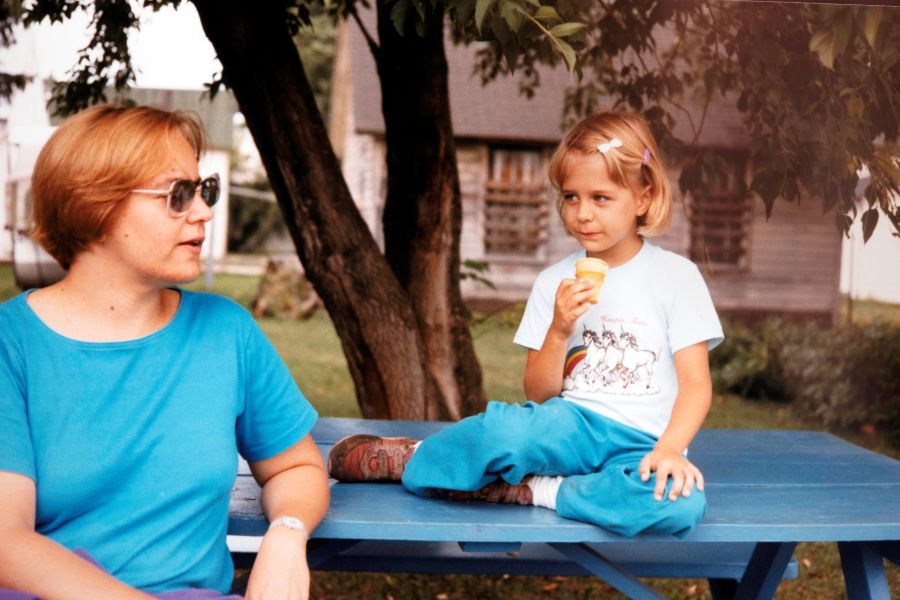
“Sing out, Louise!” my mom would call to me when I left the house in the morning. Not every day—that would have been a bit much. But if I had an audition or interview or a class presentation, she’d belt it out before the front door closed: an inside joke, a callback, a reminder to bring the pizazz. When I was in fourth grade, my mom had taken me to New York to see the Tyne Daly revival of Gypsy, my first Broadway show, and ever since that had been our shorthand. Naturally shy, unnaturally tall, I was Louise. Which meant she was Mama Rose.
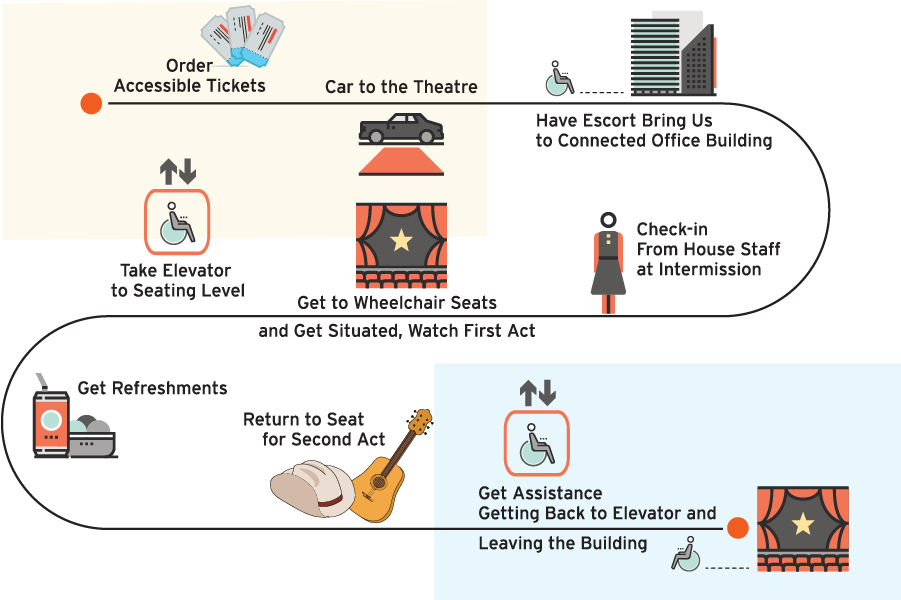
In 2022, I took my mom to The Music Man starring Hugh Jackman and Sutton Foster. By that point, the melanoma diagnosed in 2019 had moved into her brain. I’d known she had a fatal cancer diagnosis—that’s why the tickets were full price—but if I had understood that she’d be paralyzed on her left side by the date of the performance, I would have sprung for orchestra seats. As it was, she somehow got herself up the many carpeted stairs, despite half her body not working. My husband and my kids were there, too—it was my kids’ first Broadway show. And my mom’s last.
A fitting pair of shows for her—and me.
The Music Man, like Gypsy, is the story of a fast-talking showbiz hustler, and the rubes and chumps who fall under that hustler’s sway. Lovable and disreputable, Harold Hill and Mama Rose slyly walk off with anything not nailed down, while distracting their audiences through the power of patter and sequins. These are shows about shows, or, at least, shows about show business. Harold Hill and Mama Rose are not, themselves, performers—they bring forth the star power of, respectively, the bored youth of River City and a couple of girls who really should have been in middle school. Big talkers, bold schemers, undeterred by pesky concepts like propriety and legality, they dream so big that, by the end of both shows, their dreams have, improbably, become reality.
My mom was, to be clear, a government lawyer, not a petty con artist. But she often jumped into projects before figuring out the steps, trusting that a solution would emerge—call it the “Think System.” And she could talk just about anyone into just about anything.
Because of the metastasis that moved into the right side of her brain, the left side of her body basically stopped functioning in June 2022. She was repeatedly hospitalized over the next six months and had two brain surgeries to remove the cancer, but it kept growing back. The doctors seemed genuinely surprised by how aggressive and insistent the cancer was, but I wasn’t. My mom wasn’t going to create a half-assed disease.
While in the hospital, she had a bracelet on her wrist explaining that she was a “fall risk.” A neon sign above her bed proclaimed the same. Yet she was able, through the sheer power of her personality, to persuade multiple nurses that the signs were inaccurate and that she should be allowed to walk herself to the bathroom. They were all, somehow, shocked when she fell. “She was so confident,” they told me. She was.
These two musicals are also, I ought to mention, about fatherlessness. We learn in “If Momma Was Married” that Rose had a succession of husbands, but they never stayed in the picture long. Even Herbie can’t—won’t—hold on, despite being in love with her. Meanwhile, The Music Man’s Marian (the librarian) also has no father, though his death weighs heaviest on her ostracized, lisping little brother Winthrop.
(I will admit, watching Sutton Foster in the revival and doing a bit of mental math, it occurred to me for the first time that perhaps Marian might not have been Winthrop’s sister at all. She would hardly have been the first young woman in pre-birth control days to take a convenient trip and then hand her mother a newborn “sibling.” The Pick-a-Little Ladies harp on Marian’s alleged promiscuity; they’re judgmental, sure, but are they wrong?)
In any case, both shows take place in single-mother families. The absent fathers aren’t described deeply or known very well; what matters, to the kids now, is that the dads aren’t there. Watching Gypsy with my own single mother, in the era of Murphy Brown, meant seeing our situation depicted onstage with, if not positivity, at least honesty.
When I was in first grade, a few years before that first trip to New York, my father died suddenly. Afterwards, in a perverse memorial, my mom maintained a running display on our refrigerator of dire statistics, cut out from the newspaper, about the children of single mothers: less likely to graduate high school, more likely to use drugs. The clippings stood as a challenge to me, and a warning to any visitor: Whatever negative thing you’re thinking, we already said it out loud, so there. Let other people have their houses, their pets, their 2.5 kids and alive spouses. We had an apartment and a chip on each of our shoulders. As Mama Rose puts it, “Some people may get a thrill/Knitting sweaters and sitting still/But some people ain’t me!” Or, as my mom often said, “At least in the city, you get murdered by someone you don’t know.”
How much of that was bravado in the face of tragedy and how much was genuine non-conformist chutzpah, I’ll never know for certain. My mother became a widow at 37, a number that strikes me as younger each year that I exceed it. From that day on, it was just the two of us. Rather than wallow in grief, she chose brashness and glitter. The good times were just around the corner; the magic was there if you looked for it hard enough. Maybe a bunch of narrow-minded stick-in-the-muds couldn’t see it, but we could—right?
So I sang out. She told me to, and I did. Like gangly Louise and speech-impaired Winthrop, I was an odd child whom the other kids rightly recognized as weird even before my tragic loss. Also like Louise and Winthrop, my natural unease faded when performing onstage. Middle school plays led to high school plays led to college directing and improv led to playwriting led to screenwriting. A lifetime of singing out, one way or another.
❦
Last summer, I took my oldest daughter to see the Audra McDonald revival of Gypsy. Decades into my career, I laughed louder at the jokes about show business than anything. The relentless hustle, the constant shifting of what counts as a good gig, the willingness to do and try almost anything to stay afloat—all of it rang brutally true. Each pitch I try to sell, each draft I write, is another shot at the Orpheum Circuit; each failure a reminder that I probably didn’t work hard enough on my gimmick. Maybe next time, I’ll Zoom in a light-up bra. As for what my daughter thought of the show, I’m not sure. She enjoyed the performances, but did any of it remind her of me? Of her grandmother?
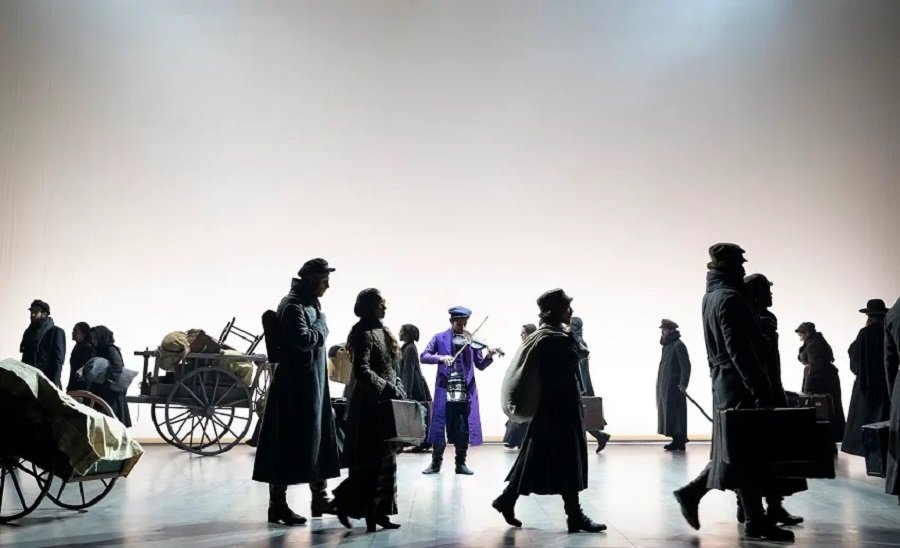
That was in June. In July, by an odd twist of fate, my younger daughter was performing as Mrs. Squires (a Pick-a-Little Lady) in our local children’s theatre production of The Music Man. The final moment of the show was all the more poignant in a church basement with no special effects. On Broadway, the children of River City were performed by a cadre of shiny-uniformed professional dancers. In a low-frills production, though, the transformation during the finale reprise of “Seventy-Six Trombones” is entirely where it should be: in the minds of the adoring parents, starstruck at seeing their kids onstage.
I thought, watching both productions, how mad I was that my mother wasn’t there to see them. How much she would have had to say, probably during the performances themselves, in a furtive whisper. She never got to hear my older daughter’s opinions about narrative and structure. She never got to watch my younger daughter sing and dance onstage. She would have had so much to say about all of it.
❦
After we saw The Music Man on Broadway, things got worse quickly for my mom. Between her two brain surgeries, I moved her from her chic apartment in Capitol Hill to an assisted living facility in the dreaded suburbs (the only one with a room available on extremely short notice). Despite her reluctance to move to Virginia, she, true to form, threw herself into the community with an impresario’s zeal. Appalled that there were no regularly scheduled trips to the library, she got them added to the schedule, mostly by acting as though they were already happening. The “Think System” again.
Her devotion to the sunniest possible interpretation of the available facts was a challenge during her illness. She refused to consent to hospice care, believing that somewhere out there was an experimental treatment that would turn the whole thing around. I finally brokered an in-person conversation with her, me, and her oncologist, forcing him to say in the bluntest possible terms that there were no treatments anywhere that could cure her. Seemingly convinced, she signed the hospice papers, allowing herself to be discharged from the hospital, so she could return to greater comfort in assisted living. But once the oncologist left the room, she turned to me and asked, “We’re getting a second opinion on that, right?”
One of the last conversations I had with my mom when she could still speak was in the hospital later that week (despite having the paperwork in order, transferring her back to assisted living took negotiating with multiple social workers and the ambulance team). She told me about her latest scheme: It was early December, and she had taken it upon herself to come up with the assisted living center’s holiday programming. One event would be a staged reading of A Christmas Carol, and she had decided that, to jazz it up, they should bring in a director from New York. She asked me for the names and contact information of directors I had gone to grad school with. This was days before the tumor rendered her fully paralyzed and incapable of speech. She would be dead before Christmas.
Gypsy ends, of course, with “Rose’s Turn,” the mother of all 11 o’clock numbers. Mama finally gets her moment in the spotlight after years spent in the background (or, at least, that’s her claim—it’s hardly the first showstopper the character sings).
My own mom—I realize now that I’ve neglected to mention her name, it was Ashley Doherty—worked hard to have enough going on in her life that her ego wasn’t entirely bound up in my success and failure. And she did this by putting on her own shows, up to the end, except for the show she couldn’t—wouldn’t—face. Every time I tried to talk to her about favorite hymns or Bible readings for her funeral service, quotes for a tombstone, she shut the conversation down. There was no need to plan for an event that plainly wouldn’t be happening, right?
So I’m left to construct the memorials as best I can without her input.
This time for her. For her. For her. For her. For me.
Dorothy Fortenberry is a screenwriter, playwright, and essayist. She lives with her family in Burbank, California.