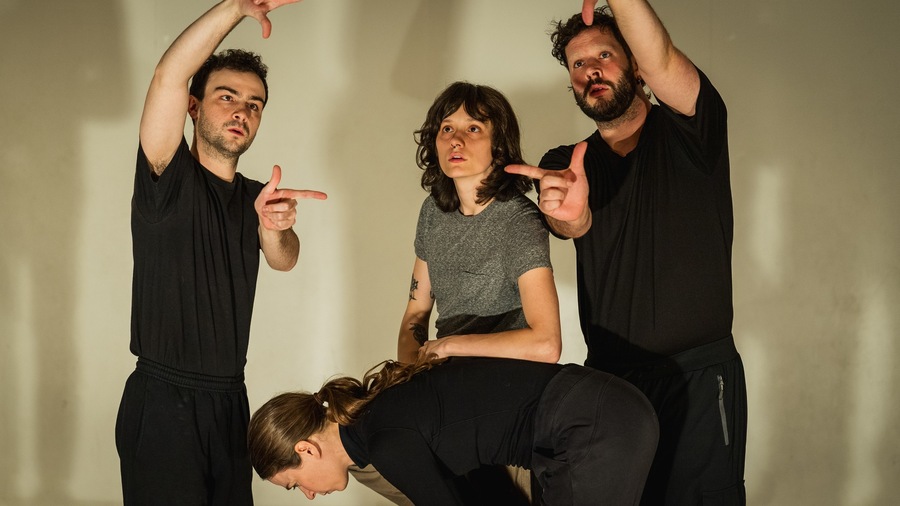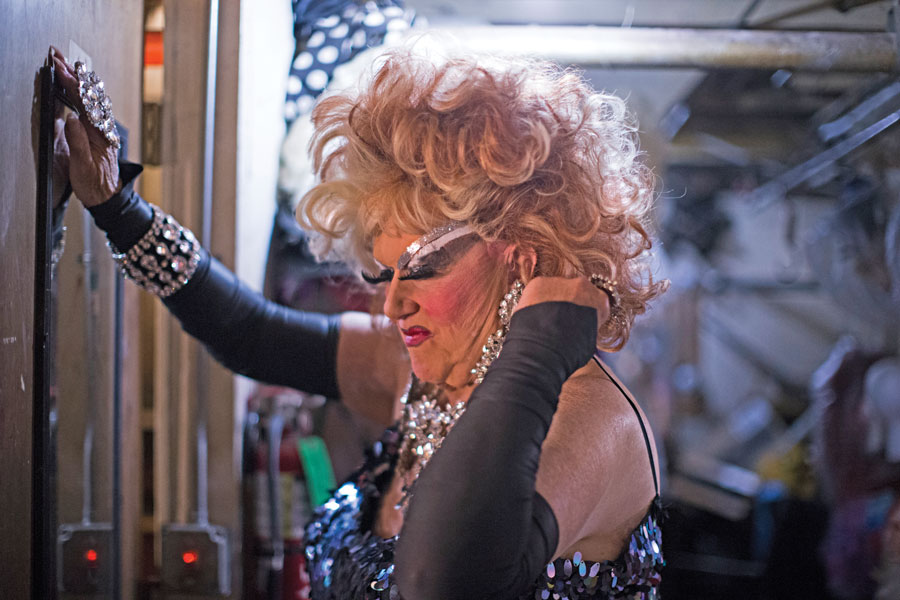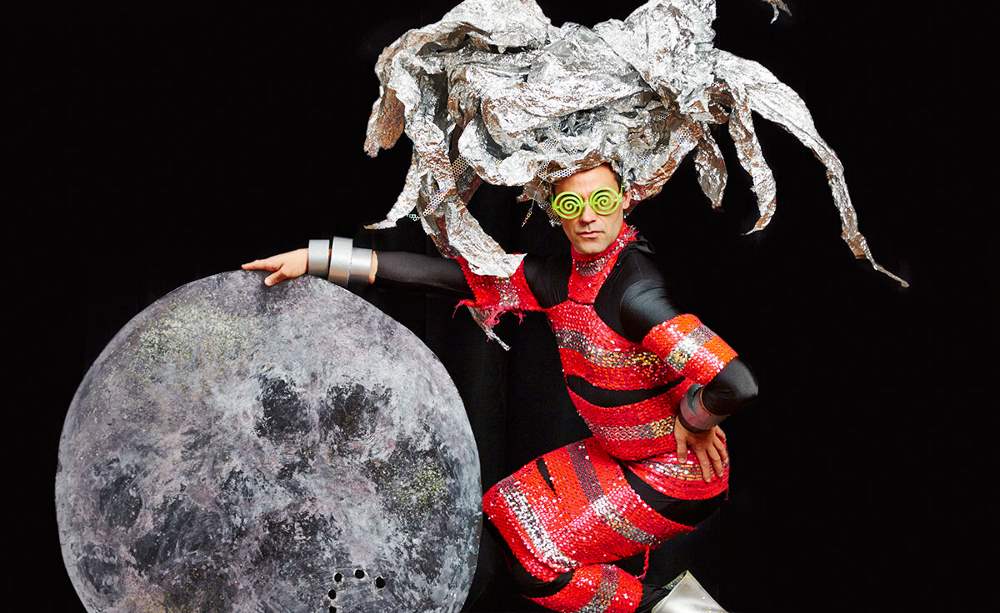
“Why are you called Pig Iron?” The simplest, and oldest, answer is that pig iron is the raw crude iron used to counterbalance scenery in theatre. It mixes something heavy with something light, something functional with something magical. After 10 years of telling the story like that to countless people, one time Dito said, “Oh, I thought it was because those two words sound funny together. And what they mean changes when you put them together. It’s a kind of alchemy. And that our plays are like that, unusual mixtures of unlikely things.”
That’s our alternate and fanciful origin story, courtesy of Dito, the poet, always finding a new layer underneath the obvious.
What is hardest for me right now is that Dito was my and our counterbalance. He was pig iron. He was heavy and light. He was simple and extravagant, a poet who dwells in interior spaces and a theatrical shapeshifter who comes alive in front of a crowd. He was Dito and Martha. He was a superstar and incredibly humble. He often bumped into things and we called him clumsy, but then he would do a backbend on a bar in heels while singing with everyone holding their breath and he would always come out unscathed. I thought he was invincible.
Dito and I met on our first day of college. We were roommates. I met his parents that day as we moved into our dorm. He seemed to know exactly what to do on that first day because he had been to the campus many times before, since his mother, the equally gracious and worldly Stephie, was an alum and he had come for reunions. He helped me adjust then, and he continued to do that for the next 36 years. We were roommates throughout the next four years and later sometimes shared a room, or even a bed, on a tour.
Somehow we decided not to audition for the same shows on campus, maybe so as not to compete for roles. He was not competitive in the least. At night we would each come home from a rehearsal and talk about what had happened, how the project was coming together, what someone said that was hilarious.
This conversation was ongoing and creative fuel for decades. Dito loved to talk shop, to get into the weeds of a process. And he knew when things got too intense and when the mood needed to lighten. We did a lot of silly voices, silly walks, jokes to make sure we didn’t take ourselves too seriously. But we sometimes did take ourselves seriously, and we knew that it mattered to make a play about a lost queer icon in Lorca who was killed by fascists just for being who he was. And it mattered to make a play about the thin membrane between life and death, sleeping and dreams. It mattered to evoke ghosts, to capture the moment when innocence is lost, to try to honor the trailblazing gay theatremakers who told themselves to live faster. It mattered to make a play about loss, about life cycles, about buying and selling and trying to understand, like a counterbalance, if this equals that, or if life is always teetering between being completely a mess and out of order to suddenly finding alignment, with everything in its just place.
In this unimaginable moment, Dito’s gift continues to remind us that he was a fulcrum, and that even when everything feels totally off-kilter, he would help bring it all back into balance.
Our senior year, Dan Rothenberg, Nate Read, Telory Arendell, Dito, and I, along with a string quartet, created a version of Cyrano that we called Cyrano for Two Quartets. Dito played Cyrano. Sometimes when a performer plays a role, it bleeds into their life; it blurs lines; it exists between one reality and another. Cyrano is a poet, so gifted with language. He is a lover, soaking everything in. He knows everything, sees everything, cuts to the truth. I played Christian, who knows nothing, is tongue-tied, needs help. This dynamic played out in 100 different ways over the next three decades.
Shortly after that production, we graduated. I was the graduation speaker—though it should have been Dito. Like Cyrano whispering lines to Christian, he helped figure out what I could say to speak directly to that moment of transition in our lives. I spoke about Swarthmore needing a mascot, about living under the canopy of an ancient tree and being held and enveloped in nature that would outlast us, about a classmate we’d lost that year and how to impossibly grapple with grief at a young age.
I proposed Puck from A Midsummer Night’s Dream as an apt mascot for Swarthmore, but I could have easily proposed Dito. Puck is quick-witted, mischievous, making things happen, bringing things together. Puck knows about alchemy. He enables lovers to meet, mixes them up, and rights the ship in the end. He elicits pleasure, indulges in fantasies, and makes sure the audience has a great time. Dito played Puck between me and my wife, Julie. He sang at our wedding. I blessed his rings as one of the attendants at his.
Dito left for New York after graduating to attend the Neighborhood Playhouse and the Martha Graham School of Dance. I left for Minneapolis to work with Theatre de la Jeune Lune. Dan stayed for his final year at Swarthmore. Suli started her sophomore year.
But there was a pull to work together, and thus Pig Iron was born, in the summer of 1995, with an adaptation of Homer’s Odyssey. We toured it to the Edinburgh Fringe. It was flawed. We all got food poisoning two days before our first performance and in the middle of tech. Dito and I fell out of a cab, crawled to our flat, and slept in the bed we shared on the floor of the living room for 24 hours. We opened. Six people attended. It went like that for a while until we received a surprisingly stellar, five-star review in The Scotsman. The next day, 85 people were there. Something was born, out of ropes and pulleys, creating and recreating what a body could mean, what a voice could express, and what world could be concocted that rhymed with the world we live in.
There are stories to tell about each of the projects, the residencies, the tours, the time in our living room offices trying to understand how to create a spreadsheet, and then our actual office reading and rereading a grant proposal before we submitted it. Dito was part of all of that. Our personal and professional lives intermingled; the lines were blurry. We wanted it that way. If our plays were about life, we drew from our shared life, not just from a shared rehearsal space. Dito was a thought partner, whispering brilliant ideas, as we launched our graduate school.
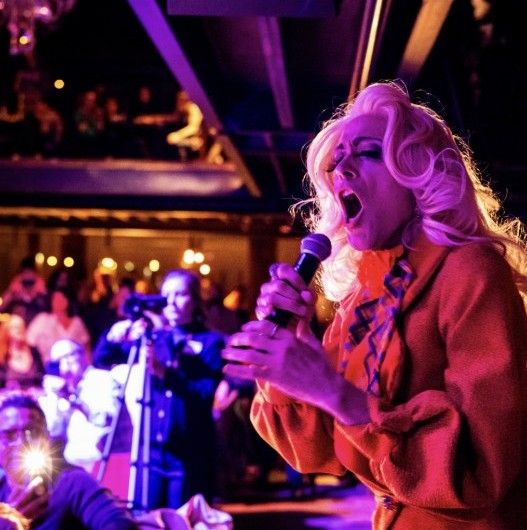
Dito reached a point where he wondered about his own balancing act. He felt he needed to do all of the administrative work in order to get to do the artistic work. Like he needed to earn that right somehow. But after 20 years running the company, he asked if he could take a new role and focus on a different equation. Martha Graham Cracker was a blazing fire at that point, and Dito felt that he wanted to spend more time performing and less time editing marketing emails or triple-checking board reports. And this meteor of a person radiated more, illuminated brighter, reached further.
Martha Graham Cracker, after years of channeling songs that others had written and allowing us to hear them in new ways, wrote and composed her own musical, Lashed But Not Leashed. Give it a listen; it’s brilliant and straight from Dito’s heart through Martha’s soul. He got to sing and perform in Heather Christian’s Oratorio for Living Things right after the pandemic and again last fall, another counterbalance. The piece is so intimate and so gigantic, with 12 singers bathing each audience in harmonies about every moment of life on our planet from the tiniest to the grandest. Dito could carry both extremes. During the pandemic, the songs of Aimee Mann whispered in his ear; two Cyranos, Aimee and Dito, living in the in-between and singing from their heartbreak. The result, Poor Judge, was a masterpiece that emerged from Aimee’s songs and Dito’s imagination.
We are left without an anchor, adrift, unable to find balance. The world feels impossible right now, but Dito brought everything into focus, quieting the noise and ushering in humor, presence, mischief, and humanity. The messy world was on one side of the seesaw, dragging us down, and Dito was on the other, helping us see our way out. Without him, I am listless, and a thousand hearts are broken.
Dito, an angel among mortals, a Puck, a Cyrano, space goddess, lanky terpsichore, humble giant, poet of words and pictures, friend, partner, goof, bosom buddy. You have left us and we now must face ourselves without your hairy arm to clutch, your mismatched eyes to gaze into, and your patient heart to let us be fully seen.
Quinn Bauriedel is a co-founder and co-artistic director of Pig Iron. He is also the director of the Pig Iron School and associate professor at Rowan University, helming the Pig Iron/Rowan Devised Performance MFA Program.