I remember sitting in my childhood bedroom, spinning in a white rolling chair, when I first learned about the Bermuda Triangle. At 11, I was watching the Jack Black adaptation of Gulliver’s Travels, where a mailroom clerk is swept into a storm through a stretch of ocean known for vanished planes, failed compasses, and sunken cities. The detail I couldn’t shake was that my home formed one of the Triangle’s three points.
I had long heard the tales that cast a subtle shimmer over Puerto Rico, the kind that made its being called La Isla del Encanto—the Island of Enchantment—feel instinctive: the soldier who vanished at La Garita del Diablo, the Taíno lover turned zumbador bird, and the dog of San Gerónimo turned to stone waiting. But this realization suggested that the source of our magic had been too narrowly understood: We existed, quite literally, as a coordinate of risk.
There is seduction in this volatility—not in possibility, but in anticipation itself, like the brief suspension before a drop tower falls, when the stomach turns cold. Puerto Ricans live close to that feeling: Families scatter and regroup, neighborhoods change names, the lights go out. It was a familiar sensation, one I recognized moving through Theatre Communications Group’s 2026 National Conference in San Juan, June 10-13, titled “Pa’lante: People Practice Power” —pa’lante, from “para adelante,” a phrase shaped in Puerto Rican self-determination movements and shorthand for “onward.” For the conference’s 34th edition, it brought together theatremakers and arts practitioners from across the country, marking two thresholds at once: its first bilingual iteration and its first conference held outside the continental U.S.
It was in the second-floor corridor of the Sheraton Convention Center Hotel & Casino that the gathering felt most itself: Artisans’ booths hung pointed vejigante masks—bright, horned—beside hand-painted Flamboyán flower ponchos. Small bottlecap trinkets bore hand-painted cursive spelling “Boricua,” and plush pillows of Nuestra Madre Reina and other saints were laid across display tables. Güiros and maracas were lifted and tested like babies shaking a new rattle, then set back down. First-name introductions rose over paper plates of churros, besitos de coco, and coffee thinned with milk.
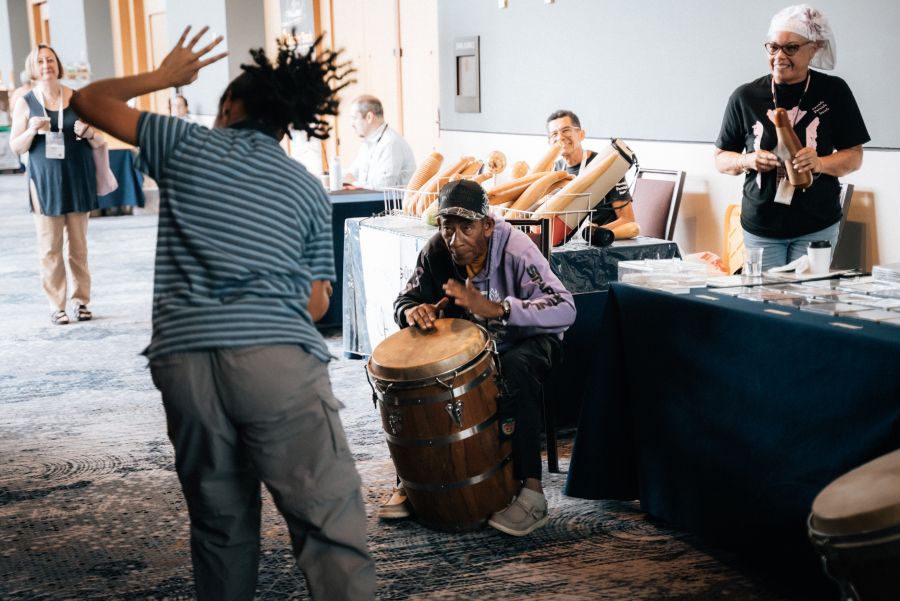
From above, it was a henhouse—English blending into Spanish, Spanish into English, Spanglish at its most fluid—side-to-side steps and murmured promises to reconvene later at nearby bar El Bori already forming. “Art Burst” performances cut instantly through the clucking: members of Tercera Llamada moved through the hall in full-body works, from a silver-dripped jíbaro to a Van Gogh drenched in Starry Night, followed by Majestad Negra dancers, who enticed the crowd into the main ballroom channeling the stomp and drum of Bomba.
Wearers of breezy knee-length dresses, plant-printed Hawaiian shirts, and flowing skirts settled into their seats, fanning their ID badges across their faces, as Melissa Santana, executive director of the Instituto de Cultura Puertorriqueña (ICP), opened the formal proceedings. She noted how TCG’s presence aligned with the institution’s work since 1955 to preserve and expand Puerto Rico’s cultural life.
“Your decision to come together here creates an opportunity for dialogue, mutual learning, and new relationships,” she said. “We hope this gathering strengthens connections between our artistic communities and opens paths for collaboration.”
Her words landed with the kind of care that made everything feel briefly adjusted—like the jolt that comes when you arrive at a table you had long wanted to be invited to, and realizing the scene is no longer a static image, one of mannequins holding forks and spoons, but a three-dimensional reality.
Edgar García, drama professor at the University of Puerto Rico, articulated what we had been reckoning with. “Sometimes you hear things like, ‘Oh, there’s so much water to get to Puerto Rico. Nothing can get there,’” he said. “These sayings subtly or overtly always point towards division…We have to do the opposite. We have to run the opposite way.”
The image he offered as a remedy was a bridge—not merely symbolic, but built to bear weight. Bent far enough, he said, this structure becomes a boomerang that returns what is sent outward.
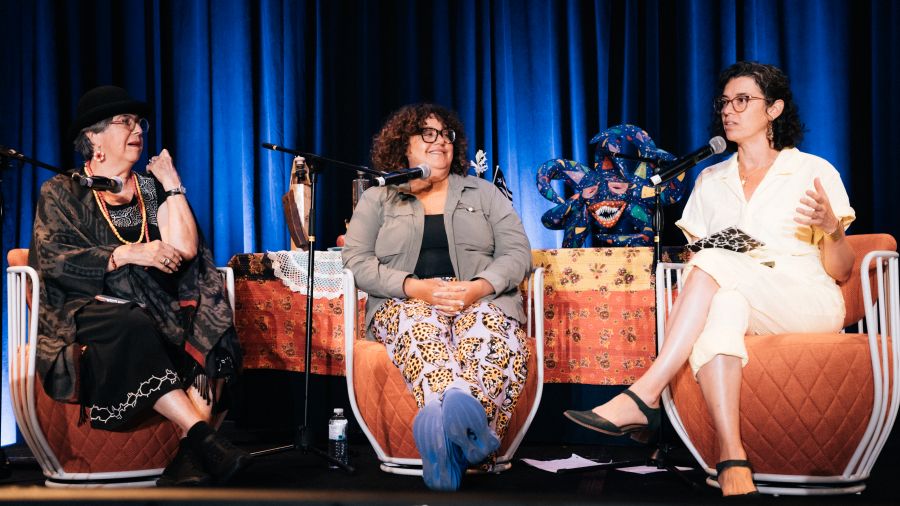
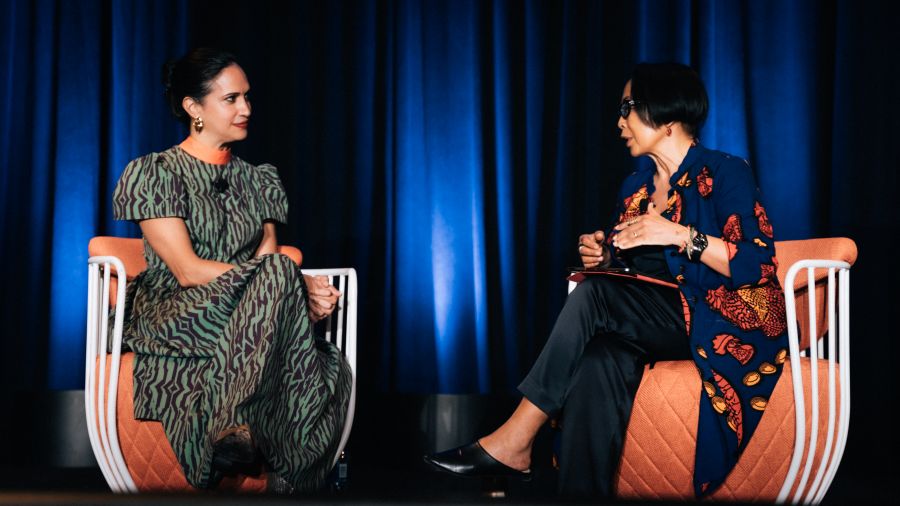
I had come to know that unyielding kind of solidarity before: in the Boricanos en la Luna who carry the island with them and return its voice enriched by distance. The speakers of the conference’s opening plenary were among them. For “In Conversation: Quiara Alegría Hudes with Elisa Bocanegra and Rosa Luisa Márquez,” the Pulitzer Prize-winning playwright (Hudes), the Puerto Rican theatremaker in the diaspora (Bocanegra), and the veteran drama professor (Márquez) traced the people, places, and moments that redirected their lives. For these three, theatre began less with ambition than with recognition: seeing Raúl Juliá on screen, or being babysat in the afternoons at Teatro Tapia, or encountering the work of Black and queer playwrights. They cited mentors like Black Lives Matter co-founder Patrisse Cullors and Brazilian theatre practitioner Augusto Boal as pointers to paths they could not yet see for themselves.
Bocanegra recalled arriving in Hollywood and being told she could be “the next Rosie Perez” if she lost weight—a comment that led her to drop her agent and step outside those expectations. Márquez called auditions “very cruel moments,” in which “you’re not allowed to be as complex as you are,” and argued for theatre being built through relationships: groups of friends, families, and chosen families gathering to say what they find most important.
When Hudes asked what had sustained them through decades of practice, the answers were simple: laughter, thinking about others, and, as Márquez added, “laughing while thinking of others.”
The session closed with Alegría reading an excerpt from her forthcoming play Menafee, inspired by the story of Corey Menafee, a custodial worker at Yale who one day shattered a stained-glass window depicting enslaved figures as an act of protest. Márquez followed with a musical number charting her career—the packing of a bag, securing an apprenticeship, leaving home—with the ease of someone who does not take herself too seriously, her arms stretching like a bird at full span as she took in her standing ovation.
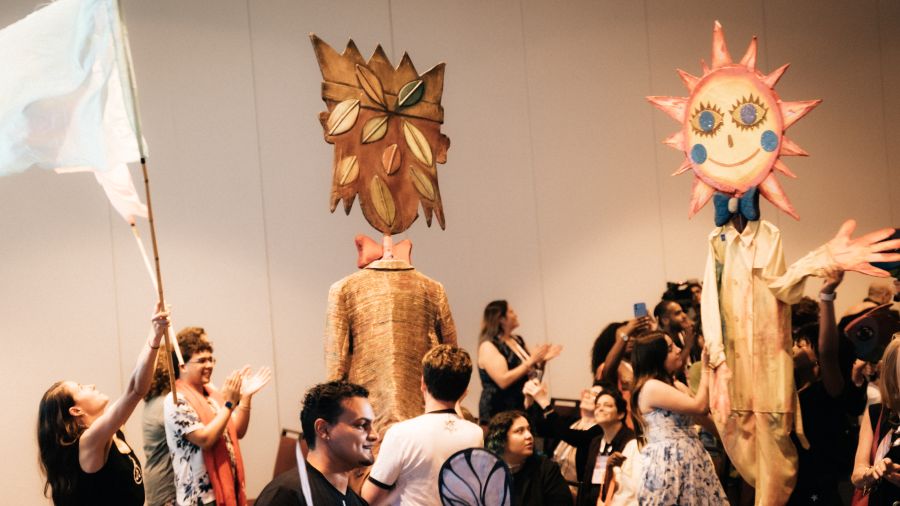
Unannounced, flags of turquoise, blue, and violet swept into the room. Then a sun-headed foam puppet in a yellow trench coat. Then blue-scaled fish figures on sticks. Propulsive drumming gave way to on-beat clapping as people placed their bags on their chairs and rose in childlike awe, as if pressed against a candy store window. Arte y Maña and Y no había luz collective had entered, their larger-than-life presence tipping the room into the conference’s first surge of life——one that would continue to swell into the opening night’s party at ICP Headquarters in Old San Juan.
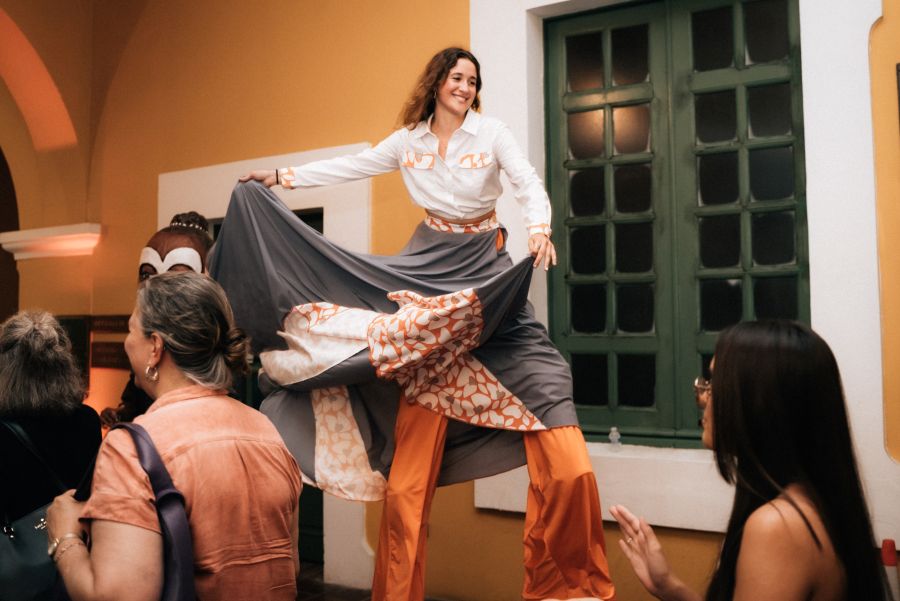
Agua, Sol y Sereno greeted guests on stilts, towering figures in motion, flicking their wrists as if shaking off water while the percussion around them rasped, scraped, shook. Inside the open-air courtyard, the line for rum drinks stretched like a caterpillar, held together only by the intermittent passing of plantain montaditos and ceviche. In the center, about 50 participants gathered in a loose circle of movement, bodies un-self-consciously pulsing to syncopated rhythms—locals and visitors alike—as if stepping over something small underfoot, flattening it without ever breaking stride.
It was the kind of wordless coordination that best-selling author Priya Parker would point to in the second-day plenary, “The Art of Gathering: Why Theatre’s Tools for Gathering Communities & Transforming Conflict Matter,” as she drew on advice from her mentor, conflict theorist Dr. Harold “Hal” Saunders. “Some communities,” she noted, “do not need more speech at all—only dance floors, soccer games, shared silence that does not rely on language.”
Raised between two opposing belief systems—her mother’s Indian, Buddhist, progressive household and her father’s white American evangelical Christianity—she came to see that human connection is strained less by disagreement than by the inability to “hold heat.”
“We believe conflict is sin,” she said, “so we’re actually avoiding the most important conversations we need to have with care and humor and grace.”
In her forthcoming book The Art of Fighting, she distinguishes between conflict-avoidant and conflict-comfortable cultures, arguing that the latter separate identity from opinion. A voice from the audience broke in with a loud “ha!”—Latinos, someone said, were definitely “conflict-comfortable.”
The United States, she suggested, sits in a unique position: attempting to build a multiracial democracy where identity and opinion are often fused. She framed this not as failure but as practice. In a moment of chosen affiliation, in which people can decide what institutions and communities they enter, theatre becomes one of the few spaces where difficult conversations can be held without exit.
Apparently the same can apply to any space where people of the theatre convene. A willingness to be open threaded through all the conference programming: across roundtables, panels, and lectures on subjects ranging from AI integration to leadership toolkits, to a writing workshop grounded in Latine, Caribbean, and diasporic traditions, and another on artistic practice as care. Sticky notes covered the walls with attempts at definition: connection, dreams for the field, ideas for more sustainable structures. Pens and papers spilled onto the floor beside notebook margins where someone had written a new phone number or the phrase, “Presence might be the highest form of productivity.” Midday naps left people with bed hair and the quick recalibration of recognizing one another across years, or meeting for the first time and already arranging to sit together for lunch, exchanging business cards as placeholders for continuation. TCG Rising Leaders of Puerto Rico met with TCG Rising Leaders of Color, Puerto Rican theatremakers with U.S. playwrights, cultural organizers with nonprofit leaders, each crossing into the next.
Especially resonant was the “Intergenerational Leaders of Color” affinity group gathering, where BIPOC and global majority participants filled the room to its edges. There Emilya Cachapero, co-executive director of TCG’s National and Global Programming, was honored for 35 years of service and for what colleagues called a kind of “fairy godmother” presence. She spoke of being told, after learning she could not have children, that family isn’t always meant to be made through biology, and of coming to find her version of that kinship in the network she had built over decades of work in the industry.
A sense of belonging sustained through relation also surfaced in a different register when Alexandra Meda, co-chair of TCG’s board of directors and artistic director of Studio Luna, spoke about a trip to the bioluminescent bay at La Parguera in Lajas, Puerto Rico. There the captain told her the water was alive, with two million tiny organisms in every gallon, dinoflagellates too small to see, each capable of producing light. Only there were the conditions precise enough: The current that would spread them elsewhere held them together instead.
“These creatures do not glow when they are calm,” she said. “They glow from friction, from being moved, from being pressed against. The light is what they make under pressure.” Meda extended the metaphor to TCG itself, picturing board members, staff, volunteers, and advisors across decades as a kind of mangrove system, decomposing into the structure that continues to hold the present. Every person in the room, she suggested, was moving through the same tide. “You cannot stop it,” she concluded. “The only question is whether it scatters us or whether we move through it together—not casually, but in a way that makes us inseparable.”
The determination to bind was evidenced as participants’ drifted out the conference space and into the local theatre scene together in the evenings, moving through works including La Goyco’s LPM 100X35cv, a visual and poetic exploration inspired by the legacy of Luis Palés Matos; Teatro Breve’s Noche de Jevas, a sketch comedy of women’s everyday lives; Deborah Hunt’s Road of the Useless Splendor, a puppet work following two travelers, mad alchemists from another time; ICP’s La Cuarterona, a retelling of Alejandro Tapia y Rivera’s 19th-century drama about interracial love and social prejudice; and Abracadabra’s Cortadito o Cappuccino, an interactive musical narrated by café servers. The repeated intersections—shared rooms, shared nights, shared audiences—began to accrue a certain weight, less like encounters than a slow solidifying.
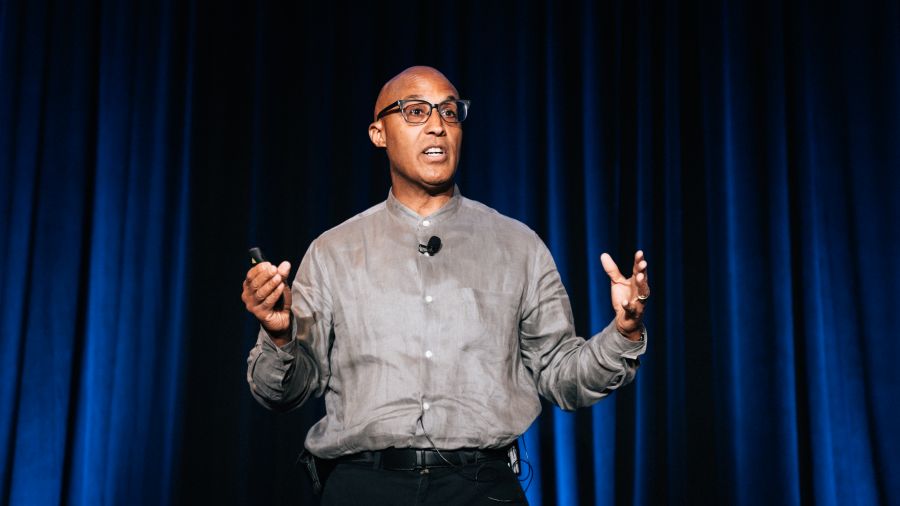
By the third and final day, what that interconnectedness makes possible came into focus in the plenary delivered by law professor, writer, and human rights advocate Alan Jenkins, “A Moment of Inspiration: Cases of Artists and Creative Protecting Democracy,” in which he traced the ways that artists shape civic life through resistance, engagement, and collective action.
Jenkins’s presentation drew on research into artists and arts communities resisting authoritarianism and advancing democratic and human rights movements across the world, and invoked what political scientists Erica Chenoweth and Maria J. Stephan call the “3.5 percent principle”: the idea that a small but committed portion of a population can, under the right conditions, shift the trajectory of political movements. He moved through the tactics of resistance: refusal to comply in advance, documentation, amplification of affected voices, cultural mobilization, and the protection of truth, among others.
What stayed constant was a sense of urgency. “This is the least risky moment for us,” he said. “Things are only going to get riskier, so this is the moment we have to decide what actions we’re going to take.”
Emilya Cachapero later answered that question with a measure of what had already been built. “When we started this journey, there were no TCG members on the island,” she said. “Today, TCG’s membership includes more than 40 Puerto Rican theatres, local universities, and individual artists.”
After applause and cheers, a certain serenity remained—like staying at the table after a good meal, unwilling to leave the satisfaction behind. We had partaken, and no one seemed in a rush to go. From the back of the room, I turned to see, far beyond the ballroom floor, a Victoria Espinoza cabezudo peeking through the distant doorway as final remarks wound down. Stilt dancers and pleneros were already moving back into formation, preparing themselves, as if the party might begin again.
Perhaps this is why words like resilience and perseverance have become badges pinned to the island’s chest—not because we are people practiced in endurance, but because we carry an inner knowing that we will somehow make it to the next day. I don’t mean this as blind faith or something divine (though the traces of Catholicism that run through our mountain-curved streets are undeniable), but as a kind of proof that our 100 x 35 persists in spite of everything that should have broken it.
We move forward not because we possess a clear vision of the way ahead, or because we hold the answers to the present, but because we have learned that movement itself does not undo us.
Maybe that’s why, despite turbulence, there remains an impulse to make an occasion of things: to turn one story into three, and to stubbornly insist on joy. Perhaps that is what pa’lante truly means: not the desperate act of pushing forward despite everything, but the recognition that we were never still to begin with.
Miranda Purcell is an actress and journalist working across film, theatre, and communications in Puerto Rico and the U.S., with credits in award-winning projects and major news outlets. She is a 2025 TCG Rising Leader of Color and an alum of the National Critics Institute.