John Adams once predicted that July 4, the date of the vote ratifying the Declaration of Independence, would be “celebrated, by succeeding Generations, as the great anniversary festival…with Pomp and Parade, with Shews, Games, Sports, Guns, Bells, Bonfires, and Illuminations from one End of this continent to the other.”
Adams had little interest in theatre at the time, but he understood that live performance is bound to democracy as a civic space of convening, public discourse, and collective engagement. Just over 50 years later, a visiting Frenchman would affirm Adams’s sense that democracy and theatre are bound up with one another. “When a revolution that has changed the social and political state of an aristocratic people begins to affect literature, it generally manifests itself first in the drama and remains conspicuous there,” politician and historian Alexis de Tocqueville argued in Democracy in America. The book is still read today for its prescient insights into and understanding of the United States, and its passing observations on U.S. theatre offer a tidy summary of why and how it persists in the 21st century.
In de Tocqueville’s nine months of travel around the nation in the company of magistrate Gustave de Beaumont—an itinerary which spanned Boston, upstate New York, Quebec, Michigan, Wisconsin, and Memphis, among other places—it is certain that the two men attended the theatre in Philadelphia, New York City, and New Orleans, though there may have been other visits that they did not document. What would de Tocqueville and de Beaumont have seen on American stages in the early 19th century? In Mobile, Alabama, and New Orleans, they would have seen theatre produced by managers Noah Ludlow and Sol Smith, whose partnership exemplified one way theatre operated up through the mid-19th century. From the 1830s through the ’50s, Smith and Ludlow commanded the theatre scene in the South and Midwest. They not only controlled acting companies and repertoire; they also built, ran, and owned influential theatres, most significantly the St. Louis Theatre and the St. Charles Theatre in New Orleans. Their acting companies were itinerant, stopping in smaller towns to perform while traveling to and from Smith and Ludlow’s larger theatres.
Indeed, theatre in the U.S. has always been about travel and movement. Large companies known for their impressive quality and stars with name recognition were no less itinerant than small groups who hustled from small town to small town trying to make a living. With itinerancy, though, came suspicion. In Mark Twain’s famous novel, Huckleberry Finn encounters two fraudsters on the Mississippi who offer a “Shaksperean [sic] Revival ! ! ! Wonderful Attraction!” with the “world-renowned tragedians, David Garrick the Younger, of Drury Lane Theatre London, and Edmund Kean the elder, of the Royal Haymarket Theatre.” These may have been fictionalized parodies, but their struggle and desperation would have been instantly recognizable to any 19th-century jobbing actor. Harry Watkins, whose career spanned the 1840s to the late ’80s, never impersonated a fake British star (he did claim to perform “in imitation of the celebrated Lucius Junius Brutus Booth”), though he knew his Shakespeare well. But his plight was often no better than Huck Finn’s companions. Of an 1845 stint in Galveston, Watkins rejoiced that one show had done well enough that he could afford both shoes and food. “I had nothing on my feet before, and now I have a good pair of boots, and enough money left to buy something to eat with and that is a good deal in Texas,” he wrote in his diary.
Though the two Frenchmen were unimpressed with the quality of what they saw (“The theatres are bad,” de Beaumont bluntly observed), the important thing to note is the connection de Tocqueville posited between democracy and theatre. “Most of those who frequent the amusements of the stage do not go there to seek the pleasures of the mind, but the keen emotions of the heart,” de Tocqueville argued. Audiences in democracies like to see onstage “that medley of conditions, of feelings, and of opinions, which occurs before their eyes. Theatre becomes more striking, more vulgar, and more true.”
If de Tocqueville and de Beaumont were looking for the most meaningful theatre on the continent, they may have been looking in the wrong place, and with the wrong measuring tools. Theatre in the U.S. was not a proper literary endeavor until well into the 20th century. Instead, theatre as it emerged in what became the United States, and was practiced up through the end of the 19th century, was not about inventing a new literary canon but about innovation in performance itself. As theatre historian Constance Rourke has argued, Americans “emerged as the theatrical race,” defining “theatrical” in opposition to “the dramatic” and characterizing it as “full of experiment…closely interwoven with the American character and the American experience.” Rourke went on to argue that some of the earliest performance innovations in North America happened during encounters between Europeans and Indigenous Americans. She found evidence for the claim in treaties as early as 1677.
“These treaties were essentially plays,” Rourke wrote, “recording what was said in the parleys, including bits of action, the exchanges of gift, of wampum, the smoking of pipes, the many ceremonial dances, cries, and choral songs. Even the printed form of the treaties was dramatic: The participants were listed like a cast of characters, and precise notations were made as to ceremonial action.”
Rourke and subsequent theatre historians also recognized the primary, and problematic, invention that North American theatre contributed to global entertainment: blackface minstrelsy. The practice emerged in the early 1830s as a white performance form presented as a representation of Black life. Comic actor Thomas Dartmouth Rice claimed to be mimicking a Black man he had seen in the street when he performed “Jump Jim Crow,” but his appropriation, distortion, and exploitation owed far less to accurate research than to the white racist imaginary. The first minstrel shows featured white performers in blackface (often burnt cork; eventually makeup companies offered specialized products), though by the mid- to late 19th century Black performers found that their access to professional performance often depended on their willingness to “black up” for minstrel shows.
While de Tocqueville and de Beaumont did not comment on minstrelsy, they did notice that racism was no less part of the theatre than the nation at large. As de Beaumont later reflected, “The first time I attended a theatre in the United States, I was surprised by the care with which white spectators were distinguished from Black audiences.” He used this practice in his 1835 novel Marie, or Slavery in the United States to illustrate the ferocious violence Black people experienced under white supremacy.
Across the 19th century, theatre was where American national identity was rehearsed and produced, often self-consciously: In 1828, actor Edwin Forrest offered a prize for a new play in which “the hero shall be an aboriginal of this country.” While Forrest was primarily looking for a starring vehicle for himself, he also earnestly wanted to develop U.S. dramatic literature. Metamora, or the Last of the Wampanoag, by John Augustus Stone became a staple in Forrest’s repertoire, and inspired a character that resonates to the current day, that of the “vanishing Indian.” Theatre historian Bethany Hughes has noted that so-called “Indian plays” like Metamora typically depict “noble savages dying to make way for virile young Americans.” Like minstrelsy’s racist depiction of Black people, these Native American stereotypes have persisted into the 21st century.
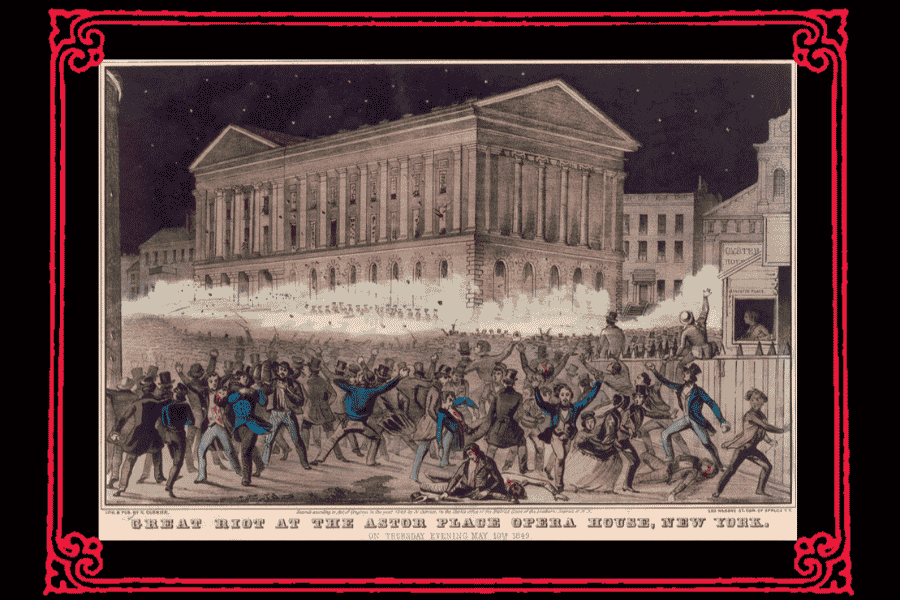
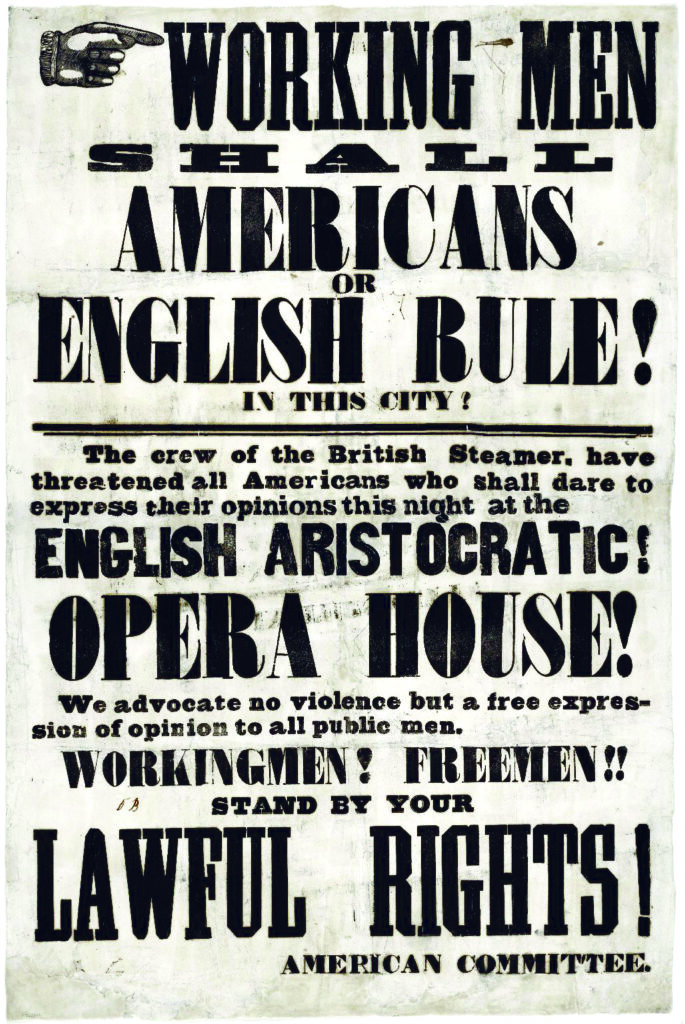
Plays by Shakespeare—whom Ralph Waldo Emerson described as “the father of the man in America,” despite his being English—were also a staple of the emerging American identity. De Tocqueville remarked “there is hardly a pioneer’s hut in which the odd volume of Shakespeare cannot be found.” Audiences were even willing to resort to violence to assert American ownership of the Shakespearean tradition. Forrest, for one, had a long-established rivalry with British actor William Charles Macready, which came to a head in 1849, when Macready dared perform Macbeth the same night as Forrest and only a few blocks away in New York. A fierce riot broke out, leaving dozens dead and more than 120 injured. The Astor Place Riot, named for the theatre where Macready was performing, was fueled more by class identity and anti-British hatred than fandom per se. Nevertheless, the riot demonstrates how integral theatre was to life in the U.S.
In the post-Civil War years, American theatre also grew into a big business, and no business was bigger than vaudeville. From the 1880s to the 1930s, vaudeville circuits criss-crossed the nation. No matter where you were in the country, music, dance, sketch comedy, and novelty acts were almost always available. Vaudeville, a descendant of variety theatre, concert saloons, minstrelsy, burlesque, circuses, and medicine shows, among other popular forms, in turn shows its influence on entertainment today, from standup comedy to late-night TV to musical theatre.
Crucially, vaudeville distinguished itself from some of its disreputable predecessors thanks to the influential impresario Tony Pastor, who prohibited the sale of alcohol and proscribed risqué or salacious content. This allowed him to offer “family-friendly” fare and to expand audiences to include middle-class spectators, especially women, who had shunned or been excluded from earlier diversions. At its peak vaudeville encompassed everyone from ill-paid small-time hacks in slapdash shows to big-time operators with national names performing the highest-quality work in state-of-the-art theatres.
The capital of the big-time circuit was unquestionably New York’s Palace Theater, built in 1913 by manager-producer Martin Beck of the Orpheum Circuit, which was operated by producer-manager B. F. Keith. Keith founded the United Booking Office of America. That eventually merged with Beck’s company, further consolidating their power. This merger was typical of this period, following the recurring trend toward monopolies, and not only in vaudeville. One of the earliest and most successful of such empires was the Theatrical Syndicate, run primarily by Charles Frohman, Abraham Lincoln Erlanger, and Marcus Alonzo Klaw from 1888 to 1919. This triumvirate controlled booking in most theatres, as well as the careers of many actors. Their domination was eventually successfully challenged by the Shubert brothers, and the Syndicate’s influence waned after 1910. As the Shuberts’ actions demonstrated, no control is so absolute that it cannot be challenged (today the Shubert Organization owns nearly half of Broadway theatres).
De Tocqueville once wrote that “the pit has often imposed its law on the boxes”—i.e., in the popular arts, ordinary people will not be dictated to by the elite if elite taste contradicts their needs and desires. This popular pushback might show up not only in theatre’s content but also in its practices, including racial segregation. In the 1920s, Sherman H. Dudley founded the Theatre Owners Booking Association (TOBA), which established a circuit to provide Black performers with long-term contracts. Dudley also bought or leased theatres in the South and Midwest to ensure greater access for Black entertainers.
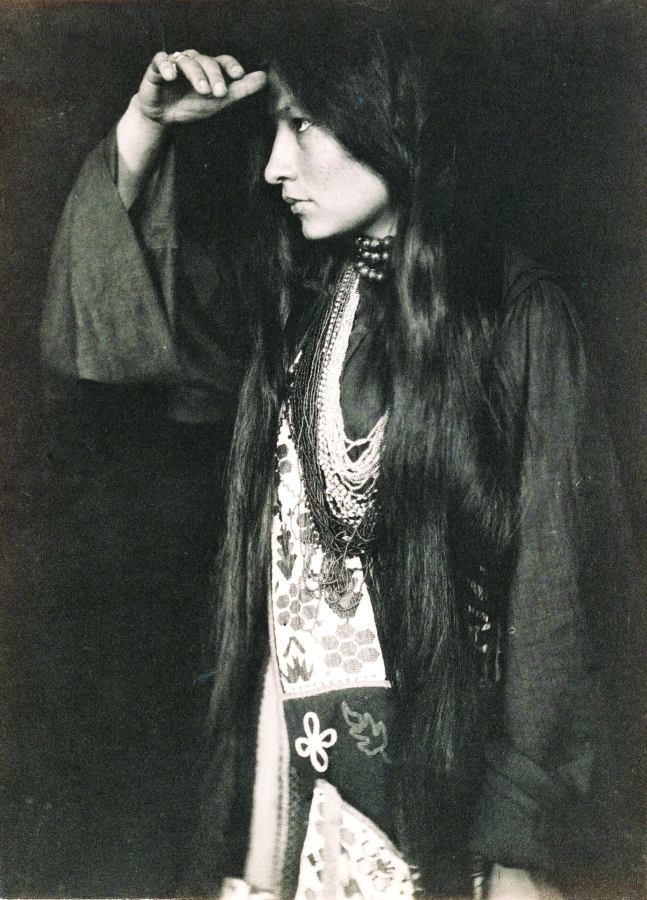
By far the most important issue being wrestled with on U.S. stages was the question of who belongs here and why. For their part, Indigenous people used theatre in multiple ways to provide their answer, and to resist their erasure from the national narrative. Activist and artist Zitkála-Šá (Yankton Dakota Sioux, also known as Gertrude Simmons Bonnin) wrote the libretto for The Sun Dance (1913) in collaboration with composer William F. Hanson. Her goal was to merge Ute stories and experiences with Western art to create serious work from the Indigenous perspective; the opera debuted in Utah that year and was performed on Broadway in 1938.
Other notable Native artists of this period include popular vaudevillians Mary Nelson Archambaud (Penobscot), a.k.a., Molly Spotted Elk, and Princess White Elk (Yurok, born Bertha Thompson). Writer-performer Will Rogers and playwright Lynn Riggs were Cherokee Oklahomans with influence in multiple entertainment venues, including vaudeville, Little Theatre (a sort of precursor to regional theatre as we know it), Broadway, and Hollywood.
Immigrants also employed theatre to claim space in their new country. On the vaudeville stage, actors Joe Weber and Lew Fields, both children of Jewish Eastern European immigrants, formed a double act as two bumbling German immigrants trying to make it big in the U.S. Immigrants from one part of the world performing as those from another was a popular approach: Chinese American Lee Tung Foo performed in multiple languages, sang popular and classical songs, and caricatured recent immigrants, including the Irish, Scottish, and Chinese. Diverse playwrights, including María Ruiz de Burton, Israel Zangwill, Li Ling-Ai (Gladys Li), Clifford Odets, and Eugene O’Neill all wrote movingly about their immigrant and first-generation experiences.
Much American theatre bloomed well outside the mainstream of national life. Indeed, for centuries theatrical works in what would become the U.S. were performed in Spanish, as theatre was first used to colonize and convert Indigenous people to Christianity as early as 1568. In the 18th century, Spanish settlers wrote plays and performed them in Alta California and Louisiana, well before the first purpose-built theatre was built by the British in their North American colonies in 1716, and before even the arrival in 1752 of Lewis Hallam’s English theatre company.
Well into the 19th century and the 20th, theatre in languages other than English dominated the stage. German-language theatre could be found in the Midwest and West, especially Wisconsin and Texas; Chinese theatre was a staple of entertainment in San Francisco and across the U.S. from the 1850s on. Yiddish theatre would be ubiquitous in New York—from 1890 to 1940 there were 200 Yiddish theatres in the U.S., most in New York City—and would go on to birth a generation of artists, including Stella and Luther Adler, Harold Clurman, and Lee Strasberg, who would revolutionize theatre practices in the U.S.
Up through the mid-20th century, the most robust theatre circuits with the largest audiences were Spanish-language ones. They ranged from small family companies like the Compañía Hernández Villalongín, which performed on either side of the U.S.-Mexican border, to large-scale commercial businesses, with San Antonio and Los Angeles as major hubs. In the 1920s, Los Angeles easily supported over 20 theatres that changed their bills daily. Circuses and tent shows blanketed the Southwest, especially after the 1910s, when the violence of the Mexican Revolution drove many artists to settle more permanently in the U.S. Up through the 1940s, artists from Mexico, Cuba, the Dominican Republic, and Puerto Rico would frequently rent and fill Broadway houses.
In the early 20th century, a division began to emerge between theatre as a crowd-pleasing business and as a challenging art form. Broadway was not yet the nexus of commercial theatre that it would become after World War II, but it did reflect the emphasis on profit and popular appeal that was becoming increasingly distasteful to theatre artists who saw themselves as serious art makers.
Meanwhile, theatre was being taken up as a legitimate academic subject, with universities as diverse as Brown, Yale, Case Western Reserve, and Howard establishing theatre departments. The Little Theatre Movement encouraged the proliferation of theatre outside of commercial structures, with director Helen Spaulding declaring Chicago’s Skyloft Players in 1942 a “theatre OF the people FOR the people BY the people.” Alexis de Tocqueville would certainly have approved.
The American theatre as we know it today, though it contains traces of and owes large debts to all this history, was largely built since the 1950s and ’60s, fueled by the nonprofit funding model, the Ford Foundation, and the early support of the National Endowment for the Arts. All those pillars are in question today. Indeed, now is a perilous moment to be arguing for a telling of history that encompasses our nation’s extraordinary diversity. Not long after being inaugurated for this second term, President Trump issued the executive order “Restoring Truth and Sanity to American History,” which sought to prohibit any telling of the national story that seeks to “undermine remarkable achievements of the United States by casting its founding principles and historical milestones in a negative light.”
If it is true, as de Tocqueville put it in 1835, that “no part of literature is more closely or more abundantly linked to the present state of society than the theatre,” then we should be able to look to our nation’s stages, as we always have, for signs of where our country has been—and where it is going.
Charlotte M. Canning is the Frank C. Erwin Jr. Centennial Professor in Drama, and director of the Oscar G. Brockett Center for Theatre History and Criticism at the University of Texas at Austin.